How to Captivate Your Customers with Vanessa Van Edwards
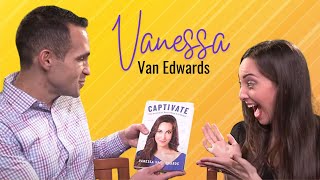
A recorded conversation between Nir Eyal and Vanessa Van Edwards about her book The Science of Succeeding with People. Vanessa frames the book as a research-driven, actionable guide that translates academic findings (especially the Big Five personality traits and body-language studies) into practical tactics for marketing, product design, and customer messaging. She describes original analyses (e.g., TED Talk gesture counts) and experiments from her Portland lab, and explains how to use personality signaling to improve conversions and customer fit.
Chapters
Welcome to near and Far. I am Nir Eyal, and today I am so happy to welcome my friend Vanessa Van Edwards, who has just published this new book, the Science of Succeeding with People. We've known each other for a while now, and I'm so excited to have you on the show to finally speak about the book. So it just launched. Congratulations.
Thank you.
And so tell us what's exciting about this book. Why should this book be in the hands of everyone who is in business today?
Yes. So I am the kind of person where I like to crack codes, I like formulas, I like algorithms. And so this is taking a lot of the fuzzy people skills that are out there. Like people say, be yourself or be authentic, where I want to break it down into a science. So if that's you, if you're someone who's like, I need to have the black and white, that is what this book is. It's sort of a textbook to people, if you will.
Right. What I love about it, though, is that there are tons of citations to real studies. It's not just hocus pocus, it's actual verified scientific research that you put into the book.
I am a data geek. I love research. And so I wanted to basically find, okay, what is the most robust science that's out there? How can we synthesize it down into actionable tips that actually work? And then can I add a little bit of my own science? So I run a lab in Portland, Oregon, and we try to add big data to things. So we will do huge surveys or we'll test some of these hypotheses to see does it actually work for real business professionals, not just college seniors, which are most of the people in academic studies.
Right, right. So tell me something about that research. What kind of research have you actually done that then made it into the book?
Yes. So I love puzzles. I love looking for people puzzles. So one of the things that we talk about in the book is we analyze thousands of hours of TED Talks. I wanted to see if there was anything about virality of TED Talks, specifically with the body language research. So there's all this really interesting body language research on hand gestures and power posing and smiling. And I wanted to know, does that actually translate when it comes video? So we found that, for example, one of the things we found is that the most popular TED talkers, we analyzed all the ted talks from 2010 and found that they use an average of 465 hand gestures in 18 minutes, whereas the least popular TED talkers do they. They do. They do we'll just like, you know, jazz hands it. So the least popular TED talkers use an average of 272, so almost half. And that backs up the academic research on hand gestures. So. So it's just an interesting take on. Okay, so the science says hands are important. How does that actually work? What the TED talkers did is they weren't just like, hey, razzle dazzle. The best ones, they all use their hands along with their words. So they'll say, I have a big idea, and they show you how big it is, like a beach ball. Or they'll say, let's talk about three things. In a way, it's like anchoring for the listener. So they're speaking to you on two tracks with their words and with their words and their nonverbal. So it's. Those are the very charismatic speakers. And that was an interesting way to think about the research on hands.
And now tell me some of the research around how products and services are developed.
Yes. So I've always been fascinated with branding, as we have talked about and geeked out for many hours. And I realized that we have all this robust personality science, and there's a lot of things out there like Myers Briggs or Enneagram, and there's not a lot of science behind it. The one that's used by academic universities all over the world is the big five. So that's openness, conscientious extraversion, agreeableness, and neuroticism. So I looked at this science and I'm like, okay, the science is great, but how do we use this? And I realized that the most powerful brands, the brands that get really good conversions, really high click rates, have what I call personality indicators. They don't maybe realize they're doing this. What they're doing is they're saying, okay, our ideal customer is a high extrovert, high open, and low neurotic. How do I signal to that person that we are for you? And I realized that if you take personality and you add it to branding, that's how you get really viral marketing campaigns. And it fits very well with the hooked model with triggers and rewards.
Yeah, we actually, if you want to see examples, Vanessa has sent us an excerpt of the book that's now@nearandfar.com where you can actually see these screenshots. They're really interesting how you take each of these big five personality traits and show how if you're looking for this type of audience, here's how to present that format. Can you give us maybe some examples of companies that did it really well.
Perfect. So here's a really common example that I see. So I'll use my brand as an example. So we do data, we love science. Our courses and our workshops are very step heavy, right? Like it's frameworks and lots of bullet points. So I realized that in my marketing, if I have what I call low conscientious branding. So conscientiousness is one of the personality traits that has to do with details. So if you're low in conscientious, if you're high in conscientious, you love details, steps, schedules, to do lists. That would be me. You're usually a researcher. If you're low in conscientiousness, you like big ideas, you like strategy, you like broad strokes. So in my marketing, a fatal mistake I made on my landing pages was I was promising big ideas. So I would say things like change the way you interact with people. So a low conscious person is like cool. I like that. A high conscious person is like, how? Why? What's the data? Where's the citation? So I was getting very low conversions on my landing pages. So when we changed it, where I added all these details. So after the first five chapters you'll learn this. After the second five chapters you'll learn this. We have 500 citations, 300 pages of this, 14 experiments that triggered the low conscience people. This might not be for you. We're in the specifics. We like the weeds and it triggered high conscience people to be like, ah, this is going to be data that I like.
And how do we figure out what type of audience we have? Or is it about finding the audience we want?
I think, and this is just me, I actually don't think it's a chicken and the egg problem. I actually think that you should start with the kind of audience that you want, specifically buying customers. So I think that there are two different kinds of customer Personas. There are non buying customer Personas. So those are the people who are dabblers in your product. They might read your blog, they might follow you on social media, but they're probably not going to buy. They might not be recommending you to friends. And then there are buying Personas or committed Personas. Those are the ones that are like your champions or the really dedicated fans. They click on everything you do. They might even buy without even seeing your full promo or your full product. I think it's better to think about what are the buying Personas and how can you appeal to them more as opposed to trying to do it the other way around. I think that's more powerful. And that's the same thing for Hooked, right?
Well, I guess with Hook, the way I thought about it is that you're kind of making your best guess at the type of customer you're looking for and you're designing the rewards. You're sitting inside the confines of an office building, right? You're not out into the field. And so you have to design that first. Endeavor to see, hey, once this gets into people's hands, how do they respond? Do they find the rewards rewarding? But I think it starts from a fundamental assumption about who your customer really is.
So it's interesting you mentioned rewards and testing it. So let's take a really specific example. So let's say you want really high agreeable customers. So agreeableness is how you relate to people, how much you cooperate, how much you like teams. High agreeable people, they default to yes. They typically are like, yeah, I can make it work. They sometimes will even say yes to their own detriment. Low agreeable people are default to no. They're highly analytical. They typically, they're the ones who like Google research what you say. They're a little bit more skeptical, a little more slow to adopt. So if you want a high agreeable person, someone who loves teamwork, a reward for a high agreeable person is going to be more about the team. So a great reward for them would be a gift to their social network or an offer to their friends, or giving them a giveaway to give out to their people. That would not appeal to a low agreeable person. In fact, if you ask a low agreeable person, if you give them five books to give away or five of your free products, they're like, I don't stand behind this product. I don't want to give this to friends. Whereas a high agreeable person is like, ooh, you gave me social capital. You gave me something I can spread. So that's a very different reward. A reward for a low agreeable person might be something specifically for them. So maybe it's a badge for them, right? So they personally get to elevate their score. Or maybe it's a free month for them, right? Like that's gonna appeal much more to them because it's more individual centric versus community centric.
And one of the things that's so great about using the big five is that it's such a well researched area of consumer psychology. It's not Myers Briggs stuff. There's a lot of good science behind it and I wonder, is it better to go to your existing buying customers and give them these metrics? Maybe sample 5, 10 people, get them to come into your office, give them a $100 gift card somewhere for their time and ask them, hey, can you take this quick assessment? These exist, right?
Yes. So I, when I encourage people entrepreneurs, you do customer interviews, right. You do customer validation. One of the best things you can do is in that customer validation, have them take the free personality test. If you really also want to make sure that you're getting an accurate one, you can also ask people to send it to their best friend or their spouse or their colleague to take it as them.
Interesting.
So one little thing, a little note of caution here is I've asked thousands of people to take our personality test. I think we have like 19,000 people who have taken that personality test. And everyone always does it as the best version of themselves. So they take it as them on their best day.
Interesting.
Now, if you have a product that is them that is not on their best day, like you are selling a product, that's when they're very stressed or trying to lose weight, that is them not on their best day, you're better off asking them to check their answers with a spouse or colleague and then you get a more accurate picture of who they really are, not just who they want to be. On the other hand, if you're an aspirational product or an inspirational product, you're a coach, then you actually want them on their best day because you can see, wow, okay, this person is, let's say openness. For example, people are high in open. They're very adventurous, very creative, they like trying new ideas. If someone ranks medium high on openness on their best day, you know that they are aspiring to be more adventurous. As a coach or as a service provider, you would be better off saying, that is something I want to help you with. I want to help you try new ideas in a way that fits for you. So depending on where you're going, that can actually be an interesting way to appeal with your services.
Yeah. So it sounds like you've got a small control group that you can do some in depth study with.
Yes.
That provides hypotheses for what you can then build and test. And then you're still gonna have to build and test. Right. You're still gonna have to build, measure, learn to see what's working.
You have to build and test that landing page. As an example, like, I thought I had an idea of my, of my students, but I Actually really didn't. So when I had this landing page and I'm watching our numbers and they're not as good as they should be, I was able to slowly start adding things to the page and watch the conversion numbers change. And I found the more details I added, the more students who bought and less refunded. So one of the things that we were having a problem with was people would buy it and they were low contentious and they'd be like, it's too many details. I'm bogged down by the details. And they would ask for a refund. I'm like, how can I sell signal this earlier? So not only did our conversion rate go up, but our refund rate went down.
Brilliant.
And so that's also an aspect of this is it's not just your opt ins, it's also your conversions and your customer journey, that longevity that you have. So keeping them in that system of, okay, we've triggered them, they're getting rewarded. How do they stay in that loop of coming back to use your product?
Terrific.
Very cool.
You've taken some really complex, dense science and you boil it down to very actionable tips, which I love. I'm a big, big fan.
Thank you.
So the book, again, just so everybody sees it here, captivate the Science of Success Succeeding with People by Vanessa Van Edwards. And thank you so much, Vanessa, for being on the show. It's been a pleasure. Thank you.
More from Nir


Your Beliefs Are Sabotaging You (Here's Why) - Beyond Belief for Athletes with Nir Eyal







