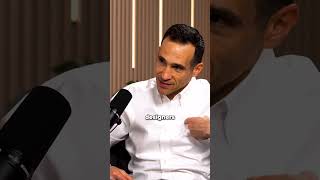
In this motivational talk for Glenbard athletes, Nir Eyal explains how beliefs function as powerful, revisable tools that shape perception, feeling, and performance. He opens with a 1950s rat‑swim experiment, showing that a simple belief that rescue is possible unlocked a latent capacity for the rats to swim for 60 hours, illustrating that belief can unlock hidden potential without any physical change. Eyal then defines belief, contrasting it with immutable facts and faith‑based convictions, emphasizing that beliefs are evidence‑responsive and can be chosen deliberately. He presents three “powers of belief”: (1) Attention – a newspaper experiment where participants who believed they were lucky spotted a reward image instantly, while unlucky participants missed it; (2) Anticipation – a placebo steroid study where men who thought they took anabolic steroids lifted more weight and gained muscle, demonstrating that expectation alters physiology and effort; (3) Action – a Serena Williams anecdote where a coach’s false statistic about net‑rush success reshaped her belief, leading her to actually achieve an 80 % success rate and win Wimbledon. Eyal anticipates objections about “lying to yourself,” arguing that everyone already filters reality through beliefs and that the goal is to replace limiting beliefs with liberating, evidence‑based ones. He frames beliefs as tools, not truths, and invites listeners to explore his book Beyond Belief for methods to identify and transform limiting convictions.
Chapters
Hello, Glenbard athletes. This is Nir Eyal, author of Beyond Belief, and I'm honored to share with you some of my learnings over the past 16 years of studying human behavior. I wanna start by sharing a story of a study that was conducted back in the 1950s. You see, back then there was a biologist by the name of Kurt Richter who had a very simple question. The question was, how long can a rat swim? So he takes a wild rat, he puts it in a cylinder of water, and he stands there with a timer to see how long it can swim. Now, it's kind of an ethically dubious study, not so nice to the rat, but that's what he did. He determined that the rat could swim for about 15 minutes before it gave up and drowned. Now, he wants to see, can he increase how long a rat can swim for? So what does he do? He takes a new group of rats, he puts them in the same cylinder of water, and this time, at the 15-minute mark, when he see the rats are struggling, he reaches in, he takes out the rats, He dries them off, he lets them catch their breath, and then plunk back into the water it goes. Now, I want you to guess how much longer does the rat swim for? At first, the natural limit of these rats was about 15 minutes. Now, after the conditioning, after he puts them in the jar and he teaches them that salvation might be possible, that if they persist, something might save them, How much longer does the rat swim for? Some people guess twice as long, 3 times as long, maybe 4 times as long. Imagine that for a second. Imagine if I could give you some kind of intervention that helped you run 4 times longer, that increased your performance 4x. If you could keep going 4 times longer than your limit, that'd be amazing, right? That'd be incredible, unprecedented. But the rats didn't swim 4 times longer, not even close. The rats swam for 60 hours, not 60 minutes, 60 hours of nonstop swimming. Why? What changed? Their bodies hadn't changed. They didn't suddenly become super rats. Their environment didn't change, same exact cylinder of water. What changed? Well, we can't ask the rats, but the only variable left is that something changed in their minds, that suddenly, Some kind of switch was flipped and what was always within them, they always had the 60 hours, all of a sudden was unlocked. Now, this demonstrates the amazing power of beliefs. What are beliefs? Well, here's what beliefs are not. Beliefs are not facts. A fact is an objective truth. It is something that is true whether or not you believe in it. So for example, the world is more like a sphere than it is flat. That's an objective truth. I'm sorry, flat earthers, the world doesn't care what you believe. A fact is a fact. On the other end of the spectrum is what we call faith. Faith is a conviction that does not require evidence. God rewards the righteous. It's a matter of personal faith. No evidence is required. But between fact and faith is something very special. We call this a belief. A belief is a conviction that is open to revision based on new evidence. And what's so amazing about beliefs, why they're so powerful, is that beliefs can change. You see, if there's one thing I want you to remember, is that beliefs are tools, not truths. I'll say it again, beliefs are tools, not truths. We can pick and choose the beliefs that serve us rather than hurt us. So what I wanna share with you right now in the next few minutes are the 3 amazing powers of belief, the power of belief to change what you see, what you feel, and what you do. Let's start with the power of attention, the power of our beliefs to change what we see, not metaphorically, but physically change what we are able to see. I'll show you right now. There was an experiment done a few years ago where they asked people to do a very simple task. The task was to simply look through a newspaper and count the number of pictures they saw. How many images do you see in this newspaper? Now, they separated these people into two groups. One group were people who believed they were lucky people. Another group were people who believed they were unlucky. Now, this wasn't a fact. They didn't follow them around to see who was lucky and who was unlucky. They just asked them, "Do you believe you're lucky or unlucky?" The people who believed they were unlucky on average took 2.5 minutes to do this task. The people who believed they were lucky took just 11 seconds. Why the difference? Well, it turns out that on page 2 of this newspaper, there was one image that said in big bold letters, "There are 43 images in this newspaper. Collect your reward." The people who believed they were lucky people immediately saw that image, they read what it said, they got up from their chairs, collected their prize, and they were out the door in 11 seconds. The people who believed they were unlucky Even though they saw the image, we know they saw the image because they correctly counted on that assessment 43 images. Even though they saw it, they didn't process it. They didn't read what it said because things like this don't happen to me. Things can't be that easy. And so they sat there and counted for 2.5 minutes missing the opportunity that was literally right under their nose. You see, beliefs shape how we see reality. You don't see things as they are. You see them as you believe them to be, as you are. The second power of belief, the power of anticipation, the power of our beliefs to change how we feel, not just our feelings, but our physiological state as well. In an experiment, they took a group of men and they gave them an exercise protocol. They taught them how to lift weights, but they separated these two groups into people who were given what they thought was an anabolic steroid. They gave them a pill and told them, this is a steroid. Unbeknownst to those people involved, there was no such thing. It was a placebo. It was a sugar pill. There was nothing inside that pill that could have grown their muscles any bigger than if they hadn't taken the pill. Amazingly, the group that believed they were taking a steroid even when they were just taking a placebo ended up getting stronger and gaining more muscle mass than the group that didn't take the placebo that they thought was a steroid. So what does this show us? Why is this, why does this occur? How can placebos grow muscle mass? How can they make us stronger and better? Well, turns out, wasn't some magic, turns out that the people who believed they were taking a steroid performed better on purpose, consciously, that they did a few more reps and sets. They pushed themselves a little bit harder. They added a bit more weight. Than the group who didn't think they were taking a steroid. So our beliefs can become reality based on what we expect. The power of anticipation, the power of our beliefs changes our behavior and our behavior becomes our biology. The third power belief, the power of our beliefs to change what we are able to do. A few years ago, Serena Williams was competing in Wimbledon and she was not doing well that year. And the reason she wasn't doing well is that she was not rushing the net. She was hesitating. She was afraid that she was no good at the net. And at that level of tennis, if you hesitate for even a millisecond, you're gonna lose. Now, her coach called her over and says to her, "Serena, look, I was looking at the data, and did you know that you score a point 80% of the time that you rush the net?" And Serena says, "What? I thought I was terrible at the net." And her coach says, "Hey, you know, look, statistics don't lie. This is the best news of the day." And it's true. Statistics don't lie. But her coach did. She was not scoring anywhere near 80% of the points at the net. But the amazing thing is, is that the lie became reality. When her coach told her this lie, it unlocked something within her. Just like those rats we talked about earlier, she was limiting herself, this limiting belief that was holding her back. And when her coach knew what she was capable of doing— remember, the definition of a belief is a conviction that is open to revision based on evidence. He had seen what she was capable of doing. She just didn't believe it. And so when he unlocked her potential, she did end up scoring 80% of the points at the net and she ends up taking Wimbledon that year. Now, some people are probably thinking right now, "Is this guy telling us to lie to ourselves? Should we be delusional? Should we be gaslighting ourselves?" And I would argue you're already lying to yourself. We all are. We think we see reality clearly. We don't. We see reality filtered by our beliefs. Have you ever noticed that you can't spell belief without a lie? It's right there in the middle of the word. You can't spell a belief without lie. Now, does it mean we should make up things out of thin air? No. It means we should look for evidence to help us build these liberating beliefs as opposed to the limiting beliefs. You see, we're all lying to ourselves. We just pick the wrong lie. We need to pick the belief that serves us rather than hurts us. Beliefs are tools, not necessarily truths. So that's just a quick introduction to some of the powers of belief. There's a lot more in my book, Beyond Belief, that can help you actually find those limiting beliefs and convert them into liberating beliefs. I hope you'll check it out, and I wish you all the best in the year to come. Thank you.