How to Make a Great Mobile App - Nir Eyal talks with SC Moatti, author of "Mobilized"
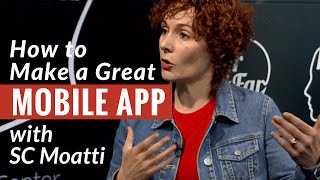
SC Moatti explains how organizations must adapt to mobile through a framework of appearance, personalization, and learning. He argues mobile success requires real identity and user context, and uses Nokia, Facebook, and Airbnb to show why incumbents face rapid disruption without mobile-focused teams and new business models.
Chapters
98765. Welcome to nearandfar.com it is a pleasure to have you with us today. And we are three today to welcome Esi Mwati, who is the author of this book, An Insider's Guide to the Business and Future of Connected Technology. Today we are going to be talking about how to build great apps and I am thrilled that you are able to join us today. Now, I know a little bit about this book because I am lucky enough that you asked me. I'm honored that you asked me to write the forward to this book. But I think it's an important book and I'm so glad that you're here with us today because unlike a lot of business books out there, we have a lot of authors on this show and a lot of business authors either come from a academic background or from a more practitioner background. And you are very much in the practitioner camp now. You also teach. But tell us a little bit first about your background and how you got started in the field.
Yeah, absolutely. And thanks for having me, Niri. It's great to be here.
My pleasure.
So I started my career as an engineer and then got a business degree and then most of my time as a practitioner, I worked for mobile first companies. I worked for Electronic Arts. I worked for Facebook, for Nokia, for Trollia. I had my own company, which Facebook acquired. And so through that dozen years of experience building services that nobody had really built before at the time, I learned what it takes to, number one, build a mobile product that is used today by billions of people, whether it's Facebook or Nokia, and also see how companies transform, transition to becoming mobile first. And for existing companies, that's a huge challenge that they're facing today.
Right. Right. So give us kind of a taste here. What's the, if you could boil down, which you did in your book already from your years of experience in industry, what does it take to make a great mobile product?
Yes, absolutely. You know, the one thing I learned is it's easier than we think. The main thing to remember is that we see our mobile products as extensions of ourselves. Whether it's a smartphone or a wristband or a pair of glasses or any sort of mobile product like a piece of clothing, we see that as an extension of ourselves. And so when we think of what's the best mobile product out there or a great mobile product out there, we have to think of what's my best self. And then I use the mind, body, spirit framework to describe that. So body we want to look good. We expect that our mobile Products will look good spirit, we want to have meaningful lives. We expect the same thing from our mobile products, that they will be very personalized and then mind we want to keep learning and growing as people. We expect that our mobile products will do the same.
Fantastic. So do you recommend that product teams the audience of this book, I'm guessing it's PMs, it's designers. Are they thinking about that framework as they are starting or in the middle of the project? Where is this most useful for them?
Yes, absolutely. So the audience for this book is actually the audience of people who take my class at Stanford and we had a lot of product people, entrepreneurs, designers, but we also had CFOs of companies who are transitioning to mobile. So it's really anyone who wants to understand the mobile revolution now when they should use this book is whether they have a brand new product. There's actually a step by step guide and I just released a new workbook that will give them really detailed instruction on how to get started with with a new product. But if they have an existing product, I look at a ton of case studies and I give also a number of tests and rules that they can use to see if their product pass certain of some of these rules that I describe.
Can you give us an example of how when you've worked with clients or at your former companies like Facebook and other companies, you work with Nokia, can you give us an example of how this came in handy and how you were led to a different conclusion versus what the team might have originally thought was the answer?
Yes, absolutely. So here's an example. I'll take the mind rule, that rule that helps us learn along the way. I worked for Nokia and we built an augmented reality search discovery service. Now we started with processes that were restricted to the R and D organization, engineering, product and design with processes that are pretty well known in Silicon Valley like agile and lean and that kind of stuff. Now one thing that we didn't get is we didn't get the business results that we expected. And that's because at the time mobile was still very new and perceived as a technology as opposed to a complete culture change, which is really what it is. We decided to expand our methodologies to the entire organization. So not just R and D or back office or it, however you call it in your organization, but also the front office. So sales, marketing, customer support, so the entire organization started to use Agile methodology and that all of a sudden completely transformed our business results. So when you look at this framework that I give, you want to pick and choose what is relevant for your organization. It's not a one size, fit all model. It's a very personalized model and understandably so, because we are all humans and we are all unique. And one of the big things that mobile brings to the table is this extreme personalization with the support of technology.
What's the biggest takeaway from your years at Facebook? I often use Facebook as the model, the archetype of a company that's doing so many things right. And what's particularly interesting about Facebook is they were a desktop first product when it started at Harvard, and then they successfully transitioned into a mobile product, which is actually pretty rare. Not many companies can make that into interface shift. So you were kind of at the heart of that transition. What did you learn? What stuck with you from that experience?
Yes, yes, absolutely. And you remember, I'm sure, like Facebook is going to die because it's not getting mobile. So I was really instrumental in helping with that transition. One of the main things that I think Facebook did is it started thinking Facebook. It started thinking mobile was a technology. So it trained everybody to every engineer to the programming languages of mobile. And the stock went from $40 to $20. So the thing that Facebook really understood at that critical moment where it was really in trouble is that it's a culture change. And so when you go and look at a culture change in an organization, you look at a number of things. One is you start to make a lot of acquisitions. So big acquisitions like Instagram and WhatsApp that remain brand in the Facebook overall conglomerate. And also small acquisitions like my company to, to bring talent in the organization that understands mobile, that helps transform the culture. Then it started an entirely new mobile division in the organization that says we are responsible for mobile success because nobody else really wanted to own it or didn't really know how to own it. And when it started showing some success, the rest of the organization said, wait a minute, you're building a mobile news feed. But I'm the newsfeed team, so I want to build my own mobile newsfeed. Okay, so do you understand how to build for mobile? And then there was a back and forth, a lot of reorganization, a lot of learning from one division to the other to ultimately make sure that everybody in the organization was understanding what mobile is about. And that took about 12 to 18 months, which for Facebook is a really long time for any company. I would say it takes three to five times that amount. A lot of the companies that I work with right now, they're just beginning their mobile journey. Now, it's a little bit late, because if you look at what happened to companies like Motorola and BlackBerry and Nokia and Yahoo, and a lot of these, it only takes a couple of years for them to disappear because we all change devices every 18 months.
Right? Right. And so when you say mobile, you're not just talking mobile phone, Right? You're talking any new interface, the watch, the voice interface. Do you think the same principles of this trinity applies to any new interface?
Absolutely. And that's a question I get all the time, like, how do you define mobile? How do you define mobility? I will say there are really two things. The first one is a mobile product has your real identity, as opposed to a Persona, like an advertising billboard or some IP address with a bit of cookie, like a web interface. And it also has your context, as opposed to assuming where you might be or making assumptions based on what you know, your browsing history and stuff like that. So these two criteria, your real identity and your context, are what defines mobility. So it doesn't really matter what the actual product is. In fact, you know, smartphone is a very clunky interface when you think about it. It doesn't quite fit in one hand. It isn't quite usable by one hand. It doesn't quite fit in a pocket.
So it's identity and context. I think that's really, really interesting. And I think what's so interesting about that, and specifically with mobile, is that the context, what we can do with context is so much more interesting now. The fact that I can target people or I can trigger people at exactly the moment in time that's contextually relevant, that they really need the product or service, I guess, as the interface shrinks, and now it's just more easily accessible or I guess even disappears. Now, with Alexa and Cortana and Siri becoming this voice interface, it's really about this technology being anywhere, all the time, so that whenever we need it, it's useful.
Absolutely. And all these services ultimately will be invisible. Right. And that is really the goal. And you're absolutely right that this personalization, the context and the identity, is what I think is the biggest opportunity for mobile. And right now, we're only scratching the surface. I'll give you an example. You take Airbnb, for example. It's a fantastic mobile service. And yes, you can say, oh, it started as a website, but it is a real amazing mobile service. What's amazing about Airbnb is that it will show you beautiful listings, it will show you places you may want to visit, but it doesn't show you places that your friends have gone to or that are in your price range or that based on what other people like you do, could be of interest to you. There is so much more that Airbnb could do to be more personalized, and Airbnb is at the forefront of mobile. So I think that we're really just scratching the surface with personalization. Where I see opportunities are with big industries, big boring insurances, payment systems that know so much about us, probably more than at least I know about myself. And using all that data to personalize a mobile experience. There's actually a lot of power into that.
And so they might not even be late to the party quite yet, because very few of those big companies are actually applying their technology and the data that they have well right now in the mobile space to begin with. So that still might be a greenfield opportunity.
There are still opportunities for them. Yes, they could be disrupted very quickly, but it's true that they have a lot of data behind the firewall that will help them stick around for a little bit longer.
You said in the book, and you said earlier that it's a cultural shift, it's not just a technology shift. Tell me more about that.
Yes, absolutely. So, cultural shift. And I'll go back to Facebook. You need to really understand that if you think of mobile as a technology change, what you're going to do is you're going to do what people did during the Web 2.0 or Web 1.0 era. You're going to take your big website and you're going to say, cram that into a little tiny smartphone or a watch or something else, and you're going to fail because the business models aren't adequate, the technology isn't adequate, it's a lot of money and there's zero roi. And so basically, you're going to see it as a technology change, and it's going to be a big cost on your IT budget that doesn't bring any roi. Instead, if you see it as a culture change, what you're going to be looking at is what are the new business models that I can invent with mobile? What are the new ways that I can use real identity and context to reach people on mobile? So the way that. And companies are still skeptical about that. Yeah, that's all very nice. It's all creative. It's all what you guys do in Silicon Valley. But what I look at is the cost of a mistake. You look at Facebook, a free website. Right. It doesn't Take a lot to fix a mistake. It's free, so it doesn't really cost anything from a business perspective. And it's a web service, so it's very easy to patch. But when Facebook becomes a mobile app, you cannot patch things very quickly. It takes actually a few weeks. Right. So the cost of a mistake in terms of technology is higher. And the business model of Facebook, when it was a free web service and now when it is different kind of advertising on mobile and a little bit more refined and personalized is also a little bit higher. So initially the culture at Facebook was move fast and break things great for free web service. But recently, during the mobile transition, they removed the break things part. Just move fast. Because if you break things on Facebook, it's going to stick with you. You're going to get bad reviews, People are going to delete your app. They're not going to like it. It's not just Facebook. It's any company needs to adapt to the cost of a mistake from a business and technology perspective that mobile requires.
So how do you do that as you get bigger? Big companies are legendary. And we have kind of a joke here in Silicon Valley that, thank God big companies are so slow to adapt because it provides opportunity for us little guys to get started. But if you are in a big company and you're just pulling your hair out that the innovation isn't happening quickly enough, maybe because of cultural reasons. Right. Maybe it's an organizational behavior problem. More than knowing what to do, it's actually getting it done. What's been your experience? How do you move things along other than get everybody the company, the book? Right. Of course, that's the first step.
Of course you need to do that. Thank you. So there are a few options. One is you buy your way into mobile. If you can afford it, that's probably the best thing you can do. You let a small company in Silicon Valley do innovation and disruption and be successful enough that you're like, okay, so I'm gonna bring that as a brand and let them be successful in this new business.
Even if it's crazy expensive.
Even if it's crazy. If you can't afford it, you do that. And that's what a company like Facebook did.
Yeah. I remember when they bought Instagram, right. Everybody laughed at them. A billion dollars for Instagram. What a joke. A billion dollars. What a ripoff. It turns out it's worth, what, 35 billion.
It's a great deal. Right. So Zuckerberg has a real talent at that. And WhatsApp same story, right? $19 billion. That turned out a fantastic deal. Yeah. So if you can afford that, that is your best bet because that is the best way you're going to stay at the cutting edge of mobile. Now, most companies cannot afford that. So what you do is you bring in mobile talent and you have to be prepared for a lot of back and forth in the organization. I mentioned a couple of steps at Facebook created a mobile organization, said, now this team is responsible for mobile success. And then when there is success, everybody wants to be a part of it. So breaking up this team in smaller teams or having maybe rotational program for that team to go and learn from other product teams and then there's actually a lot of back and forth to understand what is the best organization when a company becomes mobile first.
Yeah. And, and what if it doesn't succeed? What if it doesn't take off like Facebook does? I mean, this is what I see at a lot of big companies where they have the skunk works, they have the little project that hopes will create the next disruptive business, but as soon as things don't work out or they don't hit a home run on the first go, they pull the plug and they pull the budget. How do you think about that?
Try again. Here's what happens at companies. The mobile transition is not driven by it, it's driven by marketing. Because more than half of their user base right now at most companies is using their mobile services. So what companies start to do is their marketing department says, okay, people are on mobile. We're going to allocate budgets to mobile marketing and they start spending on mobile advertising. Now, mobile advertising is not very effective. It used to be in the very, very early days. Now it's not a very good, you know, mobile is not a very good interface for advertising. So without a mobile product, mobile marketing departments are actually very limited. And then they go and they turn to their R and D organization and they say, you know, without an app or a website or something that is a product, we're not going to be very effective with our marketing dollars. We're not getting the ROI we need. So, hey, engineering, build us an app. Build us a mobile website. Engineering is excited. Yes, we're going to build something brand new. And so they look at what it takes to build a mobile product. Now the challenge is it's very expensive because you need to build a mobile website, an app for iOS, an app for Android, sometimes for tablets, sometimes for watches. They come, they show the bill to the CFO who says, there's no way we're doing that. And so the CEO has to sort of arbitrate that. And he will go back and forth between saying, okay, we'll do whatever the CMO needs from us because we need more customers, we need more engagement to, okay, we got to cut cost. And it's just going to be a lot of back and forth. You have to be prepared for that back and forth and for that back and forth to go really quick because you can get out of business fast.
Right? So it's really a threat to not do something. And maybe that's the right way for the CEO to look at this. Mobile opportunities. If you're not at the cutting edge, you're falling behind, you're at risk of being disrupted by a different industry player.
And CMOs make the case better and better, as far as I can tell, just because the list keeps getting longer, Right? You see BlackBerry, you see Motorola, you see Yahoo, you see the graveyards are filling up. Absolutely.
Very interesting. So one more point before we go here. Give us just one quick bit of advice. If you could talk to PMs, designers, entrepreneurs, people who have dreams of making it big in mobile, is there one motto that you would love for them to keep top of mind?
Well, so I'll tell them, look at the mobile formula and remember that it's easier than you think. I talk with a lot of technical people who says, oh, you know, I need to do a lot of analysis, I need to learn to program really well. I need to understand how app store marketing works and all that kind of complexity. No, it's actually easier than you think. It's about building things that people want and remember. It's about having our real identity. What can you do with that that you couldn't do before? And understanding our context. What can you do with our context that you couldn't do better before?
Terrific.
That's my advice to entrepreneurs.
Fantastic. Fantastic. Well, again, thank you so much for being here. Just to remind you, the book is called An Insider's Guide to the Business and Future of Connected Technology. So glad you could join us today and thank you for watching today. Great to have you with us. Join us again. We'll be here in a couple weeks for more great insights from business authors like sc. Thank you so much.
Thanks for having me.
Nir, thanks for coming. It.
More from Nir


Your Beliefs Are Sabotaging You (Here's Why) - Beyond Belief for Athletes with Nir Eyal







