Interview with author and podcaster Angela Duckworth
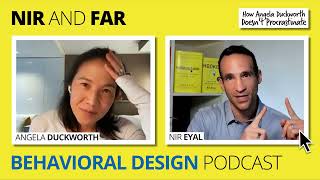
Angela Duckworth talks about why she rarely procrastinates on work but struggles with book structure and admin tasks. She uses goal fusion to reframe tedious work as part of bigger goals, and relies on One Sec, an app that cuts unwanted phone use, backed by a PNAS study.
Chapters
Welcome Angela Duckworth, to the near and Far Podcast. It's great to have you here. So I have to tell the listeners, I'm sure most of them are familiar with you, of course, you're a professor at UPenn, you're the very famous author of Grit, and I'm a big fan of your work. I have been for years and years. And recently I heard you on your fantastic podcast called no Stupid Questions, which you host with Stephen Dubner. And I've been a subscriber for a long time. Everyone should go out there and subscribe. It's a fantastic podcast. And recently I heard you say something that kind of stopped me dead in my tracks. You said that you were not a procrastinator, that you did not procrastinate when it came to work. And I thought, how can that be? How does anybody not procrastinate? So basically I looked up your email, I sent you a message and I thought, she's probably too busy to reply. Nine minutes later I get your email back perfectly on brand, saying, yeah, sure, let's chat about it. And so I really appreciate you taking the time and I have so many questions. But yeah, let's start with this idea of a person who doesn't procrastinate. I thought everyone procrastinated.
Okay, so to be fair to myself, I was saying that I don't procrastinate in the context of, if you ask me like you don't have any self control problems, I would say no, I have two in particular. I have a bad temper. And also I think I have what the, you know, biblical sort of like the pride sin, you know, the seven deadly sins. I mean I do think I can be arrogant and, you know, self centered. So I would say that I struggle least with procrastination of the things that people say they struggle with. And yeah, I almost never do. But I am not marketing myself as a, you know, self control, perfect person.
Sure, yeah. So, so that's great to hear that you are human, which, which is, is fantastic to hear because, you know, but I'm sure part of the reason that you've accomplished so much in your professional, professional life is because you don procrastinate. So tell us more about that. How come in the work context you don't procrastinate and have you always been that way?
I think I have been a low to zero procrastinator for much of my life. I cannot remember a time where things, you know, for days or weeks that I should have started. I am not the Sort of person who does things at the last minute. You've seen data, I've seen data. This is like typically this bunching, you know, it's like do on Thursday and then all the assignments flood in. And you don't even need to be a social scientist. You need to be a teacher. Right? It's like, oh, you know, projects are due on Friday. That's. That's when you're going to get them. You're not going to get them on Thursday. But I'm more of a. Oh, it's due in two weeks. Okay, let me make a timetable and get started. So it's something that I, you know, can't give you a full explanation for why that is. I think there are at least two reasons. I mean, you and I are both blessed. My cap, work that we love and don't dread. So I don't really have a sense of wanting to not start. When I wake up in the morning, I come downstairs because the kitchen's like one floor below, and I hit boil on the hot water maker. And while the coffee is being made, I start working. You know, it's not like I have anything that I'd rather do. Like I want to read the newspaper, I don't want to scroll through the headlines. I don't want to look at social media. You know, I just start working. So that's one thing. I do love my work. I think the second thing is, and I don't know that it's always good. I think that for me, it's like a. It's like a. It's, you know, if I have a problem, like right now I'm thinking about something and I can't solve it. And it's like, I not only don't procrastinate, I don't even sleep. I'm just like constantly thinking about it. And it's very hard for me to not work on it while it's unsolved.
Okay, so it sounds like for things you enjoy, procrastination is not a problem. Which makes sense, right? That's the whole chicks at me high get into the flow of things. Things for tasks you enjoy, I guess. What about the things you don't enjoy when it's maybe, maybe not in a professional context, but other tasks. Right. Doing your taxes or, I don't know, other stuff that you just don't really like to do. Do you procrastinate on that stuff?
Oh, that's fair. So you might say, you know, Angela, things that leap to mind are all the things that you like to do is of course you're saying that you don't procrastinate. But maybe the things that are not leaping to mind are all the things that I hate to do. Maybe I procrastinate on them so much I've forgotten them altogether. You mentioned the passes. So we have a ridiculously traditional division of labor in our marriage. My husband Jason does all the taxes. When I met him, I was doing this like single page tax form called the 1040 EZ and he was horrified. He's like, you don't have any deductions. Like it's like far from optimal. I was like, I don't care. It's like one page. Isn't that great? One page, double sided, but still one page. So I don't, I don't know that I don't procrastinate on things that I don't like to do. But you're probably familiar with this research on job crafting. I mean, I do think that if there's something that you can outsource, even if it's to your spouse or you know, just otherwise find a, like a creative and legal workaround, like, oh, you know, I don't have to do it at all because I, you know, whatever X, Y or Z. So I feel like my life has been curated to some extent, like down to the fact that like I have to make coffee and I have to do my work and many other tasks that I don't like doing are, including taxes, are managed by somebody else. So maybe that's another reason why don't procrastinate. I managed to avoid those tasks.
But in your professional life there must be things about your day to day job that also feel like drudgeries. How do you get through those?
So if I had to think of specific examples of things that I just think are like, oh gosh, I really have to do that, that's horrible. Well, first of all, you're making me realize that. Yeah, I mean I keep getting this email from human resources at my university to some training that I must be procrastinating on because the emails are getting more insistent. I think I'm over deadline to do some official form that I haven't done. So there. But if I think of other specific examples, like I don't know, like, you know, sometimes I dread a meeting because I know it's not going to be very productive, but I know I have to have the meeting or I have to work on some project and just like that part of it is really tedious. Right? As a teacher, I love my students, but I hate looking through all their feedback. I ask for feedback every class and it's on a scale from zero, you wasted all my time to 10, like you blew my mind in a good way. And then there are all these open ended comment boxes and I, I don't really love looking through all the things where it's like, what's another thing I could do better? What's another thing I could do better? So, so how do I avoid procrastination on that? You know, there was this research paper that came out by Ayelet Fishbach on goal fusion. He's not the only author. It's also Aryeh Kruglansky and they both worked on goals for a long time, you know, arguably their whole careers. But the idea of goal fusion is if, say you have a tedious task, like I have to look through all the comments about my lecture so I can revise my plan for the next lecture, but that's not that fun. Goal fusion is that you take that goal and you, you fuse it with the goal above it. The, the sort of the. Why, like why do you, why do you need to do that? Oh, because it's important for me that my students actually get a better class. So my, my higher level goal is, you know, teach a better class, but my low level goal is go through all the feedback. The idea of goal fusion is you can in your mind put them together so that while you are going through your feedback, you can say to yourself, I'm not going through my feedback. I am teaching a better class to my students. And I think that cognitive trick actually works for me. So sometimes I do, you know, pull a goal fusion and I try to say to myself, like, oh, I'm not doing this tedious thing. I'm doing the fill in the blank higher level goal that, that serves.
That's a good one. Yeah. And so when it comes to your, your main work, I know for me, you know, you've written a very successful book. And for me, when I was writing, I love the topic, I'm super passionate about it, but there's that crank factor of like, oh, I got to sit down and, you know, write these words. Does that, does that, does that ever happen to you?
Well, I want to know, like, what was it like for you? Like, what was the hardest part of writing your books?
The hardest part of writing the book, which actually was the most satisfying, was getting down the conceptual model. So I'm a big fan. So I'm not a PhD, but I rely on the work of fantastic people like you to kind of put together a model, a picture. And that actually took the longest amount of time, and it was the most annoying in terms of how much effort it took was just to put these concepts into some kind of visual. I love to have some kind of picture that I can use to teach a concept. And so creating the hook model, these four parts, and creating the indistractable model with four parts and a picture that was good enough to remember and relatable enough so that others could learn it, that took me the longest. But that was also the hardest because I had to figure out what to exclude. So that took a really, really long time. Probably more time than actually writing a book. I did procrastinate on it, okay? So that part I actually enjoyed, and there was a lot of energy there. But then once I kind of, in my mind, cracked the formula, what I definitely had trouble getting to work on and definitely procrastinate on was writing it out word for word. Because, like, what's exciting to me is the big idea. That's super energizing. But then I already know the big idea. Now I got to sit down and, oh, I'll tell you another thing I procrastinate on, right?
The punchline's already been.
Exactly.
Now you have to go back and write the joke.
And that's exactly.
So I'm jealous. I mean, I will say this. I am, you know, struggling. I mean, mightily struggling. It's humbling, you know, Like, I cannot tell you how hard it is for me to, like, I'm working on a book on the power of the immediate situation to determine what you think, feel, and do. And I'm excited about the idea, but there's something about, like, this part of, you know, structuring the sequence of, like, you know, how many chapters going to be, and, like, what's. What's the flow? I really, really struggle, I think, with procrastination there. I think there are two things. One makes you get to work, and the other one doesn't. The thing that doesn't. And I think the thing that would incline me to, I think, uncertainty. Like, you don't know what to do. I think people do things when they. When it's. There's a big yellow button that says click here. Like, we don't. But if you just don't know, like, you wake up and you're like, and now what do I do? Do I reread my notes? Do I make another outline? Should I have a zoom call with Somebody who knows this area of expertise more. Should I read this book that I got out of the library? Like, I do think that that argues against action, but for me, the reason why that gets overwhelmed is that I have this other thing which is like, I just have this, like, weight on my chest when I can't figure something out, and I can't sleep and I can't eat, and I'm just obsessed with it. So I probably have both of those forces, but one of them is bigger than the other. And the. The impelling force that, like, moves me forward creepily is just larger than. Than not knowing what the hell I'm doing, which is actually a good description of where I am.
Yeah, interesting. That's what I guessed. I. I think a lot of people who are like you, and there are very few people like you who don't procrastinate, but I think the common trait. I know we have a mutual friend, Adam Grant. Seems to me he's also what he calls a precrastinator. It seems to me that there's this, like, this burning pain, this discomfort of if I don't do this, bad things will happen. Do you think that outweighs the OR is more important than the joy of the task itself?
I don't want to make judgments for anyone. I think that I have this pen pal correspondence with a student who graduated, gosh, now years ago, I'm losing count how many years it is. And when he graduated, I realized that to my surprise, I was like the closest faculty member to him. And just thinking about this kid who kind of in my mind needed a little mentoring, I was like, why don't you write me a note every Sunday by email and I'll write you back. And now we've been doing it for years. And in our recent correspondence, I said, I realize now after years that you really want to have joy and, and curiosity in what you do. And that is the most important thing. You know, whether there's a career progression, whether there's like, a higher level purpose, whether, you know, society gets, like, measurably better. You know, these are things that may matter to other people, but, you know, for you, you're just really curious and like, do I have that right? He was like, yep. So I don't want to legislate for anybody else, like, what should be the most important, really. And it's not humble bragging and it's not false, you know, piety. It's literally, I'm like, you know, I don't know what other people's Utility functions are. But for me, like, Joy, like, was it fun? I think that is less important for me than it is for many other people. Like, I want to produce something that is very fine. I'm mindful that I'll not be alive for another half century. I mean, I'm 53, so like, probably at least at halftime, if not more. And I'm like, I want to do something that is excellent, and I want to be gratified. But, you know, if it's not fun, I think that's okay. For me.
Yeah.
For me, for Angela. Not for everybody.
Of course. Yeah. I guess I could have predicted that answer in terms of your work on grit. So that. That's very much on brand.
A little bit of research there.
Yeah, yeah, yeah, absolutely.
Yeah.
Another thing, you know, I was thinking as you were asking, like, what. What kind of things do I procrastinate on? One thing that always is tough for me is I love to give great presentations. I love to be on stage. I love to present and see people's eyes open. And I can see that they get a concept that's going to help them. But I hate rehearsing a speech. I don't know if that's something that you feel, especially because I know the punchline, as you said, even though I know it makes such an impact and there's no way around it. You have to practice a talk thousands of times. When you see someone give a TED talk as great as yours, I know how much effort you put into that, but is that something you struggle with at all?
I think I cheat in that I don't practice my talks, but I think I have so much practice in repeated performances of the talk that it is practice. It's just that the performance has to count. This is probably a bad habit. Going back to sight reading all of my lessons. I was taking piano as a little girl, and I got really good at sight reading. So I guess my piano lessons ended up being, like, the small amount of practice I had. So, again, I'm not recommending this to anybody. But. But. But I know what you mean. And. And I do think. Look, I don't. I. Look, you can't outsource everything, and you can't avoid everything. I'm like, oh, I have a little trick for that. I don't do it at all because of this other thing. But. But obviously there are times where you, you, you. You do have to figure out how to. And I will say this. I know there's all kinds of, you know, popular TED talks About how procrastination leads you to creativity and. But the. I don't know him, but the scholar who I think has done the most substantive work on procrastination is Pierre Steele. And I read a lot of his work and I think his view, he should certainly speak for himself and you should ask him, is that it's just a form of impulsivity. It really is. It's a failure of self control. It's doing something now that feels good now but is not good for you later. And I think procrastination neatly fits that definition. Like people regret procrastinating and so forth. So again, I'm not saying I'm perfect, but I'm saying that like, it is something we all have to reckon with. And for those who are like, it's great, like, it's actually the secret to creativity, I think on balance it's not. That's just my opinionated perspective on it.
Yeah, no, I couldn't agree more. And I think if you look at the work output of people who planned ahead and say, okay, I'm going to put in bits of time, I'm a big advocate of time boxing. It sounds like you do something similar. I'm going to put in a little bit of effort as opposed to cramming right before. The work output is way better. When you have that time to deliberate on something in small bits versus having to do it all in the last minute. No doubt about that. And in terms of your violent agreement. Yes, absolutely. But you know the struggle, though, and I totally agree with you, it is absolutely an impulse control problem. But the challenge always is. And it's interesting how you say it's in different life domains. I'm curious if you kind of get into that in terms of where you find that you have really good impulse control when it comes to work. Right. Because there's whether it's the discomfort of not doing the task and the joy of the work itself. So impulse control isn't a problem at work. Where are the areas where impulse control is more of an issue? And how do you manage those uncomfortable sensations?
So I mentioned that I have a bad temper and sometimes I say that to my lab, my graduate students, and I think one of them is like, oh, yeah, you do. And the other one's like, I don't know. One who's experienced it is like, oh, yeah, like awful. So I happen to have a collaboration with James Gross, who is, you know, a world authority. Not the world authority, because there's more than one on motion regulation. He's at Stanford. So he's actually given me both, you know, like professional collaboration advice, but also just like personal advice. Like, you know, like, James, oh my gosh, I lost it. Like, let's talk about it. So I will say that, you know, there are two classes of strategies that you can use on any, you know, self control problem, but including regulating your emotions, which is what James studies and what I, you know, struggle with the most. So one class of strategies are situational strategies. The other class are cognitive strategies. So one are like actually changing your situation. The other are like changing the way you think about your situation or what you're paying attention to. Like things that are in your head, really. So in terms of my bad temper, you know, I try to do both, right? Like, how can I reframe this from a third person perspective so that I can take, you know, like the other person's point of view more and not be so mad at them because I'm like ignoring everything that they're thinking and feeling. That's the cognitive side. But I will say that in my own personal life, I really am trying to do situational things. So, for example, like, some of the worst arguments I've had with my husband have been around, like the holiday time, you know, it's the end of the year, everything's due. Like, all the reports are due. There's a lot of social obligation that somehow puts us both in a bad mood. There's like a lot of family stuff that always dredges up, you know, memories. And when I lose my temper, like, it's usually in December. So I asked James Gross one year, I was like, okay, this is ridiculous. Like I. And I also, I know I'm in the wrong largely. Like it's not 50 50, like, what can I do? And we started to lay out some of these stressors. It's like, okay, well, like, can you reduce the number of holiday parties that you go to? And I was like, well, I should really rem. Know what? Honestly? Yes. I don't have to go to every holiday party. Like, can you make some deadlines in January, not in December? Like, if you can, like, yes. Like, can you take a couple days off from work so you can just like manage some of these family things and not feel like you're like stretched thin? Yes. Can you like, have a conversation at the very beginning of December to like, just brace yourself with, you know, your family, like, okay, this is going to be a hard month and, you know, I lose my temper and I'm going to really Try not to. So those are all situational things, like telling other people things, managing your commitments. And I guess if you ask me, like, what is keeping me up at night, literally, I'm. I am writing another book. And it really is. I think that people are well aware of these cognitive strategies, like, I should reframe it, I should pay attention differently, etc. But I think these situational ones, like, literally change your situation. Like, just make it so that you don't have as many things to do. You know, I've been reading a lot of B.F. skinner lately, and so I guess I feel like, you know, part of this is obvious and yet part of this is not so obvious. Somehow we don't feel like that's the same thing as using self control. Like, if I. If I literally change my situation somehow, that's not actually doing the thing that is called self control, but it is a thing. I think, and James, I think would agree with me, that is often the most efficient thing you can do, which is to avoid the terrible temptation in the first place. You know, like, I just installed this app on my phone. This is called One Sec. And like, when you click on the app that you're trying to avoid, which for me is email, because, yeah, I guess I am a workaholic. So apparently I've tried to open my Gmail 31 times in the last 24 hours. And when you click on the app that you're trying to avoid, which I installed as gmail with this 1sec app, it takes 1 second and then another second, and during that second, it says, breathe in, breathe out. And then it gives you this screen and then you have to click like, I don't want to open Gmail, which is the big white button, or continue to Gmail, which is like, smaller. Well, it's not smaller, but it's under it. And it's significantly reduced my use of this app. That has been interrupting my thinking process. And that is a situational strategy. I didn't have to reframe anything. I didn't have to reappraise anything and have to direct my. It's like I installed this app and I'm not using this app anymore this time waster anymore. And there is, by the way, I know you like science, so there is an article in the Proceedings of the National Academy of Sciences showing that this app reduces unwanted app use BY Something like 57% in six weeks.
Absolutely. Yeah. There's a ton of these types of apps that I put in the book Indistractable. And we have online. I'll put in the show notes as well. But yeah, this one is new because.
It came out after your book.
Yeah, it's called One Sec, right?
Yeah, it's called One Sec, like O, N, E, space, S, E, C. We'll.
Put a link in the show notes as well. Yeah. These tools, I love them because they essentially interrupt the interruption. Right. It's that momentary pause of helping you gain some insights and mindfulness between the stimulus and the response, and that's so hard to do. Right.
I mean, I can't believe I've been opening my. I was like, oh, I don't. When I first mentioned this app, too. I have a postdoc who did his PhD with Wendy Wood, you know, in the habit lab. And I was telling him about this paper, and I was telling him about this app, and I was like, you know, I just installed it with Facebook, even though I don't use Facebook, because I just want to see how it works. And he was like, oh, you don't have anything that tempts you? And I was like, no. And then I just. He was like, what about your Gmail? And I was like, oh, gosh, you know me well. So then I installed it on this. And I literally can't believe that I've. I've tried to open Gmail 31 times in the last 24 hours. That's ridiculous. I had no idea. So it interrupts the interruption and it brings things to conscious awareness that we're really not conscious.
Yeah, yeah, yeah. If only we could have that same tool, you know, when I. When it's 9pm and I've already had dinner, but I want a little munchies, and I, you know, start snacking at night. I need. I need this app for. For, you know, on the chocolate bar or whatever it is at night.
Absolutely. 100%. Yeah. Someone will invent that, I hope.
Yeah. Well, I want to be mindful of your time. It was fantastic to talk to you. Thank you so much. Was there anything that we didn't cover that. That maybe you'd like to mention?
No, but, you know, I'm a. You were very kind in your words, but I've been admired of yours and we run in the same circles, and lots of people have lots of nice things to say about you and your translation of all this scientific research for the greater good. So thanks for having this conversation with me.
Oh, likewise. Thank you so much. And everyone definitely go check out no Stupid Questions. Fantastic podcast. And of course, Angela's book, Grit is wonderful. It's essential reading. Thanks again. Angela Duckworth. Great to see you.
More from Nir


Your Beliefs Are Sabotaging You (Here's Why) - Beyond Belief for Athletes with Nir Eyal







