Mike Norton
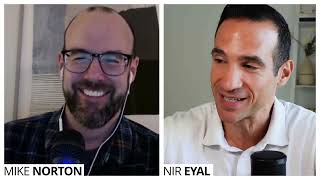
Mike Norton, a Harvard Business School professor, explains why humans create rituals and what they do for us. Rituals help people regain control during uncertainty, strengthen bonds between couples and families, and manage performance anxiety. They differ from habits because they add emotion and meaning, whether inherited cultural practices or improvised personal routines like athletes' pre-game rituals.
Questions this video answers
April 29, 2024
Chapters
Everything in human life, we turn to ritual at one time or another. When we started asking people just straight up about their rituals, they would tell us about that kind, and then they would very frequently say, but I actually made up my own little thing. And then it was almost like confessional. They would say, you know, I never told anybody this, but when I'm anxious, what I do is.
Hello, everyone. This is Nir Eyal. Welcome back to the near and Far Podcast. Today we are so excited because we have our good friend Mike, Mike Norton, who we've known each other for years and years. Mike is a professor at the Harvard Business School, and he wrote a couple books. His last book was called Happy the Science of Happier Spending, which was fantastic. And he also has a very famous TED Talk, which has been viewed over 4.5 million times. You've probably seen it. It's called how to Buy Happiness. His work has been featured in the Wall Street Journal, the New York Times, Scientific American. Mike Norton, welcome back to the show.
Thanks, Nehren. It's great to be here.
Yeah, it's been a long time. I know we talked about your last book, but today we're going to talk about your new book, which I have right here, called the Ritual Effect. I listened to it on Audible. It was fantastic. I enjoyed every minute of it. You narrate it, which I love. A lot of times authors don't narrate their own books. I thought you did a fantastic job.
You did a great job.
Not as easy as it looks, right? You think? Oh, you just read the book, but I don't know if you found this, but I thought it was much more difficult than I expected. How about you?
I completely agree. And also some. Some names that I thought I knew how to pronounce. Absolutely not. Had to work on it. Yeah.
Well, that's just names. I remember I made the mistake of telling my daughter that while I was reading. Indistractable. I said I was just reading and I wasn't really thinking, and I said epitome, as opposed to epitome. And let me tell you, my daughter will not let me live that down. Every time she says, huh, Daddy, that's the epitome of such and such. So anyway, sidetracked there. But anyway, let's get back to your book and your work. You have been studying rituals for decades now, right? Tell us more about. About your research.
Years ago, I was working on this kind of money and happiness, and really the goal there was trying to find little everyday things that people could do with their money. Differently to kind of get more happiness out of it. So not so much like if you had a billion dollars, you know, would you be happy or not? But kind of everyday little things that people could shift. And from that got into this idea of gift giving, which is like in and of itself totally fascinating how we give gifts and what gifts mean. And then gift giving then got me into rituals because it's such a ritualistic activity that humans have been doing for thousands of years. And then I started looking around and saying, wait, it's not just gift giving, it's everything in human life. We turned a ritual at one time or another.
Yeah, interesting. So what was it that you found was. I mean, there's so many interesting insights and stories in the book. What was to you the most surprising discovery?
I think that it really was the ubiquity of them. So I mean, when, when we started, we were looking in just a couple of domains of life. And I think, I mean, when you think of the word. Well, first off, if you think of a ritual, you think of like people in robes with candles, chanting or something. So I'm not usually studying that kind of ritual. But then you think of things like holidays and things that are received wisdom sometimes again from thousands of years ago, or things that your family has handed down or your culture has handed down and started kind of along those lines. What are those sorts of rituals doing for us? But the really key insight was when we started asking people just straight up about their rituals, they would tell us about that kind and then they would very frequently say, but I actually made up my own little thing. And then it was almost like confessional. They would say, you know, I never told anybody this, but when I'm anxious, what I do is like go in the bathroom and yell at myself in the mirror. Or you know, when my wife and I are having a ritual, we do this little cute thing. One couple, like they said, they clink their silverware together every time before they eat. And so there's these funny things where there's no like thousand year old text that says to do these specific things. But that was what was so interesting is like under the surface, people were coming up with their own all the time.
Yes. And as I was listening to the book, I was dying to tell you all about our rituals. But I'd like to ask you about your rituals because I've got some quirky ones that I've never shared before. But do you have any rituals that you do with your family or in your own life?
Yeah, we were Just talking about our daughters. And I think so. Sometimes people say, like, I'm not a ritual person. I don't do any rituals. And I ask them if they have kids and if they say yes, I say, what did you do when you brought your kid home from the hospital? And it's like one of the most stressful times in your life because it's like they're literally like, here's a human. Take care of it forever. And the big thing is sleep. If you like new parents, are you sleeping? Is the baby sleeping? How's the sleep? It's like the most monotonous conversation that we all have. And when people say they don't have any rituals, I say, well, how did you put your. Your baby to sleep? Or how did you put your toddler to sleep or your 5 year old to sleep? And they say, well, I don't do rituals. But you know, what we did was. And then they would have this incredibly elaborate sequence of events. And of course we did too. You know, it's like this book.
Twist around three times, then bounce up.
And down, then swaddle, then completely, then the bath, then the book, then the swaddle again, Then, you know, I mean, really, really elaborate. And if you do it wrong, you look at each other and you think, maybe we should start over. You know, we don't want to jinx this. Let's start it over. And so you just see, you know, my wife and I, and nobody is saying, let's construct a ritual to help the child. That's not how we go about it. We just do it. It kind of comes out of us in these moments. And that, again, was. What was so interesting is that we're just freelancing them all the time to figure out what works. Right?
And so, yeah, I remember you brought up Skinner's work around how pigeons, when they were given variable reinforcements, how they would also make all kinds of weird gestures and bounce up and down and twist around and do a little polka dance because they couldn't figure out this condition of figuring out how to get the reward. So they would make up these, these various dances. And what I found so fascinating about that is that you were saying that in the more the condition is, is plagued by a lack of certainty and control, the more likely we are to make up rituals. Yeah, maybe you can say a little bit more about that.
It seems to be a really strong link. So one of the examples that I found fascinating was if you look at which cultures now, but also historically develop rain dances, they've emerged Independently, in different cultures over time. And on the one hand you could think, well, I don't think that dancing makes it rain. So what possible reason could there be for all of these different cultures to do this? And what the research shows is the cultures that are most likely to develop them are in places where there's unpredictable drought. So not predictable drought and not all drought and not no drought. Unpredictable drought. And that I think is the key, because if you know that there's going to be drought, you know, from this state to this state, you can deal with it. The unpredictable thing seems to be what causes these rituals to emerge. And of course, one of the reasons they emerge, it's not probably going to make it rain. But when there's a time of drought, what happens is social bonds start to fray. You know, I look after my people, you look after your people because it's a drought, you know, there's a scarce resource. And these rituals bind us back together. They remind us that we have a shared history together. They remind us that we've gotten through this before because we've done this exact dance for this exact reason 100 years ago, 500 years ago. And so the rituals coming in this time of great stress, not clear that it's doing the thing that we had hoped it would do, but it's doing something really for us. It's the same with parenting rituals too. You know, it's totally unclear if it helps the kids sleep. It might not, but it helps the parents feel like we have some sense of control and we know what we're doing.
Exactly, exactly. So do you think that there's a connection between the decline of rituals, specifically religious associated rituals? As society became more science based, more things became more predictable. We didn't have to think that it was Zeus throwing lightning bolts. Now we understand why lightning happens, right? We, as we develop more scientific understanding, we need it in a way, ritual less.
I think we turn to them in so many domains of life that I think there's something in us that turns to, you know, ritual. So if you think of a wedding, for example, that's less about kind of the need for control or, you know, need for regularity. And it's more about let's use a ceremony to bring families together and bond them together. So we have, I think sometimes the decline in religious ritual can be a thing where ritual's declining. But at the same time, if you think of something like Burning man, which I have not been to, but you know, you break down what Burning man is, it's literally People going on a pilgrimage in the desert, which sounds very familiar from various ancient texts. You know, I mean like minded people on a pilgrimage in the desert, taking various substances, sometimes at the end burning a thing, you know, in a very ritualistic way. It's not religious in the way that we would typically say religious, but it has a lot of the features of those kinds of rituals. So it's not clear that they're declining overall, but we're definitely constantly replacing and exchanging and updating.
You know, one thing that's that I was fascinated by reading the book is specifically around the decline of like organized religion and rituals that that come with organized religion was why it's so hard to start new rituals. Like, I don't know if you've seen with like Sunday assembly and all these, like, you know, when, when people take the God out of these rituals, the supernatural out of these rituals, they have a tough time sustaining. And I wonder if you had any opinion on, on that.
Yeah, there are cases where it's been successful. So one of my favorite things we encountered was something called the Seattle Atheist Church, which I just love because those words don't make any sense. Seattle's fine, but the other two don't make much sense together. But they were trying to do exactly this right, which is there's so many positive things about religious gatherings in terms of shared values, in terms of helping each other, helping the community. You know, religion does so many different things for us. The only thing missing for them was the idea of some faith in a higher power. They're able to sustain it. But I do think, if you think about what bonds groups together, the more shared beliefs they have, the more likely they are to stick together. Because I might disagree with two of them, but agree with four of them. And so I'm still in the group, but the fewer beliefs we have then, you know, as soon as I disagree if we only have one belief, if I disagree with it, I'm out. So, you know, it's interesting the way we have a kind of a constellation of beliefs that allow us to be in groups at the center of them, at the periphery or out of them. And I think faith is something that's a very powerful belief for people, very bonding belief. And it does then have that glue that some other kinds of beliefs I think don't have as strongly.
Is it hopeless? I mean, is it, let's say you've got a group of people or do you believe that beliefs are the prerequisite for these rituals?
I mean, if you look at something Like Peloton for example, by the way, I never mean to trivialize religion. Like peloton is the same as religion. I don't mean that at all. But if you think of what people are getting out of Peloton, it's again, it's a community of like minded people engaged in a very difficult activity. There are goals associated with it, there's well being associated with it, there's social connection associated with it. And so we do create sometimes virtually now, these communities that are really bonded together by some shared belief or some shared interest. They don't have necessarily the features of religion that we're accustomed to. But for some people it doesn't mean it's any less meaningful in their life than for other people their religious faith might be.
And do we see that those groups and those rituals that don't have that strong belief in common, right. Where they don't have the expectation of, you know, if you do this, this will happen, do they tend to be looser bonds? Are they less likely to stick together based on that shared belief?
Yeah, I mean, it's a great question. I think the history of, you know, new religions pop up all the time, but they might only have two adherents, you know, so I think even with religion we're freelancing very often and coming up with new faiths. Then there's a set that have survived over again sometimes thousands of years. And so those are religions we're accustomed to. It's not clear actually, as you said at the beginning, what it, what are the prerequisites to start a new faith like that. Because it's very, very challenging to, you know, get an entire group of people to switch from something they believe to something else interesting.
And one of the things you talk about early on in the book is around habits and you kind of have some beef with, with over reliance on habits. Maybe you can talk about that a bit.
Yeah, I think, I mean a lot of the research that people like us do is really trying to help people have better habits. Whether it's like quitting technology so they can do the things they want to do or exercise or whatever it might be. And I'm all for great habits. Just to be very, very clear. I wish I had better habits for sure. But I started to think about, you know, if you had a life of perfect habits, you know, I mean, imagine starting tomorrow, all of your habits were perfect. You know, you, every day you got up at 6am and ran for this amount of time and you ate this specific healthy meal and you know, the entire day was a good habit. It felt to me that if you did that for 10, 20, 30 years, you'd be super healthy. There's no doubt. But would you feel like you had a rich, interesting life, a full life, or would you feel like maybe you missed some things along the way? You know, I mean, if you've ever been in a relationship with someone who has very strict habits, it's difficult. You know, it's like, hey, why don't we go out for dinner? And they say, well, I can't go out for dinner because I already had carbs. And so, you know, this. This kind of thing. And so I think for me, partly what rituals do is they pull us a little bit out of just the executing the habits towards something that has a little more emotion and a little more meaning.
So how do you define, like, what's the difference between a ritual or a routine or a habit?
I think I'm gonna ask you a ridiculous question, which is just, do you brush your teeth first and then shower, or do you shower and then brush your teeth? Yeah.
Yeah. So I don't have a specific order. I kind of go with the flow, actually, you know what it depends on? It depends on when my wife is using the bathroom to do any of the above. So I do the opposite. When she's in the shower, I brush and vice versa.
I see. Does she have an order? Do you know? Or she's also flexible.
That's a great question. We've been married now for 24 years, and I don't know if she has an order I should ask her.
We'll find out. Yeah, I mean, it's interesting. So like many people say, and then if I ask people, you know, well, will you flip the order tomorrow? How do you. How would you feel about flipping the order? About half of people are like you. I. I could not care less. I got a shower. I got to brush my teeth. I don't have any strong feelings about that. But about half of people say, I'd rather not. And I say, really? Why not? And they say, I don't know. I just would feel weird or off for the whole day if I didn't do my morning routine in the order that I do it. And they know that it's not essential. You know, if they're brush first and then shower, they know that it's not essential to do it that way. But when they do it that way, it creates emotion in them and they feel good. And by the way, when it gets interrupted, for those people, they feel Off. So it really shows you that even these very mundane actions, for some people, some of the time, they get imbued with more. It isn't just the habit, it's something else on top of it. And for me, that's when it starts to move toward ritualistic. Not people in robes with candles, chanting. You know, not that far down the continuum, but. But when the. How you do things really starts to matter to you, I think that can start to move us toward more ritualistic, more emotional, more meaningful.
What have been some of the most impactful rituals that you think more people should do that they don't?
You know, it's funny because some of the ones that are. Are. I'm hesitating to use the word profound, but I think I'm gonna. I'm gonna throw it out there anyway, are the tiniest, tiniest little things. So I think, you know, the idea. I mean, if I said, you know, what's great, actually, is to meditate for five hours a day, that would be. I'm sure it is, but who's gonna do it? I mean, you know, nobody has time to do it. So it's almost this question of, like, what are the small things that we can do to change things up for ourselves? And we do see things like this morning, like so many couples, for example, when we ask them about their, you know, special. We don't usually say, what are your rituals? Because people think we're crazy. But we say, you know, do you have things that you do that are special that you make sure to do regularly? And so many people, for example, have something with coffee or tea in the morning, that one person makes it and brings it to the other person, or they both go to the same place and have it in the morning. You know, they're very, very. It's just liquid in a cup, you know, I mean, these things are not profound enough of themselves, but you can build things into them that are profound. I was actually talking to a ritual skeptic, let's say, who said, I don't have any of these rituals. And they said, I have tea every morning, but it's just having tea. There's nothing special about it. So they said, how would you suggest I turn it into a ritual instead of just a habit? And I said, well, I don't know you that well. But, for example, some people will always use the same mug. That might have emotional meaning for them. Maybe it was their grandmother's or something. So they're. Yes, they're drinking tea, but they're also connecting to the past. And they cut me off and they said, oh, my God, I use the same mug every morning. And it's a mug that I bought with my daughter when we were watching elephant seals giving birth. And she said, every morning I make sure I use that exact mug. And last week, my husband brought me tea in a different mug, and I made him take it away and bring it back in the elephant seal mug. So just a mug, just liquid. But this little action every morning, she's connecting. I mean, in a very, I hate to say profound, but a very profound way to like giving birth to her daughter and witnessing another mother give birth as well. It's really powerful, not time consuming, not, you know, very elaborate, and yet really meaningful.
Absolutely.
Yeah.
I was thinking as you were saying that story. So my strange ritual with. With my wife is that before we go. Go to sleep, the last thing we do before we go to sleep every night for the past 24 years has been that we give each other three kisses every single night.
Did you fill in our survey? Because we actually had a couple that said we kiss in threes.
No, I did. Well, not every time. We kiss only right before we go to sleep, only at night. Last thing we do in the day before we're asleep. And what's interesting about that is that, you know, I was thinking about, like, this past what we were just talking about, like, do you need a belief to have a ritual? And in a way, I was like, well, there's no supernatural there. There's no. Really, like, what's the belief? The belief is that if she didn't reciprocate, like, if she didn't want to kiss three times, that would be disastrous. Like, I can't even imagine how awful that would feel. And so the belief is that, like, it's. It's in the. The sacredness of our relationship. That's the belief, right? It's that we've established that this is our little cutesy ritual, which I've never said out loud to anyone else besides. So now I'm sharing with everyone listening, but that it's a belief in the, in. In the, the sanctity of our relationship. That that bond is still tight. And if, if that were to be broken somehow, the, the removal of that ritual would be awful.
One thing that we see, Ximena Garcia Rada, we did research on couples rituals, and one of the things I think that they do for us is so if you think about how we show we're committed to each other, you know, we put rings on each Other's fingers. And, you know, there's ways in which we sign documents together and we buy whatever, but at the same time, every day, how do we really know that we're committed that. That we have a history together? And we're committed to having history going forward. And we see actually that these little rituals are a little bit of a symbol of the commitment. Right. Because we have been kissing in threes before bed every night for years. And you know what? We're going to do it tonight and tomorrow and for the next 10 or 20 years as well. So there are these really. I mean, again, it's just kissing. People kiss all the time. But when it's your thing with your partner, it takes on this really outsized meaning. And by the way, we really see that happening. If you ask people, and I can ask you, imagine if you got divorced and your wife reused the three kisses with a future. I mean, right? I mean, it's the word. Like our exes are allowed to get married, have kids. I mean, they're allowed to do all kinds of things. They are not allowed to reuse the ritual. I mean, it's just so.
Absolutely not. That is so true. I would be. It would be so heartbreaking.
I mean, devastating. Yes.
It would be devastating if that ritual was. Was taken away from us. It's so true. Right. Because we assign so much value to that ritual. In fact, I remember just a few weeks ago, I asked my wife or my wife asked me. I can't remember how it was like, why do we kiss in threes? We didn't even know why we kissed in threes. And so we made up a reason that it's I love you. It's three words. So that's why we kiss in threes. But we didn't even know why we did it.
I love it. I love it. Nobody does, by the way. If you ask people, when did it start? They often don't know. They just say it just happened. It just came about as part of our relationship, and it just has a lot of meaning to us.
Now let's shift gears a little bit. I'm so curious around rituals around performance. You talked about in the book about how people have special totems or special rituals they do before a high stress, important behavior going on stage or an athletic event or whatever the case might be. Talk to us a little bit more about that and how we might be able to utilize that in our own lives. Yeah.
This is, again, one of these cases where we started studying something and then ended up studying something. Else, because the. I mean, if you want to waste an entire day of your life, you can type in any athlete or celebrity's name followed by the word ritual and hit search. And you're going to get. Not for every celebrity, I wish there were two. But for most celebrities and athletes, you're going to get some news story about whatever their ritual is before they perform. And they are all over the place and, like, incredibly elaborate and completely idiosyncratic. You can see similarities across them. And yet the things that people come up with are so, so fascinating. And so we started looking at those actually kind of, what, you know, what is this? What are these, these really high performers doing before they perform? And. But then we started asking people, you know, well, what do you do before a meeting? You know, you're not like playing Wimbledon or whatever. You're just, you know, it's like a stressful zoom meeting coming up. So, you know, do you do anything before that? And what people say is things that aren't so dissimilar from the things that like Serena Williams or Rafael Nadal do. They're like private is the biggest difference. Instead of public. We allow celebrities performing at a very high level to be very idiosyncratic in public. We just allow it culturally. We just say it's a little weird, but, you know, I mean, the guy's going to serve at like 100 million miles an hour. It's fine if he does that crazy thing. If I did that, like at the beginning of this podcast.
That crazy thing, by the way, is picking his wedgie. Right? That's the ritual.
That's exactly right. It's my favorite. The only thing my daughter remembers, I gave a talk and my daughter came. It was like an hour long thing. I was talking about rituals, blah, blah, blah. And then my daughter, she's 8, she came up to me and she said her only feedback was, does that guy really pick his wedgie? That was the only. So yes, it's true. Nadal does pick his wedgie. Yeah. But we know that we're not allowed to do that because we're just like regular people. But what people do is they do them in private. This is the go into the bathroom, talk to yourself in the mirror, get yourself psyched up. People have all kinds of things that they do before their big meetings, often around breathing, making time and space to get ready for the stressful event. So we do see, in fact, it's extremely common when people are stressed that they do something before they go, need to perform. And one of the Things that it does for. So if you've. You know, our number one strategy, which is terrible when we're feeling stressed, is to tell ourselves to calm down. And I promise you, that's the worst possible thing you can ever say to yourself.
It's never worked for anyone.
It's not how we're built. Yeah, I wish.
It's even worse when you tell someone else to calm down. That's even. That's even less effective.
I think you need to calm down is one of the most. Yeah. Anyway, it's a life lesson to never say that to anybody. Never say that. And yet we still say it to ourselves. Right. You know? Yeah, you just calm down. Just calm down. And what that does is, like, you were stressed about the meeting, and you tell yourself to calm down, and you can't. So now you're stressed about the meeting, and you're stressed that you can't calm down. And then spiraling. Then you get stressed about your job. You know, you get stressed about everything in life. That's how anxiety works. And one of the things that rituals do is literally just functionally bring us away from the spiral. They take enough of our attention away from that and bring us into the moment that we literally don't have the time and space to go that far with the anxiety because we're doing our thing that we do every single time. Love it.
So should people. Is this a good idea to say, hey, if I'm struggling with this particular performance issue or I tend to get anxious or whatever the case might be, like, should we all start adopting some kind of little ritual or sacred object or something that might help us with that? And if so, how would we go about that?
Yeah, the first thing I would say always is notice what you're already doing. So often, even people who say, I don't do anything before I do stressful things, if you really get them to think about it, they'll say, well, actually, I do. There is something that I do. But they'll often say, but I don't do it every time, or I only do it if I have time to do it before the. Whereas other people say, I make sure that I have time, and I do it every single time. And so I think sometimes there's things you're already doing that you can do more regularly in almost a practiced way. And I think that's when they can start to help the spiraling stop and. And focus our attention enough. But like, with all things, of course, they work for some people and not for others. So the Main thing is to experiment, honestly, is just to see if these things are. Are helpful for you or not. And if they're not, we have other ways of calming down. Luckily, this isn't the only way.
Can the ritual just be in your head or can. Does it have to be some kind of physical manifestation? Could it be like a mantra that you're saying or a little prayer?
There seems to be something for sure. I think if you think of meditation, it's, of course, it's very psychological and mental, and yet there's often also a physical component of breathing or speaking or whatever it might be. And that's what we often see, actually, is that they're paired together, that there's something happening psychologically and something happening physically. Those seem to be the most common ones that people turn to. We don't know for sure if, you know, only thinking or only, you know, physical activity are the better ones. But it does seem like if you just look across many, many people, we have the theory that let's pair them both together, and that's going to get us where we want to be.
Great. Well, this was fascinating. Was there anything else that you think we all should know and remember about rituals and adopting them in our own life?
No, I think we should all try kissing our spouses three times before bed, though, and just see how we do. That's my number one recommendation. Excellent.
You know, from the book I remember. Okay. So the part that I was telling my family over breakfast the other day after I listened to your book, maybe you can tell the story about how there was this family that thought there was, like, too much goodness in Christmas, and so they wanted to also have some bad every year. Can you talk about that a bit? I thought that was a great story.
Yeah. And the way that this happened with his family is something went wrong one year. This happens on the holiday, any holiday, all the time. Something goes wrong, the pie doesn't turn out the way it was supposed to. Somebody's late, something terrible happens. And what this family did when these terrible things started to happen is they just decided that they would build them in and own them, which is a wonderful way of approaching the search for control.
Right. You can't control the crazy stuff that happens, but you can control. I'm going to force a bad thing.
To happen, completely embrace it, and then we own it, you know, as a family. And they would just get creative every year and do like, they've made completely disgusting food on purpose that they would force each other to eat. You know, they really went far, far, far with it. And they're still celebrating Christmas. You know, they have a tree and stuff like that, but they're making it their own. And that's what many, many families do with holidays is they use the received things and then around the margins, you know, they really make them idiosyncratic and special for their own family. Yeah.
So my favorite example was that everybody had to eat refried beans served in a diaper. Amazing.
It's beautiful. It's beautiful. The spirit of the holidays.
Yeah, of the holidays.
Exactly.
Who's going to ever forget that ritual? So what a great place to end our conversation. Mike Norton, thank you so much for being on here. The book again is called the Ritual Effect. Highly recommend you go out and check it out, Mike. Where can people learn more about you and your work?
Easiest is michaelnorton.com and actually the most fun thing is we have a rituals quiz. There's a link there and you can take it and see where you are on. Do you have a lot? Do you have a little. And the most fun thing is to take it with your significant other and then compare your scores and have a little conversation about it because it could be pretty interesting.
Fantastic. Well, thanks again for being here and we'll see you next time.
Thanks, Nir.
Sa.
More from Nir


Your Beliefs Are Sabotaging You (Here's Why) - Beyond Belief for Athletes with Nir Eyal







