Why Positive Thinking is Bad For You - Oliver Burkeman Interview
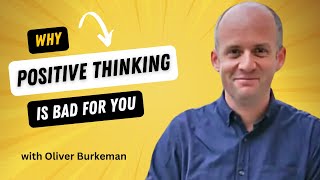
Oliver Burkeman argues that relentless positive thinking backfires, creating more anxiety and fragile resilience. He proposes Stoic practices instead: imagining worst-case scenarios, accepting what you can't control, and questioning whether your goals actually matter.
Chapters
Hello, welcome to nearandfar.com today we've got Oliver Berkman, who has just published a new book called the Antidote Happiness for People who Can't Stand Positive Thinking, which I read a few weeks ago and thoroughly enjoyed. And Oliver is joining us today. So we're gonna dive right in. Oliver is a journalist at the Guardian and writes a fantastic column that I read very frequently. And this new book, one of the things I loved about it is that it's so counterintuitive. So, Oliver, why don't we dive right in and tell us what's wrong with positive thinking?
Well, yes, that's the big question. I think. What's wrong? I think there are many things wrong with positive thinking. But I think that sort of particular interesting notion that I try to pursue in this book is the idea that there's something about trying too hard to attain happiness, success, any kind of target like that that we set for our lives. There's something about the trying too hard that sabotages the effort. So there is something about attempting to control your moods, attempting to set and pursue very, very specific and rigorous goals. All these different things that are kind of canonical aspects of self help culture and business motivational culture, I guess you would say, as well, where it's actually the trying too hard that causes the problem.
And tell us about that. So tell us about how the nuts and bolts of trying too hard can backfire.
Well, the analogy is this, and it's not just an analogy, but the analogy is this idea that the famous parlor game about, you know, where you challenge somebody to not think about a polar bear for a whole minute. When the mind tries to complete this task, which has been studied in very interesting ways by a Harvard psychologist called Daniel Wegner, when the mind tries to complete this task, it actually fails. And all you can do is think of polar bears. Because at the same time as trying to eliminate all these thoughts of polar bears, you also have to scan your mind constantly for thoughts of polar bears. And a similar thing happens with mood control. You know, if you try to only think happy thoughts, you have to be constantly on the lookout for negative thoughts, which actually just makes negativity come center stage. In the rest of the book. I try to look at lots of different other ways in which the same sort of pattern arises. So goal setting is an obvious one. I think by trying too hard to control a specific outcome and a specific variable in an organization or a life, that there's all sorts of risks of distorting and hurting lots of other variables you're not considering. I look at the idea that the quest for security and the feeling of security is actually quite misplaced because it's the fact that we look so hard for security that causes us to feel insecure. The fact that we avoid thinking about failure and seem allergic to sort of plunging into the experience of failure that seems to bring on more failure. So you see the pattern. It's not a single argument necessarily, but it's the same pattern arising in lots of different domains.
Yeah. So if we're not supposed to be positive, what do we do?
Well, there's a bit of a paradox here, as people often point out. What I suggest in the book is this family of approaches that I group under the heading of the negative part to happiness, which is this idea, this broad idea that it's by turning towards negative feelings, learning to accommodate them, sometimes even to deliberately cultivate them, but mainly just to be sort of more accepting of them. To learn when to not try to think positive, to learn when to sort of be able to be with uncertainty, to take action without knowing where your ultimate goal is. But these kind of negative skills are just as important as the positive ones of knowing exactly where you're going and stamping out sometimes much more appropriate. It's a little tricky because I want to be careful not to throw out the baby with the bathwater and say we've got this cult of rampant positivity, so let's throw it out and replace it with a cult of rampant negativity. That's not the point at all. The point is just that we need to find this balance that involves not being so desperate to get rid of negative thoughts and negative emotions.
Yeah. You cite some ancient wisdom from the Stoics and I wonder if you could share some modern techniques and the nuts and bolts of how to better deal with our day to day life.
Well, the Stoics have very interesting perspective on negativity. I think at the extreme, I think would be very hard to adopt Stoicism at its fullest today. But this idea that you can certainly learn a lot from it. This idea that. Well, firstly that it's our ideas and our beliefs about events that cause distress, anxiety, sadness rather than the events themselves. It's a very powerful insight because it makes you realize that, well, one of the conclusions that the Stoics draw from it is that sometimes you should actually look on the think about the worst case scenario rather than the best case and in planning something, not become fixated on trying to persuade yourself that it's all going to go well, but actually really think through how it could go badly, partly as an antidote to anxiety, because when you realize you could cope with things not turning out well, that's a very empowering situation to be in. One of the ways it's been sort of translated into the context of businesses and organizations is this idea that gets known as the principle of affordable lots. So, in other words, when you're trying to. When you're deciding whether to launch some new project or make some big change in life or whatever it might be, not to try and ask yourself, how certain am I that this is going to work out, but to ask yourself, could I afford it? If it didn't work out? And as long as you could, then that should be sufficient grounds for. For moving forward. So I think that general approach, especially in sort of creative work and maybe entrepreneurialism and things like this, that says, you know, the point is not to make sure this goes well, but to understand, you know, that it's going to be tolerable if it goes wrongly, is a very sort of grounding and resilient mindset.
Yeah. One of the chapters that you discuss around what you call a popular myth is around visualization, around visualizing success and how that's kind of a popular idea that we should see ourselves succeeding. And you say actually that that's. That's not always a good thing to do.
Right. I mean, it's a classic, classic dogma of the kind of movement that I'm seeking an alternative to here, this idea that if you really focus and visualize everything going perfectly, that will maximize your chances of it. There's quite a lot of evidence, at least in some circumstances, the opposite happens. So there's a fascinating study conducted at NYU where the researchers had some of their subjects rendered mildly dehydrated, thirsty, and then one subgroup of them was asked to visualize drinking a refreshing glass of water. And everybody's energy levels were measured using, I think, blood pressure as a proxy for energy levels. Anyway, what happens if you visualize drinking a refreshing glass of water is that your energy levels fall. It seems to be that you become less motivated to quench your thirst in reality because you've persuaded yourself that you've quenched it on an imaginary level. So that's one obvious hazard with imagining that everything has gone brilliantly. You sort of relax in a way that is not necessarily helpful to achievement. Secondly, I think it just reaffirms this whole idea, this whole culture of positivity, this idea that what we have to do is try to persuade ourselves that everything is going to go well. When, as I said before, I think it's often much more powerful to realize that you could cope if it didn't go well. Because every time you reassure yourself or a colleague or a friend or a child that things are going to turn out for the best, you're sort of reinforcing this other idea, which is it would be absolutely catastrophic if they didn't turn out for the best.
Yeah, yeah.
And most of the time in business that's just not the case. It's not. You know, having a business fail is not like there being nuclear war, you know, it just isn't the same.
Yeah, yeah. One of the stories I like that you point out in the book is around GM about how their goal setting, their kind of fervent big hairy goal setting actually backfired. Perhaps you could talk about that a little bit.
Right. This is a now quite famous story of their intention to win back 29% of the American automobile market when they were doing particularly badly around the turn of the millennium. And so they made a huge cult of this number 29. They had lapel pins made so that their senior executives could sort of wear the number 29 in public. And everybody, they all talked about this one number. They kind of branded themselves to some extent around this target. And it didn't work. But it wasn't just that it didn't work, but it was actually that it was in itself counterproductive. Once you have become totally obsessed with trying to make reality hit this one number, you do what they did, which is you spend money on sort of, you spend money in all the wrong ways. You spend it on discount schemes to get people to buy your cars that people don't like. Instead of investing in R and D to build new cars that people do like, you're trying to cut the prices of what you're selling, give anyone any discount at all, as long as it gets the sales. That there's all sorts of obvious ways in which that's going to distort the longer term mission of gm. And things didn't go so well, as we know in the auto industry. And that's just an example, it occurs in lots of other contexts, not just business. Government is another long time offender where a target becomes a very distorting thing to try to aim for much better in some cases to have a strong sense of direction without a precise target.
Yeah, no, it's fascinating. I think we see that with a lot of companies in Silicon Valley that have this process called okrs, objectives and key results. And everything is driven by these numbers and sometimes they lose sight of the big picture. I think we're seeing the same thing right now in China, for example, with these municipalities being driven along their growth targets without really considering, you know, is the growth sustainable and is the growth appropriate. It's all about these targets.
Right.
That's interesting.
Right. And the personal equivalent you could imagine it would be if somebody says, you know, I'm going to make a certain amount of money by a certain age, going to be a millionaire at 35, whatever it would be, and you know, they achieve that goal, but they've also ruined their health, alienated their spouse, their kids aren't talking to, you know, that kind of thing is not completely uncommon. And that's another example, you know, of you single out a variable, but then, you know, the naturalist John Muir said, in a lovely phrase that I'm going to quote wrongly here, misremember, but when you pull on any one thread in the world, you find that it's connected to everything else.
Yeah. You also have this chapter around the self and particularly the myth of the self, which you call a useful metaphor, but wrong. Perhaps you can dive into that a bit.
Yeah, I'm not sure. Wrong, but certainly illusory in some respect. There's this idea that is very long standing in Buddhist psychology and that is gaining a bit more traction I think in contemporary thinking today, that this notion that we have of the self, which is the sort of center of all of this that we're talking about, it's about improving the self, making the self feel happier, or having the self achieve more things. It's very difficult to go through life not thinking of yourself as the center of all the gravity of your life. But actually, as many philosophers have noted, when you actually try to pin it down, like, well, what is this thing? What is this fixed, solid thing that we allegedly have? It gets very slippery and much harder to sort of pinpoint the boundaries. Now you can go up in a very, very deep sort of spiritual direction with this to, you know, how can we put aside the notion of the self and sort of be at one with the cosmos? There's also a much more practical near term set of consequences which have to do with things like the idea of self esteem. Does it really make sense to be thinking about trying to think of ourselves as good rather than bad when actually paying close attention to ourselves? We just see that we have this constantly changing set of processes. We're completely different. One second to the next. Maybe it's not even a helpful frame to be thinking about a self that we try to improve, but about our individual actions as good or bad, you know, something like that. So there's lots of different implications on different levels from coming to see that this thing, the self, isn't quite as straightforward as we tend to imagine it is.
Fascinating, Fascinating. Well, thank you so much for your time. The book again, is the antidote happiness for people who can't stand positive thinking. Our guest is Oliver Berkman and check out the link below to Oliver's blog and highly recommend the book. Fantastic read. Oliver, thank you so much for joining us.
Thank you. It's been a pleasure.
More from Nir


Your Beliefs Are Sabotaging You (Here's Why) - Beyond Belief for Athletes with Nir Eyal







