Episode 30 - Kapil Gupta
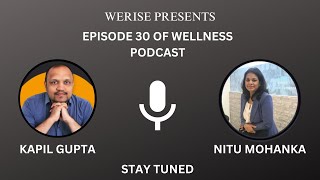
Kapil Gupta, a serial entrepreneur and mental-health activist, launched Soul Wellness, a mobile platform addressing what he calls a global mental-health pandemic. The app offers mood tracking, breathing exercises, anonymous journaling, and access to therapists, with enterprise programs that never share individual employee data with employers.
Chapters
Hello everyone and welcome to a new episode of Veerai's Wellness Podcast. Today we have Kapil Gupta with us. Kapil Gupta is a serial entrepreneur, author, mental health activist, digital marketing genius, and a foreign affairs expert. Today we will talk about his latest venture, Soul Wellness, which is completely on mental health and completely aligns with our podcast theme, wellness. So here is to Kapil Gupta. Thank you so much for coming today to our podcast.
Thank you so much, Neetu. My pleasure.
Great, superb. So, you know, tell us something about Soul Wellness. What is it about and what triggered you to start this wellness journey for your audience?
Sure. So let me first talk about what triggered. I don't have a— unlike most other people who, you know, were looking for a cab, they couldn't find a cab and they invented a cab company. I don't have a personal story around mental wellness. My reason for mental wellness really was I was seeing so many triggers go off. I've been seeing them for a very long time. But post-COVID, I mean, people's lives suddenly changed. Words like toxic environment, words like work-life balance, words like burnout. Stress. It became so common that I knew something needed to be done. It was starting to become, you know, a big problem. And that is where I have been thinking about doing something in healthcare for, you know, almost a decade. And it seemed like the perfect time, um, and, you know, uh, jumped into the era of mental wellness.
Yeah, so I mean, even if, uh, you know, 50% of world population starts working in this domain, still there is a lot of scope for the other 50% to take help from this other 50%. You know, I mean, it's, it's just like the next big pandemic.
Uh, it already is the probably the biggest pandemic. But there is a very interesting aspect that we noticed when we started off. See, people keep talking about the stigma that is associated with mental health, okay? And I always— I mean, I have probably asked this question off of 15,000 to 20,000 people over the last 1 year. And, you know, so what do you do about your mental wellness? Do you do something? The answer in 50% of the cases is I do nothing. In 40-45% of cases, the answer is I do something. I go for a run. I do some meditation. I do some yoga. I do some, you know, whatever, gym. I do some dance. I go travel. 40-45% say that. 2-5% people would necessarily say, hey, I have actually sought some kind of mental wellness help. Which has been either to go to a therapist or go to a counselor or, you know, do something, okay, something which is clinical now. And that is where I always get stuck. I mean, my, my way to look at mental health is everybody— I don't care who you are, which role you are in, how rich, poor, good, bad, you know, wherever you are in your life, whatever age group, whatever gender, wherever— more than 16 hours a day, in every action that you take, In every decision that you take, all that you are doing is mental health. Everything is governed by it. So while people keep talking about the stigma, but people don't necessarily think about mental wellness in, you know, in what I call as the 16-hour theory. Once we start, when once we start talking to people about that, is how Soul Wellness actually came into being. And so basically we say what people are missing is the vocabulary, the tools and the framework. So neither do they associate the vocabulary of mental health with what they do, nor do they have any active set of tools to utilize, and nor do they have a framework to get help, right?
Kapil, I think the whole topic of mental health has a very big stigma attached because, you know, it's like, you know, you have become someone insane and you need medical help, and that means that you are not a part of the society anymore. I think that is why there is a stigma, but people don't understand that even a small trigger which gives you stress could be something which is related to mental health. And if you don't address it at the time when it's coming to you, I mean, it, it just gets bigger and it retaliates in a bigger way. So it's not about having insane, but it's about everybody. If we don't know about how to manage our mind, it will culminate into that extreme case that happens, you know, for with people who has panic attacks, anxiety attacks, So it's, you know, your mental health is a priority. Everybody's mental health is a priority. If you're not taking care of it every day, then basically we are going backwards towards, you know, from our wellness. So that's my take on mental wellness. And how, tell me how Soul Wellness is solving this problem.
So what we have done is we say, I mean, as I was mentioning earlier, people lack the vocabulary, the tools, and the framework. We fulfill that requirement. Now, we fulfill that requirement in 3 key aspects. Number 1, we provide people with a mobile app platform. Through that mobile app platform, they get access to a set of tools. We say there are 3 kinds of tools that people require in mental health. One is what we call as self-help tools, tools that people can use with the environment. Uh, you know, it could be something like a mood tracker, it could be something like a screening and assessment, goal setting, it could be providing them with other tips and tricks to do. So Box breathing, for example. I mean, it's a fantastic tool to use in case of mental health. So simple, yet so effective.
Yeah.
The second part of what we talk about as tools is what is called as community support tools. So in our platform, there is an option for people to do journaling. They can do journaling as themselves, or they can do that anonymously. They can do that as they share public, share with their connections, or whatever, or they can do that as my diary. And third key difference in journaling for us is, you know, unlike an Instagram where people talk about life that they don't have, you know, clothes that they don't wear, people that they don't meet, food that they don't eat, places that they don't go to. Here, because it is mental wellness, people actually would associate and talk more about their life. The third part of tools is the expert interventions, which is where there will be clinical tools and, you know, as well as non-clinical experts, what we call it, called as Alive Therapy. So this is the first part, the mobile application. Then we provide a capability for organizations to create a wellness program for them, customized for them. In, in that case, the organizations are able to have specifics, you know, screening and assessment tests, specific support group, specific capability within the platform. And third, there is a full reporting dashboard that sits at the back end of this. Through which an individual or an organization are able to look at their mental wellness journey. And it really— just because there is so much going on in the application and people are using that as kind of the key, you know, the key platform or the key tool— there is this data essentially associates with people, associates with communities, and provides a whole bunch of information to customize as well as to provide interventions going forward.
Isn't it too probing for, you know, companies to get into so much personal details of their employees? Just asking.
Absolutely right. We absolutely do not provide any individual user data to the company or to the group. There is a huge privacy concern, and not just the privacy concern, you know, companies won't want to have that. I mean, between you and me, think about this: an organization getting to know that somebody is in high stress and, you know, maybe, uh, self-harm risk, they won't be able to do something, and there will be so much moral legal liability anyway. But that's not the only reason. We don't share any individual data with the organization. We provide the organization capability to get data at a team or a location level. So when an individual associates with an organization, they have the option to associate themselves with the specific teams that have been defined or the specific locations that have been defined. So an organization is able to see my sales team in Delhi versus my sales team in Mumbai, or they are able to see my sales team in, uh, in Delhi versus my production team in Delhi. So they are able to see data across locations and across, um, job roles.
Okay, I'm— you're doing so much under Soul Wellness, Kapil. This thing comes to my mind What is your vision? Why are you on this mission?
So my vision is for Soul Wellness to become the platform that everybody uses for their mental wellness. Unlike a lot of other competitors or, you know, other organizations, other companies in this space, I do not have the vision to get more people to use therapy or more people to use counseling. Counseling therapy may be one tool that of course may increase as we go forward, But my vision is for everybody to have what I call as a buddy with them, and that buddy is the Soul Wellness application at every point in their life, whenever, wherever, whatever they require. So Soul Wellness is essentially the mental wellness journey of an individual, personalized, customized, and encapsulated within a mobile platform.
Yeah, if it was there when I needed it, it would have been really helpful because when I was going through panic attacks, anxiety attacks, I kept looking and looking. Honestly, you know, those meditative apps, it does not help. I mean, because the more— if I don't know why I'm doing what I'm doing, it does not work for me. For me, I have to have that thing that, okay, this is why I'm doing this, and, uh, that keeps me consistent with doing that thing. Because mental health is something— if you have to like do a lot of rewiring in your brain, it takes a lot of effort. and it, it needs a community support. It needs people around you. You can talk to, you can, you know, write about, you can express yourself. I could not find any place honestly where I could go and do that at that time. But luckily I got good mentors. I go, you know, studied a lot. I have this habit of studying. I took a lot of courses. I found the right people at that time and that helped me a lot. So maybe, you know, Soul Wellness can solve that problem of finding the right people who can help you in your journey and basically get you back on track. So yeah, kudos to you for doing this.
Finding the right person or finding the right tool or finding the right support structure, that's, you know, that's what it is all about. That's really what we are looking at replicating and solving that problem with the technology intervention, not necessarily with the people intervention only, but really getting technology to do that, right?
Support. And Kapil, I mean, there is a huge need, not just for in the corporate sector. I'm telling you, there's a huge need for founders as well, because nobody's talking about founders' wellness, but they go through a lot. They go through so much. They have to manage so much, not just money. It's about managing themselves, their families, their employees. They're responsible for so many things, and it's bound to happen, you know, that they will lose it. And at that time they need support. And I'm really dedicated myself for, you know, founder's wellness. And that is why I talk about it so much because I have been through that space. And I understand the need for, you know, support and wellness, people talking about it around me. I mean, even if somebody talks about it, I get so excited that yes, somebody's talking about it finally, you know, founder's wellness is that important now. And I think you can start focusing on that as well, you know, and maybe create something specifically for founders because honestly, they need this.
So on this podcast, you know, let me say, if you are able to structure together a bunch of founders that require support, we will absolutely be willing to run a program for them, you know, do a pilot with them, provide them with access to the platform, provide them with access to a bunch of tools. And then see what kind of support do they require further and kind of create that for them.
Absolutely great idea, Kapil. I think I might have some inputs from my experiences and people. I speak to so many people, coaches, I speak to so many mentors. I'm sure we would be able to come up with something around this.
Yeah, so let me give two interventions on this. See, one, for a very long time, my WhatsApp status used to be, it's lonely at the top, choose your climb carefully. And, you know, that was really a manifestation of, hey, I'm a founder, I'm the CEO of the company. When I need support, who do I go to? Second is, you know, what I'm starting to see— let me give you an example. I went to this corporate sometime back, and there were some 50-odd people that were in, in the audience. And, you know, nearly 20 of them after that session came up and wanted to talk further about mental health, what they were facing, and all that. And within that, there were 4 women that came to me and said, hey, why are you talking to these people? You should be talking to us. We are the HR department of this company. As a paachh logon ki mental health toros hamdi karte hain. We take care of mental health of 5 of these people every day. And what I told one of the girls is, I said, listen, first of all, you definitely need support for your mental health.
I was about to say that, that that person needs a lot of support. So it's not just 10, 10 plus 5, you got 15, right?
But also along with that, what I told her is, hey, while that is true and I'm more than willing to create a program or create something that, you know, helps you, but please don't be the advisor counselor for these people. You don't have the relevant training and you will someday end up hurting someone.
Exactly.
And I think even in the advisory coaching network, this is something that I want to be, you know, very conscious about. It's— I, I don't do counseling myself. I'm not trained to. I don't— I mean, while I may be very passionate about, uh, and while I may be a mental health activist, I don't have the academic professional training. So sometimes it is important to push people into that sort of a structured clinical program instead of doing that with them. So in that sense, what, what we want people to do is go through in the Wellness app. Wherever you can, through self-help tools or through community support tools, seek help. Absolutely do that. And wherever you need any professional support, go to a mental health professional for that help.
Absolutely. And, and, you know, because I'm in this personal development domain, a lot of people come to me for counseling. So I'm very particular about now not taking anyone who's like struggling big time because, and because I have chosen personal growth as, you know, my space. So I like to work on that. I like to work on mindset building. I don't want to play with someone's emotions who is right now in need of something else, a clinical intervention. So that's, that's not the space, you know, for us who are not academically qualified. I, although I have done cognitive behavior therapy, hypnotherapy, psychotherapy, I've learned all this, I understand the core subjects, but again, then there are a lot of interventions only a trained doctor would know about, and, you know, those people should seek help from them. But yes, if you're looking for personal growth, maybe those people who have actually been through the process, been through the journey, they are the right people for you to reach out to if you're actually looking at a lot of personal growth and, you know, business growth. So that's where, you know, we come in. Through VRI's accelerator program also. Our VRI accelerator program is right now running and we have great feedbacks. People have taken— like, we have used CBT over there, we have used neuroscience, neuro-linguistic programming, and people are finding value in it because they haven't heard about something like this ever before. And integrating that with business, it is something which is like mind-blowing for them that, okay, this is why I was not able to take decisions I think I'm free of those mental blocks now and I can go ahead and take those decisions. So I think that gives me a huge sense of purpose.
There is such a huge, you know, role that it can play. So let me give you an example. I'm currently working with, you know, some senior ADHD experts in Australia, and the objective that we are running with is, can we use ADHD principles to create a corporate training program for increased productivity, increased efficiency, increased balancing, and, you know, for people to get support using the ADST principles in normal product, in normal, you know, corporate scenarios?
Right, it's absolutely doable. I mean, I have recently, you know, learned about a concept called contrast analysis technique. You know, I don't know if you have heard about it or not. But that is something which can actually change your memories. So the brain receptors which received your event memories and distorted it, you can basically replace it with a better memory. So, you know, by changing the visual, auditory, and the feelings of that emotional outcome at that time, you can actually change and replace memory. So I think these are the techniques which is very, very powerful, and I've actually seen it happening in front of myself, how people feel different after, you know, they can get rid of that old bad memory from their mind. I mean, it's mind-blowing. I just love the concept so much, I thought I'll have to talk about it here.
Yeah, yep. There are so many misconceptions that exist around mental health. You know, if we are able to provide the right support structure for people, you know, it can work so powerfully. And while you talked about the founders, the third area that we are really looking at focus on is schools and educational institutes. I mean, look at Kota, I mean, 27, 28 suicides in 9 months of the year.
I think it's parents who need more counseling than the children, because I mean, why would a child have to do something like that?
See, while you may be right, and I'm not— I won't take that away— parents absolutely need more counseling and more, you know, more thinking on their part in what they are putting their kids through. But in the current reality, why not empower these kids with more mental wellness tools? See, the challenge is a student that is studying there doesn't have an outlet. Everybody around them is their competitor. The support structure of the teachers and the parents is only meant to push them. I mean, their normal concerns, their, I mean, their anxiety, their panic, their stress is considered, you know, detrimental to their progress, and it is just cut down. In that kind of an environment, I actually want to go in and provide everybody in Kota, for example, with the Soul Wellness platform and say, hey, 5 minutes in a day, 3 minutes in a day, use the platform to be able to get mental support for yourself, to be able to keep yourself fresh. And, you know, let me give you a, you know, a metric that I usually give to schools and colleges. Assuming you are a student and you have to increase your marks in a specific subject by 5%, and you have to spend X number of hours to increase the marks by 5%, spend that X number of hours on your mental health, and you will improve your marks in every subject by 5%.
Yes, absolutely.
Not just that, spend those X number of hours in mental health and you will improve your performance in all areas of your life by 5%.
Absolutely.
We are currently talking to, uh, you know, groups that are going for sports trainings. We are currently talking to groups that are going and doing variety of different kinds of things. I mean, we want to run programs for media and lawyers and you know, doctors, you know, and police officers, and, you know, other structured, organized groups. Whoever is able to get better access to mental health tools— see, please note, I am not talking about mental illness. That's something we deal with, but that's a slightly different subject. Mental health and mental wellness— if you are able to get any sort of help, it completely alters the kind of role, the kind of performance, the kind of efficiency with which you would be able to work.
Absolutely, Kapil. And I will add to that with my experience that when I was in depression, I was actually, you know, diagnosed with clinical depression, my entire business fell flat. I wasn't able to do anything at that time. I had to take a complete break for 6 months from everything that I was doing and completely focus on myself. And when I did that and when I came back in course. I mean, I'm doing so much better than before because now I know how to take care of my mental, you know, health. And that's given me so much growth. I mean, I am starting, you know, product after product, service after service, because I know that, you know, I can handle it now. Whatever comes my way, I know I can handle it now because I know how to handle myself, you know, mentally and physically. And that, that actually contributes to the growth, right? So That's how important it is to take care of not just your physical health, but the mental health as well.
Yeah, the challenge is there are very few people like you who actually recover from depression to be more powerful. Most people either get stuck in that area only, or even if they recover, they are never able to exceed their performance levels.
I think with the right guidance and right support system around you, you can do that. I wouldn't say that I did it alone. I'm eternally grateful for those people who have actually written those books that I read, who created those courses and trainings that I went through, and who are giving those live trainings, you know, that I can sit and watch and, you know, just be a sponge and absorb from them. So that's what has been a real help for me, honestly.
I mean, that's exactly what I mean, being able to provide these, the support and the tools and, you know, the ability you were able to get with the structure around you. Is exactly what I think everybody should have access to.
Yes, absolutely. And one last question, Kapil, how do you take care of your mental health?
Well, first of all, let me say, and this is a question I get asked very frequently, okay? When I started mental health, my friends jokingly used to say, but you don't have, you have never seen a mental health issue, how will you be successful in that? So let me give you a couple of secrets. See, first of all, my, uh, the 16-hour theory that I talked about— every action and every decision is mental health— is something that I have lived by for, you know, decades now. So for me, that entire structure, it's so engrossed in my overall thought process that I'm able to absorb a lot of stress. I'm able to take care of a lot of, you know, what life throws at me just being that way.
Yeah, because you have that kind of neural connections in your brain that you can handle it.
Exactly. I don't get, you know, flustered with stress most of the times. Second, I have created a structure where I am very clear on what I want to achieve and where I want to be. Okay, and that's not money. Most people's challenge in life starts with money.
They don't understand what is money. That is the problem. Movies have completely distorted our understanding of money.
Yeah, more than that, how much money do you really need? I mean, I'm very clear, and everybody around me knows that I don't want to earn enough money that my 7 generations don't have to work. I want to earn enough money that I'm able to give a kickstart to my daughter's career.
Outside of that, financially free yourself.
Outside of that, I absolutely don't want to give them enough money that their generations don't have to work. I mean, what's the fun of life? What, what will they do with their living? And I have— I mean, I've brought up my daughters that way. They expect me to give them a good head start in their career, and that's it. So I don't have a money problem. Even now, at the age of 46, I live in a rented house, and I'm extremely happy, very satisfied with it.
Money is only— I just took this, you know, this one session yesterday on this. Money is only an exchange of value. That's it. It's nothing but an exchange of value. And you only need money when you need to buy a value in exchange of it. If you are giving value, you will get money. You need value, you need to give money. So people don't understand money, and that is a very big challenge because they think that it is something that is very scarce and we need to, you know, just lock it under some kind of locker and put it under some sheets. But no, it is currency and it needs to be in flow. Yep.
And the third thing that I do, I am very clear, I am always there for whoever requires support, but I have this theme that I call as passionately unattached. So wherever, whatever I do, whether it is a company that I run, whether it is a friend that I have, whether it's a relationship I am in, or whether it is I'm helping somebody, I am always passionately unattached. I will do all of that with full passion, but I'm very unattached in the end result of it. Sometimes jokingly I say this is like the Gita version of 'Karam Kar Falti Chinta Mat Kar.' Because you have cracked it, actually.
You have cracked it. You have cracked the essence of life. And you are just following that, and maybe that is why you are so sorted.
And so in that sense, I don't have— so these are the 3 secrets. If I have to tell anybody what to do about their mental health, I will tell them, I can't help you. Because see, one challenge, and this is why people keep struggling with mental health, mental health is very irrational, it is very unreasonable. What is your mental health will never be somebody else's mental health. So when you were going through depression, or when you were going through, you know, your clinical anxiety stage or whatever, nobody around you would be able to understand why you have that problem. People will keep saying, oh, you have this in life, how can you have depression? You have this in life, you have this. It's very irrational. It's objective only for you. So you can only get help for you. You can't give advice to anybody in, you know, what will work for them. People need to discover it themselves. And that is why I keep saying mental wellness should only— I mean, if you have to get clinical help, go to a clinician. They are taught in the science and the art and the, you know, process of how you will get help for yourself, discover it by yourself. So you can't be guided toward this. You can't be brought to a destination. You can be guided to think in an objective manner to get to the destination.
True, true. Absolutely. Thank you so much for coming to the podcast, Kapil, and sharing your insight. This was really helpful. I'm sure the audience will have a lot of takeaways from this podcast. And people who still think mental health is a stigma, please think again because it's not. It's here. It's now, and it's the time for you to take advantage of platforms like Soul Wellness. And there are so many people, and just start seeking help.
And there is a book that I'm currently authoring on this subject, mental health. It's called In My Head, which should come out in the next 3 months. So when it comes out, do read that. It will help debunk a lot of challenges that people face with mental health.
Wow, superb! Looking forward to that, Kapil. Thank you so much.
Thank you.
Thank you so much for having me. Thank you so much for coming today.
Bye.
More from Nitu


Eliminate Decision Making Fatigue. #growthmindset #hacks #positivevibes #life #motivation


I left my 3-year-old son in a store and I don't regret it...#corporate #parenting

The Box technique to control anger. #hacks #growthmindset #angermanagement #techniques #life

Plan your Sleep Cycle. #hacks #growthmindset #planning #shorts #sleep #lifecoach #positivevibes


How to get rid of Negative Thoughts. #growthmindset #negative #thoughts #positivevibes #hacks

Easy hack to track water intake. #hacks #growthmindset #positivevibes #techniques #lifeisbutadream

I earned 30 LPA at Deloitte, PwC, and Accenture but I still never got promoted. #growthmindset