Episode 42 - Anurag Singal
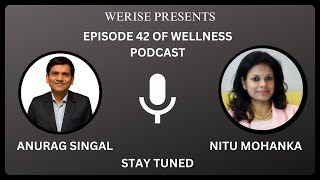
In this episode of Veerai's Wellness Podcast, host Veerai (Speaker A) interviews Anurag Singhal, a chartered accountant turned entrepreneur, mentor to over 10,000 professionals, and two‑time TEDx speaker. Anurag explains why he left a 14‑year corporate career—citing limited recognition, blame‑sharing in large firms, and a desire for personal accountability—to launch his own ventures, the CA Job Portal and Betafin Partners. He describes his mentorship approach, emphasizing career clarity through neutral, goal‑oriented conversations and helping mentees see beyond narrow professional identities. Anurag shares insights from his TEDx talks, which focus on staying in Kolkata despite a lucrative offer elsewhere and the reality versus hype of entrepreneurship. The conversation shifts to personal wellness: Anurag recounts battling thyroid issues, asthma, and stress, and how he now dedicates two hours daily to yoga, meditation, and family time, learning to set boundaries and prioritize self‑care. Finally, he offers a philosophical takeaway: each individual's journey is unique, and comparing oneself to others is misleading; success must be viewed in the context of personal circumstances and accumulated karma. The episode blends career advice, entrepreneurial realities, health management, and a broader life philosophy aimed at inspiring listeners to pursue purposeful, balanced lives.
Chapters
Hello everyone and welcome to a new episode of Veerai's Wellness Podcast. Today we have Anurag Singhal with us who is associated with two different businesses. One is the first CA portal for chartered accountants in India, which is CA Job Portal, and she's also— he is also associated with Betafin Partners, which is a host of financial services for corporates in India. He has mentored more than 10,000 people. He is a mentor to professionals, students, and entrepreneurs. And I mean, I cannot even imagine mentoring 10,000 people, but yes, Anurag has done that. So welcome, Anurag, to our podcast today. And so humbled and happy to have you today with us.
So these are a mix. 10,000 is a mix of group as well as one-to-one. So one-to-one would, I would imagine, would be like maybe 1,000. Such sessions over the last, uh, so many years— 15 minutes, 30 minutes, 1 hour kind of sessions. Some of these mentees would have been, uh, taking sessions over a period of 2 months where we discuss life in greater depth. And a lot of them are like on a group where you go and mentor around careers, give them career clarity. So there have been people, for example, who've done MBA after CA because they attended those sessions and realized where the gap is in terms of branding and perception.
Bottom line is you have mentored 10,000 people, so I cannot even imagine and fathom that number yet.
In a group setting, you will be able to. I mean, one-to-one, yes, for sure. It will be difficult in a lifetime to achieve that number.
Yes. And you're also a TEDx speaker. I forgot to mention that. How about that?
Yeah. Been a couple of times.
Yes. A lot of credentials to you, Anurag. And of course, you have a very good social media following. I have been following you on LinkedIn. I think that's where we connected as well. And it has been a lovely journey speaking to you for, I think, almost 4-5 years now. And enriching, of course. And you always add a lot of value whenever we talk, so thank you for that. And also, in your 20 years of experience till date now, Anurag, you have worked 14 years in corporates and then you jumped into this whole entrepreneurship game, right? I would want to know what was it that made you move from— because a lot of your mentees and people who are watching this podcast would want to know What was that shift in mind that made you jump from being a corporate employee to entrepreneur? Please tell us about that.
So I had 3 years of articleship, around 14 and a half years in corporate as an employee, and then since 2, 2 and a half years running my own firm. I think the transition was necessitated by the fact that How do I put it? So you can simply say that, okay, I was— so that would also be a thought. But yes, what I kind of thought was that in a typical corporate world, for specialized skills such as financial modeling and advanced level of analysis, etc., In an individual capacity, you might be an outperformer, but you tend to then kind of cross-subsidize the larger cohort. And in an individual capacity, once you are running a firm, even if it is the so-called freelancer, looked at very in a very different connotation in India, you tend to get full reward for whatever you've done, the bouquets as well as the brickbats. So in a larger corporate setting, I think that even the brickbats gets refused because then the boss takes the blame and the boss's boss takes the blame. But then against that, the entire hierarchy also takes away the cake, different chunks of the cake. And at the end of the year, maybe if the appraisal cycles are not on your side and you're like, promotion nahi hua, paise nahi bade, picture hague. So I thought, let me jump on to entrepreneurship. At least I can blame myself instead of blaming the system, blaming the boss. System, I think that blame game, I've done a lot maybe, uh, and we all do that, right? And then I also, uh, had that locational disadvantage in job. That I have chosen to build a career from the city of Calcutta. So that has its own challenge in terms of the demand-supply. And you have also been from Calcutta, so you know, uh, how difficult it is. I mean, there are good number of jobs in Calcutta, but then the attrition there is very limited because once you settle at a very good CXO level, then generally don't leave, because of which there's a lot of demand-supply mismatch. So yeah, those are the various triggers. And I think by the time I jumped on to see my own entrepreneurial venture, CA Job Portal had already found its feet because it's now like 10 years into the system. Me along with my wife Sonia, uh, we've been running this. So as much there was not a crisis on the existence front that what exactly will I do, but yeah, God has been kind even on the firm front. We have got some clientele now And yeah, that's how the journey—
so it was a bad appraisal that was the trigger, if I can say so, because a lot of people are getting triggered now.
I would say that, you know, uh, as you have identified in the course of my, uh, sessions also that I have done, so I have a need for validation or recognition more than that numerical number of CPC. And then when that does not come, uh, and you feel kind of, yeah, I have slogged it out, I have So the kind of financial models, probably for example, which I prepared in job, they were of a very different level. But then, uh, in an individual capacity it is my work, and in the corporate setting the company has done it, the department has done it, and you are kind of lost, and you are there for taking the blame when there is a reference error or things go wrong. Yeah, model Anurag ne banaya tha, but otherwise it's the whole system who has done it. So yeah, I wanted to get rid of that blame allocation metrics and credit allocation metrics, as they call.
Yeah, so about 14, 14 and a half years of handling this pressure was, I think, enough finally for you to take that plunge into entrepreneurship.
I can also say that when I took up my first job at Tata Steel, like you also had started, I didn't know financial modeling and this valuation stuff at all, and I actually wanted to get into corporate accounts. It was my boss who taught me the entire nitty-gritties of this. He said, okay, I'm going to patiently invest in you for 6 months. So I mean, that large exposure, those settings, meetings with bank, credit rating agencies, etc., are also possible only in a large corporate setting. I mean, in individual capacity, then you end up being that one of those 100 valuers who just gets work. So I think it's good for people to start off there. But you need to find your mojo and branch off. To my mind, that should be the good strategy, right?
So you are also, you know, advising a lot of people on career clarity. How does that start? I mean, because of course you have so many years of experience, so how does this whole thing work of getting career clarity from a coach like you or a mentor like you?
It's very interesting. I mean, I recently did a mentoring session with a youngster. He said, I want to be a supply chain finance professional. I said, when you were born, your mother never told that she wants her son to be a supply chain finance professional. What is the end goal? It will be money, it will be a house of your own, it will be proper power, prestige. He said yes. I said, then therefore please get over this fact that you are born for supply chain finance. I mean, that might be an intermediate passage to the end goal, but that is not the end goal. And that kind of gives a lot of clarity to people.
Why I'm doing what I'm doing.
Ah, and for, for like a lot of conversations that I also do with my mentors, for example, for me the trigger is not so much money as it is recognition or validation, which again I need to work on that because it's very risky to depend on others for validation. But for me the end goal is not a Europe trip or having a Mercedes car. I want impact. I want that, wow, sir, you taught well, you've done a good job, you helped us get a job, or whatever. Uh, so yeah, that clarity has to come, and I think that clarity comes when you discuss it objectively with someone who looks at it from a very, very, uh, neutral, dispassionate perspective, like I do with you often.
Yeah, and I must say that this is the growth mindset that we keep talking about, right? That despite so many years of experience, despite doing so much, earning so much, you are still open to learning. And I think if we have this kind of mindset, Anurag, that's a— then you are actually eligible to be a mentor to someone else as well, because you are yourself like at ground zero all the time, ready to learn. So I mean, you are continuously improving yourself, and then you are able to help someone else as well from that, uh, learnings for yourself. So like, really hats off to you for being able to be that open-minded to, you know, work from ground up and, uh, working on yourself, introspecting, working out on your inner self. I mean, not many people are doing it, honestly. Not many people are doing it. So congratulations on that, Anurag. Also, uh, tell us a little about your TEDx talk that you have, because I have been fascinated by, you know, TEDx, and I saw that, okay, you are also at TEDx, because the first time when I spoke to you, I was like Okay, I'm speaking to a TEDx speaker today. So tell us about that.
TEDx talk, I think I've given 2 TEDx talks now. So one TEDx talk was around my decision to stay back in Calcutta and try to build a career here. And what went into in terms of the whole fear of missing out, because I had come to your city, Gurgaon, had got a ₹10,61,000 job in October 2008. And then in a couple of months, I quit that and I came back to Calcutta at half the salary. Most people told me that I am a moron and I'm just— it's the end of my career. And which maybe they were right in a way, but I, I, uh, my TEDx talk was about that whole decision around that transition. And then what I did maybe to make good whatever was the deficit in terms of money, in terms of recognition, validation. Uh, the other TEDx talk recently that I delivered in Bangalore was around the whole transition from the job world to an entrepreneurship world, where on a Monday morning you don't end up cursing your boss, he's overloaded me with work, but rather you are worried that do I have enough work to give to my team members and, uh, how do I really plan this whole week. So that is a complete shift of priorities in India, getting work done, getting it executed from team, those are very difficult challenges. So I had spoken around that. Typical hypocrisy around entrepreneurship. Wow, entrepreneurship, yes, yes, yes. For the purpose of marketing, And, uh, reality vis-à-vis the larger jingoism around entrepreneurship that we will tell on social media. So I spoke around that.
I think you speak about a lot of pain points people are, you know, facing, and that is why you have so much engagement from people, because they are actually resonating with you that, okay, I'm also going through that.
Yeah, yeah, absolutely, absolutely.
So going through that, and okay, uh, Anurag, but tell us, how do you manage yourself with, uh, you know, so much of, uh, work? You, you have a family also, right? And there is just so much to, uh, manage, two different businesses you are associated with. How do you manage your own self? How do you take care of your own wellness?
I think I have not, uh, lived up to the expectations there on that front, uh, so, uh, taking care of my own self Yeah, but right now when the self eventually retaliated in form of manifestation of a lot of diseases like respiratory issues and thyroid and all, so now I kind of, let's say, spend 2 hours a day on yoga and walking, etc., do meditation. Uh, I have taken a point now to spend time with the kids. So this Monday I went to Nikko Park the whole day. Doing that.
My childhood memories from Nikopark are like really, really cute.
But I did it on a Monday, okay? So most people will say, because my niece had come from Bombay, so I did that on a Monday. Uh, so we have been learning to do that, uh, because as, uh, you will also realize, there's no real upper circuit to how much work you can do or you want to acquire, but somewhere you have to draw the line. And something which I am also learning from you, that you do not pick up every phone call at that very moment. You can have, say, okay, I will give you a call back when I am free, and I have a calendar for the day. You can't just barge into my calendar. So those are little, little ways of manifesting that, okay, I value myself, take care of myself. So That helps.
Wow. And people look up to you, Sanurag. I mean, there's so many people who look up to you. If you are taking care of your wellness and you are talking about it, I'm sure the message goes out widely that, you know, even, you know, Anurag has been through, you know, moments of lows and he is taking care of himself now. He is taking care of his wellness. So if you are talking about this, I'm sure a lot of people get inspired about taking care of their wellness. So this is actually the whole idea of this podcast, that we could inspire people about thinking about themselves, thinking about why it is important. Because if you are well, you take good care of everybody around you, and everybody gets like, you know, lifted, uh, with your energy. So yeah, I mean, I'm really glad that you have started taking care of your wellness, because as finance professionals, we are not trained to do that. We are always supposed to be serving the client or the company, right?
The thing what happens is that then, let's say you have internal bitterness around certain things, that gets manifested in your interaction with others. So consciously, unconsciously, the vibes that you give, uh, will carry that in. In fact, that is why, you know, I've been working with you also on trying to work around that pent-up emotions which have So now the doctor tells me, so there's an allopathic doctor who tells that thyroid issues, so low beta-thyroxine, so that's called management of your disease.
So there is no cure, it's not a cure.
And here's my teacher who says, suppressed feelings, respect, validation. And I feel that the latter part is actually important, that those feelings which have been maybe suppressed or not been able to manifest the way they wanted, that is actually the cure, not thyroxine.
Yes, yes. And you are actually working on it, and it's totally reversible. Thyroid is totally reversible because I have been able to reverse it for myself. So anybody and everybody can do that, but if, you know, you have to be open to the idea because the doctors shut down the idea saying that Okay, I shouldn't be saying so much about the doctors, uh, saying that. Maybe they have studied that so deeply and that is why they can say.
In case of breathing issues, uh, I went to the best pulmonologist in Calcutta. He said, boss, you have got mild to severe asthma, so here is this puff. That was September, and I then went to my yoga teacher and told, can I do something about it? Because I just don't want these puffs. And also to my homeopathic doctor, who actually works at the element level. Uh, believe you me, I have been in Delhi in that nightmarish of a situation pre-Devali where you have the whole, uh, smog in the air, but I was able to survive without puffs. Uh, so, you know, working on those feelings, working on the physical aspect, you know, for example, the chest, it over the years, it— the posture has become like this, constricted. Instead of that, the chest should be like this, like a king, when the king sits. So those are the things which I think my yoga teacher has taught me a lot, which I am trying to work on. But yeah, I realized that whatever it is This is all management of symptoms. Management.
So this realization is also very important, Anurag. If people like you and me, we have come to this realization, it is our responsibility and duty also to spread this word that, uh, we do not need to manage our symptoms. We can actually cure them, and we can live a more happy, healthy, abundant life.
And you can then, as we discussed, that they achieve the purpose of your life. The purpose of your life may not necessarily just be to acquire materialistic wealth. The impact that your life or your words can create on others.
Absolutely, absolutely. And it is, it is our responsibility and duty to talk about these things so that we can actually reach out to those people who are looking for hope. And if with so many years of experience, so many years of you know, going through the hustle, doing the things that we do, uh, the kind of experiences we get through and the kind of learnings we have, it is our duty to pass it on to our next generation, to pass it on to people who are looking up to us for inspiration, for hope. So that is why this whole podcast exists, right? So that we can spread out that message. You also have one podcast that you talk about at, and it's not just about entrepreneurship or profession, it's about anything and everything that people can learn from us who have been through those experiences, right?
There been student who said, sir, shifting to Commerce from Science after Class 12, 5 years later now I'm a chartered accountant. So there you feel that, wow. So yesterday we placed a youngster, his sister also we had placed 3 years ago. Then when this guy became a chartered accountant, we placed him also. It is like we become a family consultant, like a doctor. So if you go to the house, you get all the mangoes and the grapes and everything.
Yes, so being that guide, being that mentor, being that someone Who is a support system to a family? Why not? Why not? And you are doing it so well with your endeavors, your efforts, uh, that I think we need more of people like you who are doing that kind of work. I mean, people are struggling with the right jobs, with the right career clarity. If you can come in at that place and, you know, fill that gap, I mean, nothing like it. Right. So Anurag, tell me one thing. With all your experiences over so many years, what is that one piece of knowledge that you would want to share with the audience today that would give them some kind of, uh, you know, hope, insight, or something that would make their life better? What is that one thing that you would like to share?
I think my entire life I have been trapped by this whole human tendency to compare your journey with someone else's on a totality basis, not understanding the individual nuances. So I think one learning which I have got is that your journey, as it in Bhagavad Gita, it will be called as your prarabdha or your sanchit karma, which have been accumulated in the past. And those are a lot of things that you get are very naturally coming to you, and a lot of things you struggle, but they don't come to you. So I think one critical learning for me has been to help people understand that their journey will be very unique for various reasons. So someone will say, okay, he succeeded more than me. I said, fine, but he lost his father at the age of 4. Would you like that? I said, then in totality, you need to look at it, right? You're just looking at one aspect of the whole story, that he has got success, but what about that other part? Would you want to exchange shoes with that? He said no, and I want to keep working to accumulate better, and I think that should be my one learning. I mean, given I have also achieved some level of so-called success, I can tell you that some things came very naturally to me. I didn't even work very hard for them. And I actually aspired for a lot of things. They didn't come to me. Toh hai, kuch na kuch aapka hai. Kahani backend me chalta hai, algorithm bhi.
Yes, I think that's very profound. And anybody who's watching this, please take this piece of advice. That every journey is different. Don't compare yours to anyone else in this world. You are unique, your journey is unique, and your experiences are unique. Make the best out of it, right? With that, uh, we bring this to a close. Thank you, Anurag, so much for coming and sharing your insight with us. I hope there's a lot to learn from this podcast to people who are watching, and we hope that it adds value to their life. Thank you so much, Anurag.
More from Nitu


Eliminate Decision Making Fatigue. #growthmindset #hacks #positivevibes #life #motivation


I left my 3-year-old son in a store and I don't regret it...#corporate #parenting

The Box technique to control anger. #hacks #growthmindset #angermanagement #techniques #life

Plan your Sleep Cycle. #hacks #growthmindset #planning #shorts #sleep #lifecoach #positivevibes


How to get rid of Negative Thoughts. #growthmindset #negative #thoughts #positivevibes #hacks

Easy hack to track water intake. #hacks #growthmindset #positivevibes #techniques #lifeisbutadream

I earned 30 LPA at Deloitte, PwC, and Accenture but I still never got promoted. #growthmindset