Energy Over Time: Maximizing Your Impact with Joseph Frost #TimeManagement #EnergyManagement
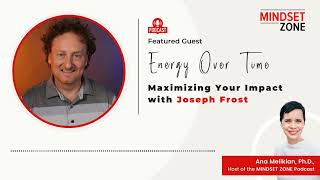
Joseph Frost argues energy per hour, not time, is the real productivity metric. After a double cancer diagnosis, he developed the Energy Leadership framework distinguishing seven levels from victim states to absolute passion. Daily journaling and recognizing personal triggers help align your energy with your core values.
Chapters
If you can bring a higher level of energy to it, you'll be more productive. It's not a dollar per hour, but it's energy per hour. How do we get more energy out of each hour? That's the ultimate measure of productivity, I think, for most of us moving forward. Expanding possibilities. The mindset zone.
I'm your host, Annemarie Kienle. I'm here to support you increase your impact while preventing burnout. The Mindset Zone is a place to pause, increase your self-awareness, and embrace the experimentation mindset. Find more resources, including information about the Mindset Zone book and audiobook, at mindset.zone. Yes, instead of.com is.zone.
Today, our special guest is Joseph Frost. Joe Frost is a global speaker, thinker, and entrepreneur leading the fractional and decentralized leadership model into the future of work. Welcome to the Mindset Zone, Joe.
Ah, thanks for having me, Ana. This is terrific. I'm excited to be here.
And I'm really looking forward to this conversation because I love your perspective about energy management instead of time management. So let's start there. Speak a little bit about that.
Yeah, I think it's really interesting. As humans, we've created this constraint called time. And in general, it serves us pretty well, but it is a linear constraint. Is a lot of times we're thinking about what's next, what's the next thing on our schedule, what's the next time event that we have coming up, whether it be an hour, a day, a week, a month ahead. What it also does is it really creates some limiting behavior and limiting opportunities. And it's most real when you realize that you might not have as much time as you think you do. So I personally, I've been diagnosed with cancer twice.. And both of those times, time stood still and it really made me think about what's important, what is really life about? And this idea of time, I started to question it. Even things as much of productivity, what's my dollar per hour? How much money am I going to make in this amount of time? And I changed my thinking around managing time to managing my energy because energy is here in the present., and it's always with us, and we have such control over it. And if we think about energy as the substitute for time in our day-to-day lives, in our personal lives, our family lives, in our business especially, it allows us to transcend this linear constraint of time into something I feel is much more valuable, which is energy.
And what you say, I'm also a cancer survivor, and cancer diagnosis, when we heard that word, it's really, how do you say, put everything into perspective. So I can understand what you are saying from a personal perspective and make us that reevaluation of what is important. And I love the reframing that you are doing because it creates a lot of limiting beliefs, everything around time management, productivity, And just that shift into, okay, we can manage our energy at the present moment and what we are going to leverage that energy to create the bigger impact can make all the difference. So kudos to you and thank you for articulating this in a so helpful way. And you take this a step further because you also speak about the different levels of energy leadership. So, okay, there is this refocus. Instead of thinking about the time management, let's think about energy management. But now, how do you take this to the next level into energy leadership?
Yeah, I think as I was starting to dive into this energy management notion, I came across Bruce Schneider. He's an author, and he wrote a book called Energy Leadership. And in that book, he presents 7 levels of energy. And I I like to simplify it. There's really two main types of energy. There's catabolic and anabolic. And catabolic is a destructive energy. We have all met or been in situations where things are going fun, exciting. You're in a room with people and all of a sudden somebody walks in or somebody says something and the whole energy level just goes down and the whole, and it spreads like rapid fire. That's catabolic energy in action. And then there's anabolic energy, which is the kind of energy of, of growth and creativity and inspiration. And we've all been around people that carry and bring with them a lot of that anabolic energy. And we have both types within ourselves and we have the ability to go in and out of both types if we understand how to do that. And neither is good or bad. That's something I learned. It just is. And so being understanding of the type of energy that you want to have and channel with you at any given moment and build, be able to rise it and lower it as needed is a really good skill set to learn. I learned all this from a coach, Natalia Berdychiyn. She's a coach and she kind of introduced me to these concepts. And it was when she said, what do you want to do with your business, Joe? What are your goals? And I started talking about, well, we want to sell at this revenue level in 3 to 5 years and, and she started to challenge me about like, why is that important? And what is it you're going to feel like when you're there? What are you going to get from that sale? And when I started talking more about the feelings I wanted and the things that I would do after I sold, she asked the question, well, why can't you just have those feelings now and do those things today? And that was a really big shift for me. And that was just this creative energy that surrounds that idea is how can I do what I want what I want tomorrow today, and then getting the creative juices around that. It's from that moment on, I started traveling more, started spending more time on projects that I enjoyed and less time on projects that I didn't. I started a new business that funded my travel. And so, I was able to create some of those realities today that I was planning on waiting for later. So, the time aspect again came back into play and trying to understand how I can use that creative energy to get today what I want tomorrow was very powerful for me.
Love it. Love it. And a ton of good stuff here to unpack. So let's slow down, pause, and unpack this because you said so many important things here. And let me maybe start by the end because so many of us, we fall into the when-then trap. When I finish this project, when I sell the company, then I will travel. And what a masterful coach does is bring us, why wait for then? Why not doing it now? And that is what your coach did. And just to give credit to whom is due. So it's Natalie. Can you spell her name for the listeners if they want to look for her on the web to find her?
Yeah, Natalia, N-A-T-A-L-Y-A, Berdykian, B-E-R-D-Y-K-I-A-N. And she lives in Barcelona. She's a wonderful person.
Yes. So that to have the right person at the right time, how different a good coach can make in our lives. And you had that person that by asking one question to you or a series of questions, help you to reprioritize and again, change your perspective around time. But I want to go back a little bit to the two types of energy that you speak for the energy leadership, the two types of energy, the one that so often can drain us and one that is more feeding, that is more creative. You said that I agree that we have those energies. And sometimes things have to go to the bottom for us to rebuild. It's part of the cycles. But how do you identify those levels of energy in yourself now? And what you do about how you leverage both of them?
Yeah, great question. Awareness that they exist is the starting point. So understanding those 7 levels of energy and starting to understand what's unique about each level. But once you study that activity a little bit, then it becomes awareness of yourself. And more importantly, what are the triggers and what are the catalysts? When I think of triggers, what are the things that I encounter in day-to-day that lower my energy state? You know, who are the people that I encounter that lower my energy state and starting to become aware of the things that are going on in my surroundings and how I react to them that naturally lowers and or instinctually lowers my energy states. That was really important for me because once I understood what was triggering me dropping into a lower energy state, and we all have them, then I was able to figure out, okay, what are the catalysts to get me out of that lower energy state? So one example is—
Yes, I was asking exactly, give us a concrete example to visualize this. Absolutely.
If I'm in a meeting with a client or a business associate and we're in conflict, a lot of times that's natural. It happens a lot in business and there's healthy conflict and unhealthy conflict. But any kind of conflict starts to naturally lower instinctively your energy levels. And then when you become even more critical of that person that you're in conflict with and judgmental, the energy keeps going lower and lower and lower. And I'm kind of that person at times where I'll be judgmental and critical. And when I realize that I'm sinking into a lower energy level, I had to train myself to be more curious and less critical. So rather than make a snap judgment that person said something that I didn't agree with and so further this type of way, I started to catch myself and say, okay, let me dive in or lean in a little bit more and try to be curious. And that curiosity actually started to raise my energy levels again. So that's one example where just knowing instinctually where those triggers lie and then how to apply a catalyst to get out there was very helpful for me specifically.
Love it. And you spoke about the book, the Energy Leadership, the 7 levels, that framework. So the level 1 is that the victim energy, that is more apathy kind of energy. Then there is a level 2, the conflict energy that you were describing in your example. And then level 3, the responsibility energy. And then level 4, compassion energy. Level 5. Reconciliation energy. 6, synthesis energy that is to do with intuition. And then level 7, absolute passion energy that is a state of non-judgment.
Yeah. And those levels 1 and 2, that's your catabolic energy. And levels 3 and above are your anabolic energy. And what's interesting is there's an assessment they can do as part of the process and you can identify your natural energy state and then your reactive energy state. So I have a very natural, like, high 5, 6 level, but then my reactive was really low. And what's wrong with me? I was really upset. Honestly, I was like, I thought I was really good. But I learned that one of the hardest things to judgments that, you know, no judgments at level 7, but one of the hardest things to not judge is yourself. And so that became like my biggest aha personally was stop being so self-judgmental and self-critical. And sometimes it's high expectations. You know, we're chargers and drivers and movers and shakers. Like, we, we're driven, and we can also be very judgmental of ourselves when we don't meet some of those expectations. So being able to be less judgmental of myself actually raised my energy level as well.
I love that because it's totally true. We can be really not gentle with ourselves, and it's important to start there and apply that towards us. And tell me how that's related, because another thing that I know that you speak a lot about when you speak about the future of work, you speak about these new models of leadership, you speak about having a vision. And so tell us a little bit about the vision and how Can we be gentle with our vision, not to be another thing that we get in a guilty trip towards ourselves?
Yeah. Thanks for asking. I see myself as a visionary leader, and there's a, there's many visionary leaders that you may encounter in your life. And we leave with just these large, big ideas and inspiration and creativity because we're at that high level when we're visionary. All of us are when anybody starts visioning your next trip. Your next birthday party. When you start getting that vision zone, the energy just goes up and it's so contagious. So, I feel I'm a visionary leader and I bring that value when I'm in an organization. I also find that I get very like crystal clear on that vision and I can see it. I can almost feel it and taste it even though no one else around me can and it's hard to communicate. And when people start veering off, when the organization is going astray from that crystal clear vision I have, I get once again critical and judgmental and angry. And it's a lot of times because I'm so attached to that end outcome. And what I realized, I had this aha moment when it became clear that there's not one vision that is actually right or wrong. There can be multiple visions that are right or wrong. And really, if we detach from that outcome and attach more to the process, the direction, the feelings we want to have when we get there from a company standpoint. As a visionary, that was really hard for me to comprehend. But as soon as I did and realized there's a multiverse of visions, this company can move forward in hundreds of thousands of different directions. Every decision everybody makes in the organization every day impacts that vision and where we go as a company, just the constant variability there. When I became aware of that and accepting of this idea, my vision was multiplied exponentially because now I could think about all these different directions we could go in different pathways and different opportunities. And I became very, very excited about having multiple visions without losing the realities of setting goals and outcomes for the team to get somewhere. We don't, can't just abstain from that altogether. But losing the attachment to a very specific outcome was very rewarding to me and eye-opening.
Yeah, I think that will be related with that absolute passion energy. It's the non-judgment. You are not judging. You are much more open kind of energy. And I love how you are describing the multiverse of visions. And I can immediately see the applications for our personal visions, because if we, sometimes if we get too stuck in the one vision, like the only way, one goal, the only thing, it's almost we can lose our soul in the process. If we have that more open kind of the multiverse of visions, we are still going towards the future, but in a much more powerful way, in my opinion.
I was describing this to my 26-year-old nephew godson a year ago, and he's like, well, then how do you guide your way through this multiverse of futures in the right way or in a way at all? And I explained to him that I also discovered that the pathway through this, in my opinion is understanding your core values and making sure that you've got a very clear kind of tunnel around your core values. And then you can tunnel through this sea of opportunity in a way that's still true to who you are. And it's easy to lose yourself without any sense of guidance along the way. And then he said back to me, it's like, oh, so you have this kaleidoscope of opportunity and you're telescoping through it with your core values. And I thought, wow, that was brilliant. I'm going to use that, Sam. Please let me. On my next TED Talk, that is going right in front.
I love that. And how is this related with your model of decentralized leadership?
It's related in the sense that I believe that we should have teams of leaders and not leadership teams. And it starts with the premise that everyone is a leader and they need to understand what that means and give, given the space, the opportunity to lead in their own way. So energy being this universal connecting piece and core values as the way to help us kind of tunnel through the opportunities. We do an exercise right away with our new teams around core values, and we, I've discovered there's this this thing that I call the core value conundrums. And we have personal core values, we have company core values, and everyone, an employee has their own set of values as well, external to the company, internal to the company, to themselves. And as much as we'd like everything to be black and white when it comes to core values, it rarely is. Or if it is, it can also be subjectively black and white. So a good example, is I personally value family and I personally value freedom. Those are two very specific core values to me. And when I'm traveling alone on the other side of the world away from my family, I feel very guilty that I'm not with them, but yet I feel very wonderful that I have freedom from everything at the same time. And that is a core value conundrum that when it's, when it's positioned in a certain way, it creates a lot of frustration and anxiety and lowers the energy level again. So, one of the things that I've done to try to address that is I've made a journal. I journal every day as much as I can. I journal every day. And one of the things I journal is I want to have 7 trips with my family this year. So, I'm trying to include family in these opportunities, and that helps me break through those core value conundrums.. But within an organization, there's similar core value conundrums. There's the company core values and individual core values. And if they're not in alignment, and I would say most of the time there's conflict in an organization that's significant and serious, it's a core value conundrum to be able to have a conversation around like, where is this impacting you on your core values that make it, doesn't make it feel right and vice versa. And then work through and trying to discover the, Opportunities to make them fit together. It's not discounting either values at all. It's trying to bring them more together is a way that I've taken this energy leadership concept and applied it to the decentralized leadership. It's hard to give everybody specific goals and timelines for things when you have a true decentralized organization. You have to rely on individual leader to want to do their job and they're motivated generally by their core values. So there has to be alignment. There has to be conversations around when those conundrums exist and then getting everybody on the same page to know where we're going. It's not easy to do, but it's important that we keep trying.
I love this, love this in so many aspects. And I love that you gave an example that is within the individual. We can have these two values that sometimes are not in alignment or in the organization. And the key that you are describing, we have to work through, we have to transcend either or to find another points of connections, another way to align stuff. That doesn't mean to be in a unidimensional kind of way. So I think that is really an important message. And I think what you are describing in this model of the decentralized leadership where, yes, it's more challenging, is sometimes less clear. It's the multiverse. There are different avenues and different ways and can be a little bit chaotic at times. And yet, if we are anchored in the core values, if we have ways of working these issues that can emerge, I think we are much more as individuals and organizations much more equipped to deal with acceleration of change of the world that we are living in.
Yeah, I think it's the world we're moving to in work is decentralized. And COVID really kind of blew up that in many ways, but more people are working remote, whether it's locally remote, hybrid, or across the world remote. Virtual technology exists. Creating teams and bonding is a big challenge these days. And leadership. You can't manage the same way you used to by walking around the hallway and keeping everybody on the same page. You've got this decentralized virtual world that you have to work through. And so the things that we learned years and years ago to make us good leaders don't necessarily apply today. And we're trying to explore different ways to have the same outcomes with the decentralized leadership model.
And almost bringing us back to the beginning of the conversation, I think many of the traditional models of leadership almost were based on time, time the person is sitting on their desk, time that the task takes to be done. And this decentralized model that you are describing, I think, is much more based in respecting the energy, in managing the energy to create or to materialize the potential vision that is there. Yeah, absolutely.
When you give people, individuals, the freedom to create in their roles, their natural energy just goes up. And I have discovered that energy is the driving force. When you can bring it, the energy of you is the energy of your business. And when you can bring it, you can do just about anything. And it's individual in roles as well. Somebody who's a salesperson, that's having a bad day that walks into a sales call with low energies can have much lower success rates than somebody who's having the highest energy level just shows up and is just vibing as much as they can. They're going to have more success in any role that you can think of. If you can bring a higher level of energy to it, you'll be more productive. And that gets back to this idea of time. It's not a dollar per hour, it's energy per hour. How do we get more energy out of each hour? That's the ultimate measure of productivity, I think, for most of us moving forward.
And I honestly, I think that is the future of work and other things, because while you were speaking, I was thinking, because the problem a lot is that we are conditioned to our education, even if we think about the school system, is based on time in the classroom, time in a subject, not in the energy around what motivates the kids to learn and the love of learning. And I'm absolutely an advocate that we should be changing that too. Yeah.
And I think if you try to put some traditional structure around it, when we think about value as a consumer of value, if you can imagine spending 30 minutes with the best keynote speaker that you've ever listened to and walking away and just the inspiration and message and excitement you feel versus 8 hours in the most boring class you ever took in school. You tell me which one has more value. It's the one that packed energy into 30 minutes versus time into 8 hours. That's the reality of our world. It's energy per hour, not time per hour.
I love that and the power of creating the transformation that way. So how can people keep learning more about you and the work you do?
I am pretty prolific on LinkedIn. Joseph Frost is my LinkedIn handle. I also speak once in a while, and when I can get a chance to travel and speak, I have combined those two things together. I'd love to talk about Decentralized leadership, energy, the future is fractional. And, but I'd say the easiest and best way for people to connect with me is on LinkedIn and follow me there.
Perfect. I will make sure that I'll put the link on the show notes of this episode. And so appreciative and grateful for your energy today.
Ah, thank you. Well, you brought it too. So I appreciate you and thanks for sharing earlier about your challenges with cancer. And I still live with mine every day. And I know then I have to just keep bringing the energy as I move forward.
Otherwise, the alternative isn't as pleasing. Yep. And at the same time is leveraging the clarity and make the most out of it. Yep.
Absolutely. Thank you.
Yeah.
Thank you, Anna. If you can think of a person who will find this episode helpful, please share it. Spreading the word about the Mindset Zone podcast is very powerful. For extra resources, including information about the book and audiobook, Mindset Zone: Actualize Your Human Potential, go to mindset.zone. Yes, instead of.com, it's.zone. As always, I'm so grateful that you are here. Expand what's possible for you, for the ones around you, for the world.
More from Joseph
Unlocking Business Growth with CRM and AI– Tony Bagdy with host Joseph Frost- EP #77
Unlocking the X Factor in Fractional Business – Introducing Cuppa Joe- Joseph Frost– Episode #29
Navigating Business Growth Challenges - Steve Thornton with Joseph Frost- EP 75