Unlocking the X Factor in Fractional Business – Introducing Cuppa Joe- Joseph Frost– Episode #29
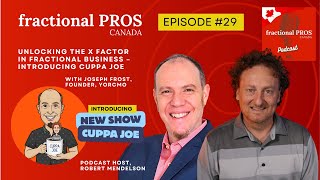
Joseph Frost, founder of Your CMO, argues that fractional executives need a referral engine built from other professionals, not client referrals. He coins "lead man gets paid" and outlines an A/B/C framework for turning casual contacts into active referral partners through a giving-first approach.
Chapters
Hi, it's Robert Mendelson, Fractional CMO, here in beautiful Montreal, welcoming you to another episode of the Fractional Pros Canada podcast. We're part of Fractional Pros Canada, the home for Canada's fractional community, and you can find us on Facebook. We bring you conversations about everything fractional that matters for fractional executives and businesses from coast to coast. Think of this as your go-to spot for real talk with practical wisdom and strategies you can actually use, all without the corporate fluff and with plenty of Canadian content. Whether you're a fractional pro or a business in our great country of Canada and beyond, this conversation is for you. Grab your espresso and let's dive in. Welcome to the Fractional Pros Canada podcast. I'm your host and fractional CMO Robert Mendelson here in beautiful Montreal. Today's Fractional Pros Canada podcast is powered by Your CMO, the proven framework for fractional CMOs. I run my practice on the Your CMO system and it has definitely upped my game, as it can for any fractional CMO. And you can learn more at yourcmo.com. That's yourcmo.com. And speaking of Your CMO, for a special feature this week, we're sharing an episode from my new weekly LinkedIn Live show with the founder of Your CMO, none other than Joe Frost. And we are calling the show Cup of Joe. Uh, my script here says pause for laughter, so I'll just quick pause. Okay. It's shorter than our usual pod episodes, but in the next 15 minutes or so, we go fast and deep on every fractional's most important pain point, which of course is biz dev. A quick heads up as we were getting started, we did run into a few technical gremlins. So you'll hear us working through those in real time, but stick with it because we quickly dive into breaking down proven strategies for building a steady client pipeline. Despite the rough start, we do cover a lot of great actionable ground. So if you like what you hear, you can join us for Cup of Joe live every Friday at 1:00 PM on LinkedIn. And now let's get into it.
Time is all messed up right now. Take over, Robert.
For those of you who don't know, which would be everybody, Joe and I have been talking as if we were live and we just realized we're not live. So go figure.
All the good stuff we had. We had such a memorable conversation. Now I can't remember what it was.
Well, let's just bring it down from the top here. So, Joe, you're joining us first of all from the other side of the world in Portugal. And I'm up here in beautiful Montreal and welcome everybody to a late, better late than never edition of Cup of Joe. And so today, Joe, we're going to pick your brain about something that is probably the biggest pain in the neck but essential for every fractional. You want to take a stab at what that might be?
I call it the X factor. And when I was watching the NBA Finals a few years ago, I came across, I think it was one of the Canadian teams that finally won. I forgot who it was. I'm so bad at names, but it was the board man gets paid quote. And I thought it was their star player because he likes the rebounds and he had this saying, board man gets paid. And I coined the phrase lead man. Gets paid. It's all about the leads. If you get the leads, you get paid. And if you don't get the leads, you don't get paid. It's all about leads.
I'm assuming you're referring to the Toronto NBA team, the Toronto Raptors, I believe. Yes.
And was it Kwame? Who was the guy that was the really good player back then that took them to the championship?
I ain't no sports fan. And as a Montrealer, I'm especially no fan of any sports teams in Toronto. So, I can't help you out there.
Just remember, lead man gets paid in the fractional sport.
Lead man gets paid in the fractional sport. That is the takeaway for today. That is the theme. And that makes a ton of sense. I know, Joe, you're a huge advocate for a very specific model of building a referral engine basically with a small group of complementary fractionals. And you've argued, and I think you've proven from experience, you've learned from experience, that's much more effective than the traditional model of relying on client referrals or even doing cold outreach. So, I want to dig into that and I'm going to switch things up. I'm going to play the role of a constructive challenger and channel some of the common questions and skepticism that maybe a newer fractional might have about this model. All right? Are you ready for this?
Let's argue.
All right. So, we'll start at the beginning. You often say the traditional wisdom of building a business solely on just client referrals is a flawed strategy for fractionals. So tell us why.
Well, it's odd, but in the fractional space, I find that clients don't like to refer you out because it feels like they're giving up a key employee. And if they refer you out, it's less time you have to spend with them. So there's a subtle psychology there. I, as the firm, the business owner, your CMO, I will have clients call me and say, I've got an opportunity, but I don't want to give it to my CMO because She's, she or he's doing such a great job for me. Do you have another CMO that might be interested in it? So that's why the common practice of relying on client referrals doesn't work as effectively for fractionals.
Okay. Now, if I'm a fractional, I might say to you, well, Joe, you know, a warm referral from a past client is, you know, the gold standard of trust, right? It's a prospect. They're already like 80% sold. So for someone just starting out, that feels like that's the safest, most reliable best source of new business. Are you saying that that is not the case, that should be deprioritized?
[Speaker] Well, most, I'll say this, if you're just starting out, you don't have past clients. So that's not even a source for you to even be thinking about. But as you start to build your clients, current clients then are also not your best source because of the time factor that I shared. But when they become past clients and you've done a nice job for them, they certainly could be a good source of referrals. But I'll say in practice, I don't see a lot of that. I see a lot more of the business coming through referrals from other fractionals, which is why we push that so hard, and referrals from other professional networks and networking groups like Entrepreneurs Organization or Vistage or many of the trade associations that exist out there. Getting referrals from those sources is, is more likely to build your practice than relying on current clients or past clients.
All right, so explain to us what makes referral from another fractional pro so much better than one from a happy client.
Well, I wouldn't say it's better. I would say that, um, it's just more likely to occur. So if you're going to invest time and energy to generate referrals, invest it in going out and building out a referral network of other fractionals. Think of that as this asset that you're going to build and accumulate and nurture. And instead of having a single client with their sphere of influence, you have a group of peers that each have clients and each have clients of clients that you can extend your network to. It's more scalable likelihood of business coming from that effort.
Okay. So, now, I'm hearing, you know, "Oh, I got to go out and do networking to build up this this referral and networking is a time suck. Nobody likes networking. It's awful.
Yes. Networking is one of the things that actually people do like doing when they take away the attachment of finding business doing it. If you think about most of us professionals throughout our careers have been to plenty of different networking events that we've enjoyed, especially if they've aligned with some of our interests. And we've been able to learn from others. But when you approach networking with a requirement, I'm networking to find leads, it becomes a chore and it becomes, you know, it's just not the same mindset. And so, that's why many fractional, like, I don't want to network. No, you've networked your entire life. It's how you got to where you are today. You just don't want to do lead gen. You don't want to do prospecting, but networking you should be doing all the time as much as you can because it's enjoying.
So it's a mind shift and you don't approach it as work. You approach it as I'm going to go and have some good conversations with some interesting people. And along the way, you know, just maybe I'll make some good connections that can grow into eventual referral partner, something like that?
Not exactly. A little more intentional. I mean, that general mindset, yes, I want to go meet some people, have conversations, and along the way, I might find some opportunities. But more intentionally understanding, we learned this from Chris Coco at Sales Acceleration. This concept is not unique to him either, but you have 3 buckets of potential referral partners and you have A, let's call A, B, and C. And let's start with C. C's your network. C's is what you just described. I'm going to be going and talking to people and every now and then I might bump into somebody who's got somebody that knows, but I don't really have an expectation that that's going to happen regularly. Now, that's my C. But as I'm meeting Cs, I come across the Bs. Now, the Bs are people that I understand now that do have a capacity to refer me into a group of businesses that I could potentially serve. And that could be because they have business themselves, they have clients. Another fractional client could be in that position, or it might be just a natural refer— a connector. There are a lot of people out there that love to give referrals to their friends and people they like, and that, that's another reason why that person is a B. Now, you've separated a lot of the noisy people into this B bucket and you want to turn the Bs into As. Now, As are people that are actively referring you business, not necessarily close business, but referring you business. And that means it's somebody that you've met that you identified as a B-level prospect and you've started engaging with leads they've sent you. And those A referral partners, that's where you separate the cream from the crop in the fractional space. Because if you have that group and I say it's 20 cup of Joes to get to 5 of those A players, when you have that group, you no longer are suffering from lead gen. You are actively receiving leads on a regular basis from this group that's also getting leads from you on a regular basis. Now, how you— the characteristics of that group also can be different. It can be geographically focused. It could be industry focused. It could be even discipline focused. Having that group and having it effectively sending you leads or referrals, I should say, on a regular basis is the goal. That's the intention. That's the networking intent that I was telling you about. You are trying to get somewhere, but you're going to do a lot of stuff along the way that it's just nice to do.
So if I'm going to a networking event, I know there's going to be a mix of business, you know, executives there, maybe business owners. There's going to be maybe some fractionals in the crowd, maybe some consultants in there. What would be a good, a realistic kind of goal to come away from that event with so that, you know, I'm being intentional about it. I've got a plan. I'm going to have fun, but also I want to get something out of this. What should be my goal? Is it like come away with 5 new C referral partners or something like that?
I would, I would reposition that as what can you give? If you approach networking from what can I give mindset, When you're there, how do I give away as much as I can to as many people as I can in this room tonight or over lunch or over breakfast? And when you have that giving mentality, the law of reciprocity, which is the most true law in the world that I know of, you will get something back. But if you go in looking to get, you may not get anything. It's a mindset shift change. Networking should be about what can I give? And the easiest thing to give many times is a connection to another A, B, or C referral partner. If you meet somebody in a networking group and you're talking about a client they have or a prospect that they're looking for or something of interest, like, oh, you know, I have this, person in my, uh, my network that you should talk to. You guys are very similar in your approaches to business, so you just make a connection. That's a gift, and that gift definitely keeps on giving.
Yeah, that's interesting. I just had a call with somebody yesterday, and, you know, halfway through the call they said to me, all right, well, I want to help you out. Who would you want to connect with? You tell me who you want to connect with, and I'm going to "you know, in the next minute, just scan my brain, whatever I have in front of me, and I'm going to come up with 3 people to connect you with." And he did. He actually rattled off 5. 2 of them I actually, I was already connected with. And the other 3, he's like, "All right, I'm connecting you with that person, that person, that person. That's it." I mean, it's kind of like the concept of, you know, you plant a seed to grow a plant. You're not getting any fruit right away. You got to keep nurturing it. You got to water it, you got to make sure it gets sun. Eventually, it starts to grow and eventually starts to bear fruit. And it's kind of like the same concept. You give, give, give, and eventually, you know, I'm a big believer in what goes around comes around.
Yeah, absolutely. Well, speaking about giving, I'm going to give you 30 more seconds and then I have to jump on another call since we messed up our timelines. This is going to be a short cup of Joe. This is a single shot instead of our double shot that we generally Right.
All right, well, I think we can wrap this up. Um, I think we've kind of, uh, proven the point here and made the point that, uh, what was, what was the saying?
Uh, lead man gets paid in the fractional sport.
There you go. Lead man gets paid in the fractional sport. So everybody go and make some connections, give, give, give, and watch the magic happen.
Give a lead away today. That's the mindset.
There you go. All right, let's go do it.
Thanks, Robert.
Thanks, Joe. Cheers.
Cheers.
That's a wrap on another episode of the Fractional Pros Canada podcast. If you're a fractional professional based in Canada, we'd love to have you join us in the Fractional Pros Canada Facebook group, the home for Canada's fractional community. It's where Canadian fractional executives connect, share insights, and help each other succeed. Until next time, I'm Robert Mendelson, Fractional CMO. May your impact be full-time, even if your hours are fractional.
More from Joseph
Unlocking Business Growth with CRM and AI– Tony Bagdy with host Joseph Frost- EP #77
Navigating Business Growth Challenges - Steve Thornton with Joseph Frost- EP 75
Energy Over Time: Maximizing Your Impact with Joseph Frost #TimeManagement #EnergyManagement