Navigating Business Growth Challenges - Steve Thornton with Joseph Frost- EP 75
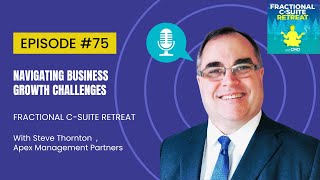
In this episode of the Fractional C‑Suite Retreat, host Joseph Frost, MBA, interviews Steve Thornton, managing partner of Apex and Pinnacle Business Guides practitioner. The conversation centers on how C‑suite leaders can identify and act on their company’s profit "sweet spot"—the mix of customers, products, and services that generate the highest contribution after accounting for complexity and cost to serve. Thornton explains the use of 80/20 and percentile analysis (e.g., 64th percentile for "gold" customers) to segment clients into gold, silver, and bronze tiers, and how activity‑based costing or variable contribution metrics can turn raw revenue data into actionable profit insights. They discuss the dangers of profit‑less growth, the importance of cascading simple, rule‑based guidelines throughout the organization, and how Pinnacle’s flexible, principle‑based operating system differs from more rigid frameworks like EOS or Scaling Up. The dialogue also covers practical tactics for growing a fractional consulting practice—networking groups, targeted content outreach, and positioning services as outcome‑based rather than hourly. Throughout, both hosts stress the need for clear communication, trusted advisory networks, and aligning talent, culture, and KPIs with the chosen profit strategy.
Chapters
Growing a business is hard, but it does not have to be.
Once a week, we take a break from the hustle and bustle in business to talk about innovations and what's new in the C-suite. This is the Fractional C-Suite Retreat, and I'm Joseph Frost. Pull up a seat at the fire, grab a drink, smoke a cigar, and just join me as we relax, learn, and get inspired. This retreat is sponsored by Your CMO, helping organizations grow with better marketing strategy.
Welcome. I'm excited for today's guest. He is the managing partner of Apex. Apex has been around for the last 6 years working with manufacturing and distribution companies. And recently, Steve Thornton has joined the Pinnacle Business Guides. I'm excited to have Steve on the show. Welcome, Steve.
Hey, thank you very much, Joseph. I'm happy to be here and I appreciate the opportunity.
Great. Well, before we get into much detail, I want you to share one thing that you've been thinking about recently that you think C-suite executives should be thinking about more than they are today, but maybe just haven't had a chance to consider it.
Well, you know, one of the things I think is really important for a C-suite executive, I know it was for me when I was in the corporate world. Is to know where am I making money and where am I not? In other words, you know, what's, what's, what's the profit sweet spot? When I get an opportunity, is this good business or bad business? And should I take it or not? And I think some definition around that, I think, is something most should want to know more about.
Well, it sounds like, you know, looking at a P&L could tell them that, right? Isn't that the easiest way to do that?
Well, you know, you would hope so, but it's typically not the case. Typically, you know, most companies struggle with knowing, is this good business or bad business? While they get some financial reports, you know, the mix of products and customers and so forth are so different in terms of size of order, the type of product or type of service that, Comparing gets to be very difficult. And so many of them don't have good data and don't have the ability to do the analytics to decipher it and categorize it in a way they can act on it.
And why is it important to understand that difference and where the good— clients are coming from or if the good business is coming from. Why is that, you know, other than stated obvious, it's just good to know what's actionable about that that you found?
Yes, that's a great question. I'll give you an answer and I'll give you an example just to give you both sides. So the answer is that if you don't really understand what's good business and what's not good business for you, then you're going to go out and your sales team's going to go out and maybe get more of that bad business. That's one. And you may find yourself getting filled up with that. And the result of that is that you have a bad mix. And all of a sudden, you were expecting you're going to make money that quarter or that month, and all of a sudden, you didn't.
You lost money.
And so, you know, I have an example of that. I have a colleague from my past. That was telling me that they have been doing great. And then all of a sudden they had a really bad quarter because it was one of these things. They didn't truly understand what part, what business was good and not good for them in terms of the profitability of the business, the amount of capacity being consumed, the complexity that was entered into the equation. And then all of a sudden they had a very bad quarter. And now the corporate owner is looking at them like, what's wrong? Do we need to make a change? And they have been on a success streak until that point. So again, it just raises red flags for the leadership team that's reporting to the corporate group. Now all of a sudden, there's a question of credibility they have. There's a question of they have to kind of prove themselves back to that group that they've got it under control and they understand what happened.
Yeah, I think it's so relevant to marketing as well. As you know, we're a fractional CMO company, so we talk a lot about ideal client profiles.
Yes.
And part of that conversation has to be around the profit mix, profitability of that client or that service offering. And if it's not, if it's just, oh, we want to do more business with business owners in the manufacturing sector with $20 million in revenue and above, like that doesn't get you to a profitable customer necessarily. It, it may you may be surprised that that's the wrong customer. It's $100 million above that you need, or it's a $2 million and below startup that you need. Unless you really dig into the data, you're just kind of guessing, right?
Absolutely. And, you know, I'll give an example. I think this would relate to your company. So I partner with a fractional CFO firm or firms over time, and sometimes I'll try to help them with their business. And I use the same principles. Now, they're not big in terms of having thousands of customers and thousands of different services, but they still have the same principles that are important. And one of those is understanding where, you know, what size of customer, for example, what you do, what size of customer makes it a good customer and what size or in terms of revenue or profitability if you get to that level. It makes it attractive. And so, you know, one of the things we did for them is we went through and said, okay, your top, uh, top 60— to get to cumulative revenue of 64%, which we would call your super core customers, this is this dollars per year or dollars per month you're getting to that. And then to get to the next level of 80%, this is the level. And then we went down about the 95th percentile because I like to think of that bottom 5% as being pure complexity. And so I'm saying, my suggestion to him was he needed to raise his minimum up to at least the 95th percentile and really kind of cut out the bottom unless they can just pay more to meet that threshold. Because again, those people are consuming a lot of resources, a lot of time. You might not be getting paid because the smaller they are, the risk of payment becomes an issue. And again, he's going, he's going through that process because again, they should, and it should have a pretty dramatic impact on his financials.
Yeah, we have that conversation a lot. Every time we start, engage with a new client, it's, it's one of our fundamentals, is understanding who their ideal client is. And then we talk through it from the lens of lifetime value. So it's, and you look at the lifetime value of a client That conversation changes also completely because the short-term value might look like, oh, this is our best client. This is who we need to go after. It drives the most revenue, but it's gone in 90 days or 180 days. But that lifetime value, now you start having conversations around retention and upsell and referrals and other income streams that are derived from that client relationship that change the, the calculus quite a bit. I think that's a question that many business owners don't ask themselves. C-suite execs aren't thinking about enough. It's just—
I think you're right. And I think in your business, looking at what that lifetime or potential lifetime value can be, because you might have somebody who's in that, that tier that's there, they're a keeper, but they're not great. Okay. So if you did your— if you did something like gold, silver and bronze, they might be in the bronze group. But do they have the potential to join that gold group? And then if they do treat them that way and see if you can get them to that point. But it, but that potential, and in your case, potential lifetime value, I think is a very good metric for you.
Yeah. I think it's powerful when you start putting real dollars to discussions around ideal clients in the marketing space. We don't do that enough. We talk about demographics and psychographics, geographics, but you start putting dollars around it, uh, it gets interesting. Too many times those dollars are just revenue dollars and they're not thinking about, okay, but what is the cost of servicing those clients? And that gets to your point, like there are what might be also attractive looking clients from a revenue standpoint, but the complexity of the service or the demands of the relationship are really costing also real dollars to support, or It's causing conflict within your organization with the people and the culture because of that particular client. And those are costs that need to be considered as well. I agree.
And you said a very key word, and that is complexity. And complexity is going to naturally occur. Every time you add a customer, every time you add a service or product, you've added complexity. You add a new employee, it's more complexity. There's always complexity. But what we have to do is figure out at what point when we add complexity are we adding more cost than value and make sure that we don't cross that line. That's the key line. And, and, and, and, you know, the other thing I would say is if you understand where you're— where your profit sweet spot is, you really understand. And again, my first look, if I were just telling you something off the surface to look at, Again, I take— I figure out where that 64th percentile is and whatever dollars, you know, on lifetime or annual value that might be for your firm, you want to look for more customers that look like that and more. That's like a focus yourself.
So that 64th percentile seems like an interesting number and target. How did you get there?
Well, you know, where our basis is 80/20. So we do the 20, you know, 20, 20% gives you 80. And there's a number of other things that go that same distribution. Well, we like to look at the 80 of the 80, and that's where we got the 64th. And so for us, if I were in your case, I'd probably say, okay, I make my goal, that 60 gold level, that 64th percentile. I'd probably go 64 to 80 as my silver. And then, and then bronze would be beneath that. Now, probably around that 95th percentile, I'd be looking at shipping. So that's kind of the, that's kind of the little mental model. It's simple, but it directs you to do the right things. It says I need to, I need to have my sales efforts focused on gold customers. I don't need to seek silver and bronze. I need to seek gold. Because they're the ones who really bring the money. And they're the ones who, if you really analyze the total cost to serve, if you really had that number, and we do some analytics in our firm to do that. But if you had a way of estimating that, you would find that's where you're making all your money. And you're probably not even making money on the silvers or the bronze.
Now, are you looking at revenue or profitability when you're building that 64th? Chantal?
Well, in terms of, in terms of building the 64th percentile for you, I would probably look at, rather than just to keep it simple, but, but in terms of when we do analytics and understand the profit sweet spot, we're looking at either a variable contribution or we have an estimate which kind of gets you close to an activity-based costing type look at a total cost to serve. So we have two lenses when we do the profitability work. But as far as creating your simple model, I'd probably choose revenue.
So it can be any set of data with a number you could apply this concept towards. And the more profit-focused you could get that number, the better data, the better. But it started revenue, it could be contribution margin, it could be profitability.
Absolutely. Yes.
And the goal is you use that to then give you a target, that of target set of customers that then represents who your ideal customer should be from an ongoing marketing and sales perspective. Is that right? Yeah.
And, and we, we look at both, uh, we look at both the customers and the products, and then we do kind of a, the cross of the two. To get the ideal—
Yeah, kind of concentric circle.
Where do these circles— Where do those two meet? And in your case, it would be that if you looked at the different services that your firm does, you would also do the same thing on the services and see, 'cause you may find that you're doing some things that are really not worth it. And if you're gonna do 'em, if you have somebody that compels you to do 'em for whatever reason, you got to make sure you get paid for it because it's really—
yeah, those one-off things that you do that just never go away, just haunt you. I think sometimes that they do.
And you might end up— if you're not careful, this is what happens. We just— if you just keep adding to your, your list of products or services, what ends up happening is you're adding a lot of overhead because you got to serve all this stuff, right? And you got to do it better and you're not doing it good enough up front. And And when you do that, you're just adding overhead and you're not adding enough variable contribution to pay for it. And so over time, you have what's called profitless growth, where your top line is going up, but your bottom line is not. And that is a very dangerous thing. And then if something goes wrong, then you're just in chaos. And then you're looking at restructuring and so forth to try to figure out how to solve it. But it is, again, this all goes back to why understanding where I make money, what's good for me, what's not, how do I know whether to take that order or not take that order, that kind of information is really critical in running a business.
So how do you communicate and cascade that information and message down to everyone in the organization so it's very actionable at all levels?
Yeah, so great question. And I'll answer it two ways. I'll answer it when I was the executive and it was my business unit or business units. And then I'll also answer it from the standpoint of what I do today, which is consulting. So from the standpoint when it was my business unit, we created rules of the game. We created some rules and said, look, here's what good looks like. And we would create definitions. For example, I ran, one of my businesses was an extrusion press, a large aluminum extrusion press. And we did titanium and aluminum on that press. And in that case, we defined a certain value per push on the constraint press that was gonna be the defining characteristic of how we priced business. Because as long as we met that threshold or more, we knew we were doing well. And so we were able to translate something very practical that they could all say, yep, it fits or doesn't fit. So you want to make it. And then when you do that and you also define the kinds of customers that tend to give us that type of work and the types, now all of a sudden the sales team knows what to go pursue. They know what to avoid and they know what to pursue. So ultimately what we want to do is make it as practical as possible for them to stay in the zone that's going to be in the profit sweet spot. And as a consultant, I basically do the same thing from the other side, where, to be honest, as a leader, it was easy because it was a direction I could give. But as a consultant, I have to teach and try to persuade and try to show the way. So it's a little different. More effort to make that happen. But, but that's, that's what we do. We try to make it really practical. At the end of the day, we start off with a lot of analytics, so you'd be kind of blown away with all the analytics. But we get to the point of, okay, now how do we give this to them in a practical way they can go execute every day?
Tell me a little bit about your practice. You've got Apex, which does this profitable growth consulting that you're talking about. It also does some operational excellence, mainly in the manufacturing arena. And then you've got your Pinnacle Business Guides framework where you provide strategic planning and coaching on a business strategy standpoint. How do they all fit together? Which hat do you wear? Like, what are you wearing right now?
So the hats, I don't do the operational excellence anymore. Other than if I have a Pinnacle client who needs it, and then I'll do it for them. But my focus is around Pinnacle, trying to grow that Pinnacle practice we have, which again, what I like about it, and then I'll go to the other, what I like about the Pinnacle is that you're dealing with the entire business. You're trying to help get the model right. You know, it starts with why are we here? What are we trying to do? We then get into how are we going to win in the marketplace? Which gets into the value proposition, how we know it's good or not good. It might have been good enough till now, but it may not be good enough to go where we want to go. And then you get into, which is the most important element, is do I have the talent in the culture to win? You know, it's kind of like in sports, we embrace that we need great talent and we embrace that you got to have this certain culture to win. But oftentimes in business, we don't take it as seriously.. And we try to start accepting things that we shouldn't accept, whether it's behaviors or it's non-performance. And so, we have to fix those things. And then the other thing is having the right KPIs. In other words, how do we know if we're making progress or not in both leading and lagging? And how do we— and so, that's another piece of it. And then do we have the right playbooks and training and all those things? For this to all— for us to be able to execute. So that's, that's the kind of things that we deal with in Pinnacle. And it, it, it's, again, it's exciting because you're dealing with all the elements. Your question was, how do these things flow together? Well, the other one I do, as I mentioned, we talked about earlier, was profitable growth. Well, when I'm working with a Pinnacle client, one of the things I want to do in the strategy session is understand where is the profit sweet spot, because if we can play there, we can make a big improvement. Financially for that company right away. And we can get a very quick, significant impact. You know, we tend to see about 2 to 5 points on, uh, ROS margin. So in other words, you know, you got a $100 million company, we'd expect that with that effort, 2 to 5 points on the bottom line. So $2 to $5 million. So it's a significant impact by getting it right. And, um, and so that's That's one of the reasons why that fits so nicely with Pinnacle as well, because if you can help somebody improve their bottom line a lot, then they're a lot more open to working with on all the other things, because they don't feel the stress of paying the bill. They don't feel like they're being pulled every which way, because for a lot of these small business owners, your team's not fully where it needs to be. All the problems come to you. You're working yourself 65, 70 hours a week and you're kind of almost like a slave to your business. And it's a very, you know, it's a very difficult life sometimes, even if you're making money.
Yeah.
Yeah.
The entrepreneurial trap where you leave a full-time job to have a full-time plus overtime job with a worse boss. Exactly. Exactly.
Yeah. And, you know, that's, that's a fact. I mean, even, you Even in like a business like I have, you know, I'm the worst boss I've ever had because I'm, you know, I'm, I'm, I'm, my demanding on myself is, is, is probably a little beyond where it should be sometimes.
I agree 100%. Sometimes the owner entrepreneur is the, the bottleneck of their own business. They don't know how to, they not necessarily self-aware enough to realize it, but they're either not delegating appropriately or they're just kind of stuck in some old ways and not open to new thinking. And it's those opportunities that companies like yours have to really make a difference, come in fresh perspectives, fresh eyes, spotlight areas of opportunity, profitable growth that might not be there in their own mind. They didn't see it. Right? We see the same thing. We come in as a fractional CMO for companies. We are almost always replacing the owner in that seat. It's usually the owner that's been the marketing leader up until we come in. It is hard sometimes for them to let go. We call them the do-it-all marketers. You know, they just think they know better than the CMO. And until they can recognize that there's a real expert in that seat now and defer decision-making, it can be a challenging engagement. Do you run into engagements that are challenging with honors?
Yes, you do. And again, part of it's like you said, not willing to let go. Part of it also is not as good. And we're all guilty of this, but we're all ego-driven people, right? And we've found success by controlling things, by doing certain things. And until we learn to let go and let others who are more gifted in certain areas help us, it can be not as productive. And one other point, I think all of us need this, whether it be through people like us or just in our networks, we all need wise counsel, right? None of us are good enough alone. And that's And so it's really critical that we have people who we can go to and trust to get advice. And I think that is one of the most valuable things that any business owner can have is that group of trusted advisors that they can truly go to and talk to about whatever the issue might be and be told the truth from the other person's perspective.
So how are you growing your business, Steve?
You know, I'm doing two things. You know, in the world that you live in and I live in, a lot of it, you know, you'll hear people talk about networking. And I do a lot of networking. I've got some network groups that I host, and they're getting more and more productive. And productive being that we're helping each other. There's leads that are starting to be shared, those good things. And that's how most people in the world that we live in get business. The other thing I'm doing is because my network did not initiate in Houston. So because I was in the corporate world 30+ years all over the place. So in addition to that, I'm also doing work. I send out an article, I get a top of funnel type of lead list off of open rates on, on funnels. And I've had this for about 4 years or more. And so I then send books, uh, to people, uh, depending on the client and the potential fit. I'll either send, uh, one on Precision Growth, which is around the 80/20 profitable growth, or I'll send them a book on Pinnacle. And then I will follow up, and there's just a cadence to the follow-up. But I try to start by sharing something of value. That they, that they would value. And then hopefully that leads to, um, uh, an opportunity to have a conversation. And then there's either a fit or there's not a fit, or sometimes the fit might be some time down the road. So, you know, and, and so it's just a pretty low, you know, low-key type approach to try to see if there's an opportunity to help each other.
And who are the type of companies that you're looking to—
Excuse me. Oh, excuse me.
Yeah, I'm allergic to prospecting, so—
Yeah, I understand.
I understand.
So, you know, in general, you know, look, I would say for Pinnacle, uh, it can be smaller, especially if it's a service firm. If it were in manufacturing, it needs to be probably at least $10 million in revenue., and that's just so that there's an affordability. If somebody were less than that and they need help, then I might could do something on coaching light for them. But, but it would— but that's $10 million is probably a better number. Um, and I would say, um, you know, my, my core is manufacturing and distribution. But again, I have service companies on them too that I do work for because the things I do are the same. It's just a matter of the context is different. And then, you know, if it's on the 80/20 profitable growth side, it can go up to very large companies like a couple billion in revenue.
Well, I know you started your own networking group. We recently launched the Fractional Pros. I don't know if I've talked to you about that, but it's a unique peer group platform that we've created to help our CMOs get more opportunities to both partner with referral partners and target directly business owners. And we are doing it by creating niche verticals, industry verticals to go after, and then a collaborative group of fractionals and other professional services providers to come together in a peer group that want to target that same industry together. So I think that's the way the future's heading with our type of business, Pinnacle specifically, and fractional work. It's, it is very word of mouth driven. So the referral relationships are important. But the industries and the specialization is becoming more important in the, in the eyes of the business owners that they're asking for and they want to see somebody who's been here and done it because they're, They can demand that now that there's enough fractionals in the market space and coaches and other professionals that they can get access. Now, I will also say that most fractionals that I know and coaches that I know will tell you that industry doesn't matter. Like my skill set is fundamental, it's strategic, it works across industry types of companies. And that is true. But the audience, the customer, the ideal client profile, does appreciate the industry knowledge as part of the package that they can get.
Yeah. And I think, yeah, I mean, you know, as I mentioned, I have clients on all sides, but when I go into a manufacturing operation in particular, for me, it's natural. And it's because when you've operated in the world 30-plus years, you know, you kind of know your way around, right? And And even though I can translate, and I do in other venues, it's not the same. I mean, I'm definitely faster up to speed.
Yeah.
Yep, exactly. And the other thing I think is great about the fractional space, which is more your world, is back when I was in the corporate world, it wasn't as known or available. This goes back to, I guess, mid-2015. Yeah, there were some out there, but it wasn't as prevalent or as known. And, you know, the ability to get a fractional CMO versus having to put them on staff, even if you're a bigger company, because it's not about saving money, it's about getting impact. And you want to get the best talent. And the fact that I can go buy the best talent for 40 hours a month or whatever the number is and not have to afford that on a full-time basis all the time is very helpful. Plus, if we have a surge of work that you can expand that capacity for periods of time, that is extremely valuable to a corporation, even larger corporations. So I think we're going to see more and more of that take over as companies have to become more and more competitive because you just can't afford to stay. Because again, the old thing of I have to get 40 hours a week of capacity every time I hire somebody. But if I don't have to do that, I can be more optimized.
Yeah, it's outcome-based that we look for. An engagement that's not hourly based. Yeah. Someone's still looking for an hourly worker, they're probably not looking for a fractional leader. They're probably looking for a doer. And that's not a good engagement signal for us. Yep.
I, I agree. And, and really it's all about, again, everything's value, right? Yeah. It's all about selling value.
Yeah.
Impact.
So I have a couple more questions for you. This is around the Pinnacle side. I'm curious, when did you first decide you wanted to become a, a business coach? Not necessarily with Pinnacle, but just in general, when did you decide that you wanted to, um, go down that path?
Well, you know, I, I, I had my own operating system when I worked in the corporate role that I created back in the 1990s that worked great for me. It was very metric-oriented, and, and so I— it had— it was very much around using Pareto and action plans and we had a certain cadence for meeting structures and so forth. So, I had a process that I'd implemented in many companies. And so, initially, my thought was, well, do I just go forward with that? Because that's what I have lived with all these years. But then I thought, no, I probably need something that the market recognizes. So, then I started looking at options. And there's all these options of EOS and scaling up and, of course, Pinnacle and others, that predictable success. There's all these different options out there. So I started to think, well, how do I— why do I pick? And, you know, a lot of people will start by looking at the OS. But, you know, at the end of the day, what sold me on Pinnacle and why I think Pinnacle is far better is that, you know, some of those systems preach one size fits all and they'll use words like stay pure and so forth. But the truth is that the businesses I run, they're not the same. And what was the winning formula in one was not the winning formula in another. And so while many of the systems and structures and so forth were similar, they were not exactly the same. And I think there's some level of, you know, that they need to be optimized to fit that client. And so that flexibility that you have at a pinnacle to make it work for the client. So it becomes the client system, not a Pinnacle system or not an EOS or scaling up. It's the client system that, that is perfect for them. That's what we're striving for so we can get them the results they want and make it their system. So that's that flexibility in terms of how you design the system and how you engage the client. That to me made Pinnacle by far the best choice.
So when was it that you did start your look to your search? Was it a year ago, 2 years ago, 6 years ago?
I can't— Probably on that part, I had been thinking about it for a while, but I was busy with other things. And so I probably started in about 2 and a half years ago. And then about a year and a half ago, I started, I engaged with Pinnacle.
And so what was really one specific thing going on 2 and a half years ago that really triggered that need? In your mind, like, I, I need to go out and find something?
Well, I, I was looking, you know, in consulting, and this is just a natural consulting dilemma we face in consulting. We always face the dilemma that, you know, you, you need X amount of capacity and you're feast or famine in that capacity. And I was looking for something where I could have more impact longer term with clients, because a lot of the other work I do, you, once you've done it, you you've helped them, you may touch base with them periodically, but you're not going to be fully engaged with them and you move on to someone else. And I was looking for something where I could work with a company for longer term. And I enjoy being more strategic with a company. And this allowed me to play more of that kind of a role. So I thought that the business operating system was a much better offering to have. And so that's why I'm trying to—
Shift toward that. Yeah. What were you afraid you were going to find when you started looking for a business operating system?
Well, initially I was afraid that there weren't going to be any. And my challenge was, I like what I had, but can I market it, right? Can I get the attention in the marketplace for it? And, you know, because the marketing effort to get people to be interested in it would've been significant. And so my initial fear was that. And then the other fear was that a lot of systems are very surfacy. And I'll say this in general about any of these things, it's all about getting results, right? It's 100% about getting results. And a fear I have with any system, even the one I used for years, is that you have to make sure people are focused on the outcome we're trying to get to. And because I don't like check the box, I don't like anything that feels like check the box. Although it's, we have a standard and it's a process, it needs to, we need energy in that process.
If it's just going through the motions, we're not going to get the impact we need.
Yeah.
So what were you looking for? What was the, before you found Pinnacle, what was the one or two things you really were searching for?
Yeah, I was looking for something that dealt with both the strategy, that dealt with the talent aspect of tying those things together, that, you know, within the strategy of understanding where the competitive space we need to play in was going to be, what the value proposition would work and would win might be, and then tying in things like I mentioned earlier, Things like KPIs, like, you know, the whole system needs to be integrated together in a nice package so that everything works well together. And again, I think that's what I found with Peddle.
Took you a year to do your search. What were you doing along the way? Were you talking to people? Were you searching online? What was your journey to try to discover the options out there for you?
Yeah, I was talking to people. I was building this network I mentioned to you, and I was building this network out, and I was talking to people, and people, you know, and the name I would hear a lot of is EOS because it's the most prevalent system out there. And then I'd hear a little bit about scaling up, and so I'd do some research on these different things, but I'd find these gaps, and that's what was slowing me down. And one day, one of my network partners mentioned, have you ever heard of Pennant? And I had. And so he, he told me what, you know, how to— told me about it. And I went and researched it, and I went online and, and connected with Greg Cleary the next day. And, uh, and then within, I guess, within a week or so of that, I, I, I signed up. So I was sold pretty quick. Greg's a phenomenal salesperson. Yeah. Just so you know.
So yeah. Yeah.
I do not.
Yeah.
Yeah.
So what was the ultimate decision criteria for you when you made that choice to go with Pinnacle? What, what was the one or two things that this is it, this is why?
Well, I, I think the fact that it, it did not tie my hands. In other words, I could work with clients on profitable growth. On one hand, if they had an operational problem, I could feel free to engage with them on that, whether for free or not. And then I also could do Pinnacle. You know, some of the other things you might find out there, they are, if it's a franchise, then it's the franchise's client and you can't only do what they have authorized you to do. You can't engage those clients in other ways.
Yeah. Well, that's, it's a great, great journey. And I'm glad you're, you're at Pinnacle, but we're, we're proud to be partners with Pinnacle. We've been around EOS and scaling up, and there's some great people in those organizations also, but Pinnacle has a special group of people that's put together and, and I do appreciate their principled approach to client work versus process driven there's frameworks there and there are processes, but they're based on principles and they can be kind of moved in and out as I've seen most of the guides do, meet them, meet the clients where they're at.
And that's, that's what's important. Yeah. And to your point, it's important, you know, if a client's got a problem in a certain area, you want to focus on solving their immediate problem first and foremost and not just across the board, which again lends itself to more check the box.
Yeah, everything. Well, it's been great chatting with you today, Steve. I really appreciate your time and your insights, and we've covered a lot of ground. So thank you very much.
I appreciate it. Well, Joseph, I appreciate you inviting me on the show, and I enjoyed the conversation and look forward to working with you guys. Awesome.
And if people want to reach out to you directly, what's the best way?
I can be reached at Steve@stevebennett.com. Stebe@apex-mgt.com.
So that's Apex-MGT.com. All right, that'll be in the show notes. So thank you, uh, for that. And for our viewers and, and the listeners, appreciate you tuning in. And make sure you continue to tune in, uh, as we bring on different guests to the show. And we're My producers remind me to ask you to download and like and subscribe to all of our stuff so it gets more eyeballs on it. So appreciate all of our audience and listeners out there. So thank you very much. Have a great day and week, and we'll talk very soon. And that's a wrap.
There's another successful episode of the Fractional C-Suite Retreat. See our show notes and more episodes at fractionalcsuitretreat.com. This podcast is sponsored by Your CMO. Helping organizations grow, save time and money with better marketing strategy and fractional execution. Visit them at yourcmo.com. Your CMO dot com. Spelled wrong on purpose.
More from Joseph
Unlocking Business Growth with CRM and AI– Tony Bagdy with host Joseph Frost- EP #77
Unlocking the X Factor in Fractional Business – Introducing Cuppa Joe- Joseph Frost– Episode #29

Energy Over Time: Maximizing Your Impact with Joseph Frost #TimeManagement #EnergyManagement