Unlocking Business Growth with CRM and AI– Tony Bagdy with host Joseph Frost- EP #77
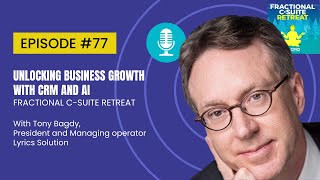
In this episode of the Fractional C‑Suite Retreat, host Joseph Frost interviews Salesforce consultant and founder of Lyric Solutions, Tony Bagdy. The conversation explores how modern CRMs—especially Salesforce—are evolving from simple contact‑management tools into strategic operating systems and rapid‑application‑development platforms that can drive growth for midsize companies. Tony shares client stories that illustrate moving beyond “leaky‑faucet” fixes to building dashboards, event‑ticketing integrations, and automated email health reports that free CEOs to focus on strategic work. The discussion then shifts to Salesforce’s AI push, particularly AgentForce, and how AI tools like ChatGPT, Gemini, and low‑code environments such as Replit and N8N are accelerating formula creation and app building. Both guests stress that high‑quality data, solid governance, and well‑defined business processes are prerequisites for successful AI adoption. They contrast a “release‑early‑iterate‑often” mindset with the need for upfront rubrics to evaluate ROI before automating. The episode also examines emerging AI leadership structures—tiger teams, fractional AI officers, and executive directors of AI—highlighting the importance of cross‑functional ownership and change‑management culture. Throughout, Tony and Joseph provide practical advice for C‑suite leaders on how to prioritize process, data, and people when embarking on AI‑enabled digital transformation.
Chapters
Growing a business is hard, but it does not have to be.
Once a week, we take a break from the hustle and bustle in business to talk about innovations and what's new in the C-suite. This is the Fractional C-Suite Retreat, and I'm Joseph Frost. Pull up a seat at the fire, grab a drink, smoke a cigar, and just join me as we relax, learn, and get inspired. This retreat is sponsored by Your CMO, helping organizations grow with better marketing strategy. Welcome.
I am excited today for today's guest, uh, primarily because he is a professional guitar player. We'll learn more about that later. Um, he started his career not stringing, uh, notes, but, uh, with Lotus Notes, and he's had a 20-year career since then in digital marketing, uh, all things digital and product, and that led him to Salesforce. Extensive period of his life. And as he's left today in the corporate agency world, he has gone off on his own and started Lyric Solutions, and they specialize in all things Salesforce, been shown to double and triple people's growth with just simple applications of Salesforce on top of the database that's so powerful. And we're really excited to have him here with us. So thank you, Tony Bagdy.
Many thanks, Joe. Appreciate it.
Yes. Good to have you. I like to start these with just a simple prompt. No AI pun intended, but is there anything that you think C-suite leaders should be thinking about these days that they're maybe not?
Yeah, I mean, there's, there's always so many things, but, you know, although I guess C-suite leaders wouldn't want to admit that. But I would say that There's a couple things and they're linked. The first is that, you know, in my world, in the Salesforce world, or what some people generically refer to as the CRM world, is that, you know, CRMs can be a bit of a mystery. Sometimes they're a bit of a dirty word. Even Salesforce is, you know, to some people, a dirty word. Some people, it's, you know, the key to the highway, as famous Chicago blues tune went. And I think that what a lot of C-suite people do not realize is that CRMs, Salesforce, whatever you may be using, it's not just plumbing. I think oftentimes people come to us and they have a little problem. It's like a leaky faucet, you know, and can you help me fix this leaky faucet? And of course we do that. Of oftentimes if the companies are open to it, we see opportunities for them to really leverage the platform to specifically drive their business and their specific business processes forward. And what— I'll tell you a little story about a client of ours. We met a client a little over 2 years ago, and they really thought of the CRM as this bucket where you just put a lot of names in and you kicked a lot of emails out. That's what they saw it as being. And really, you know, there's marketing automation systems to do that. But, you know, we worked together, we collaborated, and, you know, I explained to them what some of the opportunities would be around that. And my primary contact there held kind of a, you know, a special projects role. And I let her know, I said, hey, As we're getting into these conversations, what I'm really seeing here is that Salesforce isn't just for kicking emails out. This is that this is going to be strategic for your company and it's going to be, you know, what some of us call the operating system for everyone in your company that's going to give them the piece of data that they need in the moment to make themselves and move towards their goals more successfully. And I let her know sort of off the cuff that, you know, this is a key role and that, you know, I was looking forward to working with her and that to look at it as a strategic role. And she embraced it in that way. And she was about 6 months, 8 months, 9 months after we started working together, she was promoted into a chief role, chief of staff role.. And the CEO of the company talked to me about 6, 9 months ago and let me know. He said, Tony, I didn't realize when we started talking that I would be able to spend time this Saturday cleaning out my garage. Now, what he had— what he was doing on Saturdays was collecting all the spreadsheets from the various business lines in his company, you know, from accounting, what have you. But they have 7 business lines. And trying to make sense of them, understand what's going on with the business. And he was, I think, pulling his hair out doing that. And now, uh, he gets emails sent to him on Saturdays with basically the health of the business, and he can, he can assess that quickly. You know, I can't speak for him, but it's, it's not all morning, it's not all day, and he's getting his, his garage cleaned out. So I think that What I would say and, and what I see time and time and time and time again is that people think of Salesforce, they think of CRM as being this sort of necessary evil that I need to keep track of contacts and accounts in and don't realize that what it can do is actually drive your business processes, support your data governance, keep everyone working along the best, you know, you know, really the best practices in terms of process, whether it's sales, whether it's event management, whether it is property management, whatever process you have. And then you get data and intelligence along the way that enables you to propel that forward. So I think that the message I would have for CEOs that I'm pretty sure many are not thinking about is the strategic importance of CRM and that it's not just it's not just homes for data, but that it's, uh, you know, with a CRM like Salesforce— there are others too— you can rapidly build applications that can, um, you know, really, really help you scale your business.
I think the misnomer about Salesforce is only for sales. Sounds like that's a branding issue, you know, from a marketing mind. I'm like, why do they call it Salesforce then? Why is it not like StrategyForce?
It's such a, you know what, that's a great question. And I'll tell you about 7 or 8 years ago, I was at sales, the old Salesforce Tower here in Chicago. And it just hit me over the head, which is that Salesforce, I don't even think of Salesforce as being a CRM to support sales. I think of it as a rapid application development platform and that, and it can, and sometimes an application, application, oh, you're gonna build an application. Sometimes an application, it could be something really simple and only take an hour, maybe a couple hours to build, and it can have an impact. Some applications might take you a couple of weeks to build. But, you know, we have a client now that is— they've— they have a challenge and they have two systems, one that's managing a large event that they run every year in Salesforce.. And now we're integrating the two so that their team members, uh, aren't sending discounts out to people who have already bought the tickets for more than the discount is. So, you know, we're, we're bringing that data together so that, you know, they're, they're targeting the right people. They're not targeting people that already have tickets and they're giving discounts, uh, as appropriate and not to, not deeper discounts to people who have already purchased full price. So, you know, there's just one example of that and that's actually a fairly complex application. We get the information in, we're creating some ticket records and then we're linking that to a contact. And so the person can see on the contact record, oh, they've registered, you know, so, so yeah, it's, it's, that's a great point. I really think that, you know, Salesforce started as a sales process tool, but it really can be used for just about anything.
I know Salesforce has made a big push into AI with their agent force. And I think I saw numbers that agent force is quickly its fastest growing part of Salesforce, if not the largest now part of Salesforce. Tell me a little bit about what you know about agent force.
Yeah. So, so yeah, obviously I've never seen in about 9 years that I've been in the ecosystem, I've never seen a push as big, uh, for product at Salesforce as Agentforce. So, um, you know, a lot of marketing muscle behind it. Um, you know, as we talk to account executives, you know, they're very bullish on it. And you know, what I see with it is that, um, I think with a lot of AI, there are a lot of people that are saying, give me some, you know, I want some of that AI, you know, it's the greatest thing, I want some of that. And in fact, I got a call,, from a, uh, it's a current client and this person left and they've gone on to another company and they called me and said, Tony, we— are you working with AI? And I said, yeah, we are. They said, okay, well, we want to, we want to talk to you. And I said, okay, that's great. Um, what are you looking to do? Well, I'm not sure, but I'm gonna have you talk to this person. Yeah, you know, and, and I think that one of the challenges is that, um, Oftentimes people get excited about something before they think about the business problem that it's going to solve. And so, you know, where, you know, I'm seeing the most traction is in the B2C world, especially with customer service. So if you've got, you know, you've got detailed guidance that's written out on how to deal with customer service problems, you can point the AI at that and have it serve as, as, really, it's not just a chatbot, it's a smart chatbot that can actually hold a conversation. And actually, one of our shared clients with your CMO is starting to work on a project like that that integrates with Salesforce. We're more on the receiving end of a lead, but the AI is looking to actually have more of a conversation to better qualify the leads because this particular client is getting lots of leads. That, that are not good leads. That takes time, it takes energy, and so they're, they're looking to, to clean those out. So I think that, um, you know, in terms of agent force, you know, there's, there's a big push for it. I think that, um, it's still— it's not early, early days, but it's still a little bit on the early side. Um, some things I'm seeing though, um, as I apply it in my work is, you know, most of us are using ChatGPT or Gemini. And I will say that, you know, I use it every day now. I use ChatGPT every day now. And I would say, you know, at least in my work and, you know, I need to talk to my team members about this too to see how much they're using it is, you know, with complex formulas, which you sometimes need, ChatGPT does a great job of creating those and that, you know, a couple of years ago, one of these formulas might have taken me a couple hours, you know, if it was really large, complex, might have taken me a couple of hours. Now it can take a few minutes to create. The important thing, as we all know, is that you still need to understand how these formulas work, how they apply, so that you can check them and test them. So, yeah, so I mean, I'm sort of diverging from AgentForce, but, you know, I'm seeing one thing, which is obviously using ChatGPT, no big deal, everybody's doing that. But I am starting to see tools that can point themselves at Salesforce. And, and, and I wouldn't be surprised if Salesforce creates something like this themselves. Maybe AgentForce can do this or will do this, but I've seen one that can actually look at your metadata and understand what's going on behind the scenes and give you recommendations on how to improve what you're, you're doing. And it's even starting to build some of the applications that I'm conceiving with clients and historically I've conceived with them and built for them. So to me, that, that's a big jump from going to, you know, giving you some, some input on a formula to actually building the application. And I think that's pretty amazing and pretty exciting.
I think so. It— that's— it's— I've been playing with Replit. I don't know if you've played with that tool. I was just looking at my phone. To, you know, it can tell you your, uh, your use of your time on your digital device. And it, it's not surprising that ChatGPT is the third most, uh, for the week that I spent on my, uh, above mail, uh, and, um, just above it is Safari, which, you know, internet searching for whatever I would get to do. Not necessarily searching, but, you know, usage. The, the top one is Replit because I spent about 2 hours this weekend building this really cool AI app. Man, I was blown away. An idea guy like myself has always been hamstrung by needing coders or developers or somebody to help me bring it to life. Well, shoot, sitting in front of Replit for 2 hours, I was able to create an entire concept that was working in a real live working test environment. It's amazing. In 2 hours, which would have taken me, gosh, months. In the old days.
It's insane. Yeah. Yeah, it really is. You know, and this may be wishful thinking on my part, but, you know, you know, one of the things that peers of mine talk about in terms of making AI work and really sing is, is having established processes. Because if you don't have established processes in a CRM or some other type of system, you know, the AI is going to have a harder time helping you, you know, optimize it, improve it, etc. But it's good process, it's good data governance, which equals data quality. And I also think that it may be more important to be thinking upfront about how you're gonna leverage the AI to create these tools versus sort of, oh, let's, my mantra before, and I'm reevaluating this, I wouldn't say I've changed it, my mantra before is, old, you know, uh, dot-com days is release early and iterate often. Um, and, you know, we work that way here. Um, I think though that when applying AI, we may want to do a little bit more upfront thinking. I guess you could still rapidly prototype and, and develop from there, but I guess depending too on the complexity, we'd want to, to do a little bit more upfront thinking in terms of, um,, you know, bringing AI to bear. So it's, it's, it's really interesting times. And it, you know, I think the other thing I would stress is talk to other people who are using it, you know, just like you're talking about, you know, you know, the apps you're using is that I think there are apps popping up all over the place. They're addressing different needs, different issues. And so, you know, podcasts like this one, networking, I think is really important to understand what people are doing and what, what they're seeing.
Yeah, I think it's an interesting time to be in business altogether, but the AI is just a transformative technology that it's everywhere and makes it really difficult. And the speed of which it's changing itself is just aweing or it's, I don't know, you think about AI like this newfangled electricity. And when electricity came around, I love this analogy, it all of a sudden was available to everybody. And the people that figured out how to use it or generate it were the people that made money. I think AI is very similar that way, but it's like it's 110, it's 220, it's 480. It's like all of the different energies you could possibly have and all at once if you can't figure out where to to focus and spend time. Do you build light bulbs? Do you build power plants? Do you have just nice brighter houses and venues for people to come into? It's just so pervasive. It's harder to pick a lane and choose where to focus.
Yeah, it really is. I think that's a really good point. I mean, I think, you know, something else that we're seeing, and we are a smaller agency, I mean, I hadn't talked too much about us. So if you don't mind, I'll tell you a little bit, just your audience a little bit more, but I'll keep it short, which is, you know, we're a small agency, we're agile, we're a small team, high-quality work. We tend to work with clients that are 10 to 200 users. So we're not working with the biggest of the big, which may be the companies that are looking into AI. But what we find is that the companies that are engaging with us, they're, they've got just more rudimentary problems or rudimentary issues and that they've gotta get that groundwork in place, which is, you know, defining the process. And many companies think they've defined the process and we start talking to them And they realize, oh, we really haven't defined this. And then we define it. We help them, you know, propel that with Salesforce, which then ultimately delivers data, which provides the insights, which enables people at various levels of the organization to optimize whatever they're doing, whether it's managing the company or selling or what it may be. But we are still seeing, you know, companies aren't too much and again, we're working with a smaller cast of characters, they're really looking to get their foundation in place first. And intuitively to me, that is actually, I think it's more important because if you don't have that, if you don't have your systems, you don't have your process, you don't have your data, I think that you're gonna get lapped when it comes time to apply AI. And so, again, you asked at the beginning of our conversation, what should, What should CEOs, C-suite people be thinking about? And I guess it's the same answer from a different perspective, which is get your processes, get your data together because, you know, if you do, if you're able, and I think most companies will be able to leverage AI to propel their businesses, is that if you don't have that, you're, you're gonna be starting, you're not starting from the starting line, you're starting from 50 yards back, you know?
So. I agree 100%. We've, we've, made a decision to build some AI core competency inside of our business, support our CMOs and their clients. And as such, first thing I wanted to do was hire a fractional CTO to come in and make sure I've got the infrastructure in place and the guardrails and the best practices for— because we're not a software company, you know, never done this before. The second thing we did is we hired a full-time automations engineer someone who has some experience playing with AI inside of a platform like N8N. And then what we quickly realized is that if you just start building something, because we were experimenting, like, oh, let's just try to build this, let's try to build that. And everybody's got an idea of what they should build, right? You've been in this space a long time. We realized that you really have to have a process for approaching what you should build and then how you hand it off properly to the build team so that they don't start building stuff they shouldn't be building because they didn't get good upfront communication or clarity. And this, you know, back a couple months, it's not like we spent many months learning this lesson, but we've figured out by trial and error what we need to start doing better. And it is, it's mostly upfront. It's thinking through the business process you're trying to solve or automate or make more efficient. And then is it worth it to automate? What's it gonna take? What's the real savings here? Or what's the real upside here? And being a little bit more diligent about like a rubric of sorts that can help you walk through when to move forward with the build and when not to.
Yeah, yeah, there's a real art to that. And, you know, You know, I know that I, you know, it's something that I pride ourselves on, which is that there are some clients or some projects where you need to, you need to define very carefully upfront and do that. But there, you don't have to do it for everything. And so I think being flexible, you know, I've worked, you know, your quintessential IT person, you know, sort of the old school and still some people do this and it's fine. It can work is you define every requirement upfront. And if it's a big project, you know, you're, you're spending weeks, months on this and that, you know, by the time you get, you start working on the project, you know, 20% of those requirements are outdated or just not quite right. So it really is, you know, a balance on that front. But yeah, I think thinking ahead about what you're going to do is important. And I do, one of my peers mentioned in a conversation recently that you know, if, if anybody can sort of do this, you don't think it through upfront, is that you're just going to get to the wrong place faster. And you're going to actually put yourself further away from where you want to go. And, and we see that all the time, not in terms of AI implementation or usage, but just in terms of people buy Salesforce, and they start creating fields and they'll put a bunch of fields on a form not realizing that, well, no, those should be individual records that should be attached to this so that you can get the reporting that you need in a certain instance.
So, you know. I heard this analogy or metaphor recently that it's, I think it's called like the designer's paradox or something. I completely am butchering this, but let me describe the idea. For you. Imagine a field of grass and a designer will come in and their job is to put sidewalks or pathways on this field of grass. But this paradox or this paradigm or this thing I'm picturing it would tell you to first watch how people walk on that grass, see the trails they create, and then build the pathways versus going in and just assuming and building the pathway. And when you, when Ohio State did this, when their new campus was built, like in the '50s, the designers did that. They waited a year before they came in and actually paved the, or passed the sidewalks. And what you see is this like almost this crisscrossing, odd-shaped, no, there's like no design to it at all. It's just actually where people are walking from this building, cutting across here to that building cutting across here and that zigzag, that's how they passed it. And I think with AI, it's a little bit like that. Like, you don't want to go in and under— you build something that you think people are— how are they going to use this? Is there a way for us to use these apps in real time in such a way that then we can put the energy into automating them and building? And that only happens through some sort of experimentation and prompting, like giving your team The, the ability to prompt away, break things, but then find the path that actually works for you. Then let's automate that versus we're gonna tell you how to do this.
Yeah. Well, that's spoken like a marketer right there, which is, you know, understand your audience and understand what, you know, they wanna do. And, and, you know, I, you know, having worked in the marketing space and product space and, you know, I, I, I still have product peers who, who, we laugh in that people say, well, you just do it this way. Well, no, this is— the users are telling us, no, this is what they want. And there's— you really— I guess what I'm saying is that AI or no AI, technology or no technology, it's important to understand what the users are trying to do and where they're trying to go and being there to serve them. I think there are fewer forces in the universe greater than consumer desire, and you want to put yourself between consumer desire and where they want to go and facilitate it.
So, wow.
Yep.
So you're well-versed in your history, your experience as a data, you know, from Lotus Notes way back in the day where you just had almost on a rudimentary level learned about databases because it was so, you know, old back then. Not that you're old, and I use Lotus Notes too. But then, you know, you became a digital marketer, tech marketer, and then more deep, more recently in Salesforce. Like you've seen product and data merge over the years and now AI just, it's gotta be like this exponential force for you that's blowing it up.
It is, you know, one of the things that I'm curious about And it's an open question for me is, you know, while my peers talk about this and I believe this, which is having good quality data, you know, to me it's always been about structured data and what that means, you know, data that is clean. So if you're saying the state of Illinois, it's always Illinois and not just IL or IL, you know, something else or, you know, you're not sort of mixing apples and oranges in a field or what have you. But I think that there's some promise that AI can work with unstructured data. I think depending on how you're using it, it may be better or worse. But I have a lot of clients that have really dirty data. And I'm wondering, can we start pointing and teaching AI how to help them clean that up? And you've got these tools. There's a number of deduping tools because You know, sounds arcane, but if you've got 5 Joe Frosts and you're trying to sell to Joe Frost and one person's looking at version 1 of Joe Frost and one person's looking at version 2, they're going to— one person's going to know you're about the future of companies, but the other one's not going to know you're interested in AI, you know. So, you know, you've got to have, you know, you want to dedupe those records. And, you know, one of the things I'm wondering about is, you know, how far can we push this and can it start to clean your data or help facilitate that for you in some way.
So yeah, I'm curious what you think. Is the AI going to be used to take this unstructured data and put it into a structured database for then ongoing use? Or is the AI just going to become this, make the structured database obsolete and just be able to manage unstructured data?
It's a great question. And I don't know if anybody knows the answer. I would say it's probably the latter. Um, I would say it's probably the latter and, you know, something that you, you, you talked about with agents as well. And, you know, as much as I love Salesforce, I mean, Salesforce is an amazing platform. I mean, I'm just, I'm blown away by it every day that, that I work on it. But, you know, one of the paradigms is that it won't be about agent force and Salesforce agents, but it'll be about agents that live at a higher level and are looking into Salesforce, they're looking into your ERP system and they're looking into, you know, what in Salesforce's world, it's Data Cloud and consumer data that is unstructured, that enables the AI to make comparisons between what you know about them and what it's seeing in Data Cloud, maybe site website visitation, and then being able to create, you know, some kinds of programs for outreach and engagement. So yeah, I mean, I think that using AI to— that's a good question. I mean, I think it'll probably be both. You know, I think there'll be use cases where companies absolutely need to have structured data. It's gotta be pristine. It's gotta be amazingly good for them to achieve one set of business cases. But I think that there's other business cases where going to that effort, putting that effort in, it won't be needed. And that, you know, you'll look at your data and start working with it in an unstructured way. I mean, that's what I think. I think it'll be both, and then it'll depend on what the use of that is for and how mission critical and what the level of accuracy needs to be for it to succeed.
So, so I'm hedging. Yeah, but it's fascinating to see how it all plays out and it changes in days, weeks. I'm curious how you think the AI leadership will evolve. It's this new discipline that— well, not altogether new, but it doesn't seem to be well Bryant, we also— doesn't seem like the IT leader is naturally the best AI leader, and there is no other leader that would normally own AI. It feels like it should be every leader's job to figure out how to use AI in their discipline, but a company does need to have some— someone's leading the charge with AI. I don't want to call it an AI strategist because I think AI should support your strategy, not be the strategy. But what are your thoughts around the leader of AI?
Well, I'm glad you asked that question, actually. And the reason I'm glad, and I'm not going to drag her in too explicitly, but my wife has been fortunate enough to evolve her career into being— and I should get her title right, it's Executive Director of AI in her organization. And it really started out— they're a teaching hospital and rehab hospital. And they started out with her engaging the organization, and they have research doctors and physical therapists, et cetera, and engaging these different audiences and looking for use cases and applications for AI. And, you know, meanwhile, she was doing research on this. And, you know, it was interesting. You know, a lot of times when you work in a company and somebody says, hey, you know, there's a committee forming for X, Y, everybody runs for the hills. You know, everybody's like, no, talk to that guy or talk to that girl. And in this case, there was a lot of interest, a lot of desire, and a lot of people got involved. And they started developing some use cases that were capturing the interest of the C-suite. And ultimately they decided to— my wife's role is very interdisciplinary. She's working kind of with different groups in her initial role, which she's still doing. But she actually, I think she, and I may be getting this wrong, but I think she reports up to the head of IT and head of marketing, and that she's working with— they've hired a data specialist. I don't know the details of it. And, you know, she's helping IT and, you know, she's bridging a gap with IT and IT is bridging the gap with her and working with this data person to start, you know, putting, you know, a strategy together for, you know, leveraging AI in the organization, you know, and, you know, strategy, a simple definition of it is, you know, initiatives, you know, vision prioritized, you know, what's your prioritized vision. So, you know, it's early days, but she's got a lot of little wins, you know, on using agents. I know one of them, for example, which is going well is, their HR team is using it to help onboard new employees. And the way it's done is that they've got a very large sort of employee handbook, you know, here are all the policies here, you know, and there's practical things like, you know, contributions to your 401(k) plan matching, what have you. And so new employees can go to this agent and just ask questions and it can just answer this. So, you know, simple, simple thing there. But there's also applications in terms of client or patient treatment as well. And because they're a leading hospital, they've developed cutting-edge techniques and they have, you know, many therapists that are working. I think they're finding ways of doing this and doing it obviously privately. Because the one thing we haven't talked about here in AI is the whole privacy piece and just how, critical that is for some organizations, especially like a hospital. So, you know, sometimes maybe I go on a little bit long, but, you know, I think their approach is, you know, they had a person who is seeing the intersection between what's going on in the organization, how AI can leverage it. And, you know, they kind of cultivated her over a year or year and a half, something like that. And now she has an official role. It's not— it's— I want to say it's about halftime. It's 40 to 60%, something like that. And, and she loves her new job. And I think that from what I can tell over the dinner table, I think she's going to bring the organization a lot of, a lot of value. So that's one approach. Yeah, it's almost like a tiger team. Yeah. Yeah. IT person, the data person, and then you've got the person who's actually out and seeing the applications and bringing the ideas, bringing ideas from within the organization, from outside of the organization into that group. And then, you know, I think they're trialing some things, so.
Yeah, I think the Tiger Team approach or the AI committee approach, I've seen that be a solution. It still needs a C-suite leader to even assemble the team, to get permission to, you know, those resources to be used that way. I find that it's becoming more prevalent. Everybody's starting to realize we've got to do something, but there's still plenty of organizations out there that aren't even thinking about it. They don't want to think about it. They're just ignoring it. And it's surprising it's still so many. But those that do, it just, there's not a clear, is it the CEO that owns it? Is it the CFO? Is the C, you know, is marketing on it? Do they create the IO, CAIO? There's fractionals now that are starting to pop up out there, fractional AI leader, which stands for FAIL. It's crazy. I think it's an interesting time to see what evolves from it. I don't know if it'll need its own discipline leader, but certainly somebody has to be the change agent and architect. And technologists to keep up with it. But it's— they don't— you don't need the same IT, yeah, like chops that you would for most technology.
AI is totally different. Yeah. Yeah. I mean, I have an opinion on that, you know, because it seemed that a lot of the organizations I've worked in over the years, especially when it came to digital marketing and marketing is how— and especially in nonprofits which have multiple missions, you know, they're not just looking for donations, they're looking for advocacy, they're looking for volunteers, etc. And that I don't know that it's all about what role you put it under, whether it be IT or operations or what it is. I think what it comes down to is the actual people or person at the company and who is the one that, whether they be IT or operations, is more attuned to what's going on in the broader organization. You have some IT leaders who are just focused. They're just laser, just all IT, all IT. And then you have some that are thinking about the business sort of beyond that a little bit. And they're— and they, they've got lieutenants that can actually sort of run that. So I think a lot of times it comes down, you know, at least from what I see, you know, the—
in—
into the, the personality of that. I, you know, something that we tell clients, um, all the time is that some of the things that you want to do look really hard. They look really hard and they're not. They're actually really easy. And some of the things that you want to do, they look really, really easy. They're not. They're really hard. And the point of that is that at a minimum, I think to your point, in terms of leadership, is ideally somebody or some group of people can be thinking just outside of the box. You know, some of that, you can go one of these offsite places, you know, Idea Ranch or whatever it is, and just think, okay, how can we use AI? What can we do? I just think of everything you can possibly think of. And then if you can bring people who understand what's there in terms of the technology, in terms of find, you know, the, the proverbial low-hanging fruit, the things that may look hard that may not be, the things that can give you that entree into using AI to give you confidence in it, to give you experience with it. And then what I also find with clients is that once maybe we build an application for them, it's not AI related, and they go, oh, you're able to do that? That means I could do the same kind of thing over here, which they never talk to us about. And they go, hey, can you do this thing over here? I was like, yeah, sure, we can do that. And I think that companies at least getting, getting a taste of it and starting to build those muscles is really important because you may find some things that are easier to do that you can then, you know, apply in other places or stepwise, you know, you, you can build sort of some stepwise discipline in, in bringing AI into the organization.
Yeah. And I think the organizations that are embracing AI are approaching it, as you said, kind of just in their own organic way with their own people that are the champions internally, but then also open to bringing in outside expertise from the different disciplines where they need it. And guys like you and CMOs that we have can bring that support along with what we do in our focused efforts, whether it be Salesforce consulting or marketing. The more we know about AI, the more valuable we are to our clients. And I think that you're in a unique position with Salesforce and Salesforce agents and where the business is going these days. The company is looking to leverage AI and strategically, you naturally should be thinking about Salesforce and someone like you that can help them do that, I think, is where the opportunity lies for us to work together and continue.
Like, yeah, yeah. I mean, there's always one more thing to say. I'll say this, which is that, um, you know, as we all know, technology has, um, you know, dramatically increased the pace of change. You know, we all— I think most of us know this. We don't think about it every day. And, um, Change is difficult for people. And in the past, we had applications that could advance change at a certain pace, and now it's going to be even faster. And so I think another message I would send to the C-suite or a CEO is that trying to build an organization that's resilient and will accept change, because oftentimes, It's the change agents within an organization that, you know, they're either accepted, embraced, and elevated, or they're spit out and sent out with the garbage. And I think that's actually another reason why fractionals are a great option because people are much more likely, I think, to listen to the outside person. You know, they're less likely to just say, oh, that's such and such, I'm not gonna listen to them. They've got another crazy idea. And I think that just from what I've seen in my career, that companies do tend to listen to the outside, the outsiders more when it comes to change and advancement than they do internally. So, you know, the message would be, you know, embrace change, don't be afraid of it, and try to engender a culture which accepts that and find a good fractional to help you out with it. Yeah.
Amen.
All right, Tony, it's been great having you on the show today.
I really— thanks a lot for being here. Thank you. Yeah, absolutely. And, uh, glad to be here, glad to chat with you. And, uh, yeah, if you're looking to reach, you know, me, you can reach us at letstalk@lyricsolutions.com, uh, or you can reach me directly at tony@lyricsolutions.com, or go to our website. And, um, we're always happy— we don't charge clients to talk. You know, if they want to talk and they don't quite know where they want to go or if sure if they need Salesforce or if it's, you know, we don't charge for that. So always happy to talk to clients and go from there.
So appreciate you having me on, Joe. Yeah, absolutely. And our clients always been happy to talk to you too, Tom. Appreciate that. And thanks to our listeners. Appreciate you tuning in and make sure that you do what you need to do. Subscribe or download or give us some love. That's what my producer always reminds me to add at the end of the show. So thank you for listening. And that's a wrap.
There's another successful episode of the Fractional C-Suite Retreat. See our show notes and more episodes at fractionalcsuitretreat.com. This podcast is sponsored by Your CMO, helping organizations grow, save time and money with better marketing strategy and fractional execution. Visit them at yourcmo.com, yourcmo.com, spelled wrong on purpose.
More from Joseph
Unlocking the X Factor in Fractional Business – Introducing Cuppa Joe- Joseph Frost– Episode #29
Navigating Business Growth Challenges - Steve Thornton with Joseph Frost- EP 75

Energy Over Time: Maximizing Your Impact with Joseph Frost #TimeManagement #EnergyManagement