Am I Publishing Enough Content On Social Media? How Much Is Good Enough?
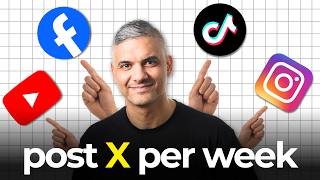
Alex Hormozi posts 450-500 times a week, Cody Sanchez around 300. The host breaks down a three-tier framework: Starter creators should aim for 10-20 short-form posts weekly plus long-form content, while top creators publish 250-300 pieces per week by repurposing one long-form recording into clips, quotes, and carousels. Higher volume accelerates visibility and algorithmic favor.
Chapters
Tom asks a question here on Q and A Wednesday that every creator eventually faces. Am I publishing enough content on social media? And how much is good enough? The real answer isn't be consistent. Okay? You hear this all the time. That's not the answer. What I found is that to be visible enough for the algorithm on any social media platform, posting two to three pieces a week is just not going to cut it. It's like fishing with a stick when everyone is fishing with a boat and a net, right? You need volume to create visibility. You need volume, get feedback loops to hear from your audience and get comments and learn about what they like and don't like. And the more content you put out there, the more chances you have that that one piece of content will go a little bit viral or get a little bit more reach than normal. Let's break down what enough actually looks like and what the real data from top creators are, because I know how frustrating this could be, because I was searching for this answer and I had to do all this research, and I'm just going to share it with you so that you know what the final answer is. Finally, what is enough? When it comes to posting on social media, there is no doubt that volume matters on social media. I found that the more I post every single week on social media, the more exposure I get, the more engagement I get, the more followers I get. It's just so undeniable. And most people don't actually see this because they're not actually increasing their volume on a regular basis to see this change because of sheer competition on social media, how crowded it is, how you must create enough content that some of it actually gets seen. All right, think about it. If there's so many people posting, if you want to be seen, you got to post a little bit more than most people do so that you can be seen. And from that, you learn what actually works and continue to create more of that kind of content. I'm going to start with the top, you know, the top creators in our space and what are they doing, right? How much are they posting? What volume are they actually hitting every single week? Some of these creators are pretty public about how much they post online. For example, Alex Hermosi, who is a business influencer, he reportedly publishes hundreds, hundreds of posts per week across platforms, even as high as 450, 500 pieces a week. That's about 65 posts per day across LinkedIn, Instagram, TikTok, YouTube, X, you name it. So think about that. He's posting 65 posts a day. Why am I giving you this example? Why does this matter? He's not posting randomly. He's actually systematically repurposing from other recordings, from other long form content. He does have intentional content, intentional reels and intentional short form. But that's how he gets data fast. He realizes, okay, this clip worked. This topic works. This, this idea works. Let me create more content on these ideas so that I can, you know, continue to get more reach on social. So one of the things I learned about social media is that it's all about experimentation. You're just throwing things out there so you can get some data and then you refine your, your data because you're now getting information, you have now new information. This is what's working better than other things. And you continue to experiment over and over and over and refine. Another example is Cody Sanchez. She has a brand that has really blown up in the last couple of years, but she's been doing it for a long time. A lot of people don't know this. She's grown a massive short form video count. Over 400 million views on her short form content across platforms. She has over a million followers on TikTok. Her reach is huge, but it's not by accident. She said publicly before that she posts up to 300 posts a week. Mel Robbins, very popular podcaster, has a New York Times bestselling book called the Let Them Theory. Reviewed it here on this podcast. Her strategy is really massive reach with a massive amount of content and not just posting on social media, but also posting long form videos on YouTube. She has over 1200 videos published on YouTube now. I wasn't able to get specific numbers about how much she posts regularly on social media, but she's been doing this for quite a long time, for over a decade. So she has lot of content that she's created over the years that is able to be repurposed and republished on different platforms. What about me? I've been doing this for 11 years and I admitted on the show several times that I ignored social media for nearly a decade. Right. I really didn't focus on social media until last year and really started to grow my presence there and started to up my numbers. Right. Right now we're publishing about 50 pieces of content per week. Right. That's more than average. Right. Most people don't, you know, average that many pieces of content. But I know that this is just the beginning that's going to increase and we're going to continue to grow our team so that we can continue to publish more Content so that we have more at bats and more information, more data so that we can create better and better content. I know that most entrepreneurs struggle to post even five to ten pieces a week. And when you hear things like Hermosi posting 450 pieces a week, it sounds impossible, right? So, so I want to give you a strategy. I want to give you a game plan. No matter how much time you have, no matter how much resources you have, you could start somewhere so that you can answer this question. What's good enough for you at this stage? So let me lay it out clearly. If you're just starting out, your aim should just to be to learn as fast as possible. You want to learn what resonates with your audience and what doesn't. What you should continue to double down on, what you should just kind of not worry about so much. So in order to do that, you need to Post at least 10 to 20 short form posts per week. That's enough volume for you to get some data that you can do something with, right? So 10 to 20 short form videos or short form content, that could be a reel, this could be on TikTok, this could be shorts on YouTube. I want to throw in a couple other things, like two to four feed posts per week. So like a post with a little bit of content, an image, something a little less, you know, interactive as a video, just maybe a picture and some text. And that allows you to understand who's resonating with your content in a little bit of a deeper level because it requires them to read and then one long form piece of content per week. I do this with a newsletter that's kind of the easiest one where you can write a letter to your audience. This level of production is enough output to get you meaningful feedback on a weekly basis. You could see on social media on your dashboard, which ones are the outliers, which ones are performing better than others, which posts. And then you can also see from week to week with your newsletter, okay, this one got more opens, it got more clicks. What was this one about? What was this really kind of delving into? Maybe I should go a little deeper in this area. Maybe I should talk about this area or the topics around this area more in future newsletters and see what happens. Quick tip. A great tool for YouTube stats is called Vidiq. It lets you know how you and your competitors are doing in terms of which videos are outliers, which ones are doing way better than the other videos on that channel or your channel. Okay, let's say you're past that point of starting out. The next step is growth tier. This is where you're going to start becoming algorithm friendly. Where we're posting 25 to 50 short form posts per week. This is like kind of where I'm at, right where you are posting, you know, lots of posts, multiple posts a day now, by the way, when I say posts, this is across social media. It's not just one platform. So you might not be on all the platforms, but you could spread these numbers across whatever platforms you're on. You want to bump your feed posts to four to seven a week and then you want to bump your long form pieces to one to two and long form again. It could be a newsletter, it could be a long form video. So for me, I post three long form videos on YouTube. This is a long form video because it's like more than 90 seconds. That's what long form is these days. But it could also be a podcast episode, audio podcast. But this also gives you more feedback. This level produces enough content again for algorithms for you to favor your profile and for enough posts to actually get the eyeballs. The next level or the last third level is the top tier. This is where you're gonna have incredible competitive advantages. Where I'm trying to move into, to be honest, and that's posting, you know, up to 250, 300 posts per week across cross platforms. So that would look like, like a long form video, 30 clips from that long form video, 30 quotes or carousels, 20 stories, 20 test ideas or reels. So if I want to compete at a higher level and grow at a faster rate, then this is where I need to be. Now we want to ramp up without burning out. So, you know, posting 200 pieces per week, it doesn't mean you have to do this on your own as a solo creator producing 200 original videos. No, it means we're going to start repurposing longer form videos a little bit smartly and we're going to have some systems and maybe we're even going to get some help to help us cut up these videos a little faster. What I find is that you should just focus on capturing the content, right? Capture that long form video, capture that short form video, do that reel, do that quick, you know, face to camera with your phone and just get the content into a file, right? Just get it created. You have a hot take on something, record it on your phone quickly, right? If you have a question that got sent to you on email, answer it on video, right? You have customer feedback Reactions, talk about it, right? You want as much raw material as possible. This is the hard part about content, right? It's not the editing, it's not the distribution. It's actually just constantly capturing as much content as possible. And you might want to block out some time in your calendar to make this happen. So you actually making content creation sessions for yourself. The crazy thing is that you can record something for one minute on your phone. One minute is nothing. And you can create different versions of that one minute video with different B roll, with different effects, with different cuts, with putting maybe the ending of that video in the beginning and then moving the punchline a little bit later. There's a lot of things you can do where you can create multiple pieces of content from one recording. Another tip is have repeatable formats. Don't reinvent every single day. So for example, here on the podcast, you'll notice that we have Q and A Wednesday. Like this episode. We have must read episodes where I talk about a book that I've read, right. We have extended interviews with experts, right. We have a lesson, right? These are my set formats because I know what to go to. I know what kind of content I need to create. So you need to create your everyday formats or your formats of content. So this could be like Hot Take or Myth versus Truth or lessons from mistakes. It could be case studies from your own customers, right. It could be framework breakdowns, it could be a lot of things. But the point is that you need to decide what your segments are so that you can just fill those buckets every single week. I find this to be very, very helpful because it reduces decision fatigue and the volume becomes easier. Now we talked about outsourcing and we want to outsource anything that doesn't need your talent, your genius. Okay? So even if you get a part time editor for $1,000 a month or $500 a month, some places they will charge $500 a month for part time editing, where you do all the shooting, you do all the directing, you come up with all the creative and they just edit the clips. Some will even do subtitles, they'll do the thumbnails, they'll do the scheduling, they do all the graphics. So try to outsource as much as possible so that you could just focus on the content creation, the original file. Just for context, you know, I'm producing 50 pieces a week. I have a whole team helping me out, right? I have a team of close to 6,7 people working on this every single day. And I know if I want to produce, you know, 300 pieces of content. I'm going to need more people, I'm going to need more help. So let me give you a progression plan that you could take on for the next 30 days so that you can start upping your volume. Here's your progression plan. Week one to two, I want you to add 10 posts per week that are repurposed, some other contents, other recordings, other webinars that you've created, and just increase your volume. If you're at zero, then it's 10 posts. If you're at 10, make it 20 posts per week. Week three to four, you want to add another 10 from new recordings, from reactions, from the things that you record on your phone, like I said, from the segments we talked about. Week five and beyond, try as much as possible to hit about 30 pieces of content a week as a minimum. You're going to start to see things change over time on social media. When you're doing this consistently, that's going to increase your visibility. And best of all, you're going to learn what resonates faster than posting once a week, hoping that people will see it and you'll learn something from it. No, the volume is going to be a game changer for you. By the way, if you find this episode helpful and interesting, you may want to subscribe because I have an episode that's coming up that is very special. That's called can you build a software business with AI in just seven days? This is an actual experiment that I did. I'm wrapping up this episode and I can't wait to hit publish on it soon. So make sure you subscribe so you don't miss it. Before I go, I want to leave you with this. Right now, you're in a strong intermediate zone where you are publishing, but you're just not publishing enough for you to move the needle. Right? You need to publish more than most so that you can stand out. But most importantly, from the data I shared with you today, you learned that frequency will accelerate your learning, you will increase your visibility, it will increase your ability to know what's working, what's not. And the volume and the feedback loops you're going to get is going to get faster, meaning that you're not only going to learn, but you're going to learn faster so that you can see improvement faster. What I found is that if you want real reach and discoverability, you need enough volume so social media can see you. The world of social media can see you and it's crowded out there. So if you're not doing more than most people, then you're just not going to be seen. And that's just the bottom line. I actually don't think it's worth doing, really. Honestly. If you're doing one or two pieces a week, you really should be aiming for a whole lot more, like we mentioned today, so that you can start to really see progress. You can do this. Take the steps forward. I thought I couldn't do it. For a long time, I really neglected social media. I changed my tune, I upped my volume. I learned from my content. I created different content based on what I've learned from my audience, and I've seen massive improvements. You know, I had no following on Instagram and now have over 100,000 followers. And I'm still just getting started, you know, and that's all because I increased the volume. If this episode helped you rethink your content strategy, the way you output your content on social media, I want you to check out this next episode. It's called why people turn against you when you start to succeed. Because that's going to happen as you start to grow a profile on social media. Once your visibility starts to grow, and it will, you'll start seeing reactions you didn't expect. And I want you to check out that episode because it's gonna allow you to become prepared for when that happens. I'll see you in the next episode. Take care.










