How To Retire In 7 Years Starting With $0 Proven Step By Step Plan
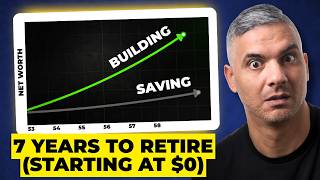
A five-step plan to retire in seven years from zero savings: build a business generating $400-500k annual profit, sell it at 3-6x that multiple for a $2 million lump sum, then invest the proceeds in dividend stocks and real estate. The strategy relies on creating an asset rather than saving more.
Chapters
I need to retire in 7 years and I currently have $0 in savings. What do I do? That's a real question I got from a listener called Vicki. Vicki's 53 years old, former accountant, empty nester. She's smart, she's capable, she's disciplined, but she's starting late. And when most people hear that, the advice that comes fast and brutal all over the internet is it's too late. Just lower your expectations. Be realistic. Is this even possible? Yes, it is possible. I know because I did it. And if I wanted to retire today, I could because I followed a very specific 5-step plan that I'm going to share with you today. Now, I got to warn you, this plan is not popular with cautious traditional thinkers. It's not going to win you any applause from most of your friends and family who believe that retirement only comes after like working hard for 40 years and sacrificing everything. If you're starting late, Saving harder and skipping lattes won't save you. The only way is something most people never consider: building an asset you can sell. Let me show you how. Step 1 of 5 steps is build an asset, not another job. Okay? This is where most people immediately go wrong. They hear retire and they think, I got to save harder. I got to spend less. I got to max out retirement accounts. And hope the market just behaves and does what it is supposed to do. That works if you're starting at 25. It doesn't work if you're starting at 50. Time is not on your side. I got to tell you the truth. You don't need another job. You need an asset. An asset is something that creates value without requiring your constant presence. It's something that can grow over time and can eventually be sold. Key point here. Some examples are like a software business, a content brand with products, a niche service that can be systemized. You don't need to be technical. You don't need to be famous. You don't need to be special in any way. You need to solve a real problem for a specific group of people with the experiences and skills you already have. That's how assets are built. For example, Vic, who asked this question, is a former accountant. She can hire other talented people to provide the service and start to scale and grow value in her company. Step 2, and that's where we get into step 2, is to grow the asset to a $2 million in profit business. Notice I didn't say $2 million in revenue, $2 million in profit. What you have left over after expenses. This is where clarity matters. You don't need a billion-dollar company or unicorn startup of some sort. No. You don't need a massive team. You don't need millions of followers on social media. You need a business that can produce results. And by results, I mean $400,000 to $500,000 in profit each year. Over the course of 4 to 5 years, that can slowly grow to become $2 million in profit. And that's very achievable if you have a high margin offer, one clear core product or offering, tight operations, you're very thrifty when it comes to costs, and you focus on execution, on delivering on your promises. Now, most people never reach this stage, not because it's impossible, but because they get distracted. Too many ideas, too many platforms, too many pivots. Focus beats brilliance every single time. By the way, if this kind of thinking is resonating with you, make sure you subscribe to the show because we have an upcoming episode that I'm working on that's called 5 Realistic Side Hustles for People Who Are Over 50 that require no new skills. Even if you just need a few thousand dollars more each month on the side so that you can retire comfortably, this episode will show you how. Hit subscribe so you don't miss that episode once it comes out. Step 3, sell the asset. This is the part people avoid talking about because they fall in love with their business. They see it being so profitable and it's growing. But listen carefully, you don't build a business just to run it forever. Okay? You can't because you will die, right? You build it to create options for yourself. Remember, we're doing this as a means to an end because you got 7 years to retire. Selling your business is not quitting. It's graduating. And the thing about selling anything is you need to sell it when it's on the up, right? When it's valuable, when it's promising. It's really hard to sell a business when it's really doing well. I get it. But that's the best time to sell because it's really hard to sell a business when it's on the way down or even plateauing. You want to be in a position of leverage. If you build a clean, profitable, well-run asset, buyers will pay you a premium, especially if they see growth year after year. They will pay 3x to 6x annual profit, sometimes more. But these are the averages. For buying a business that has these types of profits. If you're making $2 million in profit, that's really impressive. That means if your business is earning $2 million in profit, you could sell your business for $6 to $12 million. That's not theory. That's how exits work. I know because I experienced it. And that lump sum becomes the fuel for your next chapter. And leads us into step 4. Now, before you start blowing all that cash, we're going to be smart. We're going to lower expenses and be intentional as you prepare for retirement. This isn't about deprivation. It's about clarity. It's about you knowing what you can live off, right? Comfortably and in a way that feels good. Okay? When you know exactly how much it costs to live well, and I don't talk about being extravagant, but just feeling comfortable and feeling like, hey, you're, you're retiring in your own style. Like, for example, if your lifestyle requires you to, you know, I don't spend like $1 million a year, retirement feels impossible. But if your retirement is like more like, I'm going to spend $200,000 a year or $300,000 a year, it's very possible. Now you're playing a game that you can win. You're in a position of power. Okay. Now that you know, okay, this is my budget for retirement, how much I can, you know, pay for my expenses and live well. If I stick to this budget, even if it's just a little bit over the budget, I'll be okay. Now, step 5: invest in cash flow assets. Only now does traditional advice finally make sense because now you have some money to invest. After selling your asset, you want to move your capital into conservative income-producing investments, dividend-paying investments, boring, predictable cash flow vehicles. Okay, I know this sounds a lot of jargon. And by the way, this is not financial advice. Speak to an accountant or a lawyer, right? I'm just giving you something for education purposes, okay? So that you can wrap your head around how this is possible. At this stage, the goal isn't growth. The goal is income without effort. So because you're retired, right, you're not working anymore. So you're going to try to find assets like real estate that can generate rent, like, you know, putting money in the stock market and taking a dividend that can actually give you cash flow positive returns. And meet your financial goals. Now, one of the things I highly recommend is to invest in a financial advisor or a financial expert. I highly recommend you shop around because I shopped around a lot until I found a great one. Why? Because it's money well spent. These people are definitely well-versed in how to invest money and they know how to get you to your goal. So you could say, hey, this is how much money I need every year to I want to live comfortably. Here's my lump sum from my sale of my business. How do I invest this money so that I can have that recurring income? Now, I highly recommend when you're looking for a financial advisor, find somebody with a fixed fee. These people don't have a dog in the game. When they take some sort of percentage of your returns, then, you know, it can be kind of skewed, right? I kind of like the fact that when they have a fixed fee, because when they have a fixed fee, They're going to do everything they can to help you out. And they're not biased. They're not going to try to convince you to do something that you're not comfortable with so that they can make more money. At least that's my experience. Okay. So why does this work and why do most people never do this? Most people try to retire by playing defense, by saving leftovers, right? By avoiding risk. But when you have limited time, when you have 7 years to retire, this plan has to be all offense. Requires you to, you know, brush up your skills and develop some business skills, focus up, you know, start short-term discomfort, right? You're going to have some short-term discomfort for the next 7 years, but you're going to have a long-term comfort and long-term thinking of, hey, oh, in 7 years I'm going to retire. Everything's going to be smooth sailing from there once I sell my asset. And it works because you're not relying on time. Luck or market's behavior. You're actually taking control of the situation. You're relying on value creation and value always gets paid. Before I go, I want to leave you with this. Everybody who's listening, Vicky, who asked today's question, if you're listening, yes, it is possible, but not with the old rules, not with fear, not with excuses. 7 years are going to pass away like this, right? Snap of the fingers. The only question is, will you still be asking, is it too late? Or will you be living a life that finally feels like yours? You're going to have to invest into that life. You have to invest and earn that life in those next 7 years. If this episode clicked for you, then you're going to want to check out one of our previous episodes that we published called How to Make Your First Million Dollars in One Year without getting lucky, no matter what your circumstances are. I'm not saying it's easy, but I'm giving you a game plan and it will help you understand what to build and why this plan will actually work for you. So check that episode out. Thanks for listening, and I'll see you in the next one.










