How To Stop Trading Time For Money (Freelancer To Agency Roadmap)
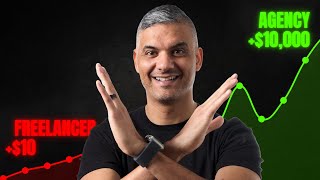
Omar Zenhom outlines five steps to move from freelancing solo to running a scalable agency: shift from working harder to building systems, productize your service with fixed prices instead of hourly rates, hire someone to handle your repetitive work, and document everything so the business runs without you. The goal is building an asset you could actually sell.
Chapters
If you're a freelancer right now, I already know something about you. You're busy, you're probably making decent money, but you're also extremely exhausted, because no matter how good you are, if you don't do the work, you don't get paid. And that's the ceiling you're dealing with. So today we're going to answer a great question from a listener who asked today's Q and A Wednesday question. How do I go from freelancer to building an agency without blowing up everything in my business? We're going to break it down step by step so it's not intimidating, but at the same time, you're making progress in a short amount of time. Let's get into it. The biggest mistake freelancers make when they're trying to become an agency, get out of freelance work, is they try to do more work, not different work. There's a difference here, and I'm going to explain. An agency is not you working harder. It's not you talking to more clients. It's not you answering more emails at night. It's you building an asset. An agency is a delivery system, not a person. It's something that you create to do the work for you. Your job is going to change tremendously. You're going to go from how do I do the work well? To how do I make sure the work gets done well without me? This is a mental shift, and the best way I can teach you this is how I learned this. I learned this actually from Ayman Abdullah, who is a business coach. And one of the things you need to do is you need to start becoming allergic to work. Yes, allergic to work. Which sounds very strange because hard work got you to where you are today. But in order for you to scale and build a business, you have to start saying, no, I can't do this because I'm allergic. I can't. And I need to get somebody else to do this. I need another system. I need a tool to do this for me, whatever it might be. You need to start delegating and start expanding now. Don't worry. You might think in your head all these questions like, oh, I can't afford it. How am I going to do this? Don't worry about that right now. Just understand the concept and then we're going to talk about implementation in a moment. Step one is to productize what you do. Before you hire anyone, before you get fancy, you need some clarity. You need to ask yourself some important questions. What do you do over and over again in your business? What do your clients hire you for every single time? What's the value? What is the actual thing that you solve for them? Right? What part of your work creates the most value for them? Think about it for a moment and feel free to pause and rewind and answer these questions in your notebook or on your phone. It's going to make a big difference and allow you to start implementing by just answering these questions. Because the answers to these questions are your core offer. It's not I do design work or I do strategic consulting. No, it's I help X achieve Y using Z. What does that mean? Well, I help busy moms achieve their health goals using a simple workout plan and meal prep. Whatever. The point here is, is that you are achieving an outcome for your customers. Your customers only care about the outcome, okay? Just keep that in mind. If you can get them the outcome, they don't really care about how you do it, okay? As long as it's legal and ethical, they're happy. Okay? So that is how you gotta start thinking about your business, because now you're gonna start thinking, what are some ways I can get those outcomes without me getting involved? Or at least you're involving yourself at the absolute minimum amount. Agencies, they grow by saying no to everything else outside of the outcomes, okay? You have to get laser focus about what you actually achieve for your customers. Step two is to stop selling time and start selling outcomes. Okay? Now that you have a clear outcome, you have to understand that freelancers, they sell hours and agencies sell results, right? If you want me to run your Facebook ads every single month and get you results, this is how much you got to pay. Doesn't matter how many hours it takes me to do this. I'm selling you a result. I'm selling you an outcome. This means fixed pricing. It means clear deliverables, and it means defined timelines. Customers really love when these three are in place because they can predict what's going to happen, right? They understand how much they have to pay, they understand what they're going to get, they understand how long it's going to take. Your offer should answer only one thing clearly, and that is what does the client look like after working with us? What's the after picture? You know, fitness is often used as an example when people teach business because it's one of the easiest ones to. To kind of see clearly. Like when you see those before and after photos of people that are getting fit, it's very compelling because you understand you have a clear picture. This is what they're buying they're buying this new body. What is that new body for you and your customers? When you sell outcomes, you can delegate all the execution to help them get to that outcome. But when you sell time, you actually undercut yourself. You actually devalue what you actually do. You're no longer selling an outcome which what people actually value. You're selling time. And time is really relative. A lot of people feel like $5 an hour is expensive. Right. You know, if you don't, I have some uncles and aunts you should be. But the point here is, is that selling time is counterproductive for you and your customers because your customers are not really valuing how long it takes. They actually would prefer it to take less time and, and would actually pay more if you can get them the outcome faster. Step 3. Your first hire is all about creating leverage in your business. This is where most people mess up. Your first hire should replace you, not support you. You gotta look at all the tasks that you do that consume most of your time. And you need to take those tasks and give them to somebody else so that you can start doing high level tasks. Tasks that actually bring in the big bucks. We're talking about somebody who could take 60 to 70% of your work off your plate. This was the first hire I made in my business. It's one of the most important hires because they're going to free you up from all the admin work that you absolutely hate and also sucks all your time. Whether it's email or scheduling or admin work or scheduling blog posts or publishing podcast episodes or filling in forms or descriptions or publishing your YouTube videos, whatever those things are in your business. They're very time consuming and you shouldn't be doing, you shouldn't be leveraging your time by getting somebody else to do this stuff. Yes, it costs money. Yes, margins feel tighter at first when you're making this higher because less money is going to be in profit because you're spending more. Now, this is how you buy back your time. And time is the only thing that lets you grow. And by the way, time is, is limited to all of us. We only have 24 hours a day. You, me, Warren Buffett, Sarah Blakely. Doesn't matter how successful these people are, they only have 24 hours in the day. That's the equalizer. So how do you make sure you use your time that allow you to scale your business properly where your time is only used on high leverage tasks. Tasks actually bring in the money that helped you grow your business so that you can make more hires so you can expand. You get the point? Step four, One of the hardest parts of this system, and that is when you need to start removing yourself. At this stage, your role starts to shift again, right? You start focusing on sales. You start focusing on client relationships. You start focusing on systems and HR and quality control and recruitment. You start to document everything. You start building SOPs. You get your assistant to help you with that as well. You get a better understanding who are the clients you're serving, so you can have better messaging in your sales materials, all that kind of stuff. And a lot of people view this as a little bit boring, a little bit unsexy, and they feel like, oh, I used to love rolling up my sleeves and actually doing the work. Yes. But you have to remember, if you want to build a scalable business, you're going to have to do things that are a little bit uncomfortable out of your wheelhouse. Because at the end of the day, you have to make a choice. Do you want to be a worker bee or do you want to be the architect? Right. The worker is going to do the work and pull out all the stops and do the R. And that's fine. Okay, you can do that. But if you want to scale your business and go beyond just yourself and make exponential amount of revenue, then you're going to need to sacrifice and start doing some of the work until you build a business to the point where you can just jump in and there's so many experts and so many people that can do the work for you. And then you could just do the design work or whatever it is for fun, or you can be part of the meetings that brainstorm ideas and. And have creative ambition and work, whatever it might be. The point here is, is that you have to understand that there is a period of time where you're going to do less of the stuff that got you started. Because what got you here won't get you there, won't get you to the point where you want to go. Now, you might be thinking, omar, okay, I build this agency. How do I stand out? How do I differentiate myself from other agencies? Well, I know that this is something a lot of us are thinking about, especially in today's day and age. And this is why I created an episode just on this topic called why does it Feel Harder than Ever to Grow and Stand Out? And by the way, you're not imagining this. Make sure you subscribe to the podcast, because this is coming out very soon. I crafted this episode to make sure that you understand like, why is this happening? Why does it feel really crowded in whatever space you're in? And how do you actually become unique and really get the attention of the right people that you're trying to attract? So make sure you subscribe. That episode's coming out soon. Step five is confronting the hard truth that if you're an agency, that only works because you are involved in everything. You don't have an agency. You have a fragile system. Listen, life is unpredictable. I'm telling you right now. There's going to be a time where you're not going to be able to be there full time. You're not going to be able to give it your full attention. It could be a family crisis, you know, God forbid, it could be a health scare, it could be, you know, something as small as an accident that you need to take care of. And, you know, all this stuff is, is kind of piling on your plate because you have other things to attend to. Clients want predictable results. They might have some sympathy for you, but at the end of the day, they have a job that needs to get done and they're going to find somebody that's going to get it done for them. If it's not you, they don't care who presses the buttons, right, as long as it gets done. That's when you're becoming an agency, when you're building a business, when you're building an asset. Now the reason why I really stress this word asset is because when you build an agency that doesn't rely on you, this is an asset that you can sell one day. You can sell your business easily because the buyer understands that this business runs regardless if you're at the helm or not. They can get somebody else to come in and be, you know, the leader, the manager and you know, the customers get what they paid for, they get the results. Your reputation doesn't take a hit, all that kind of stuff. So the value of your business sustains and you're able to exit your business and make some life changing money. When you transition from freelancer to agency to building an actual business, your income starts to stabilize, your time comes back, you stop starting from zero every single month, right? You have consistency. You build something that's actually sellable one day. This is where real businesses are born. This is kind of when you graduate into real entrepreneurship. Before I go, I want to leave you with this. If you're a freelancer right now and you're listening to this and you're feeling the tension, that pull, that's not burnout that's not you being weak or anything like that. That's growth. That's growth knocking on your door. The move to be building a business to building an hc. It's not about ego. It's about you having the ability to do what you're doing sustainably. You can't be a freelancer and grow unless you start charging astronomical amounts, right? It's very, very hard for you to be a freelancer and be sustainable for a very long time. And when you build a business around what you do, this builds freedom for your life. It's about building something that doesn't collapse if you take a week off, or a month off for that matter. If this episode lit a fire under you, your next episode should be this one. Three Ways to Force Yourself to Take Action because knowing the path isn't enough. Execution is absolutely everything. That's one of our previous episodes. You can find it here on the podcast and of course, subscribe so you don't miss what's coming next. And thanks, Will, for asking the great question. If you've got a question you want to ask here on Q and A Wednesday, go ahead and ask it over@100mba.net Q. I'll check you in the next episode. I'll see you there.










