Frederick Douglass Lecture 2024 - Human Trafficking - featuring Pardis Mahdavi, Pres. of ULV
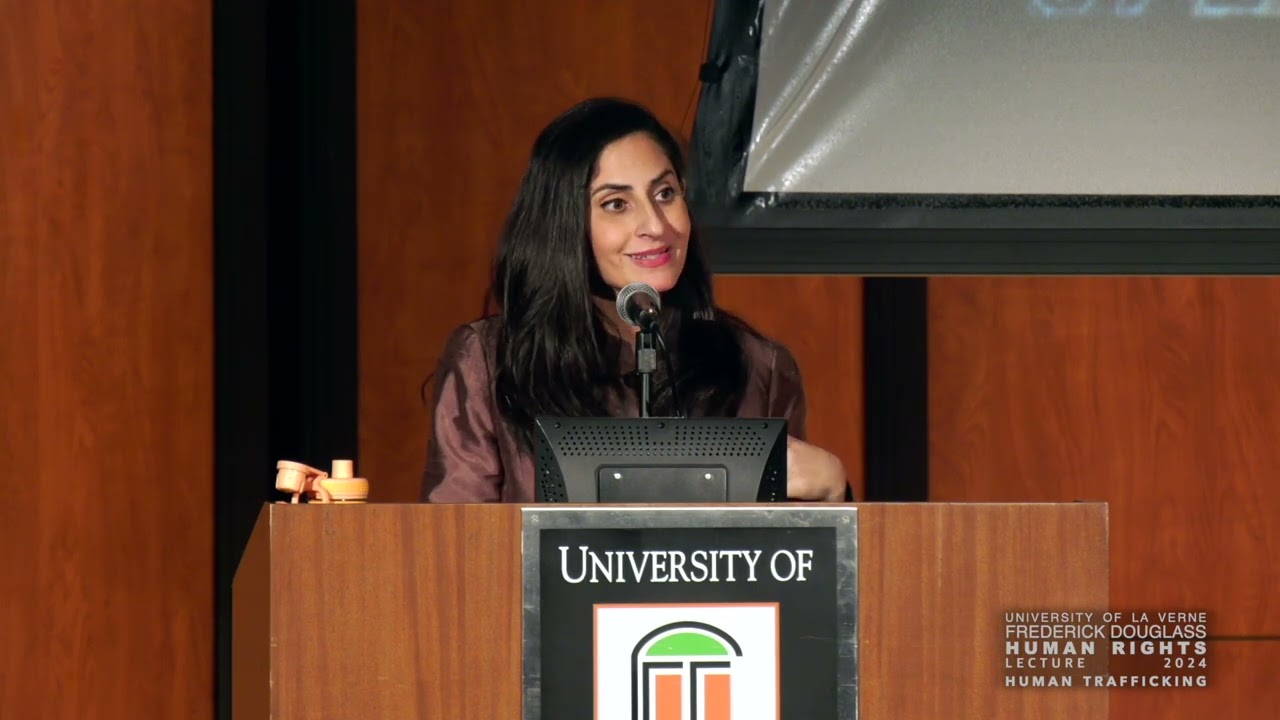
In the 2024 Frederick Douglass Human Rights Lecture, University of La Verne President and medical anthropologist Pardis Mahdavi presented a comprehensive analysis of human trafficking that blends ethnographic case studies with a critical examination of global and U.S. policy frameworks. Opening with two vivid narratives—Anu, a Malagasy woman forced into domestic servitude in Dubai, and Ravi, an Indian chef coerced into labor in Kuwait and the United States—Mahdavi illustrates how legal definitions, recruitment practices, and host‑country labor regimes (e.g., kafala) shape survivors’ lived realities. She critiques the dominant definitions of trafficking in the Palermo Protocol and the U.S. Trafficking Victims Protection Act (TVPA), highlighting how gendered, racialized, and class‑based narratives produce moral panics that conflate anti‑terrorism rhetoric with anti‑trafficking efforts, marginalize male victims, and narrow policy focus to sex work. The lecture surveys unilateral policy tools such as the U.S. Trafficking in Persons (TIP) Report tier system, the Philippines’ Household Service Reform Package, and UAE police‑centric recommendations, arguing that these often exacerbate exploitation. Mahdavi contrasts abolitionist (demand‑reduction) and harm‑reduction approaches, advocates for data‑driven, multilateral strategies, and stresses the need for survivor‑centered services, especially at borders where lack of support fuels trafficking. Audience questions explore the evolution of T‑visa issuance, U.S. domestic trafficking, and the role of guest‑worker programs, to which Mahdavi responds by emphasizing shifting law‑enforcement partnerships and the structural parallels between Gulf and U.S. labor migration systems. The lecture concludes with a call for honest, nuanced, and rights‑based policy making that recognizes trafficking as a labor and migration rights issue rather than a singular sex‑industry problem.
Chapters
So good afternoon. My name is Shannon Matthews. I am the Dean of the College of Arts and Sciences, and I would like to extend a heartfelt welcome to our dynamic speaker, who I will introduce in just a moment. A special guest in the audience, Sheriff David Rhodes from Arizona, the Yavapai County. He's also doing wonderful work with human trafficking, so I want to acknowledge him. Would like to also acknowledge any other special guests in the audience, faculty, staff, students, Board of Trustee members, and community partners. It is a great pleasure for the College of Arts and Sciences to host the University of La Verne's Frederick Douglass Human Rights Lecture Series. This lecture series was supported by the Board of Trustees and is a lecture series that highlights the importance of human rights concerns, issues, and principles to our students and the community across intersecting disciplinary approaches. Through this public lecture, the university involves contemporary scholars, thought leaders, authors, artists, activists, and policymakers to promote dialogue within the campus and beyond, and to act as a bridge between scholarly insights and the practical and lived realities of human rights concerns. The lecture is aptly named after and in honor of the 19th century author, orator, and activist Frederick Douglass, who was an eminent human rights leader in the anti-slavery movement, which is very fitting for our topic today. The lecture serves as a forum during Black History as an intentional programming event to address issues related to peace and social justice. Human trafficking as a social issue has come more and more to the forefront of conversations. Some of you have— may have even noticed signs when you go to the airport or even at local restaurants urging us to pay attention, to help victims, to contribute, and to also consider the impact on our wider community. As a result, we could not ignore the topic for this year's lecture series. Some of you may have even seen the film and seen the issue presented on the big screen in The Sound of Freedom, which alarmingly notes that human trafficking is outpacing— as an illicit industry, it is outpacing drugs and arms dealings. It is necessary, as a result, to discuss this issue. It was truly a no-brainer once we came up with the human trafficking theme for this year. It was a no-brainer to think about our 19th president, Pardis Mahdavi. She is not only a contemporary scholar and thought leader in regards to the topic, but I am also meeting my initiative set by President Mahdavi to be a good steward over institutional resources. And she is a valued treasure right here, so why not invite her to share with the community? President Makdavi has shed light on human trafficking through books such as Gridlock: Labor, Migration, and Human Trafficking in Dubai, the first edition, and also in Trafficking to Terror: Constructing a Global Social Problem, Framing 21st Century Social Issues, the first edition. In Gridlock, she explores the migrants' actual experience in Dubai, contrasting that against the discussions on a global global moral panic, thinking about the global discussion of human trafficking and contrasting their experiences. She also contrasts that with interviews with U.S. policymakers revealing the gaps and disconnect between policies and human trafficking. In her book From Trafficking to Terror, she also examines how the socially constructed war on terror and the war on trafficking are linked through discourses that not only combine the two, but help promote an anti-Muslim sentiment, and presents the need to challenge the idea of trafficking and terror paradigm, and rethinks approaches to the larger-scale challenges that this topic presents. So she is a fitting scholar to share with us on this topic. Please help me welcome to the podium our 19th president, scholar, and thought leader, Pardis Mahdavi. Thank you.
Good afternoon, everybody. Oh, good, we're getting there. Thank you so much, Dean Matthews. Big, big debt of gratitude to you and your team, to our fantastic marketing communications team led by our AVP Oliver Yunaka. Thank you so much to all of the students, faculty, staff, and trustees, and distinguished guests who have joined us today. Many of you have seen me in the last 6, 7 months giving talks about where the university is headed, talking a lot about higher education, and in those roles, I am wearing my president hat, where I'm optimistic, forward-thinking, excited, trying to have that positive outlook. Thank you. Glow, if you will. This is a topic where I'm going to take off the president hat and wear my scholarly hat, and many of you don't know me as a scholar as well, so it's an absolute honor and pleasure to be able to talk about my academic work. But I also want to remind you that trafficking is a very heavy issue, and so that same level of optimism, joy, excitement that you might have traditionally heard from me in other speeches, you might hear a slightly more somber tone, and that's a reflection of where we are when it comes to human trafficking. Trafficking as one of, I think, our most wicked problems and one of the gravest human rights issues that we face. So, for those of you who don't know, I am an anthropologist by training, a medical anthropologist by training. And when it comes to human trafficking, I've spent more than 15 years doing fieldwork, mostly doing fieldwork in the Middle East, in the Gulf countries of the United Arab Emirates, Kuwait, Qatar, as well as in sending countries. So I did fieldwork in India, in Madagascar, in South Africa, in Ethiopia, in the Philippines, in Vietnam, and in Indonesia. So following the journey of migrants and their families. And Dean Matthews spoke about the 2 first books I wrote on human trafficking, but I also wrote a 3rd book called Crossing the Gulf, which was really about the intergenerational impacts of human trafficking on the children children of trafficked survivors and how policies on citizenship and statelessness have a tendency to perpetuate structural violence in those contexts as well. And I've had the more recent great pleasure of being an editor on 2 edited volumes that focus on human rights and human trafficking as a human rights issue. So when I got the generous invitation from Dean Matthews to present today, You know, my first question was like, are you sure? Why don't I just suggest a trafficking expert? And she convinced me by reminding me of our commitment to conserving university resources. So here I am. You're stuck with hearing me yet again, although in a slightly different capacity. So as an anthropologist, I'm an ethnographer, I'm a qualitative researcher, but at the And before I put numbers and policies and statistics in front of you, I like to start with a human face. And so, I want to tell you the story of 2 different individuals that I've had the great privilege to know over the course of my fieldwork. I want to introduce you a little bit to their stories, because they reflect the many layers of challenges that trafficking survivors face. So, I'm going to start with a story face when it comes to finding their voice and finding a way to promote and protect their human rights in the face of policies that weren't necessarily designed to protect them. So I want to introduce you to a young woman by the name of Anu, who was 24 years old when I met her. Anu grew up in Antananarivo, which is the capital of Madagascar, where I did a good amount of fieldwork roughly 10 years ago. When Ania was 22, her husband, who was an alcoholic and a gambler, disappeared, leaving her with her 3-year-old and 1-year-old to care for alone. Her husband had also racked up tremendous debt, and so she was left to manage all of the financial situation of the family. In addition, 3 months after her husband disappeared, she found out that her 3-year-old had received a very grave diagnosis and was going to need a surgery that would have cost far more than she or her family would ever have been able to cobble together. Around that time, she met a friend who had recently returned from Dubai and said, you know, there was a lot of opportunities for work in the Gulf and would she be interested. And again, really not knowing another way to make ends meet, she said, yes, absolutely, I'll be interested. And so this friend took her with her to the Ministry of Labor. Unfortunately for Anu, earlier that year, there had been policies passed throughout 15 different sub-Saharan African countries that stated that women as migrants to the Gulf could not out-migrate unless they had undergone a 9-month course. so that they could learn about the various skills which were being demanded in the Middle East. Anu didn't have that kind of time. The diagnosis from her son's doctor had given him less than 6 months to live. Defeated, she began walking home, and on her way home, an unscrupulous middleman recruiter, which is not uncommon, found her and asked what she had been doing at the Ministry of Labor. She told the story, and he said, well, I can I can get you there, and I can guarantee you the equivalent of $900 US a month if you just come to the Comoros Islands, and then I'll take you to Dubai, where you will be able to work in the school as an assistant to the schoolteacher. She— that sounded good to her. He said, but I do need $900 upfront. She borrowed from friends and family, paid the middleman recruiter, went to Dubai and, of course, was promptly placed not in a school, but in the home of a family there. In the course of that time, she was assigned as a domestic worker. She was made to work 18 hours a day, very little food or sleep afforded to her. And at one point, when she agitated for her wages, her employer raped her. After she was raped, she soon discovered that she was pregnant and decided to go to the police station Dubai to report the rape and seek out prenatal services. Unfortunately, what Anu didn't know is that women in kafala countries— and of course kafala has since been reformed, but at the time, and this is still the case on an operational level, women are contractually sterilized. That's a term I've used. In essence, the contracts stipulate that when women are in country, that when migrants are in country, they are not not permitted to engage in any kind of sexual relations. Any evidence that they've engaged in sexual relations is grounds for immediate arrest and imprisonment. So Anu going to the police with a visibly showing pregnant belly was a visible marker that she had violated a contract that she did not even sign. So she went illegally into the legal economy. Again, we shade between legal and illegal, and that's going to— that's going to be important. Thank you. But she was immediately arrested. When she told them that she had been raped, they said, prove it. Very challenging to do that. And her employer said that he had had nothing to do, of course, with the situation. She was then kept in prison until she had the baby. When the baby was born, she spent the first 6 months in the prison nursing the baby. And then at the end of 6 months, she was deported, but the child was stateless, because of course citizenship passes through the father, and they don't have birthright citizenship in the Emirates. So the child was stateless and could not return home with his mother. So she was sent home, she was deemed an unfit mother, and she was sent home only to realize that her 3-year-old was on the brink of death. And so She, again, allowed herself to be smuggled, this time into Saudi Arabia, and I never heard from her again. I had the great fortune of knowing her briefly while we were advocating for her case in court, which was ultimately dismissed. The next person I want to introduce you to is a man named Ravi. Ravi hails from the state of Kerala in India. Ravi made the decision to migrate after his dad died, and his dad had been the primary breadwinner. His mom was also sick, and he was going to have to support the family. They were 7 siblings. Ravi had trained to be a chef, had trained to be a cook, and he had heard about employment opportunities in Kuwait. When he went to seek out these opportunities, he, you know, they asked him what his skills were. He said chef, and they said, okay, you're going to migrate to Kuwait and work as a chef. When he arrived in Kuwait, he was placed on a U.S. military base, and his assignment was cleaning septic tanks up to 20 hours a day. He was not paid his wages. And when he agitated for his wages, he was sent to the embassy, which kicked him into this cycle of like, where do I go to get my wages? Is it Kuwait? Is it the U.S.? Because it's a military base. Where is it, and what is it? But throughout the process, he met several folks who told him that if he really wanted to be a chef and he wanted to make money, that he should come to the United States. So he did. He had met somebody when he was at work, and they actually facilitated him to, to come to Riverside County here in California. But when he arrived in Riverside, he was not assigned to work as a chef. He was actually assigned to work in the tomato fields as a as a tomato picker. He had the great misfortune of an employer who regularly pistol-whipped the employees. And when he went back to the person who had facilitated his migration, the person said, well, it sounds like trafficking, and why don't we go and try to get you a trafficking visa, a T visa, which is something I'll talk about in a moment. And so, he went to Riverside County to seek out a T visa. T visa, but when he introduced himself and used the word trafficking, everybody laughed at him, because they said men are never trafficked. So he was turned away, was not able to have a T visa, and then ended up actually, because he could not return home empty-handed, voluntarily returning to the Middle East, this time to work on a British military base, where he today is once again scrubbing septic tanks. So again, I tell you these stories so that you can kind of put a face to some of the issues that I'm going to talk about. So I'm really kind of— a lot of my work focuses on 3 main interconnected points. One is that trafficking as an issue has been misdefined often. When I would teach about this, I would explain to students that the concept of trafficking it's sort of like a rubber band, where in the zeitgeist at least, and this bleeds over into policy to an extent, it stretches wide enough to encapsulate everyone in the sex industry, but then it shrinks to exclude people outside the sex industry, such as domestic workers, and oftentimes men. And this is problematic both for people who are in the sex industry, Again, we can talk about forced choice agency, who aren't trafficked, but it's also problematic for people like Ravi, who are trafficked on many different levels and cannot seek out restitution. So it's sort of like that rubber band that stretches and shrinks. There's an absolute disconnect between policies on human trafficking and lived experiences, and I'm gonna give you examples of 3 such policies that have actually made the work of many of us who seek to do advocacy for human trafficking. And then, you know, you have this issue of campaigns, of social justice campaigns, that rather than seek to provide restitution or that seek to elevate the issue or seek to strengthen policy on human trafficking, they are conflating the issues, right? And so, kind of at the heartbeat of what at least 2 of my books were on was that trafficking as a concept has been raced, classed, and gendered. And it very much reproduces a lot of colonial narratives about labor, but about bodies, gendered bodies, and different types of bodies, as that intersects with labor. So, it's important to start with some definitions. About trafficking, because people use this term, again, to leverage. So it's often misused. People who are trafficked are labeled as not if they don't fit a certain stereotype, and then people who aren't trafficked are labeled as trafficked. And then you have the issue of foreign policy using trafficking as a way to go around other maybe potentially more diplomatic channels. But so, the official definition of trafficking is from the Palermo Protocol. And the Palermo Protocol, the full— we call it the Palermo Protocol, but it's because it was signed in Palermo. But the full name of that is actually salient, because it's the United Nations Protocol to Prevent and Suppress Trafficking in Persons, Especially Women and Children. And I call your attention to that last part of the phrase, especially women and children. It leaves out non-binary and men individuals, but also equally problematically, the constant repetition of women and children, women and children, women and children gets us to a place where women are infantilized as children, right? So it can be kind of a reification of a problematic trope, if you will. The other thing to note about the Palermo Protocol is that it operates and is housed in the United Nations Office on Drugs and Crime, which is a curious place for a human rights document. Nevertheless, this is the official definition: the recruitment, transportation, transfer, harboring, or receipt of persons by means of the threat or use of force or other forms of coercion, abduction, fraud, deception, the abuse of power, or the giving or receiving of payments or the benefits to achieve the of another person for the purposes of exploitation. It's a mouthful. We just say force, fraud, or coercion. But that's really important to think about, because it doesn't say anything about gender or age, right? It's force, fraud, or coercion, and it doesn't talk about the particular industry. So, again, much of trafficking is outside of the sex industry. We'll come back to that. In the United States, we have the TVPA, the Trafficking Victims Protection Act, an act to combat trafficking in persons, and I call your attention to the next few words, especially into the sex trade, slavery, and involuntary servitude, to reauthorize certain programs to prevent violence against women, and for other purposes. Again, that narrowing. TVPA, Congressional Order H.R. 244, was signed into effect by Bill Clinton, but it was reauthorized by George W. Bush, and that's the distinction that was then made between trafficking and severe forms of trafficking— that's the TVPRA— and only the latter are seen as deserving of a T visa here in the United States. And so, each state does it a little bit differently, but for the longest time, in California, the threshold of abuse was so high that if somebody had experienced force, fraud or coercion, but hadn't been sexually violated, we couldn't get them a T visa. That would keep them safe long enough to testify against their traffickers. It was also— it's also of note that the way in which that bill was crafted, 5,000 T visas per year were supposed to be given out. But in a 10-year span between 2007 and 2017, even a total of 5,000 hadn't been given out. That was, again, because the threshold was so high, it was very difficult to have that. So, I mentioned that, you know, that in the— both in the zeitgeist and at the policy level, the discourse around trafficking is very much influenced by race and gender and class. So, it's salient to note that this year marks the 23rd anniversary of both the War on Terror and the War on Trafficking. So interestingly, the TVPA was written the same year that 9/11 happened. And so you have a little bit of this moral panic thing going on. So while it— while the TVPA was architected before, and the word trafficking was starting to enter the zeitgeist, it actually wasn't until after 9/11 that it got some legs. And that was part of a much larger moral panic around what Sam Huntington has called the clash of civilizations. And so, it's not an accident that the war on terror and the war on trafficking kind of collided in these really interesting ways. Particularly during the war on terror, this Islamophobia that introduced a trafficking and terror paradigm without any data. So there are very robust data on the connections between trafficking in persons and trafficking in drugs. However, trafficking and terrorism, that was a trope that was introduced as part of a much larger campaign around Islamophobia. So, the war on terror absolutely— this is Mahmoud Mamdani's work— sought to carve the world into good Muslims versus bad Muslims. And then there was a new category introduced called terrifying Muslims. And the war on terror was very much a hyper-masculinized trope to paint kind of the world into villains and victims. So, I'm wondering, Many people saw it that the war on trafficking then was the hyper-feminized antidote to the hyper-masculine war on terror. And you had a lot of savior narratives that were introduced, and this is from Leila Abu-Lughod, who's an anthropologist who was one of my mentors, this notion of the need to save brown women from brown men. These were the narratives that you heard a lot, and and you heard them as justification for a lot of U.S. foreign policy in the Middle East. People used this need to save women, and trafficking was introduced. And again, there's this kind of conflation of issues. And again, we need to sort of unpack it. Like trafficking is absolutely an issue, but to use it in these ways. Actually obscures the more robust policy architecture that we need to do. And we see this again today, by the way. So I don't— I don't want to say it's one presidential administration. Today we see this in the way in which the Biden administration has tethered border funding to Ukraine. You see this sort of playing on a certain type of moral panic to pull at the heartstrings of a population in order to have a certain type of foreign policy gain. There's no real reason for them to tie those 2 together at the federal level. However, it's been done over and over again, and that's what a lot of my research showed. So this was bolstered by— even by films. So how many of you— I can't even see the audience— but saw the film Taken with Liam Neeson? That's something you saw, Taken, right? Yeah. I hate that. I hate that movie. And here's a spoiler alert. At the end, it's the 15-year-old upper-class white girl who is taken by dark-skinned men with Middle Eastern accents and sold for her virginity on the yacht of a wealthy Emirati. So it's this like, here are the villains, and they're going to traffic your daughters. And I'm like, no, that's not how it's working. And I remember I was invited to a lunch in Beverly Hills, actually, and I remember the woman who introduced me, and she said, okay, we've got to talk about trafficking, because this could be our daughters and our sisters. And I'm like, not really, though, because most trafficking is tethered to issues around class, and most people who are trafficked It's because they've run out of options, right? And so, that kind of obscuring of the narrative is incredibly challenging. When you overlay that with the war on terror, you get this race-class gendered paradigm that is incredibly difficult to to to work through. What it does is it creates policies that, in the words of one of my interlocutors. you know, you close the door, but people have to open the window. When you don't get what trafficking is, right, then you keep creating policies that are not in the interest of survivors. So, the trafficking debate. I should note that part of my fieldwork— and now we're transitioning into gender from race— but part of my fieldwork also was conducted when I was a fellow at Google Ideas. And I was brought on as a fellow because this was a time when Google, Microsoft, all— a lot of the tech companies wanted to figure out how they could use technology to, like, disrupt trafficking. And that was, like, the key word, like, disrupt trafficking networks. And, you know, I remember walking in on my first day at Google and saying, OK, well, so you know there's 2 sides to the trafficking debate. And it was like silent, like it is right now. And I'm like, you do know you've just awarded $11 million, and you do know there's 2 sides. And they're like, what are you talking about? You mean that there are people who are pro-trafficking? And I'm like, no. The anti-trafficking movement, it sort of has broken into 2 different sides. You have the abolitionists, and you have the harm reductionists. Now, a lot of it has come down to your people's stance on sex work. And so the abolitionists— and again, watch the, watch the way in which they use that word— the abolitionists believe that you can end trafficking by ending demand for sex work. It's not really working. It's also, it's also So, you know, like, you're, you're gonna end demand in what way for the world's oldest profession? And also, that obscures the fact that a large percentage of trafficking is actually labor. So you're gonna spend all your time trying to end demand for sex— again, good luck— and end demand for sex work, but you're okay to buy clothes from Forever 21 and wherever else is using trafficked labor to produce your goods. Again, that narrative became very problematic, and it became very problematic because they very much focused trafficking on sex, which made it nearly impossible for those of us who were working on, on labor trafficking. And again, it obscured the real issue. So the abolitionists believed that you could end trafficking by ending sex work. The harm reductionists were more pragmatic, believed you've got to understand the issue and meet people where they're at and try to provide services that allow folks to get out of the situations that they're in, recognizing that this is part of a larger political economy where people are doing, you know, are making decisions from a series of limited options. So rather than looking at force and choice as a, like, as a, you know, binary or dichotomy. The way I explain it to my students, and I realize now that most of you don't see telephone cords, but it's sort of like a circular telephone cord if I could draw it, where people are constantly forced to choose from a series of limited options. So think about Anu and Ravi. Anu did not want to leave Madagascar, okay? She did not want to leave Madagascar, but her options were shrinking. And so she had to decide between letting her 3-year-old die and making a very difficult decision to migrate in the hopes of gainful employment so that they could send money home. Force and choice is not a dichotomy. You're constantly forced to choose from a series of limited options. But when you reduce the debate in this way, it becomes very challenging to start to look at, well, what are the push and pull factors, and what are the larger political economic things at play that result in people having to choose from a series of limited options? So when we think about gender, you know, again, this, this was in the zeitgeist, and it crosses over into the policy world as well. Women who were in sex work were seen as trafficked, and this was evidenced by rescue efforts that oftentimes were— consisted of brothel raids where women in the sex industry, again, it's sort of like forced choice. Many of them would say, look, this is— this— I'm choosing from a series of limited options. Sex work is what is giving me the most financial options. But women were forcibly dragged out of brothels often by their hair, often beaten in the process, and told that they had been trafficked. And that was an incredible, incredible challenge. I remember interviewing a sex worker in Dubai, and she had like the nicest apartment I'd ever seen. And I remember, you know, like finding out that she made more than I ever will. And I remember asking her, like, well, you know, why is this a choice that you've made? And she looked at me like, you silly woman. She's like, 'cause I'm too pretty to scrub toilets. And I was like, oh, I mean, that's— you know. And she said, I can make so much more money, and I send money home to Iran every year. And, you know, this is the way I've chosen. And again, that's— force and choice is so nuanced. But to make a decision and to reduce all women in sex work to traffic victims, doesn't really do anybody any good. Men and women in other industries were labeled as migrant workers, and in fact, when I first started doing this work back in 2004, people would actually laugh at me when I talked about men who were survivors of trafficking. I still get that a little bit in certain states, but that was definitely the case. And so, you know, women are typically painted either as victims of trafficking or of circumstances, Even though there are many reasons for migration, many of which are our policy, men are conceived of as migrants and never trafficked. There are limited outreach venues globally for male workers in need. When men do come forward, the men that I've interviewed in the course of my research, when they do come forward seeking restitution or services, they're told to be grateful for the opportunities that they have. Have abroad as opposed to what would happen if they stayed home. So again, the migrants' rights movement to reform kafala in like 2010 and 2012 was eclipsed by the global moral panic about trafficking. So for those of you who don't know, the labor system which is called kafala in the Gulf states was actually modeled on the United States bracero system. How problematic is that? So the kafala was modeled on Bracero. And then the United States decides to criticize the Middle East for kafala. And it's like, but they modeled it off of your program. That's one thing to note. The second thing is that when actually a lot of the Gulf countries were starting to work to abolish kafala and have a much more robust labor rights movement in place, the United States came in and said, you need to show more evidence of trafficking. Trafficking prosecutions, and you need to show more of a commitment to combating trafficking. And so countries like the UAE were stuck, right? Because suddenly they're put in this pressure cooker by the United States to enact and engage policies that go against what most of the— even their own citizens are agitating for. So these are some of my interlocutors throughout my fieldwork. It's a group of migrant domestic women that I followed. So, transitioning now to policies. Again, as I mentioned, the Trafficking Victims Protection Act was signed into effect by Clinton, but reauthorized and revised by Bush. Out of that, we got the Trafficking in Persons Report, as well as the Palermo Protocol. Those were kind of inspired by the TVPA. And then you had unilateral policies such as the Philippines Household Service Reform Package of 2006. And I'm going to kind of unpack some of these for you just so you have a sense. So, the Trafficking in Persons Report is put out by the United States. And while the TIP report was created in the early aughts, the United States did not rank itself for the first 8 years. Once the United States did start ranking itself at the insistence of a group of us who were working in Washington, D.C. at the time, since then it always gets to be Tier 1. So, that makes some people a little bit dubious. The Trafficking in Persons Report puts countries into a 3-tier system, sort of that watch list is that middle tier. And then that is leverage that's used at a foreign policy level. And I'm going to give you an example of that. When the United Arab Emirates was put on the Tier 2 watch list, that happened to be the same year that the United States— that Secretary Clinton actually wanted to get a better deal on the 123 nuclear agreement. And so they leveraged this. So, again, it's a tool that's leveraged for foreign policy, as opposed to being reflective of trafficking. Now, I also want to call your attention to these tiers. Take a look. Tier 1, United Kingdom, Sweden, Italy, and Australia. Okay? Mostly our allies. Tier 2, Brazil, Romania, Thailand. It's like, well, we're kind of cool with you. The watch list— and Philippines has since moved off that, although they bounce kind of on and off. Also, again, and Russia sometimes, depending on how we feel about them. It sort of moves. And then Tier 3 are the, are the countries that we definitively are not super cool with. And to me, the most striking instance of how problematic this is is the fact that Italy's on Tier 1 and Iran's on Tier 3. So let's— show of hands, how many of you have been to Iran? A couple of you, right? Like no one, right? It's very hard to get in and out of Iran. And when I asked And when I asked the representative for the TIP report why the United States had put Iran on Tier 3, nobody could answer, and they said, well, I think it's just easier to leave them there, because we're sanctioning them anyway. Again, undermines the teeth. Italy, by contrast, most of us who work on trafficking have met a fair-sized percentage of survivors that have at some point transited through Italy. So, it's just interesting to note that there— that there are these biases of the Trafficking in Persons Report. So, the specific recommendations for the UAE, interestingly, was tighten your borders and increase your police. Now, tighten your borders, again, in the words of my interlocutors, that's like close the door but open the window. The demand for migrant labor was still there. People were just finding— they were having to go through unscrewed middlemen, right? Again, like, if you think about Anu's case in Madagascar, she wanted to go legally, and she wanted to go in a way that would have been more protective for her, but because of a variety of policies, she wasn't able to do that. They also recommended that the UAE increase their police. Now, and this is a tricky instance, because the UAE at the time, 75% of their police force was imported. And untrained, and so increasing police without actually training law enforcement contributed to some of the problems which which became very challenging. At the same time, what what activists in country were asking for was the legalization of civil society. But the tip very much said you've got to focus on prosecution rather than on restitution or rather than on. Services and outreach to survivors. Unilateral agreements and development strategies can also be challenging. Again, the unilateral agreements, you know, I think the example of the Philippines, the 2006 household service reform package, is very telling. So in 2006, there was a unilateral policy where the Philippines, after receiving too many women back home in body bags, the government said, OK, you know, we need to actually have some ground rules here. You can't treat our citizens in this way. You can't have no days off. People can't be experiencing this level of abuse and this level of mental health challenges. And so, you know, they signed that with the Philippines, and then they turned to Indonesia to recruit. This is why multilateral policies are much more helpful. When you think back on the Philippines as well, what's of note is the historical context. So the Philippines has structural adjustment programs, right, that are again policies written in Washington, D.C., IMF, and World Bank. The structural adjustment policy program—they they they have tethered the debt relief of the Philippines to migrant remittances, right? So policy drafted in DC about the lives of people in the Philippines tethered my— tethered their debt relief to migrant remittances. We know that women remit at twice the rate as men. So what does that mean? That means that a government like the Philippines is more invested in sending women abroad than in finding jobs at home. And what does that lead to? Poverty. 60% of kids in the Philippines grow up without their moms because they are very much upholding the care economy. So that gets into sort of intimate labor. But again, the idea is just to note misguided policies can sometimes create more problems than they solve. We need to be a little bit more honest about what trafficking is and it isn't. Force, fraud, and coercion means that we need stories of lived experience experiences to help us understand what are the circumstances that produce trafficking and what can we do at a policy level. So what does it mean when we say tighten the border? What does it mean when we say we're not going to support services at the border, like the US-Mexico border? That means that the field is open to unscrupulous middlemen recruiters, and that's typically where trafficking is— breeds. Right? And so, again, when we're not honest about what it is, and we have this assumption that it's really just about the sex industry, or it's really just a problem over there, we're not able to actually craft policies that allow for the protection of the human rights of those who are most impacted. And again, that's where you'll see my refrain. That's probably the one crossover between my 2 hats, is data. Again, we need data-driven policies. We need policies that actually look at how many people are trafficked from which countries, how many people are migrating, how many people are facing challenges at the border, and at whose hands are those challenges, when we bring it to both a domestic level and beyond. So, again, the assistance is typically predicated upon, you know, are you in the right industry? Is your threshold of abuse what we would think of it? And how do we think about civil society? Again, you know, if you took the amount of funding that is placed into the TIP versus, you know, and the ranking system versus what's put into support services. If you looked at funding for prosecution versus funding for services, let's say at the border, you see a pretty huge discrepancy. And again, it's typically because it plays into that, like, oh, you know, trafficking is really about sex work and we've got to abolish that. It doesn't allow us to get at the heart of the problem. So the giving or withholding of outreach services can play a major role role in perpetuating or alleviating trafficking-like situations. And this is where we start to get into legal productions of illegality. You start to shade, right? And again, when you don't provide the services that folks need, and when you, when you actually create a situation that's— that doesn't look at the historical context of, like, push forces and pull forces, right? So, so, you know, we see this right now at the US-Mexico border, right? People are coming. They're told that there's a lot of jobs here. They're told that there's a demand for work here. There's also very serious push factors in a lot of the countries that they're coming from. But then we don't have the infrastructure, right? And then we're saying, okay, well, we're really just going to tether the money that goes to the border to the money that goes to Ukraine. Not recognizing that by doing that you create a trope that elides the actual heart of the problem. And, and I do want to just note that for a long time human trafficking was not seen or embraced by the human rights community. And the reason for that was it was seen as like too much of a hot-button issue. They're like, we don't understand, there's this anti-trafficking, pro-trafficking, there's all this race and class, we don't even want anything part of it. And that was very challenging for those of us who had grown up in the human rights framework to suddenly hear that here was this issue that the human rights community was silent on because it was deemed too controversial. Creatively, many people around the world, including actually here in California, people started to make the connections for the human rights community between trafficking and labor, which to us today is like, duh. But 10 years ago, it was very difficult to make this case. People were like, trafficking is sex work. No, trafficking is about labor, and sex work is a type of labor, yes. But to make those connections, that was the turning point for the human rights paradigm, was to say this is a labor issue. And so you had lawyers actually even here in California very creatively starting to get T visas by using like employment law, by using labor law, by using immigration law. And so, slowly but surely, they were able to start to weave these strands together to show that trafficking is a human rights issue. But again, it still remains this sort of hot button, like, do I touch it, do I not? And part of that is because we need to get honest about what it is and what it isn't. So, I guess, you know, people always say, like, well, what have been your policy recommendations? I think you have to recognize the interconnectedness of migratory patterns, right? So, the Philippines example is a classic one. You have, you know, okay, well, we're going to craft an agreement between Saudi and the Philippines, and then they turn to Indonesia to recruit. You know, I spent a year in Singapore working at ASEAN, because that's Association for Southeast Asian Nations. Once ASEAN decided to move as a bloc, Yes. On these policies, that was when actually people were able to get much more support infrastructures for migrants. But when it was just sort of one-offs, it really wasn't working. And then I think there's a real need to examine the lived reality in the light of things like structural adjustment programs. So you have these programs that are like, well, yeah, it's debt relief tied to migrant remittances. Yeah, but then what does that result in, right? And then how can governments at the local level invest in infrastructure for jobs for their citizens. So, I guess the takeaways for me are that the global policies on trafficking are often having the opposite of their intended effect, right? And that's not hugely surprising, but the fact that it's been going on for 25 years is disheartening, right? And I think that part of it is that we don't have a really solid understanding of what trafficking is and it isn't, and it's misused, right? People will use it to try to negotiate certain types of foreign policy deals when the reality is, is that, you know, it is a foreign policy issue that requires a human rights approach to start to actually untangle them. Misdirected energies can create a obstacles, right? So the energies towards a structural adjustment program that has, again, migrants' remittances, that's going to create an obstacle for the Philippine government being able to necessarily provide services to its citizens. And then it's— you know, we need to contextualize it within a broader concept of labor. How do we think about labor, and how do we think about labor organizing and labor rights in the context? So, these are some of the tropes. You know, many of us who had been working on trafficking since the early aughts, we, for a period of time, used to say we felt like we were, like, trafficked into talking about trafficking, because it just got so heavy, and we felt like we had to untangle so many of the tropes. But these are some of the tropes, right? There's this innocent victim versus the guilty consenting migrant, woman, man. But again, even the victim trope takes away agency, and then, of course, that guilty migrant also has challenges to agency. There's the construction of a saving rhetoric, very much so more pronounced around the war on terror, and you see a little bit of a refrain of that, actually. And then the end-demand framework, we now actually have evidence that it's not— doesn't really work. And then there's this notion that it's really just trafficking is because of organized crime, rather than looking at the structural issues that are creating the fertile grounds for trafficking to begin with, which are oftentimes policies, right? Or the lack of policies, or the lack of funding. So, again, you look at the U.S.-Mexico border today, a lot of what's happening there is not necessarily because of organized crime, but it's enhanced by the fact that the funding and the infrastructure just isn't there to be able to provide migrant support. And then you've got issues of structural adjustment policies, poverty, inequality, and migrant remittances that are very rarely taken into account in the trafficking framework. So, the policies are having the opposite of their intended effect, and it's actually producing situations where migrants who want to move legally and they want to move into legal industries. You think about the 2 cases I started with, Anu and Ravi. They both wanted to migrate legally and they wanted to migrate into legal industries, and they're not able to do so because of policies that are disconnected from the reality of lived experience. And so until and unless we can actually start to understand trafficking as a labor and migrants' rights issue, then we're not really going to be able to fully fold it into the human rights framework as well as it needs to be. So I'll stop there. Thank you.
In your 15 and more years working on this very serious issue, has it gotten worse or is it getting better, and where's the future going as far as your analysis?
That's a good question. I think that it's— this is like a politician answer— it's both. I think there are things that have gotten better. So I think that, for instance, we do give out more T visas now, right? We are able to do that. Now, the flip side of that is survivors say, I become a professional witness, especially in California. I've met— I have— it's funny, I've returned here after 7 years, and I've recently connected with folks I have a lot of folks who tell me, Pardis, remember how I was testifying in court for restitution when you left here in 2016, 2017? I'm still in court. Like, I'm a professional witness. Like, it's so difficult, right? So, yes, we have more T visas. However, we're making life for survivors very, very difficult. Yes, we are better at understanding that all trafficking is not just sex. However, we're still tethering trafficking, very real issues like at the border, to what's happening in Ukraine, right? So it's like, yes, no, yes, no. I think we have a more— we're moving towards a more nuanced understanding of trafficking, but I don't think that our policies quite reflect the shift in the zeitgeist, I think is how I would say it.
How would your talk speak to issues here in the U.S.? of people being trafficked within the US? I mean, here in LA County, whether it is for labor exploitation and involuntary servitude in that way, or whether it's on our streets also, and in a sexualized exploitation form, women and girls particularly, but not only, here domestically. What do you think about that? Thank you.
Thank you, Alessandro. Obviously, my colleague is probably better I'm not suited to answer the US questions. You know, I think, I think there are certainly parallels between what I observed in Dubai and what we see here. And I was involved in Los Angeles prior to leaving, and then I was very involved in Arizona. I think one of the biggest shifts, though, is that law enforcement want to partner with those of us, you know, who are working on the advocacy side. And so it's starting to move out of a criminalization framework here. So I shared that, you know, Anu went to Dubai to tell what had happened to the police, and she was locked up, right? That was that sort of criminalization framework. I think here we're moving away from that. It's not perfect, but I do think that You know, one of the most serious issues that we're facing is what's happening at the U.S.-Mexico border, because people are becoming vulnerable to trafficking because we're not supporting the services at the border. And so that's something I think we need to take very seriously.
Maybe a follow-up question to that question was if maybe you can offer maybe some clarity on the role that like guest worker programs play in your kind of framing of or reframing of trafficking.
Yeah, like kafala.
Yes, which you said was modeled on the US Bracero Program of the 1940s through 1960s.
Correct.
And I know more recently, especially during the Bush administration, for instance, there were efforts to to create new guest worker programs with Mexico because of the needs for labor here. Correct. And how that created these other sort of situations for exploitation of migrant laborers under the pretext of US guest worker programs now in the 2000s were supposed to be dramatically different from, say, the Bracero Program—
From the 1940s.
Of the mid-20th century. So how would guest worker programs or more recent iterations of that in the US context or another context, how does those fit within your redefinition and reframing of how we should conceptualize trafficking?
Yeah, I mean, I'll just say, you know, some of the challenges both when you look at Bracero and when you look at Kefala are— here's a great example. In the Kefala program, the way in which it was structured is that a migrant resident in, let's say, the in-country was dependent on their kafil, or their sponsor, okay? And it was actually written into the guest worker program that the sponsor held the passport of the migrant worker, okay? So what that was— and it was the same with bracero, right? So what that results in is if you— if you and I have a dispute, if you're my employer and I say to you, Raul, hey, you haven't paid me in 6 weeks, There's not a whole lot I can do. You're holding my passport, and me being on this soil is tethered to you. So what are my courses of action? So that's a specific example of ways in which we'd need to rethink guest worker programs such that there are safeguards and protections in place.
I really am not that learned in this, but I appreciate what you've shared with us today. included. And I see that you're sharing this trafficking issue with respect to migrant issue and the labor issue. And I'm really confused, especially when it comes to the labor part. And you're talking about even how things— it's complicated to me. And hopefully you can help with my confusion. Mm-hmm. The word that comes to my mind is slavery. Can you share with me the differences and similarities? You know, and maybe I'm just being too simple-minded, minded on this and you can help clarify, I'd appreciate that.
Yes. So in the anthropological community, actually in many activist circles, in the early aughts, people used the term slavery to incite moral panic. Slavery is a system that people were being born into oftentimes, and it eclipses the very— like, that there is a whole history there, and to just take that history and superimpose it is not necessarily the most robust way to construct policy, because it's not necessarily a system people are born into, right? And it also obscures the very multilayered challenges of slavery. And so there's been some pushback on using that word, which is why the force, fraud, or coercion framework, right? Because it's also the case that many people were frauded, right? You know, I meet survivors all the time who were brought here and told, you know, you're going to work in a hospital, and now they're at a nail salon, sleeping on a mattress, you know, in the back of the nail salon, you know, working 18-hour days. So, it— they are 2 different things, and one has a very different historical context. The trafficking framework also has a historical context. However, it's a very different one. And I think that's a very important distinction. And so, I think we just have to be really, really careful about the words we use. Yeah, it's tricky.
First of all, I want to say thank you for giving us such an enlightening and broad concept of this trafficking. I must say, I had a very narrow concept of trafficking and so forth. I travel a lot, and I meet a lot of people and so forth. My concept was, oh, they're undocumented workers and they're exploited, live in bad conditions, and especially in the Middle Eastern countries, they live like 10 people live in one little room.
Yeah.
And sanitary conditions are pretty bad. Health conditions are pretty bad. And in my opinion, it comes out of poverty of these people. They are desperate. desperate for a job, and most of them don't complain, unfortunately, or can't do much about it. Can't, yeah. And so forth. I just want to say thank you so much for broadening, telling us about all these different aspects were involved. I was looking at a very narrow aspect. Thank you. But it's such a comprehensive thing.
Thank you. No, I appreciate that, Dr. Asfahani. And thank you too for that point about, like, poverty is a root cause, right, for much of trafficking. And that's important to recognize, is those push-pull factors where poverty is a big part of that. And so, when we think about providing opportunities for folks to stay home and be able to work, again, that's why looking at structural adjustment policies in their aggregate would allow people to not have to make that very difficult choice of leaving their children and coming to work in another place, because they can't find a job at home. And it would make it such that this intergenerational trauma that the children who are left behind from mothers who leave to go work elsewhere, we can start to break that cycle when we're honest about the conditions of labor and the demands of the larger political economy. So thank you so much.
Thank you.
Thanks everybody, appreciate it.
On behalf of the college, I just want to say thank you so much. As you can see, when I said a thought leader and a scholar, I was not lying to the community, right? Thank you so much for sharing your expertise. I think we've all been enlightened, and that was the true goal of bringing forward this topic. So we appreciate you, and on behalf of the college, I want to say thank you. Thank you. Thank you so much.
More from Pardis


Author Pardis Mahdavi on Education, Human Rights, Leadership & the Future of Learning

Pardis Mahdavi: The Future of Learning, AI, and Why Higher Education Is Broken


#64: Ancient Wisdom for a New Future: Culture, Women, and the Path to Liberation – Pardis Mahdavi





