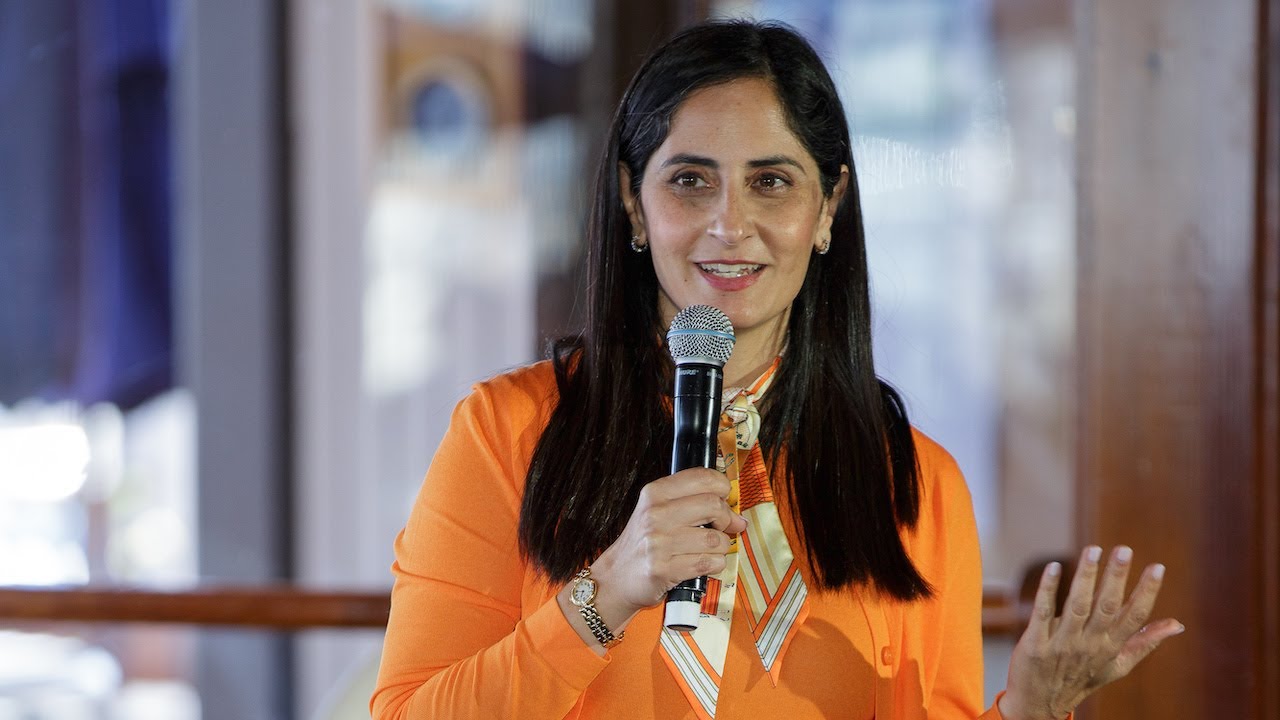
In this keynote at the ASU+GSV 2022 Ladies Lunch, Pardis Mahdavi, Dean of the School of Social Sciences at Arizona State University and soon-to-be Provost at the University of Montana, shares a deeply personal narrative that intertwines her hyphenated Iranian‑American identity, her academic career, and the pivotal role of women’s underground networks in her survival. She recounts her family’s exile from post‑revolution Iran, the move from Minneapolis to San Diego, and a formative lesson from her father that education is untakeable. Mahdavi describes being arrested by the Revolutionary Guards in Tehran in 2007, the torture she endured, and how a clandestine feminist network—facilitated by former Secretary of State Madeleine Albright—secured her release. She later faced the kidnapping of her daughter in 2012, again relying on these networks. These experiences inspired her scholarly work, culminating in her sixth book, Hyphen, which traces the orthographic history of the hyphen from ancient Greek grammarian Dionysius Thrax through Gutenberg to modern anti‑hyphen sentiment during the World Wars, arguing that the hyphen symbolizes belonging and the possibility of new, hybrid identities. Mahdavi reflects on the liminality of being “too Iranian in America and too American in Iran,” and how examining the hyphen helped her reconcile multi‑layered identities as a scholar, mother, and activist. She announces an upcoming memoir, This Goes Out to the Underground, detailing how feminist networks saved her life and shaped her sense of community. Throughout, she emphasizes education and women’s solidarity as essential to resilience and belonging.
Chapters
All right, one final great treat. Pardis is just amazing. She's currently the Dean of the Social— which school was it? Social Sciences at ASU. But she's actually leaving to go to Montana State to become Provost, which— University of Montana. I'm sorry, University of Montana. I knew I got the right state. That's the best I could do. And she's really just remarkable. And you have another book coming out actually right now, right? Yes.
Yeah, I don't know if this is on. Yes. Hi. Thanks. Thanks so much for having me. It's an absolute honor to be here and among such inspiring women. This is just really mind-blowing. This is actually a kind of a full-circle moment for me because education and women's networks are the reason that I'm actually still alive and standing here today. So, a little bit about my I'm a proud hyphenated Iranian American. And that's very— the book is not about grammar. It's about being hyphenated. So rest assured, we didn't get you a grammar book. But we'll get into that in a minute. But my family lost everything in the revolution of Iran in the late 1970s, lost everything and came here to the United States. And we were initially resettled in Minneapolis, Minnesota. Oh, wow. which, lovely place, lovely, lovely place. But in the 1980s, families like ours were a little bit— we stood out a little bit. And I came home one day from school, and this was in the middle of Iran-Contra, and there was a sign posted on our front door and it said, burn this house, terrorists live here. And so my father had to make a very difficult decision and moved us here to San Diego in 1984, where he knew that there were more Iranians and he felt that we might be more welcoming. My father said something to me in that move, as we were moving to San Diego from Minneapolis. We were sitting on the moving truck, and I'll never forget it. He said, you know what, Pardis? People can take everything from you. They could take your home. They can take your belongings. They can even take your country. But the one thing no one can ever take from you is your education. Don't ever let them take your mind. So I think my father and Dr. Proctor's father would have been good friends, because education became my job. And I went to graduate school, became a professor. And then I wrote a book on feminism in Iran, which is a pretty quick way to get yourself noticed by the wrong people. So I was giving a lecture at the University of Tehran in 2007. And 13 minutes into my lecture, I was pulled offstage by the Revolutionary Guards and taken in, arrested. And held for 33 days, interrogated and tortured. And the reason I got out was because I had an amazing network of women, feminist underground networks that worked back channels to a woman who became my mentor, who passed away last week, which is Secretary Madeleine Albright. And she helped get me out. And I'm standing here today because of that. So, So then I became an anthropologist without a home. I'm kicked out of my native homeland. I'm stripped of my citizenship. So I started writing books about human trafficking, labor migration in Dubai. So after a really simple topic like feminism in Iran, I went for human trafficking in Dubai and faced all sorts of problems there. And then in 2012, my daughter was kidnapped. And I had to rely on women's underground networks, trafficking networks, to get her out. And so it's a recurring theme for me between women's networks and then networks of educators. It's the reason that I'm standing up. So this is kind of a full circle moment for me to be standing in San Diego having this conversation with you all. But I wrote Hyphen. Hyphen is actually my 6th book. I wrote Hyphen because— after all these journeys and after all these ups and downs and all these travails, I was still having a very hard time finding belonging. And I think that I, like so many of us who are hyphenated Americans, we were often trying to fit ourselves on one side of the hyphen or the other. I was always too Iranian in America and too American in Iran. So it was like neither here nor there, always this kind of liminal being. And then as I started to interrogate my identity, I— saw many other layers. I'm not just Iranian American. I'm Iranian American woman. I'm mother. We have all these identities and these multi-hyphenated identities. And we're often trying to fit ourselves into one or the other. And we get that imposter syndrome because we're not able to fit that perfect mold. Like, I'm not the right mom. I'm not doing the right things as a mom. I'm not the right daughter. I'm not the right Iranian. I'm not the right American. And we're constantly trying to fit in these words. And I actually started looking at the hyphen itself, because my kids came home from school one day, and this was in 2016, and they said, Mom, you know, the kids at school, they're saying that, you know, once we have a new president, we're all going to be sent home. But where is that home supposed to be? Where are we supposed to live? And I said, well, you know, we are who we are. We live kind of in this in-between space. And my kids, whose last names are hyphenated. My son said, oh, kind of like that little line in my name. And I was like, yeah, actually. And so it was really for me being kicked out of my homeland and then facing being kind of almost unwelcome here during a particular period of this country's history that made me start to interrogate the spaces in between. And so I started doing research on the hyphen itself and why the hyphen had dropped out of so many other hyphenated identities. My partner is Chinese American, but there's no hyphen there. Iranian American has a hyphen. And so I started to go back in time to try to understand it. And then initially, if I went back only to World War II, I started to— I could see the anti-hyphenism that came when you had people like John Wayne, when you had people like Roosevelt and Wilson saying a hyphenated American is not an American at all. a hyphenated American is divided loyalties, and they ripped that hyphen out. So then I went back a little bit further, and I saw that New York as a city used to be hyphenated. All those New York Times fans, readers, it used to be New-Hyphen-York. But the xenophobia that, you know, invaded this country around the time of World War I and World War II, that ripped the hyphen out. And I thought, gosh, as somebody who's lived in New York, to me, New York is the ultimate hyphenated city, how could you rip it out? So I started to go back further and further in history. I wanted to understand where the hyphen was invented, how, and why. And I learned that the hyphen was invented by someone who was hyphenated themselves. Dionysius Thrax— great name— an ancient Greek grammarian, came up with the hyphen wandering the halls of the Library of Alexandria because he wanted to designate— he wanted a sign or a symbol that showed belonging. He wanted to designate 2 words that belonged together. So he created the hyphen to create belonging and to create a space in between. And he wanted to use the hyphen to create a new sound. At the time, words were not spoken, they were sung. And he wanted to create a new sound. So I would— and he— but he himself, he was a grammarian slash artist. And he also wanted it to be beautiful. And so he created the first hyphen, which was a sublinear U-shaped hyphen. Fast forward many, many hundreds of years, and we have Gutenberg, who uses the Bible. Gutenberg himself was also a hyphenated individual. He came from a family of blacksmiths, and they expected him to take over the blacksmithing enterprise. He was a poet. So he invented the printing press to make beautiful lines of poetry, which he couldn't do without the hyphen. He also wanted to use the hyphen to signify belonging. So throughout history, you have this, this usage of an orthographic mark to signal something new. And then you hit xenophobia, and you hit World War I, World War II, and the hyphen drops out. And it becomes this question of divided loyalties. Fast forward another 50 years, in 2006, the shorter Oxford English Dictionary comes out. And there are 16,000 words that used to be hyphenated that are no longer hyphenated, right? So examples would be bumblebee, Right? It used to be bumble space bee, then it was bumble hyphen bee, now it's bumblebee. So some people were saying, well, maybe the hyphen is obsolete. How many of you still write email, e hyphen mail? Some of you still write it. But that's how it was, e space mail, then e hyphen mail, now email. So people asked, well, is the hyphen obsolete? Grammarians who'd been studying the orthographic history said, actually, no, the hyphen created something new altogether. The hyphen did its job. It did its job. It created something new. It was a way station. That word in and of itself was hyphenated. It was way space station, then way hyphen station. Now it's all one word, way station. But the hyphen was a way station to create something new. And for me, that was a deeply resonant concept because I actually could then understand the power of living inside the hyphen. And I didn't need to be one identity marker or another, but I could be something new altogether. So writing that book gave me the courage to write my memoir, which is the book that comes out next month, and it's called This Goes Out to the Underground: A Mother, Her Daughter, and How We All Rise Together. And it's the story of how I relied on underground feminist networks not only to find belonging but actually to save my life. So education, women's networks, they are the reason that many of us are here. So thank you for being part of my new network, and thank you to Deborah for having me. Thank you.