Pardis Mahdavi on Iran's Morality Police
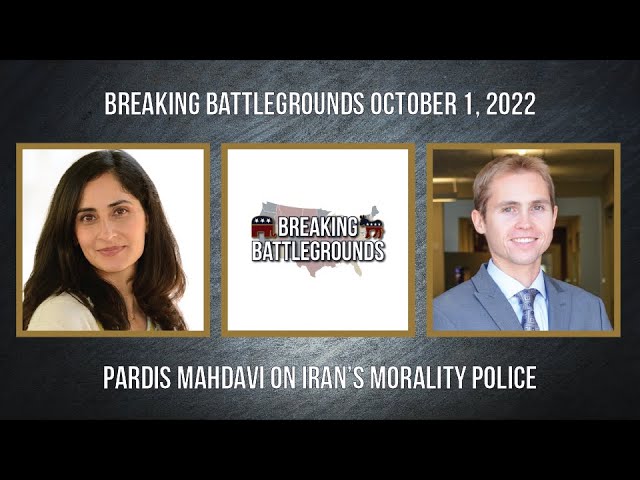
The episode of Breaking Battlegrounds, hosted by Sam Stone and Chuck Warren, interweaves two major discussions. First, the hosts and Goldwater Institute policy director Matt Beinhberg examine Arizona's recent universal school choice legislation (Education Savings Accounts, ESA) and the failed Save Our Schools petition that attempted to block the law. They detail the legislative background, the signature count controversy (claimed 141,714 vs. the verified ~80,000), the role of Secretary of State Katie Hobbs, Governor Doug Ducey’s support, and the broader political battle between school‑choice advocates and teachers‑union‑backed “Save Our Schools.” The conversation also includes sponsor plugs for DotVote and YRefi. The second half introduces Pardis Mahdavi, dean at Arizona State University and incoming provost at the University of Montana, who recounts her personal encounter with Iran’s morality police in 2007, her subsequent house‑arrest, and her analysis of the 2022‑2023 Mahsa Amini protests. Mahdavi explains how the protests differ from earlier dissent (broader gender and geographic participation, heightened international attention), the regime’s moral‑policing agenda under President Raisi, and the potential for regime change. She also contrasts the morality police with the Revolutionary Guard and reflects on the experiences of fellow dual‑citizen scholars. Overall, the episode blends domestic education policy debate with an international human‑rights narrative, highlighting political tactics, statistical claims, personal testimony, and the broader implications for freedom and governance.
Chapters
In a world driven by the use of technology, it's important to secure your campaign website that includes your first and last name as soon as you decide to run for office. Here at DotVote, our mission is for voters to remember your name while providing a website that is easy to remember, straightforward, and tells voters what to do. And that is to vote. Visit GoDaddy today and get a Your DotVote website. That's www.yourname.vote. The internet is in your favor, so use it.
Welcome to Breaking Battlegrounds with your hosts Sam Stone and Chuck Warren. Our first guest for today, we're gonna bring on with the second segment, but Chuck and I wanted to start because we've had some seismic events. One, if you're a Republican, you like quite a bit here in Arizona, but another one that is just a national tragedy that has unfolded in Florida this week. We wanted to talk about both of those and some ways you can help the people of Florida.
Exactly. Let's first talk about the referendum on the school choice initiative that the legislature passed and Governor Ducey signed.
So folks who don't know, who are outside Arizona, Arizona recently became the first state in the country to pass universal school choice for everybody. Every student in Arizona now has a choice to go to any school they want, public, private, charter, doesn't matter. And that law passed after a long, long fight in the legislature. We've been heading in this direction. Finally, they took it the whole way. And immediately, Save Our Schools, which is Arizona's union-funded advocacy, district school advocacy, immediately launched a challenge, went out, gathered signatures, and then came to the legislature this week or to the Secretary of State's office and turned in What they claimed were 141,000 signatures. Claimed.
Claimed, claimed. And as Jamie and I were talking before, and I have mentioned to you, there's 2 things here. Either A, they're dishonest, which is probably true and bad for kids, or B, they can't count, which is probably worse for kids, frankly.
Chuck, having dealt with these people, I'm going to assume it's both.
Today, about 40 minutes ago, Secretary of State Katie Hobbs, who's also running for governor—
Who was clearly coordinating with them to do this.
Clearly coordinating, and we'll have you talk a little bit about that. She put out a tweet saying, we have informed the Save Our Students— Save Our Schools Committee that the referendum will not qualify for the 2024 general election ballot. While the statutorily required review continues, our office has inspected enough petitions and signatures to confirm that the 118,823 signature minimum will not be met.
In fact, they probably have— they claim to have 141,000 and change. They may have under 80,000.
So Sam, explain to our guests, and we're going to have somebody from Goldwater on later from the podcast segment, maybe earlier, explain to them now, can they go do an initiative now to try to overturn this for 2024? For 2026 or 2024? I mean, what is Save Our Schools? What is their options now?
Well, so what they're gonna have to do is write a— I mean, look, you just change a few words. You write a slightly different initiative, and they can go out and gather signatures for 2024, and you know they're gonna try to do that.
Absolutely.
But I do think you've already had 11,000 families rush out and apply for these— they call them education savings accounts, basically a voucher.
Correct.
They've had 11,000 families rush out and apply for these. There's going to be tens and tens of thousands more in the coming year. And now that's gonna be a problem for them because they are really starting to fight against the tide where we have an enormous portion. If you look at by percentage of students, Arizona has the highest charter school attendance, highest percentage of students attending charter schools of any state in the country. Already. That's about to go up. And so they're going to be facing a much bigger hill next time. And they were clearly coordinating this with Katie Hobbs, who is the current Secretary of State, is running for governor. And they knew they didn't have enough signatures when they turned them in. There was no way for— they didn't even turn in enough sheets that if every line, 15 lines per sheet, every line had been filled with a valid signature, they still wouldn't have had enough. And that should have been rejected out of hand by the Secretary of State's office, not take a week. And they were clearly coordinating to try to keep this issue in the press, knowing that they didn't have the signatures until this announcement.
Well, it also delays— it also stops it, right? Once you submitted the signatures, it stops people being able to apply. Right. So
it would prevent all these 11,000 families from getting their vouchers. It would prevent the thousands more who are going to be applying every month now going forward. So yes. This was a delaying tactic on one end and a political tactic on the other. And frankly, these union folks should be embarrassed. They're not, but they should be.
Well, and Katie Hobbs, as we just read her tweet, and she put a letter out today, I mean, she came out and said, we haven't been through all of it yet, but they're not going to meet it. I think it's safe to say she would not have done that if she had not had the pressure from Ducey. No. And the press mocking it. The press is mocking this as well.
Yeah, even the allied liberal press that we have here like everywhere else called this one out, right? You can't have any credibility left if you're gonna pretend this is some sort of legitimate thing on their part.
I know you're not a fan of the Arizona Republic. They frustrate the heck out of me, but the Democrats between this boondoggle, this mess, And Katie Hobbs not debating, I will give them credit. They've been calling him out. I
mean,
it's been so obvious. They've been calling him out, right? I mean, Katie Hobbs, I have been impressed with the local media. They've just— you're being a wimp.
Well, Chuck, years ago, you and I worked on the Civics Education Initiative, where we were pushing civics education, an expansion of civics education in schools across the country. And one of the things that I've always believed is there are certain things that the press believes deeply in, and that if you're working in those areas, it's really hard no matter how liberal they are for them to actually oppose you. They have to go along. And debates, because that's one of their opportunities to cover things in depth without having to do much homework, that's one of those things. Correct. They're on. They're always demanding debates, as they should.
It's part of the process. You should debate. That's one thing I've enjoyed about Kari Lake. She's not shunned debates. She's gone on debates. And I think I think part of her, the energy she provides, is that people know she'll go anywhere and talk to anyone and do any debate. And when you're avoiding that, it looks just like that to people. You're avoiding debate. You're avoiding talking about the issues.
Yeah, you're scared.
Very, very, very much so.
Yeah.
Let's talk here about one of our sponsors, Yrefi. That's Y-R-E-F-I. Are you concerned, folks, about the stock market? Are you concerned more about inflation? As you know, this week the COB came out and said, Biden's unilateral decision to student loan forgiveness was $400 billion more in the deficit. If you don't think that adds to inflation—
$400 billion.
$400 billion, unilaterally, without a congressional vote.
And frankly, I think it's illegal. I mean, I hope that, I hope that that challenge in court, you know.
So we need, as people trying to prepare for retirement, preparing for kids' education, you need investments that's going to beat inflation. That's where it comes in with Y Refi. You can find them at Invest Refi. That's refy.com. Again, that's with the letter Y. So then refy.com or call 844-204-7756. That's Invest Y Refi dot com and tell them to make sure your friend Sam and Chuck sent you. There you'll find good investment opportunities that will beat inflation. And you're also helping students who took out private loans.
Well, and right now with the market tanking under Joe Biden, if you're not putting your— if you're not considering putting your money into something like YRefi, which gives you a, you know, a stable return, you're making a mistake.
Exactly. Exactly. Jeremy, do we have our next guest on now? All right. So, Sam, why don't you do a little introduction about our next guest coming on here? We're talking about the school choice initiatives today, and we're going to talk about Iran. Iran is taking some front page time away from Ukraine. What's going on there is quite remarkable. Sam, why don't you talk about who our next guest is going to be?
Yeah, so our next guest, and I apologize in advance because I'm going to have to ask her how she pronounces her name, but Pardis or Pardis Mahdavi, dean at Arizona State University, heading on to be provost at the University of Montana. She is an Iranian-American woman who has an amazing story about when Iran's religious and moral police came for her.
Well, and she has a great article in the Washington Post called When Iran's Morality Police Came for Me.
Right.
And I suggest everybody read it. It was out on the 26th of September. And we're bringing her on here shortly to talk about what it was like to be in Iran.
Perfect, and we have our next guest on the line, so let's introduce her right now.
Go ahead.
Good afternoon. I have to start out— this is Sam, I'm in the studio with Chuck. I have to start out by asking how I pronounce your name.
Hello, Sam and Chuck, this is Pardis Mahdavi. Mahdavi.
Okay. Hey, I actually got it right by accident. You did, good job, Sam. Pardis, thank you so much for joining us.
Thanks so much for having me.
So Pardis, we were just telling the folks, we were introducing you about your background and glad you've been here at Arizona State and you have a new opportunity at University of Montana. But we're talking about an op-ed you wrote, When Iran's Morality Police Came for Me, and it was on the 26th of this month. Can you tell a little bit to people about your experience and what happened? And we'll post that article on our social media, but go ahead.
Thanks so much. Thanks again for having me on the show. I appreciate it. Our pleasure. I really appreciate you taking, you know, taking up this issue of what's happening in Iran. I think amplifying the voices of, you know, the people in Iran is incredibly important, so thank you for doing that.
Our pleasure.
They're being incredibly brave right now, and
real bravery. Real bravery. I mean, we see protests all the time around the world, and Here are our first-world problems in America, but this is really life and death, and what they're doing is beyond courageous.
Absolutely. I couldn't agree more, and it gives all of us hope, right?
Yes, absolutely.
And inspiration, certainly. But yeah, so you asked about, you know, some of my experiences, or certainly the article that I wrote for The Washington Post. I had been conducting research on the ground in Iran starting in the late 1990s up until 2007, when the incidents that I wrote about happened. I actually was working on my first book. I've written 7 books, but this is my first book, was called Passionate Uprising: Iran's Sexual Revolution. So you can imagine I'm writing about sexual politics in post-revolutionary Iran, a bit of a sensitive topic. Gutsy.
Gutsy. We'll call it gutsy here.
Yeah, absolutely.
There you go. Thank you. And, you know, I was presenting the results of my research at the university in Tehran, because, you know, many of the people that I had been working with and researching were quite adamant that I present the results of my work in Iran, and not just publish it in the United States, which absolutely made a lot of sense to me. So there I was, you know, I am a professor. At the time, I was a professor. Now I am the provost at the University of Montana, but at the time I was a professor. And I went up on stage to present my findings. And 13 minutes into my lecture, the auditorium doors banged open. The morality police— and we can talk a bit more about who the morality police are— but the morality police, about a dozen or so of them, came in. Oh, my gosh. Boots clanking, came into the auditorium, pandemonium erupted, and I should have been shredding my lecture notes, what I should have been doing, but I sort of was instead standing there just gripping the podium.
Well, we're gonna stop you right there. We're gonna take a quick break.
I'm gonna leave it on the cliffhanger right there.
We're gonna cliffhanger, take a quick break.
And Breaking Battlegrounds will be right back after this word. All right, welcome back to Breaking Battlegrounds with your hosts Chuck Warren, Sam Stone. On the line with us right now, Pardis Mahdavi. She has an amazing story she was just telling about talking about the sexual, you know, sexual politics, sexual revolution in Iran, and being there and being, frankly, you know, I—
it sounds like you got knocked out,
assaulted by the morality police.
Yeah, so I think I left y'all on a cliffhanger. Yes, I was, I was 13 minutes into my lecture on sexual politics in Iran. Uh, and the auditorium doors banged open. Uh, the morality police came clanking in. Uh, and, uh, I, I can't remember if I saw or smelled or heard them first, but—
Hmm.
They burst into the auditorium. The auditorium erupted into pandemonium. Uh, at least 2 of them walked up the 4 steps to the stage where I had been standing. And grabbed me, and then I blacked out.
And so then what happened? I mean, so these folks come in there, they apparently hit you on top of the head, they storm this theater where you're giving this presentation, then what happened next?
Well, when I came to, I was in the back of the car, their car, and I was told that, you know, I was violating morality, and as a result, I would have to, you know, and I was later accused of fomenting a velvet revolution, which is an accusation that many people have been given. And so I was, I consider myself one of the lucky ones, however, because I was taken and placed under house arrest for 33 days.
And you were an American citizen or American resident also at that time?
Yes, I was. OK.
And so when they put you in a house arrest for 33 days, I believe your op-ed covered this, I mean, they take everything out. You have a bed and a cardboard table, right? You're basically in solitary confinement. Is that fair to say?
Yeah. I mean, I say they took me back to my apartment, but it wasn't my apartment anymore. You know, it was a plastic folding table, 2 plastic chairs, all my clothing and belongings had been taken out.
Wow. How much different or worse would that have been if you didn't have the ties to America at that time?
That's a tough question because, and this is why I say I was one of the lucky ones, my good friend and colleague, Hala Esfandiari, was actually taken to Evin Prison, and she was also a dual citizen. And in her case, she was also charged with, she was accused of espionage, et cetera, because of her American ties. So, you know, I think that can cut both ways. Like I said, in my case, I always say that I consider myself incredibly lucky. I also was dealing with the morality police. I think many other journalists and academics who went to Evin Prison were dealing with the Revolutionary Guard, which are— these are 2 separate bodies, right? The morality police are charged with, you know, ensuring that All Iranians and all who walk the streets of Iran commit right and forbid wrong. Now, how we interpret that is up for conversation, but I was dealing with the morality police. Many folks were dealing with the Revolutionary Guards.
Oh my goodness. So let's talk about currently what's going on in Iran. Okay, so you have this woman, Mahsa Amini. She's 22, and she travels from her hometown in the province of Kurdistan Correct. And then she went to the Iranian capital, got off the subway, and she is arrested for failing to cover her hair modestly enough, right?
Correct.
So they take this poor woman in and basically they beat her to death, right? And they thought when she complained about her injuries, she was faking it or crying crocodile, and she died. And this is what has brought about these series of protests in 12 cities or more in Iran now. Now, there have been protests. I think as an American, we always see these protests in Iran and we hope this is the one, right? This is the day. What makes this moment different than the previous ones?
So that's an excellent question, and I think it's a couple of things. The first is that this is much, it's on a much larger scale. So we've seen protests in the past, and that's what I had been working on since the early 2000s, was documenting Iran's sexual revolution. But one of the main differences is that the earlier rounds of protests, issues around women's rights were seen as kind of women's issues or feminist issues, et cetera. Today, you see just as many men protesting as women, right? This is across genders right now and across age groups. Right? Mm-hmm. So, no longer are these issues seen as just women's rights or feminist issues. This is now, we're talking about freedom. We're talking about human rights. That's what we're talking about right now. And so, you have a groundswell of resistance calling for human rights and freedom. I mean, these are part of their chants. And so, it's on a much larger scale. You've got people from different backgrounds involved. And then, a big factor is Like the conversation we're having today, you have the attention of the international community. And the international community is much more involved talking about these issues. This wasn't the case previously, right? I mean, I think about when I was doing my fieldwork in the early 2000s, you had young women like Mahsa Amini arrested, beaten, facing the brutality of the regime on a regular basis. And it wouldn't even make the papers in Iran. Now, of course, that's because the press in Iran is controlled.
Correct.
But let alone would it make the papers outside of the country. The fact that you and I, that we're having this conversation today, that is in and of itself a signal of how different it is this time. Look at the attention, look at the support, and look at how widespread it is. People are saying enough is enough.
So let me, let me ask you this. So when you have these type of protests or revolutions, generally what happens is it's large enough that it starts building dissension within the ruling elite, the ruling government, right? Right. Do you feel right now that there are some in power, not obviously your ultraconservative president there, but do you feel like some more mid-level people in government are starting to say like, we've got to change things? Because either you have to do that or it seems any type of change is going to become violent. Am I wrong on that?
Well, I think, you know, first of all, to your first question, you know, it has often been the case that, you know, you've got the reformists who are quite different, right? The reformist Islamists who are in power are going to be quite different from the hardliners, right? Correct. And when I did my research, I began to work under President Khatami, who was more of a moderate reformist. And even if you think about the person who was president just before Raisi, was Rouhani, and he was more of a moderate. That said, I think it's important to remember that the Islamist regime that is in power came to power during the Iranian Revolution, right? Right. 1978, 1979. And they came to power under a fabric of morality, right? They came to power critical of what they saw as an over-fascination with the West, what they called Westoxication. And they came to power saying, you know, we're going to bring back a sense of moral order to Iran. And that's when, you know, you had the morality police created, the Revolutionary Guard. So this is a regime, whether or not you've got more moderates and moderate reform or conservatives, it's still the Islamist regime that came to power under this fabric of morality. Now, that said, it has definitely been the case that, you know, the people of Iran, you know, what they want, you know, Especially the protesters we see on the streets today, they've been able to have conversations with different presidents.
Pardis, I apologize, I gotta cut you off again because we're heading to our next commercial. Can we bring you back for our next segment here?
No problem.
Fantastic. Breaking Battlegrounds coming back here in just a moment. Welcome back to Breaking Battlegrounds with your host Chuck Warren, Sam Stone. On the line with us right now, Pardis Mahdavi, Dean at Arizona State University, now Provost at the University of Montana. Amazing experience, terrifying experience that she's written about in the Washington Post, and you'll be able to find that on our website and social media. When we were going to break, Chuck, we were talking about the ongoing protests right now and whether regime change potentially could be in the offing, or at least system change.
Correct. Go ahead.
So I think, you know, to your question of could we see a regime change, I think that there— this is enough of a catalyzing moment that it is possible. That's why a lot of people are saying, well, this is a moment of cautious optimism. We might see a regime change.
You actually had an interesting thing in your article where you talked about these, it's sort of like dominoes. These are sort of building. The speed and intensity of these protests has been building. The regime has been able to move past past protests and maintain control, but now we're seeing a big expansion of those. You talked about men and women, but also the geographic element of it. Can you tell us a little bit about that?
Absolutely. So what we're actually seeing today is that the protests have spread to over 50 cities. Oh my goodness. Over 50 cities. Yes. And urban and rural alike. So with each subsequent protest since the early 2000s, you've seen increased numbers of people, increased fervor. Okay. So the fact that now, you know, maybe 10 years ago you might see these protests in Tehran and Shiraz and Esfahan. Tehran, like the major, you know, more urban centers of Iran. The fact that it's now all over, more than 50 cities, and people of different religious, socioeconomic, and ethnic backgrounds are involved, that shows you just how much momentum these movements have picked up and gained.
That's always a big difference, right, when other groups, demographic groups, rural, urban, Get together and do this. It brings more of a unity factor together, and there's number in strength, right? Strength in numbers.
Exactly right. Exactly right.
Let me ask you this question. This came from the New York Times. So since you have an ultraconservative president now, Raisi, about a year ago, and when he came in, he said he wanted to tighten enforcement of strict social and religious rules. And then in July, he ordered all responsible entities and institutions to devise a strategy For stepping up hijab enforcement violations, he said were damaging the values of the Islamic Republic and promoting corruption. Iran's chief prosecutor declared his support for barring women who were improperly covered from getting access to social and government services, including the subway. The Ministry of Guidance ordered movie theaters to stop showing women in ads. The backlash to the policy has come not just from the country's secular camp. This comes from the New York Times, but also from religious and conservative Iranians. who said it would only deepen the divide between the government and its people. Is that what we're seeing?
That is absolutely what we're seeing. And that has been momentum that has been building for quite some time. The young people I was following who were engaged in what they called a sexual revolution in the early 2000s, they were increasingly frustrated with a regime that was more concerned about policing their bodies, you know, a headscarf, are you wearing lipstick, are you wearing an eye-catching hairstyle if you're a man. They're more concerned with policing bodies and moral values than they were with solving things like unemployment or infrastructure issues. This has been an ongoing concern as to why the government expends so much energy, time, and resources on policing their bodies rather than in bringing basic needs to its population.
Does the Iranian regime realize that right now they are essentially the proverbial frog in boiling water? How aware are they or how in tune are they with the level of frustration that has built up in their country?
That's a tough one to gauge. You probably heard the Iranian president, right? Publicly stated yesterday that, well, this is chaos in the streets and chaos will not be tolerated, downplayed the violence. I think that the conservatives who are in power, I think that they tend to downplay publicly, but internally, as is evidenced by the fact, the statements that you just read from the New York Times piece, The fact that they have, they feel the need to tighten the grip on morality says that they know what's going on, right? They know what's going on in terms of their people, but their outward projection is to downplay it. I do think the more moderate that, you know, have been in power at different times, Khatami and Rouhani, they have tried to build bridges and find ways to engage the Iranian population, although they have been met with With challenges, of course, because the Supreme Leader remains in power.
Well, thank you so much, Pardis Mahdavi. How do folks follow you and your work?
Thanks so much for your interest. You can follow my work on my website, www.pardismahdavi.com, or on Twitter @PardisMahdavi, or at the University of Montana, where I'm now the Provost and Executive Vice President.
Fantastic. Pardis, thank you so much for joining us today. We really appreciate what you joining us here. And it's a very brave incident you went through. So thank you.
Thank you. Thanks for having me. I appreciate it.
Welcome back to Breaking Battlegrounds with your hosts Chuck and Sam. Folks, I woke up this morning like I do every morning, and I checked my stock market.
Oh, you should not be doing that, Sam.
I know I shouldn't be doing it because Joe Biden is killing me, Chuck.
Every financial advisor tells you not to go do that.
Oh, it's so bloody painful these days. But you know what? There's, there's a way for folks out there to, to actually get around some of the stock market volatility and avoid this Biden stock market. And that's with YRefi. InvestYRefi.com is a fantastic way for folks to go. and earn a set return on their money, a very good return on their money, without risking the market volatility. And what you're doing is actually investing in people to help them pay off their student loan debt. So win-win for everybody if you're doing that. And look, this market isn't going to get better with Joe Biden in office.
No.
No. This is— we're heading in a bad direction. So folks, if you're looking for a reliable, safe investment, a good place to put your money, especially right now, and you want to Do good while earning good. Go to investyrefi.com. That's invest, the letter Y, R-E-F-Y, dot com.
Fantastic. Well, we have with us today Matt Bienberg. He is the Education Policy Director at the Goldwater Institute. Matt, welcome to the show.
Thanks for having me on.
Matt, all right, so Save Our Schools, which is basically an appendage of the teachers unions, Tried to put on the ballot through a referendum to overturn what the legislature and Governor Ducey passed, which is basically the only universal school choice voucher in the country. Doesn't matter income, doesn't matter who you are.
It's better than a voucher because you can use it for all sorts of educational needs.
So it's one of a kind in the country, is that correct?
It is, yes. It's the only one in the whole country that every single kid in the state is now eligible for.
So tell our audience here exactly what happened with this referendum. What they were telling people to try to get them to sign the referendum petition, and what ended up happening where Katie Hobbs today came out and said they're not gonna make it.
Yeah, well, this year the legislature put forth a piece of legislation sponsored by Representative Ben Thoma, and then Governor Ducey ended up signing it after it passed the Senate and the House that said this ESA program is gonna be open to every kid in the state. You can take those funds that, you know, would've been spent on you in a public school and take a piece of that, put it into account, and now that student's family can use it for tutoring, for private school tuition, for at-home curricula, Special needs therapies, essentially whatever is gonna be best for that kid, the family can use it for. But Arizona's Constitution has a provision in it that says if opponents of a law gather enough signatures to challenge a new piece of legislation, they can turn in those signatures to try to suspend or block the law from taking place.
And they have a set period of time to do that, right?
That's right, yes. There's 90 days from when the legislature packed up for this year. So September 24th was the date when the legislation was scheduled to take effect. Unless the teachers union activists were able to get enough signatures to temporarily put a block on it. They, on Friday of last week, turned in signatures and claimed that they had turned in 140,000 signatures, and they needed about 118,000 to clear that threshold to freeze the program. They had estimated that— it was a very precise estimate they gave, 141,714 signatures, which is a seemingly very exact number. It turns out that they so wildly exaggerated the signature count that they were off not only by 2,000 sheets, 2,000 pieces of paper, but off by about 50,000 signatures. So this wasn't a rounding error. This was either flagrantly dishonest or—
Well, I mean, there's 2 options here, Matt, right? They're either blatantly dishonest, which would not be surprising, but it's bad for kids, or they can't count, which wouldn't be surprising either, and it's bad for kids, right, since these are the people saving our schools?
That's right. So essentially, yeah, their claims went up in smoke, and with it went their credibility, I think, because as you pointed out, whether it was poor intentions or an inability for basic responsibility of what's going on here—
Now wait a minute. Come on, guys here. I gotta stop you, because according to this same teachers union, Matt is racist.
Yeah.
I think the barrier was clearly racial. I'm sorry, I'm gonna get you in trouble, Matt. I tend to do that, but I wanted to ask one question, and I don't know if you know at this point, Most of what Save Our Schools has done to date, including an attempt to raise the sales tax here in Arizona that fortunately the court overthrew, has been funded with union money, but not from the state of Arizona. It's been from other states. Is that still the case with what they were doing this time?
So we've seen their efforts, whether it was the attempt to raise the state taxes or various other things, that they always accuse those of us who are fighting on behalf of our kids and students in Arizona as being special interests and out-of-state The Goldwater Institute here is an Arizona institute that parents here who are in the trenches, the lawmakers, right? These are Arizona folks pushing for students. And what we are seeing is that these groups on the left basically take their marching orders and get support from the National Education Association, these large umbrella national groups, leftist groups whose agenda is to continue the sort of march of the woke leftist agenda through our public education institutions. So, their plan, just like we saw with the COVID stimulus funds, was to call forth just showers of new funding. $200 billion went into our public schools from taxpayers that was ostensibly there to help with COVID relief, even though, you know, a lot of private schools and charter schools showed that you could open up immediately. And now they're claiming that the funding is needed to help with the learning loss that was caused almost entirely because they themselves shut the schools down on kids and then resisted reopening them. So yeah, we've basically seen this effort Nationally from these leftists, which is very well coordinated, pushing against students and their opportunities.
Now, Matt, one of the things I have to ask, because I thought this was just fantastic. You had the local head of Save Our Schools come out and say, well, this law that they passed, this ESA universal voucher law, is terrible because it— she literally said this— because it helps every student. I almost hit the floor.
Yes, and that's, I think, the appropriate reaction. They were complaining to say that This ESA program is now too expansive because it benefits all students, as opposed to saying we only carved out certain subgroups who are able to benefit. But the issue is that that, I think, is sort of saying the quiet part out loud, right? Because we see leftist politicians who routinely oppose things like school choice, and then when it's revealed that they themselves went to a private school or even sent their own kids to private schools, basically themselves opting out of the public schools, for private education and opposing other families having this chance because they basically see it as, we're good enough to enjoy private education, but all the rest of those families don't deserve it, can't be trusted with it, whatever it might be. The hypocrisy is fairly stunning.
It's really stunning because at the end of the day, I mean, one after another, you find out that these giant district school advocates, they're products of private schools. They're products of charter schools. The newer ones, they're They are sending their kids to these institutions. They have no shame in this. I've really come to believe that this has nothing to do with education, nothing to do with children, and just everything to do with funding a political agenda via our brick-and-mortar district schools.
Yeah, I think that's right. And so many of the arguments that they make to say, well, this is public money that's going to To private families or to schools, and so we could not possibly do that. Again, it is them saying that every family should have the right to go and demand taxpayers pay for them in a public school, but the moment those families might get help to go to a private school, they are going to oppose it. These same groups who are pushing for— we just saw Biden's loan forgiveness attempts, right? The left is cheering this. The heads of the National Teachers Union, before he did that, were calling for universal loan forgiveness without any income caps to say, We should forgive every dollar of debt to kids who went to college. They don't mean just public college. They're trying to give money to kids who went to private colleges as well. There's no principled stance from their side about public versus private, but because the teachers unions are focused on the K-12 area, they do not want, under any circumstance, competition that says, you know what, if kids think that what the public schools are teaching is not academically rigorous or that it's politically loaded and indoctrinating students, They do not want to let go of their monopoly on that. So it's not a principled position that they have. They sort of throw out arguments as fig leaves, but at the end of the day, they view competition as a threat.
What do you find, being the education policy director at Goldwater, what do you find that the press gets wrong about school choice? So for example, the Arizona Republic. If they shouldn't be required to have to file campaign contributions.
They've waged a 2-decade war, basically.
What are they not getting about it that they're not telling their readers about school choice?
Sure. Well, several things, and we've written in the past about sort of the factually wrong coverage from groups like the Arizona Republic. But, you know, for instance, they try to portray something like school choice or ESAs as a handout to the rich. It doesn't help, you know, families. And they'll say something like, private school is so expensive. that even if you're going to give families— the ESA program gives about $7,000 per student. They say, private school is so expensive. All you're doing is putting a tiny dent in a subsidy for a rich family to go to an expensive school. They don't actually take the time and bother to look at— we've published this. If you look at the actual tuition rates at private schools in Arizona, the median private school in Arizona, its tuition is about $6,500, which is right in line with an ESA award. This is just one example where Actually, something like the ESA program says we're gonna give a family enough money that if they would like to go to a private school, it will virtually fully cover tuition at the majority of K through 8 private schools in Arizona.
Well, and even—
Totally different.
Yeah, even the more expensive ones though, because I went to a private school that was, you know, qualified for inflation more expensive than that, they all do scholarships for low-income students. Absolutely. They're concerned with diversity on their campuses. They wanna make sure you have a broad selection that matches, you know, the public in their area. This is gonna allow those schools to help a lot more kids with that money they already have, right?
That's right. Yeah, exactly. As you said, a lot of these private schools, you know, they get contributions, they get scholarships to help students who can't financially, you know, pay the full price of tuition. And so the ESA program now gives, you know, a floor for everybody to again take a piece of the funding that they were spending as taxpayers, right? Every Arizona family who's spending taxes as a taxpayer, property taxes, sales tax, income tax. That funding all gets plowed into the public school system. And the families who may be doing homeschooling or in a private school right now, those are families who are paying their taxes to support other students in public education, but not themselves, you know, asking for that back in the public school system. So for years, they have basically paid twice. And so for a family who's taken that burden and said, yeah, you know, we are scrounging and we're finding ways to pay for our students, you know, to do at-home education or private school, Now the state is recognizing the fact that these are taxpayers. They are contributing to the education of students, and there's no reason to penalize them and essentially punish them and say you need to pay twice if you want to actually get an education you think is going to work better for your students. So the ESA program says every kid now, you have the option to go to a public school. You have the option to take your funds and put it into an ESA, and you can use it for whatever educational purpose that your family believes is going to be best for you. And now families are put in the driver's seat and not left to basically sit there and hope that you don't run into things like school shutdowns and the sort of COVID protocols that the unions really had a stranglehold over families in so many states in the country.
What were the lies Save Our Schools and the teachers unions were saying about this ESA? What were the lies they were saying that you can go and respond to?
Sure. There's several things there. One of these is the argument that it defunds our public schools. They say it's taking all this money out and it's going to destroy it. We've heard those same arguments in almost every state, whether it's charter schools or school choice. They claim this. Yet we've actually seen in Arizona— the ESA program, we actually got it passed about 10 years ago in Arizona. It was eligible— about a quarter of Arizona students have been eligible up until this new law. We've actually had a decade where the ESA program has been in place, and it's gone from about 100 kids to over 10,000. In that same time, our public school kids' funding per student has actually gone up by about $1,600, even adjusting for inflation. What that means is that the claim by Save Our Schools and the left who says school choice defunds our schools and destroys it, well, it actually, because it costs less per kid, what we've seen is that Arizona is able to fund fund its public school students with more money per student.
Well, it's basically an annuity for the schools, so they have one less kid to teach and they're still getting money. Is that correct?
Well, so they— the public school system actually keeps right now about $1,000 every time a student leaves the public school and goes to the ESA program. Obviously, a lot of those dollars follow the student, but there are different pots of money that stay in the public school system. So every time a kid leaves A public school district, a lot of those dollars, either federal dollars, tend to stay with that school district, and some of those state dollars go back into the general pot for public school students statewide. So when you have 10,000 students leaving public schools and going to ESA, and you're putting all those thousands of dollars per kid back into the pot, this is actually increasing the amount of money that's still there for those students. But again, Save Our Schools, again, they say things like, We've robbed hundreds of millions of dollars from our public schools. What they tend not to mention is that, you know, this year, in the same year that the legislature just authorized universal ESAs, they also put in almost $1 billion into K-12. They put in over $600 million of ongoing funding for public schools. So public schools got more funding in an increase this year than the ESA program kids are even going to get.
Fantastic. Matt Breinberg, I've got to cut you off there. Paul, Director of Education Policy for the Goldwater Institute. Breaking Battlegrounds will be back on the air next week. I think Matt is joining us for the podcast-only segment, though, for a few minutes. So if you are online, download that. We'll be right back. Welcome to the podcast-only segment of Breaking Battlegrounds with your host, Chuck Warren. I'm Sam Stone. On the line with us right now, John— Matt Beinberg, Education Policy Director for the Goldwater Institute. Matt, we were talking about ESAs, talking about the money that is actually left behind and that increases the per-student money for each of our district brick-and-mortar schools when they have a kid who leaves them to go to one of these other institutions. How much of this now is being driven— I mean, they always want to make this about teachers and teacher pay, but the reality is— The threat that charter schools and private schools and these others are posing is really not to teachers, because frankly, we don't have enough of them. It's to administrators, right?
That's right. The argument from the left is always, again, we're not funding our public schools enough. We're not funding our teachers enough. This is another point that I think is worth the audience hearing. Governor Ducey, a few years ago, laid out this plan. Legislature voted for it, a 20% pay rate for public school teachers. And we actually issued a report on it recently, and it turned out that that money was given on top of other state raises, and the end result was that the public schools gave hardly half of the dollars to teachers when it actually came down to it. So the funding increase that they got from the state, the school districts ultimately are the ones that get that money from the state and can say, yeah, we're actually going to hand this to the teachers, or no, we're not. And what we found is that They took that money, they put most of it toward teachers, and then took all the other dollars that would have been going to teachers and pulled it away so that the net impact was basically you've just shuffled money around. Even though the state intended this to be an increase for teachers on top of what you were getting, the districts took it and spread it around to all the rest of the staff. With ESAs, exactly as you said, this is funding that if a family wants to take that to a provider who's going to prioritize teacher pay, now they can do that. They don't have to go to one of these large districts that's going to be hiring associate superintendents of diversity, equity, and inclusion that are pushing this kind of racially charged content that pits students against each other.
Absolutely. I always tell the story, Matt, about the first time I went to a candidate debate at a public high school, and they had us park in the teacher's parking lot, and I parked in the deputy assistant director of community student relations parking spot. Next to them was the Director of Community Student Relations. On the other side of me was the Director of Parent Community Relations. I mean, these schools are loaded at this point with administrators and they're being paid real money.
And it's only going to get worse because of the various social issues they're pushing out of DC.
Yeah. I mean— Yeah.
And that's a trend that we've— yep.
No, go ahead. Sorry, I didn't mean to cut you off.
Just to say that that's a trend that we've seen in Arizona and nationally, that the percentage increases in funding for— we now spend as a nation double what we did, again, adjusted for inflation, on K-12 from about 50 years ago, right? So the amount of money pouring into the K-12 system, public schools, is radically higher than it was, and when you look at the growth in number of staff, the growth in non-teachers absolutely dwarfs that of actual educators.
Yeah, if I remember the numbers right, it's something like about a 7% or 8% increase in students, a 7% or 8% increase in total teachers, But doubling up of administrators in virtually every category in that time.
Yeah, that's directionally pretty much right. The teachers have sort of tracked modest increases, and then it's the rest of the bloat that has gotten layered on. We see this continuing to call for that. So ESAs basically, again, put it back to the student and say, what are their needs? The families are gonna decide this. So we're hugely excited about it. You ask what other kind of lies that the left has told. Again, at the end of the day, they try to say, well, private education is unaccountable. It's inferior. It's terrible. The research that's out there shows the kids do better in private schools, and it's not shocking. That's why families who are able to afford it or make sacrifices flee, and that's why the unions are so afraid that families will now choose this.
So as we wrap up here, Matt, how does an Arizona family apply for these ESAs? What's the paperwork they need to do? Where do they need to go? How do they do it?
Yeah, great question. So the Arizona Department of Education has its website that you can go to, and there's an application for the ESA program. Every family is available. There's also a group, Love Your School, loveyourschool.org, and it's run by a local Arizona mom here, and they help kind of walk parents through this process. So for folks who are trying to understand and navigate it and learn about the program, they can also go to loveyourschool.org to find out more about that.
Matt, you've been fantastic. We appreciate having you on the show today.
Matt Binder.
Great to be with you. Thank you very much.
Education Policy Director for the Goldwater Institute. Thank you guys for the work you're doing. It's obviously made a difference for a huge number of Arizona parents, students, and frankly is improving the quality of education in this state. So thank you.
Have a great weekend, folks. Thanks, Matt.
Running for office? You need a campaign website. Introducing the web address of the democratic process, .vote. So how do you purchase your .vote website? Visit www.yourname.vote. Type your website name, example, www.johnsmith.vote. It's available! Add your web address to your cart and check out. Once checked out and have received confirmation, you may begin to create and utilize your website to connect and engage voters. To learn more, visit get.vote. Happy campaigning!
More from Pardis


Author Pardis Mahdavi on Education, Human Rights, Leadership & the Future of Learning

Pardis Mahdavi: The Future of Learning, AI, and Why Higher Education Is Broken


#64: Ancient Wisdom for a New Future: Culture, Women, and the Path to Liberation – Pardis Mahdavi





