The Underground Women | Pardis Mahdavi and Ruchira Gupta in conversation with Maeve Conran
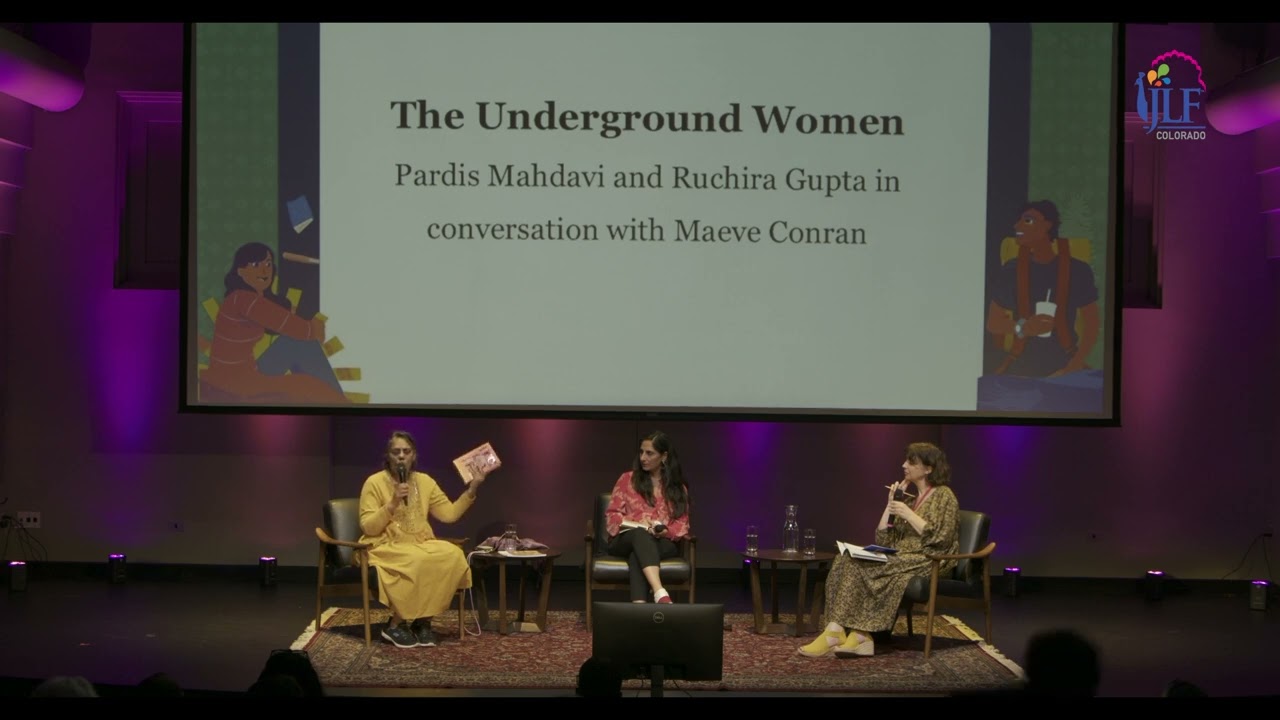
In this recorded panel, moderator Maeve Conran hosts authors Pardis Mahdavi (Book of Queens) and Ruchira Gupta (I Kick and I Fly) to explore the hidden histories of "underground women"—women whose power and resistance have been erased. Mahdavi recounts her discovery of a multigenerational lineage of Iranian horse‑women warriors, the Caspian horse, and how these stories inspired her Book of Queens, reframing the Persian Shahnameh as a celebration of female strength. Gupta shares her investigative journey from witnessing sex‑trafficking in Nepal and India to founding the NGO Apne Aap, drafting the UN Protocol to End Trafficking in Persons, and authoring a narrative that follows a 14‑year‑old girl, Heera, who uses kung‑fu to fight her traffickers. The conversation weaves together themes of intergenerational strength, the dangers of white‑saviorism, the importance of grassroots, community‑led solutions, and practical ways audiences can support women in Iran, Afghanistan, India, and the United States. Both panelists stress storytelling, partnership with local activists, and consumer‑level actions (clean supply chains, voting with one’s feet) as levers for systemic change. The session ends with audience Q&A on supporting Iranian protestors, reliable resources for anti‑trafficking work, and how everyday acts of resistance can shift power dynamics.
Chapters
Well, thank you all for coming out. I'm so excited for this panel, and it's such an honor to be on the same stage with these 2 incredible women. The title of today's talk is The Underground Women, but what I really hope that we get out of this is the fact that these are stories of resilience, of power, that have been erased in many ways. And how can we reclaim that and recognize the incredible stories that we're going to hear about today. So, when we say underground women, this is, I would say, a situation that has been imposed on them, and we are all complicit really in many ways in that. So, we're going to really excavate, I think, some of those stories. And what's so exciting about the 2 books, the latest books of our panelists today, is that there's such a personal connection, and there's a through line between all of the work that they have been doing. and their latest work. So, we'll jump right in with Pardis. Can you hold up your book? Because the COVID of this book, Book of Queens, is incredible. And I really encourage people to go and check it out in person, and then of course read the book. And it is a photograph that embodies strength and resilience. And this is not a typical photograph that we see of women from Afghanistan. Right. And to me, it's in stark contrast with what we currently are familiar with. So, who is the book? Who were the queens? And tell us, before we even get into that, it is the most incredible story how you stumbled upon this, your own family connection to these queens and these women in Afghanistan. So, who were the queens and how did you find out about them?
Absolutely. Well, thank you so much, Maeve. It's an absolute honor to share the stage with you and Ruchira. We had the great honor of sharing the stage in Jaipur in January and had a fantastic time. And so, it's wonderful to be to be able to be here. I think these books are really in conversation. So it's just great to be able to have that chance. You know, to your question, Maeve, this book, this was my 7th nonfiction book. And it was really a personal journey. I had spent 7 years between 2000 and 2007 in Iran. I was at Columbia University doing my master's and PhD in medical anthropology. I had initially gone to Iran in 1999 to study the women's movement. But when I got there, I became fascinated by the sexual revolution. And so I started studying the way that sexuality and politics were interconnected. But I also began riding for the first time. And growing up, I had always loved horses. But my family, you know, it was very difficult. I grew up mostly in Los Angeles, California. Couldn't afford to go riding, couldn't afford a lot of that. And also, my father never wanted to talk about horses, and I never really knew why. And so I began riding actually in Iran. I fell in with a group of feminists who would have their gatherings just outside of Tehran. They would ride into the hills, and then that's where they would use the COVID of the caves and the mountains and all of that. That was their cover for their organizing. Right. Right. And so one of the things that was so salient to me about the underground in Iran, this is really why I delved into that, and I come back to that here, is that many Iranians would tell me, you know, look, modern-day Islam, the way Islam is sort of put out there, and I would say this translates very much here. I think it's a global phenomenon. Modern-day religion does not give us the tools or disciplines to deal with fear, shame, or anger. That's why we need the underground, right? Is that's where we find the tools and the disciplines to deal with fear, shame, and anger. And so these women were out there and they were organizing, they were finding their tools, and I began riding with them. And I didn't know the story of these horses. I didn't know. I just felt this connection with the horses. I couldn't describe why. And then, you know, I talk about in the book, I meet this American horsewoman. Her name is Louise Firouz. Her story is incredible, by the way. And, you know, I never put together all the dots until so many years later. So in 2007, got kicked out of Iran. That's a longer story for another time. But I stopped writing and I stopped— I sort of walled my heart off to Iran. And 10 years later, I moved to Colorado, of all places, to become a dean at the University of Denver. And I started riding again. But I was riding quarter horses, and they felt very different. Nevertheless, I started riding again. And this was also the time of a new American president, a Muslim ban. And I just got to a place where I couldn't stand the way in which my ancestors were being portrayed. So I thought, I've got to go back to my Iran notes. I've got to go back to my Iran writing. I went back home one summer. I was getting ready to move all my belongings to Colorado. I go into the storage unit, and I unearth a box that says 2004. And in the box is a journal that was gifted to me in Iran with a horse emblazoned on the front. And inside the journal was a note that I had never seen before. And the note said— it was from Louise, and it said, find the story of the Caspian. It's your story. And it suddenly hit me in a way that I'd never felt before. And I started going through other things in the box looking for clues. And I remember you saying that you were And I saw a note that was written to myself that said, remember to ask your aunts, my father's sisters, about Caspians, because someone had made mention of it. But I'd blocked it. It was sort of PTSD. I'd blocked it all out. And so finally, I kind of worked up the courage to ask my dad if I could have some FaceTime with my aunts who were in Iran. And I worked up the courage to ask them about Caspian horses. And I worked up the courage to ask them about Louise Firouz, a question I'd never asked before. This was not passed down in my family. And their faces— they were 92 and 94— and their faces just lit up. And they started— you talk about excavating— they started excavating and telling this story. And the story that I learned was that my grandmother had been an avid horsewoman who had bred Caspian horses. By the way, Caspian horses are the oldest living breed of horses on planet Earth today. Wow. So most primitive horses, that my grandmother had used Caspian horses to smuggle women out of domestic violence situations from Iran to Afghanistan on horseback by getting the horses drunk on homemade whiskey. And then those women formed an all-female army that fought against the Taliban that kept their areas, territories, safe for generations. And those were the same women who Louise and others had been passing Caspian horses to, training horses that were then used after 9/11 by American Green Berets to fight the war on terror. So my grandmother's story is a story that wove all the way forward. So who are these queens? These queens are these women And it's called Book of Queens. It's a play on words. The Persian epic, the Shahnameh, some of you know, Ferdowsi, thousands of year old poem. It translates to Book of Kings. But I was always struck by the women in that story, by these warrior women like Gordafarid, the women who bested the men, who actually defended the Persian Empire, who actually defended it. These were the queens that fascinated me as a child. And I felt that they had come to life through the story of my grandmother and through the story of these horsewomen warriors. So those are who the queens are.
Yeah, wow is right. Well, we're going to have Pardis read in just a moment from that, but I do want to turn to Ruchira and talk about, I suppose, your origin story in terms of your incredible work that you have been doing for so many years that brings us up to this new book, I Kick and I Fly, and your work in sex trafficking and helping women who have been prostituted. And we'll talk a little bit about language and the importance of using the Correct terminology, women who've been, you know, forced into these situations. How did you first get involved in this work?
You know, I used to be a journalist and I was hiking the hills of Nepal when I came across rows of villages with missing girls. And I asked the men who were sitting around drinking tea, playing cards, where the girls were. And the answer changed my life. Because they said, don't you know they're in Mumbai? And Mumbai was like 1,400 kilometers away. And the villages I was in were so remote that you had to walk 2 hours to fetch firewood. And so of course, as a good journalist, I had to find out. And I began to dig. I went into the villages to the homes of parents with missing girls. And I asked them, I said, where are your daughters? And they said, oh, so-and-so came and gave us a few thousand rupees, which is like $50, $100. They said they would give our daughter a job in the big city, or that they would marry her, or they would find work for her and she would send some money back home. And we had a leaking roof, a crop failure, 4 starving children, and we let her go. Some of them heard from their daughters again, and some never heard from their daughters. And the people who came to them were people who were you know, the local village procurers who could be a grocery store owner, a truck driver, somebody known to them who would offer this thing. And so I was intrigued, like how did this happen? And so I followed the trail from this poor starving farmer who'd let his daughter go to these village procurers to the border of India and Nepal Where there were these corrupt border guards who would take, you know, a few hundred rupees and let these transporters, these procurers transport the girls across the border. And there, there were lodges, very shabby places made of plastic and cement sheets where these girls were locked up for 2 or 3 days till their spirits were completely subjugated, you know, starved and beaten. And then these girls were handed on to another set of transporters. Who would put them in buses and trains and take them to the brothels of Mumbai, Kolkata, Delhi. And there, there were pimps who would be actually at the doors of these brothels who would negotiate the price of these girls depending on their beauty. And by beauty, you know, I mean like fair skin was at a premium, voluptuousness, the younger the better. The youngest I met was a 7-year-old. And, you know, these pimps would hand over these girls to the brothel manager who would lock them up in tiny rooms for years. And behind the brothel manager were the financiers, the landlords, the organized criminal networks. And then finally, of course, the sex buyer who wanted younger and younger girls. And the procurers knew exactly where to find poor, marginalized tribes, races, class to go and find these girls from. And, you know, when I ended up in Bombay following this trail and I saw little girls in cages, I was shocked. Because I didn't think something like this would exist in my lifetime, my generation, my country, or my world. So first I started crying. And then I got angry and I said, I'm going to be doing something about it. And then I thought, you know, I'm a storyteller. I'm a journalist. I was a journalist in those days. And I'm going to tell the story. So I ended up making a documentary called The Selling of Innocence. And it's on my website. You can go and see it, ruchiragupta.com. And then I won an Emmy for outstanding investigative journalism for that documentary. But when I was on stage and looking at the audience, All I could see were the eyes of the mothers who had told me their stories because they wanted to save their daughters from the same fate. And so I decided in that moment that I would use my Emmy and my documentary not to build a career in journalism, but to make a difference. So I stepped off the stage and I turned to the lady who gave me the award. In that time, it was the US Secretary of Health, Donna Shalala. And said that it's great to get the award, can you help me do more? And I was 20-something, you know, and she said, what do you want? I said, I want to change laws, I want to punish the traffickers and the sex buyers and all of that. She took me seriously. She introduced me to people in the UN. She introduced me to the Clintons in the White House. And with all of that, I was able to go and show my documentary at the UN and actually contribute to the passage of what is now called the UN Protocol to End Trafficking in Persons, even help in drafting it. Same thing, I, you know, was able to go to the US Senate and work on a bipartisan bill with Wellstone and Brownback and get past what is now known as the Trafficking Victim Protection Act and actually contribute to the language, you know, punish the buyers, go after the traffickers, you know, have services for the victims and those at risk. And I did that, but even that was not enough. Because I had a promise to keep to the mothers. So I went back to Mumbai with my award saying I won the award and broken the silence and now the whole world will do something about it. And they said, no, you have to help us here and now. And I said, you know, I'm a journalist. I'm not a doctor. I'm not a lawyer. I'm not even a social worker. I don't know what to do. So they said that I— you have one thing. You know English and you have access to money and networks. So you can help us. I said, okay, I'll bring that to the table. And what do you want? And they said, education of our children. So we set up a community classroom, hired a teacher, set— created an NGO which is called Apne Aap, which means self-action in Hindi, and began to educate the kids and organize the women in small groups known as self-action groups. To fight off the traffickers and look for other alternatives which was not based on body invasion. And that's how the whole journey began. We faced a lot of challenges, pushback from the traffickers who would attack us. I was nearly killed once with a knife at my throat. And the women saved me by forming a circle around me. And my staff members were attacked. Our offices were always broken into, you know, constant. And yet we persisted. And now fast forward, I can report that we have, you know, helped more than 20,000 women across India exit systems of prostitution, helped thousands of girls finish school and college and become the doctor that I wasn't, the lawyer I wasn't, the police officer I wasn't, the animation artist, you know, all of that. And they have jobs now. And we also gained confidence enough to ask for more changes in law, including the Indian law. Our women marched on the streets, testified in Parliament, spoke at the Verma Commission of Inquiry. And so, you know, change happened girl by girl and law by law. And that's how my work began.
And so at the heart of the book is a 14-year-old girl, Heera. And she is being threatened with being sold into this system, actually by her father, which is part of the complexity of this. Very often we think of trafficking as somebody in a shadowy white van who's going to come up and grab your kids. So often though, people are brought in or sold into it by family members or people that they know. And that's also happening here in the US. But Hira literally fights back because she learns how to do Kung fu. That's right. Self-defense.
Exactly. So, you know, I— during COVID I thought, you know, I want to make the movement broader because I began to read about kids here in America who were suffering from unhappiness, loneliness, suicidal ideas, and because they were facing sexual abuse and bullying and online and onsite both. And it was happening across the country that little girls were being recruited by traffickers. Into prostitution. So I thought, you know, I need to reach out to young people before the traffickers can, to either become my allies as future activists or to be able to give them a warning. Because, you know, secrets are often dangerous. And it's better to talk about tough subjects with kids so we can protect them. But we have to be able to talk about these subjects in a way that they can understand with a hopeful solution. And that's what my book did because I did have a story to tell. I had a real story based on truth and hope about the girls in my NGO. And they became a composite character called Hira, which means diamond in Hindi. And my 14-year-old protagonist was like a rough diamond in the dust. She was growing up in this dirt poor red light area in a village in northern India in Bihar in a mud hut. next to the railway tracks, brothels all around her. Her father was going to sell her into prostitution. And she didn't— couldn't see a way out. There was no food at home. Her mother was breaking stones on the highway. And then she's expelled from school, which is also her only source of food. And then her mother, you know, says, you have to get back into school. She doesn't know how. A women's rights advocate enrolls her in a kung fu program. And through the practice of kung fu, Heera discovers how to fight for her body. And also, she eventually takes on an international sex trafficking ring all the way from India to Queens in New York.
And to me, I saw a through line then with the Book of Queens, where it was young women and women reclaiming their physicality and being powerful. And a lot of your work and what you talked about there with Heera is this sort of intergenerational systems where you have women who were forced into the system, maybe then they have daughters who were born in the system and they're working to get them out. So we have this intergenerational aspect. And Pardis, you have— I've heard you say this term, which I find incredible. Instead of intergenerational trauma or poverty or oppression, which is what we often fill in the blanks after we hear the word intergenerational, it's something negative. You've sort of reclaimed that concept of intergenerationality. I'm not sure I'm saying it right, but I'd like you to explain.
Sure. Yeah, I mean, I think part of that was the process for me of writing this book was learning, you know, we as an Iranian American, we talk a lot about intergenerational trauma, intergenerational poverty, intergen— you know, all the things that you've inherited, which are very real. But for me, what I felt the first time I sat on a horse in Iran was intergenerational strength. I suddenly felt the thousands of years of horsewomen warriors' strength coursing through my veins, and it reminded me who I am. And yes, I've inherited so much trauma. My parents came during the revolution, lots of challenges that my ancestors have faced. And yet, What I love about the rethink of Book of Kings, of the Shahnameh into Book of Queens, as I mentioned, was Gordafarid's story. Here was this woman, a young woman, right? Young woman, you know, she was said to be 18, 19, beautiful young woman who bested the strongest Turanian warrior, Rostam. He rides up on his horse. None of the men are able to defeat him. She rides out on her horse and she bests him. him, but he doesn't know it's a woman. So she takes off her helmet after she's got him pinned and her long black hair comes out and he's like, oh my God, I've been bested by a woman. And so for me, you know, I sat on a horse and that was the moment where I suddenly, I felt Gordafarid. And then to learn my grandmother's story and to learn the story of so many Persian women who have built empires, who have fought these wars, right? And it's that reclaiming of your power and your physicality. And, you know, as an Iranian American, you know, growing up in this country during Iran-Contra, during the Iran hostage crisis, and then again after 9/11, the portraiture of women from Iran or women from Afghanistan— we were talking about this— the portraiture of a woman from Iran or Afghanistan is typically meek, a meek woman, a woman who has, you know, no voice. They're portrayed as voiceless, as, you know, heads, eyes downcast, et cetera. And that's why it was like, no, here's another portrait of an Iranian woman, right? Of one who is like fully feeling in her power. And so anytime— and I will say, I describe myself today as a recovering academic. Because there were moments when being in higher ed, I felt very much beat down. And there were moments where I felt like I was fighting a war. And there were moments where I felt the ground was shifting beneath me. And I felt this like, oh gosh, I'm never going to be— of course, I'm an Iranian woman in this system. There's this antipathy towards Iran. No one's ever going to take me seriously. I don't know what I'm— and I'm going to hit that trauma. Or I can actually think about my grandmother, my great-grandmother, my great— and all the way back to Gordafarid, and women who said, no, I'm not going to sit and take it. I'm actually going to stand up. I'm going to fight back. I'm going to find my voice, and I'm going to say what I need to say.
Well, that idea of voice, of course, the latest news that has been coming out about women in Afghanistan is that literally they have had their voices taken away. They cannot even express their voice. in a public setting. So how do we tell these stories of strength and resilience with the current reality? I mean, what is the— what's happening right now in Afghanistan? Are there underground pockets of women on horses or women who've reclaimed their voice?
Yeah, absolutely. Yeah. And I think so. I think for me, one of the most frustrating things and one of the reasons I wrote the book, and there's a good chunk of the book that is about the, you know, 9/11 and then the period after that. was that you heard all these stories in the United States of American men, the American horse soldiers. How many of you saw 12 Strong, the Jerry Bruckheimer movie? It was about the first American Green Berets sent to Afghanistan, all men who defeated the Taliban on horseback. And so it was like, look what these men are doing. And the women were completely erased, right? These horsewomen warriors were completely— herstory was gone. Completely erased, right? And the images we saw were very much women being beaten in the streets, et cetera. And yet these women were there fighting that fight and they were there training those horses that the Green Berets were using. And so the question that I've been getting, and again, with the most recent news, we're back to seeing this. And I think we're holding 2 things in tension. We need to see what's happening so that we can do something about it. But we also need portraiture of strong women who are doing things about it, because otherwise there can be this notion that the only way— one of my dissertation advisors, Leila Abou-Lughod, has a great piece and it's called, Why Do White Women Feel the Need to Save Brown Women from Brown Men? And she goes much further in that piece, but I think we don't often see that you've got these brown women saving brown women, you know, like that, that they're, that they're not, you know, that they're part of their own liberation and they're part of that story. And I think one of the things that's important, you know, and that's why, you know, I love, I love your, your protagonist, right? I love these stories about these strong women saying, actually, no, I, I get to rewrite my story. And so while we have what's happening out there, we need to recognize the abuse that's being faced so we can fight it on a systemic level. But I think we also need to partner with the very robust grassroots and local knowledge systems. There are very robust local knowledge systems fighting this fight. And if we continue to silo, and if we continue to bifurcate this, and if we continue to eclipse and elide their voices, we are never going to get it right. We are never going to partner with the right people. We could be partnering with these local— this local treasure trove of knowledge to fight one of the most elusive enemies in the world. It's probably about time we do it.
Well, I'm so glad you brought up that point, because this idea— we, we see white saviorism across the board, whether it's in the climate crisis. Well, we will tell you Indigenous communities at the coalface how to fix this when we're the ones causing the problem in so many ways. And there's such an erasure of local community, and particularly women's ideas around, we know how to save ourselves, you don't need to come in and help us, or we need your help, but you don't need to come in and take over, and you don't need to dictate how this is going to play out. And actually, Ruchira, I'd love you to come in there, because we talk about sex trafficking and human trafficking, and we definitely see those same values coming in. We will come in and save these people, where what you have done, and the organization that you've been able to lead as well, is the women saving themselves. And they need support. They don't need people coming in from other countries and telling them what to do and taking over. Can you talk a little bit about that?
You know, yeah, it's true. Like, I always want— didn't want to be the person doing the rescue. So very often, you know, when journalists would ask me, how many women have you rescued? I used to hate that question because I wanted to talk about successes, but I didn't want to be the rescuer. And because I hate being rescued, but I do want friendships and I do want allies. And I've always faced off big problems by forming friendships across race or culture or continents or whatever. I've lived in Iran for 7 years, and you know, some of my closest friends are fighting the good fight right there, right now. And I'm with them, but the solutions they have come up with, the hardships they are facing, and the creative ways that they are challenging because they know their culture and their community. This whole Azadi movement is so inspiring to me. So when I meet them, and I was just in a conference recently in Warsaw on women fighting authoritarianism, and across the world, you know, there were so many people fighting authoritarianism in Tunisia, in India, in Bangladesh, in Iran, in America, everywhere, right? And we all exchanged information. To understand the patterns, but we all had our own local struggles. And that is really important. So even in my book, Kaikeyi Can I Fly, I write about how important it is for Heera to succeed, but she can't do it alone. And there is nothing more powerful than a community coming together around something it cares about. So in Heera's life, it's this women's rights advocate. It's her mother. It's her cousin who's been sold into prostitution. It's a little person who runs a tea shop right across the brothel in a mud hut. It's a teacher. And all of them form a community. And that's how the struggles are taken on. And they're small people, but together they are strong.
Well, we'd love to have you read a part of the book. And then we'll have Pardis read from Book of Queens as well.
So this is a bit that I'm going to read where Hira's younger sister has just died because the mother didn't have enough money to take the girl to a doctor and the roof was leaking and her sister got a cold and then died later. And so Hira says, what if everyone in Girls Bazaar, Chacha and Baba, are right? Did Chotu die because of me? What if I brought bad luck to the family? I voice my doubts aloud. This grabs Meera Di's attention. My cousin who's already been sold. I don't meet her eye, focusing instead on Jamila Bua as she fries the onion fritters for the lunchtime rush. A black crow drives a sparrow away from the garbage. It's a stark reminder that the mightiest will survive, that destiny decides who will be mighty. It's the way of the world, Meera Di. If destiny hasn't decided where I was born, who has? It's all a birth lottery, I say bitterly, walking up and down. Meera Di comes and hugs me. She strokes my head. I know you feel frustrated, but you have to find the courage to stay in school. What else can you do? I steer the conversation away from destiny. In my heart, I know that I don't believe the superstitions. All the women in our lane believe in the eternal, inescapable fate of our nomadic nut tribe because they can't imagine anything beyond it. There was no defiant mother or cousin or sister or teacher to fight for them. I decide to spell out my other fear. What if I fail? I don't understand anything in class. There, I've said it. I don't want to be the stupidest kid. She looks at me with no expression, then her brow furrows into a small fold. As far as I remember, you did fine in school. school. You used to be so fond of books, I could not tear you away from the library. I smile back. I used to love the library. Words had always come easily to me. Then came the hunger, the bullying, the chores at home, my first menstruation. Everything slipped away. Can't you help me? I mumble. Do you think I remember anything after the hell I've lived through these past few years? Meera Ji says, Under her clumsy makeup is a desperate appeal. I look at her and remember her full-throated and happy laugh as a girl. I resolve to rekindle the laughter, light, and hope in her eyes. I will overcome my fears for her. I will fight for my future, for the dreams that she could never make come true for herself. Outside, the sky is gray, the sun sending out weak rays through the mist. Far off, a train whistle blows. I promise Meera Ji I will go back to school again to meet Rini Ji, the teacher who wants to put me into this program. Meera Ji smiles again. She gets up. Her body language changes. She stiffens, drawing in her shoulders as she walks away. Selfishly, perhaps, I realize I'm not doing this just for her. I want to be a person. I want to kick and fly. I want to win. I want to have the courage, like Rini Di, to demand a life without fear.
Well, we're going to have Pardis read, but just before we move on, I was so struck by this. It's a 14-year-old protagonist. I have a 14-year-old girl as well. And the fact that we often think about these issues, trafficking, human trafficking, as something that happens in other countries. I know a lot of the work that you do is also raising awareness about the problem in this country. And I think this book as well is aimed at educating young people about being empowered. But also, there are concerns about what's happening here. And not to get lost in statistics, one of the reasons I love both your books is it tells the stories, because statistics can, I think, just cloud it and make it become this abstract concept. But there are horrifying statistics about the amount of young people Girls and boys, but it's a majority girls being trafficked right here in the US.
Absolutely. You know, human trafficking is the 2nd largest organized crime in the world according to the United Nations. And every country is victimized by it, including in the United States. About 200,000 people. I'm not joking. And the average age of a girl being recruited into the sex industry in the US is between 9 and 13. And who is she? If you think for a minute, I describe her as the last girl because she exists everywhere and she's the most vulnerable of all human beings that I know. She's the last. She is someone who is poor, female, in India from an oppressed caste or a marginalized tribe. In America, She's poor, female, teenager, maybe Black or Native American, maybe also from a broken foster care system. So many things could be going on, and all her intersecting inequalities make her easy prey for traffickers. Right here in Colorado, we have a huge trafficking problem. A lot of people from the indigenous groups who have been so marginalized historically are the ones who are preyed upon over here. And of course refugees, you know, illegal immigrants. They are the ones the traffickers know they can prey upon. Also foster care kids. And it just goes on and on. And, you know, looking for a roof over their heads. Looking for food, sometimes love. And the person who gives them love also becomes their pimp. So yes, it's very real right here in America. And, you know, we have something called the Minnesota Pipeline, which is girls who are brought in from Minnesota all the way to New York, blonde, blue-eyed, because tourists want to come to New York for sex tourism. And that's just part of the thing. In my book, I describe how Heera comes to New York on a kung fu championship, is in a shelter with kids who have been trafficked to the US from different parts of the world, and I don't want to give the story away, but she actually ends up in a brothel in Queens with kids from the US.
Okay. Well, Pardis, we'd love to have you read from Book of Queens. What are we going to hear this passage about?
I have many favorite passages, but I actually— I just flew in from New York yesterday, and I don't live there. I live in Arizona, but I was there for 9/11. And I was there on 9/11 all those years ago. And so it's a very hard time of year for me, but a time where I feel compelled to be in New York. And there's a lot around it because that day, it's— I also have a 14-year-old daughter and she has no concept. She's like, oh, you're flying on 9/11, Mom, is that weird? And I wanted to peel back so many layers for her. And that day changed the lives of so many people. forever. And it certainly changed the course of history for the part of the world, you know, that I call home. And so I'm actually going to read a passage from the weeks after 9/11. So it's actually right around this exact time, 23 years ago. So we're sitting here right now in September. It was this exact day, 23 years ago. I feel compelled to read. that passage. And so this is a part of the book where the American Green Berets have arrived, and they're in Afghanistan. They're the very first Operation Alpha. And so Steven is one of the ones— it's a pseudonym— but who I had interviewed. And it's basically seeing suddenly these women through Steven's eyes. Good luck, boys. Try not to get killed, the operative called over his shoulder as his group began their steep descent. Steven and his men watched wide-eyed as they half slipped, half walked down the badlands of the mountain. It was no surprise that vegetation could not grow out there, but Steven couldn't help wishing for at least a few bushes to break his inevitable fall when losing his footing. Rock and gravel dug into his back, and he closed his eyes, wishing he was still in San Diego with his family. But the thought of his daughter and wife snapped him back to attention. After all, it was their freedom and lives he was trying to protect. He was convinced that if he and his team failed here, there would be more attacks like 9/11 across the United States and around the world. Below and partway down the mountain, the operatives' trucks had just reached a flattened bit of terrain when a high-pitched sound began reverberating off the cliffsides and mountains' walls. Loud and forceful, it rang like a battle cry in Steven's ears. What? The other members of ODA 595 came running, but the 7 Afghan men that the operative had left behind were unfazed. What the hell is that? one of Steven's teammates asked. The trilling died down, replaced by something like thunder, something like hooves. Slack-jawed, Steven peered through his binoculars at a group of women pounding across the sand on horseback. Their black hair and colorful scarves blew in the wind and matched the manes and fabric coverings of their horses. These riders were nothing like the cowboys Stephen had seen on the rodeo circuit in places like Colorado or Arizona. No, these women who rode bareback and hands-free were practically floating atop their mounts, and some of them held guns while others had bow and arrows drawn. A decade later, Stephen would sit with his daughter watching as Daenerys Targaryen led a group of horsewomen warriors on the television show Game of Thrones. And remember the surreal scene from his own life. The horsewomen split into 2 groups, each encircling one of the operatives' trucks. The rest of the riders, led by a woman with multiple guns slung across her chest, galloped toward the operative himself and the few of his men who were on foot. The women remained on their horses, riding in circles around the men and belting out a high-pitched trill. The operative and his squadron weren't going anywhere unless these women wanted them That much was clear. Steven's tongue sat heavy at the back of his throat. How did they even make that sound? It was the truest battle cry he'd ever heard. Are those women? One of Steven's teammates asked, interrupting his reverie. Captain Nutch told them he had heard rumors of women living in the caves who were freedom fighters. But Steven sighed. Never in his wildest imagination could he have pictured this. when he considered women in Afghanistan. The men were transfixed. Steven watched as one of the women, their leader he suspected, dismounted and spoke to the driver of one of the trucks. Unwittingly, Steven had taken several steps forward, as if he could step right over and join the women below. Now, one of his friends pulled him back before he walked right off the edge of the jutting cliff. God, look how they ride, someone said. Wild. Bareback, hands on their weapons. The horses look like extensions of their bodies, Steven mused. It was almost as if the horse's legs were the women's legs, almost as if they were a pack of exquisite mythic centaurs. Steven shook his head, preventing those thoughts from drifting too far into the realm of folklore. So dramatic.
So what can we do to help and support these women who are still there in Afghanistan? We're not hearing their stories except through books like yours. And then I'll ask you the same question. How are we helping these women so we're truly empowering the women and the girls who know their culture, who know their problems, who just need the support they don't need, as we talked about earlier? groups coming who don't understand the culture and who are in many ways making situations worse? How do we help them?
Yeah, I mean, I think, you know, one of the things we do is we tell their stories. We hear their stories, we tell their stories, we share their stories, and we encourage partnering and partnering with women who are doing the work like this. I think one of the hardest moments for me right around that time, you know, after 9/11, was, you'll probably recall that Laura Bush and Estée Lauder launched this campaign, and they basically used some of the military planes, and they were dropping packages from the planes into this part of Afghanistan that I'm talking about. And so kids, people were running to grab the packages thinking they were food, and they opened up and it was makeup. And it was like this huge moment of like, dissonance. Like, what did— who thought that we needed— I remember one of these women saying, who thought we needed makeup, right? It was this, well, you know, you, you're so disempowered, you're wearing the— maybe if you have makeup you'll feel better. And it was just— And, and I, and then I couldn't help but think, God, that's probably millions of dollars that could have been used to partner. So I think one of the things that has to happen is we have to see these allies. We have to see the women like the women of the caves who I talk about. We have to see them as queens. We have to see them as experts and people we can partner with so that we can move the needle. The longer we just see them as people who are disempowered, they just only need to be saved, the longer we're going to miss the mark. So we have an opportunity to hear their stories, to tell their stories, And then to be a part of their bright futures.
And what about you, Richa, especially with the work you're doing with Apne App? And those are— that started with a group of women in Mumbai. So how do we help them?
You can help as exactly what—
Your microphone.
Sorry. So basically, the best way to help is to partner. I can't agree with that more because those who experience the problem know the solution. And we have to understand that the best way out is to listen. Like when, you know, I made the documentary, I'd won the Emmy, maybe I'd change the law in the UN or the US. But to the women, they knew what they wanted. So I asked them, what do you want? And they said, we want to educate our children. And we started a community classroom where they were. And we didn't want to put them into some 5-star place. We found the solution in the community. And what the entire method of Apne Aap has been is to find solutions inside the community, which is why we have actually transformed the red light areas, which were like 72 brothels that I describe in my book, into non-red light areas where we've put the traffickers in jail, women connected to livelihoods, the kids in school. And the community has become part of the solution by— or they are the solution because they run the community classrooms, they cook the meals for the children, they fight off the traffickers, they go test testify in court. And what is— what do I do? I just enable. I speak up because that's what I can do uniquely. I can raise funds uniquely. I can write books. So I do what I can. But the solution has to come from the bottom and transform the top.
And this is probably a ridiculous question to ask you to answer in a minute. But before we ask audience members for their questions, the broader system, though, of sex trafficking, we talked about how it's such a huge issue here and in Colorado. It's happening in Ski resort towns, it's happening in community resorts, particularly. It's demand-driven, right?
Thank you for mentioning that.
Yeah, how do we tackle that? I mean, that's obviously multi-pronged too, because of the intersectionality of everything you talked about, the vulnerability, the poverty, all of that.
I'm glad, you know, that you asked me that question, because we have to understand that sex trafficking is not a supply-driven industry. It's a demand-driven industry. So what happens is a young girl doesn't decide that, oh, I'm going to grow up to be a prostitute. You know, she wants to be a doctor, teacher, lawyer, anything else, right? And somebody comes and takes advantage of her lack of choices. So I often say prostitution is not a choice, it's an absence of choice. And who takes advantage of all those intersecting vulnerabilities are the traffickers. And why do they the traffickers take advantage of it? Because there's someone who wants to buy the girl. The man who says, I want a very young girl, I want fresh meat, I want a fair-skinned girl, I want a voluptuous girl. So he's willing to put money on the table for this, and the traffickers go look for this girl, including right here. Because in Colorado, you know, there's a heart of darkness here, right? There has been historical marginalization, people replaced from their land, evicted, exploited, mining, all of that. And yeah, so, you know, people come and take advantage of that right here in this town. I can tell you about that. And I work with groups silently. And one of the things that I'm trying to do and is to offer those who are being groomed into becoming sex buyers, because, you know, men are victimized in a different way from the way girls or women are victimized, right? So men are literally groomed into becoming sex buyers by being offered an idea of masculinity which is being— which is based on domination, and also through porn. You know, a 12-year-old boy surfing the net to do homework, and suddenly he'll be accosted by a cartoon character saying, do you want to have some fun with me? 3 clicks later, he's watching a woman being penetrated in every part of her body, saying no, crying, and he begins to associate no with yes, sex with violence, and that's how he gets groomed into becoming a sex buyer. So we have a very, very deep problem here. And, you know, everyone doesn't become an Andrew Tate, but they do get addicted to pornography. Then they get addicted to that kind of violence, and then they go out and buy girls, and then they justify it by saying, that's the happy hooker. She's she was smiling. But they don't know that she has to smile to put food on the table. And there's a whole story of unhappiness and exploitation behind it. So I would eventually— I'm thinking of putting together a campaign called Cool Men Don't Buy Sex, which is to offer a different vision of masculinity. Because most of the men we know don't want to buy sex, don't buy sex. And yet they are not the ones who we can put forward. The gentleman is not in the picture anymore. It's a strongman. So let's, you know, do something else. And I do have a pledge on my website on ruchiragupta.com. It's called the Freedom Pledge. Sign it, share it. If you know a young person, you know, you don't have to take a gun and go shoot traffickers just because I've explained the problem to you. But you can definitely warn a young person, give them some lessons they can learn. through this book. So get this book and give it to a young person, you know, boy or girl, because there's a fantastic character in my book called Salman who stands by his sister Hira as she struggles to stop sex trafficking.
Thank you. Well, if you have a question, you can raise your hand and we'll get you a microphone.
Yeah, and please wait for the microphone. Make sure you speak in the microphones for the recordings. Any questions?
Recently, in the last couple years in Iran, there have been incredible amount of demonstrations by women because women have been killed in captivity and been arrested for not wearing hijabs. other things. In an authoritarian and totalitarian situation like that, with secret police, etc., how do you partner with women? How do you support women in that kind of situation?
Absolutely, and thank you for your question, and thank you for supporting and seeing these women. It's incredibly validating to hear that. And I think when I talk to women activists, feminist activists in Iran over the years, but certainly after the death of Jina Mahsa Amini, one of the things they say is, when you keep that story alive, when people keep talking about us, that keeps the fight. So the fact that you asked that question is incredible because it means you're continuing to keep the story alive, which allows them to keep that fight alive. And I think one of the things we're starting to see with Iran are, you know, that story is traveling around the world. And one of the most incredible moments for me was when that happened and there were those protests in the streets in Iran, you know, within— I think before many of my colleagues at the university knew what was going on, my 14-year-old, they were making TikToks, like 14-year-olds in Montana were saying, we're sending our support to the women in Iran. And one of the things that was so important about that movement, back to your question about intergenerational, was it was an intergenerational movement. It was feminists, it was people my mother's age, it was people my age. So, you know, we're seen as the children of the revolution, but it was led by people my daughter's age, and we call those children of the resistance. Thank you. resistance. We were the children of the revolution. We were born into revolution and we were born into pain. They're the resistors. They're the ones who were born to mothers like us who were like, we're fighting the fight. They're the resistors. And even in the face of such authoritarian crackdown, it was schoolgirls standing up and ripping out pages from their textbook and refusing to say the Pledge of Allegiance. And so I think how we partner is we amplify that. We amplify that, and then we ask, back to Ruchira's great point, what do you need? And in that case, it was, well, we need infrastructure, we need support. One of the most important moments during the Green Movement, some of you will recall the Green Movement. Iran. Yeah, exactly. One of the most significant things that happened was someone in the US made a phone call. The Iranian government had shut down Twitter, or now it's X or whatever you want to call it. And I have my own thoughts about that, but we'll not go there. But the regime had shut down Twitter, but the activists were using Twitter to organize, to say, this is where we're meeting. This is who's been taken prisoner. This is what's happening. And a group of people here in the United States got together and made sure Twitter was unlocked so those activists could keep going. And so we are in a moment where actually we can amplify. But we're also in a moment where a lot of these wars are being fought on the public stage. And so by us saying, we see you, we see your resistance, and we also see what you're fighting against, and what you're fighting against is unacceptable, so you keep up the fight and we're behind you, it can mean the difference between life and death for many people. Thank you.
Thanks. So I guess in this age of where we get a lot of misleading information when you do a little Google search, I think it would be so helpful to have some recommendations. I don't know if you have them in your books, and wherever in this country, I mean, I feel a little bit ashamed I haven't looked further, but I don't trust what I'm seeing on the internet when I pull up these searches. A tangible address to be able to get more involved, to be able to actually elicit financial or whatever support of some sort that eventually gets to the relevant sources. And I feel really concerned about this because the trafficking is one part of a lot of the erosion of women's rights here, and something we didn't think could happen. It's like always an ongoing war, I guess, but— or challenge. But that would be helpful, like, to me, is to know what I can trust when I go on sites to look and add support. Thank you.
So I'm on the board of 3 different organizations in the United States. One is the Coalition Against Trafficking in Women, and we are a coalition of NGOs from across the world, including the United States. So that's a good place to look for resources for any country that you want to help support, CATW. And then A World Without Exploitation, rights for girls. These are three really good organizations, and we all have partner organizations in all the states. So those are resources. At the end of my book, I have given resources. I've given the name of my own NGO, of course, apneap.org, and you can sponsor a girl in India through my NGO. I make I have no admin overheads in my NGO. I just send the money there. Even the proceeds from this book are going to. Support the education of girls from red light areas or to fight traffickers. And, you know, you can always volunteer. You can donate time or money. You can educate. So you can, you know, organize a book club gathering and read from the book and talk about the issue. You can show movies, you know, to create awareness. Like, I can recommend The Selling of Innocence. It's on my website free. There's a comic on my website also free which you can use to teach. So there are, you know, 4 or 5 different ways that you can become part of the anti-trafficking movement. And it's a very big movement right now in the United States, in the world. And the wonderful thing about the movement is that, you know, we worked hard initially to make the problem visible. You know, people would tell me when I started work that prostitution is as old as the hills. And men will be men, and if prostitutes don't exist, girls from good families will be raped. And I thought, that's an insult to most men I know, you know, and it's very sexist and elitist to say that, you know, poor women should be available, sexually available. And now we have changed the language. So now people don't say prostitute so easily because they recognize there's a stigma, and they use the word prostituted woman. Or prostituted child to remind us that there's a chain of circumstances or force or fraud or coercion behind it, right? And we use the term sex trafficking, you know, so we understand that something is going on which is beyond the control of that vulnerable girl or woman. And the way forward is also to keep taking this forward. So once we created the laws and changed the paradigm around this, survivors came forward. Because then there were services in place for them, there were protections in place for them. And now our movement has survivors in the— at the heart of it who are speakers. You can invite a speaker to come and speak here to give a face to the problem. But there are many ways you can help. And of course, you can always, as I said, buy the book, pass it on. It's like a baton.
Can I just add to that is also supply chains, having a clean supply chain. You vote with your feet as consumers. And I think so much of traffic— as somebody who used to write about trafficking, and now I'm back to trafficking because of sports. So FIFA, the FIFA World Cup, for instance, right? Yeah. And FIFA in Qatar, some of you followed FIFA in Doha. I mean, there's so much that happens. And as consumers, we actually have a lot more power. If you're just going to be buying tickets for sporting events or if you're going to be buying goods made for— one of the things I think that really moved the needle, at least in this country, was an effort I was part of many years ago called the California Clean Supply Chain Act. And so what that did is it meant that any business that was going to be registered in California, any sporting event, was actually subject to a set of laws and rules where they had to disclose their supply chains. And they also had to disclose, you know, kind of within and around those athletic events, how they were going to prevent or at least kind of curb trafficking. And that was because the consumers in California voted with their feet and they said enough is enough. So I think that, you know, being mindful of supply chains, and there actually are websites where you can check. So, you know, My daughter, again, I feel badly for her. She's 14, but she's programmed to go into the website before she asks me to buy her a pair of shoes or a shirt or whatever. I'm like, did you put it in? Do you know where the supply— I mean, she hates me for it. But at the same time, like, it's just become, you know, just a part of her life. And I think— and she shared it with her friends. And, you know, I think that even those, like, small things, those everyday acts can be a part of moving the needle. And that's what you get from Iran. When you talk about the women who are now walking around without their hijab, we used to call it the millimeter revolution. It was the hijab moved 1 millimeter at a time. It was us wearing dark nail polish. We used to have our hands dipped in cockroaches for wearing nail polish. And then we started getting darker and darker and darker so we can walk. It's everyday acts of resistance is what actually changes the world. Thank you.
Well, I'm afraid we're out of time. I'm so sorry, but there will be signing. Our wonderful panelists will be signing their books outside, and there's a lot of resources in the books too. But this has been an incredible conversation. Thank you so much, both of you, and thank you all.
Thank you so much.
More from Pardis


Author Pardis Mahdavi on Education, Human Rights, Leadership & the Future of Learning

Pardis Mahdavi: The Future of Learning, AI, and Why Higher Education Is Broken


#64: Ancient Wisdom for a New Future: Culture, Women, and the Path to Liberation – Pardis Mahdavi





