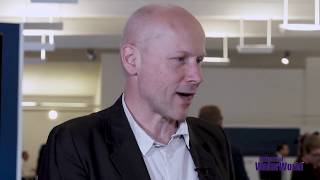
In this Waterworld magazine interview recorded at the Bluetech Forum in London, host Angela Godwin speaks with Michael Pollan of Exploration Architecture, a pioneer in biomimicry. Pollan explains that biomimicry—drawing design inspiration from biological systems—offers refined solutions for water challenges because nature has evolved over billions of years. He highlights how ecosystems operate without waste, informing circular‑economy models such as a zero‑liquid‑discharge textile factory that recycles water and nutrients. Pollan identifies economic barriers, especially the low cost of fertilizer production that externalizes environmental impacts, noting that internalizing these costs would accelerate adoption of biologically‑inspired technologies. He also discusses current work on desert water harvesting, including the Sahara Forest project and technologies that extract water from air. The conversation underscores the potential of nature‑derived designs to transform water treatment, reduce waste, and create sustainable, closed‑loop systems.
Chapters
Hi, I'm Angela Godwin with Waterworld magazine coming to you from the Bluetech Forum here in London. Joining me today is my guest, Michael Pollan. He is with Exploration Architecture. Michael, thank you for joining me today. I appreciate it.
Pleasure.
You are known as a pioneer in the field of biomimicry. First of all, let us talk about what biomimicry is. Can you explain?
Sure, yes. Biomimicry involves looking at how things work in biology and then using that as a source for innovations that suit human needs.
So why is that a good strategy when it comes to water treatments?
It's a good strategy for a whole range of functional challenges, actually, simply because biology has evolved over 3.5 billion, 3.8 billion years. And as a result, it's come up with some extremely refined solutions, including many of the kind of challenges we face in the water industry, like how to harvest water in dry areas, how to filter water, how to extract nutrients from water. Pretty much all of those you can find equivalents in biology that you could learn from.
Interesting. So can we talk about specifics? Are there certain technologies out there that you see that are doing this that are really effective?
Well, I've been looking a lot at circular economy models develop, say, factories and industries and even cities that allow all those resources and nutrients to be stewarded within closed loop cycles. Because that's ultimately where we have to get to. We know that. And so we're learning a lot from the way that ecosystems models work. In mature ecosystems, you've got a lot of kind of interconnected and interdependent species, and there's no such thing as waste. All the underutilized resources become useful for something else in that system. And we've applied that to projects such as a zero waste textiles factory. And as I'm sure you know, the textile industry uses huge quantities of water. And by rethinking all the things that were going into the water streams, we were able to redesign that system to allow for almost completely closed loop and certainly zero liquid discharge.
Wow, that's fantastic. So what do you think we need to do to get to a place where, where we're not generating waste? I mean, what are some barriers and how do we get past that?
Well, it seems that there are still some quite big economic barriers. So we were just talking on the tables recently about how it's perfectly possible to recover all the nutrients from wastewater. It's just about cost, really. It's not technically problematic. And you find that you get into competition with the fertilizer industry now at the moment, the fertilizer industry externalizes all sorts of costs, principally in terms of kind of greenhouse gas emissions and so on. Now, if the fertilizer industry were forced to internalize all of those externalities, then immediately I think we would see more of these biologically inspired solutions, much more viable, and the take up would accelerate.
Interesting. So what's next for you in your work? What are you focusing on right now?
Well, we're still working quite a lot in very desert areas, so working on the Sahara Forest project and some other ideas for projects that can extract water from the air in desert areas. So that's great fun at the moment.
Excellent. That's fascinating stuff. We wish you all the best of luck with that going forward. And thank you so much for joining us today. We appreciate it.