BlueTech Forum 2011 - Hank Vander Laan Interview
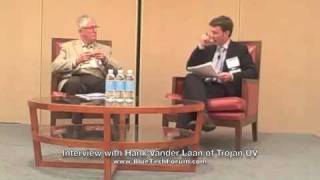
Hank Vander Laan built Trojan UV from a metal-fabrication shop into a $35 million wastewater treatment company by pivoting to municipal markets and publishing scientific data to gain regulator trust. He credits intellectual property, a committed core team, and patient capital as essential to surviving the long entrepreneurial journey.
Chapters
At Trojan uv, it would be without doubt one of the huge success stories of modern technologies in recent years. And what we're doing today is to analyze the path that companies like Trotium took and Hank is founder of the company. What the lessons learned along the way were, what were the key decisions which led to the success of the company evolving. And maybe take some takeaway points for the startup companies who are here today who might draw some inspiration from this as well. So without further ado, it's an interesting story in that it started with the acquisition of a company which was metalworks. And I think you spotted that inner portfolio, the Ellis patent for the UV system. Did you immediately recognize the potential and also how important was intellectual property to the success of the company?
Well, it's an interesting story, but very briefly, I was in the broadcasting business 15 years prior to that. I figured there's a bit of a connection. I'm still trying to figure out what that was. However, let me say, other than I grew up on a farm just north of London, Ontario, and water was always a major issue on farms. Those of you that might have been born and raised on a farm like I was, might remember that. Well, so water quality, especially bacteria, bacterially safe water, continues to be a major issue in agricultural communities. So at a school parent teacher interview, I managed a gentleman who was consulting, working for a small company called Church in Environment Products, who was a metal fabricated business, but had developed a patent on a UV device. And so I became quite interested in that UV technology and make a long story short, end up acquiring.
Because you saw the attention for the disinvention.
Absolutely. And, and the metal fabric. It was kind of nice because it gave me, gave me instant cash flow.
Right, right. And I gather also if the company grew, that your patent position was important to the business going forward. That's something you defended rigorously.
Absolutely. I certainly appreciate it again this morning for all of you, all of you developing new technology, new applications and doing a lot of innovation. Intellectual property development is absolutely key in our industry and the complexity. You know, somebody mentioned water treatment isn't quite like rocket science. And I'm not quite sure whether water treatment is more complex than rocket science. And you can certainly hear that again this morning, really a deep appreciation for all the technology development and innovation that is going on in the industry. And for us, it was absolutely key to have a huge commitment to research and development and to protect your intellectual property and your well and hopefully raise enough funds that you can actually those that imprint on what five will Finish on their powers. Yeah.
Now, as one of the east prime position, you had to choose your market segment. And it seems that a critical decision was municipal applications.
Yes, initially it was residential, and it still is. That's about, you know, after instant success, after 20, after 30 years now going on 35 years, that's about a $35 million business. And we soon discovered that we were not going to be able to grow and do the innovation that was needed if we stayed purely in the residential business. And so after this. So in 1979, we experimented treating municipal wastewater, tertiary wastewater, initially using ultraviolet light. That proved to be actually extremely promising. And so from there we expanded the research program and became very serious about municipal wastewater treatment.
And you got your first municipal plant in clusingborough, Ontario, in 1982. Now, at the time, you have this very new way. How did you convince the city to run with that?
Yeah, at that time, most of the municipal wastewater treatment plants were operated by the Ontario Ministry of the Environment, who owned and operated most of the wastewater treatment plants throughout the province. And they, fortunately they had great research staff, still do to this day. And so they allowed our scientists to work with their scientists. And it was absolutely essential, first and foremost, convince the regulatory agencies of that. And at that time, I spent quite a bit of time actually in Cincinnati with Dr. Al Vinosa. Some of you might remember Al Vinosa and Jim Kreisler, a couple of research scientists at their facility, Cincinnati, and spent a lot of time with them because they too had done a certain amount of work in ultraviolet disinfection on municipal wastewater. The cities themselves were just at great loss what they should do with this because they relied heavily on the regulatory agencies and the consulting engineering community and the consultation. So the engineer community was not anywhere near where I thought they would have been on this. And they typically, you know, won't spend a whole lot of time with you unless you have done a great job with the regulatory agencies. Whether that's in California, whether that's in Ontario, whether that's in, you know, Singapore. We find that is typically, you know, the biggest sales job is to do that.
Well, sounds like you were very open in terms of people for days after.
Yes, we quite early on published a scientific paper, a referee paper, as it was called back then, WPCF Journal. And we gained a lot of notes from Variety from that paper and a lot of support. And that became a subsequent published typically, you know, a paper every two or three months and widely distributed that information. And again, that's why you also need it you know, inspect your property protection.
Yeah, you better share the information. At the same time there was a paper Last year at WebTech by Denny Parker Brown Collar. He used some case studies of technology innovation over the past 30 years in war and he looked at common success factors and one of them they identified was the needed competition. Now you guys were first to market the uv. Did you find it was a lonely place to be initially or need competition? And I'd say that is a sole source thing because municipalities struggling with sole source.
Yeah, it can be a lonely place actually. I, I always relish competition but I relish the right kind of competition. Did competition where people used to distribute our products and try to replicate our product. I don't really appreciate that kind of competition first and foremost because they don't add any value and so they just buy them to co tails. I think that kind of competition is not healthy. I think it's not helpful. I think others innovating in their corner and coming up with insights that your group might not have covered by that time is helpful. I think it's great for the industry. We learn, they learn and becomes a win win. Thanks.
By 1993 the company was recognized as the world leader in new vehicle wastewater disinfection. And I think that year he did an IPO on the contrast stop exchange. At that point you were a leader. How important was the first mover advantage to getting to where you were?
I think it's very important. It is a. In our case we go trying to trying to raise capital was very difficult then as it is today and even I'm currently involved in three startups now not in the water industry, one in the medical devices, the other one is in the pharmaceutical industry. The third one is small financial group but. But what I find is that the same principles hold true even today. It hasn't changed dramatically from 1993 or not even from 1977. Trying to raise angel funds is a huge challenge. I'm associated with an angel group, southwestern Ontario so we do quite a bit of that once a month and where people come in with their Alameda pitches a little bit like you're you know, 20 minutes or five, 10 minutes elevator pitches. They do a two minute one. And so I'm quite familiar with what it takes today versus what it took in 77 and 93 to raise capital. Venture capital has it in its place. Angel venture and then an IPO was a great exit strategy for some of our early investors and they did very well with that. And so I, I believe it's, you know, you need to explore all of those avenues. And what I appreciate about this conference, too, is that there is such a diverse group of people that there's the innovators, there's the marketers, and there are the. And I think that's. We all need one. Another one without the other isn't going to go anywhere very fast. But at the same time, it takes a user. You need a very patient money. In our industry, the water industry, you know, I used to think I was doing terrible, that after seven years I still wasn't profitable. But I hear people here talking about 10, 15, 20 years. So in retrospect, they haven't done too.
Badly in that context. How important is it that you enjoy the journey? Because you've got to sustain yourself over a long period of time. Did you enjoy that?
I say to all of you, you know, enjoy the journey. Because if you don't have fun in the journey, you know, the pot of gold might not be there. At the end of the rainfall, then what, you think your life's been a failure? I've always said to myself, I said to my wife and my kids, you know, even if I. If you don't make it, because there were certain days and months, you thought you'd never make it. I'm still having fun doing this because one of the beauties about this business I find, and it's not perhaps unique to artists, the water business, but it is so. But that's where most of my experience has been, is that it's the dynamics and the technical challenges, the market challenges, the challenges you have as a team of trying to develop a focus and to develop a level of commitment and enthusiasm. So my associates, like Bill over there and many others, gave me a life that I wouldn't have traded for anything. Winner, lose, I thought, prefer to win. However, you don't always have that choice because once you're in that boat, you know, you row in those two oars and you're halfway between, you know, losing and winning. You keep rowing towards the winning side.
There's quite a few people who seem to be still with the company from those early days. Was the core team very important?
Yeah, yeah, yeah.
You also seem to have an ability as a company to be ahead of the curve. You, when you donated wastewater, you opened up drinking water treatment, to what extent did you see where the market was going or to what extent were you actually leading the market?
Sometimes you wonder which. Which side you're on purely. Sometimes by coincidence, you get on the right side. And purely by pure ignorance, you get on the wrong side. However, I think the key for us always was to be focused in your research and to be not only on the technology side, but also on the market side with the end users, with the regulatory agencies, and also to look at your technology in a holistic way. In other words, ultraviolet disinfection is only a small component of the total treatment process. And so it's always very important for us to understand the tone process and in how we could enhance the process, how we could enhance the application of our technology to make it of greater benefit to the end user by also, you know, your custom comes first, second and third. And if you do the right thing for the customer. We talked about that earlier this morning. You know, if you understand process and you can optimize a process that might not be your process, but it enhances and reduces the cost of the equipment that you happen to be selling, then I think you owe it to your customers to advise them accordingly. That allows you to develop a reputation where people trust you that you're going to do the right thing for them, not just for you. In other words, I always said, you know, our best salespeople sometimes will go in and say, I think I can get an order for a million dollars, but if we change this process over here, that will cost $200,000, we can sell $500,000 worth of equipment. That's a tough sell. That's the avenue we would choose. And I think I'm always very proud of our, of our team with all the effort. Best interest of the customer seems to serve you well, and it serves you well in the long term. Yeah.
You also have a reputation for continuing value engineering and innovating and also developing products customized to niches for the pharmacy industry. So it seems like you very much focus on the market application and developing the product.
Just a good example of that is a number of years ago we started to look at treating ballast water for ocean rolling vessels and potentially a huge market. However, the regulations were not in place and the regulatory agencies could not develop consensus because these, you know, crossing many, many, many borders and consensus on what these regulations ought to look like. It takes a tremendous amount of work. We always felt confident by the speakers of regulatory agencies that eventually this would become a market provided we could design the appropriate technology in a cost effective, affordable way that the shipping firms could live with. Because, you know, regulations at the end of the day, in our, our experience need to be economically viable. And if they're not economically viable, they're not going to be implemented. There's going to be huge political resistance to such regulations. So we worked on that for a number of years, kind of piped it off to the side and now it's back on really hot and probably I think should solar fresh systems last week or this week. So we think it's going to be a huge market. And so it is being proactive, keeping your eye on where the regulations are going and knowing the customer.
You probably learned a lot along the way through putting it back to any 10 things that you would say I would have done that differently.
Yeah Even you know, looking back, quite frankly, I don't know what we could have done a whole lot differently that would have gotten us there any faster. I think you know if some of the things obviously there are things that you would, you would do differently. Perhaps, perhaps especially the way you might financially structure the company. You always like to take the company to its ultimate end. And I suppose most of us would prefer to retain 100% ownership by the time you get up here 200, $500 million of revenue. And I think there are, there's sometimes a you know, real struggles as you with dilution. Right. Especially early investors tend to take a huge hit. And so some of those things perhaps I would have done somewhat differently. But on the whole not really. Again I go back and say commitment to research and development and to the well being of the end user I think are two key items.
You also got a very successful acquisition strategy like US peroxide in 2004, aquafoint 2005 or 10 in 2008. These seem to be very strategic. You wanted to get into ultra pure. You wanted to get into advanced oxidation. Can you comment maybe on your overall acquisition approach and strategy?
Yeah, the strategic acquisitions quite often are not really all that strategic and it's always somewhat dangerous to make acquisitions for the sake of growth. And most acquisitions never really work out. So we had a real discipline of asking ourselves how does this fit strategically, market wise but above all the chemistry between the people and the values that are being held by those people. In other words, do they have a huge commitment to sound research as an example or do they have a huge commitments to get rich quick? Those are two different sets of values. And if it's if the objective of the. And they tend to be all small companies. Right. They were all small startups as well. And first thing I usually look at what kind of cars they build and if the guy come in with his BMW then I, I assigned one value to them and Drove him in a cave car and I said, he's the guy, right? So we were fortunate to be. It allowed us to focus on people that loved doing what they were doing. They were in it for all the right reasons, plus they had great research and they had a huge commitment to, to make it a success. And I think so. We did not make any acquisitions that, you know, made us an instant success, but they along with us struggled to get to where we are today.
It sounds like you worked and maybe finally, how optimistic are you for the future and what types of changes do.
You see in the market? I personally believe that we're on the edge of something that's, I think even much bigger than when I started this in 76, 77. If I look at the needs and the opportunities especially I'm a strong believer in closed loops systems. And I think what we have built in infrastructure is not sustainable. And I think us, if the industry thinks it's going to just simply replace infrastructure as it is today, I think we're whistling Dixie, barking up the wrong trade. It's not sustainable. Can you imagine digging up every street in every major city to replace all of our sewers? I say, you know folks, it ain't going to happen. And you people in this room are probably going to make a huge contribution to make sure that that doesn't happen. Because if you can well imagine the trillions of dollars that you would have to spend globally if only 10% of that could be used to invest in great research that would allow us to do what they do with the space program as an example and right back there somewhere. And then I would say, you know, opportunities go over. But it does require though, a lot of patience. And sometimes I'm not so sure whether, number one, there are people that still have patience and number one, number two, perhaps even more importantly, whether there's that patient capital or not, I think that's. But I think it's a huge opportunity. This is a great time to be in this business. Excellent.
Well, thank you very much for your insights, Phil.










