BlueTech Forum 2011 - Hot Tech Area - Advanced Desalination
Four desalination innovators presented alternatives to energy-intensive reverse osmosis. Mark Lambert's forward osmosis harvests RO brine and secondary effluent. Michael Lencic's capacitive deionization recovers energy and achieves 95% water recovery. Rick Stover's closed-circuit RO reduces energy use by up to 35%.
Chapters
Desalination, as I'm sure you're all aware, is a well established and to much extent a commoditized field based upon reverse osmosis membranes. So what we're going to be looking at in this morning's session are some companies who are seeking to break out of that commoditized sector and to introduce some innovation into the field of desalination. One of the key problems in desalination is that of energy use. The energy use associated with desalination means that it cannot be applied very widely apart from absolutely where needed because the energy cost of doing so is too high. And it's very important for development of the world's water resources that we break out of that relationship and that we investigate low energy technologies, membrane technologies. In this case, we're going to be looking at low energy technologies that make desalination more accessible, more affordable and more sustainable. So we have four presentations this morning. First up is going to be Mark Lambert of hci. Mark is the Director of Corporate Development. HTI is a forward osmosis company, so he's looking at a novel osmosis membrane to desalinate water. Mark has a Bachelor's in Chemical Engineering from UC Berkeley and an mba. Following Mark's presentation, we're then going to be looking at the company Voltaire and Michael Lencic. So apologies to Michael for the anglicization of his name, but I'm sure he gets used to that. Michael is the CEO at Voltaire and they're a company that look at capacitive deionization and it's a Unilever spin off. Mark has a masters in physics which is very handy for the highly electrical technical nature of his company. He also has an mba. Our third paper will be from Michael Motherway. He is the CEO at dxv. DXV have a low fouling nanofiltration technology and that's certainly an important technology in membranes for the future. As we become more concerned with pharmaceuticals, agricultural residuals in the water supply, there will doubtless be drivers or adoption of finer membrane technologies like nanofiltration. And then our last seeker will be Rick Stover, who is Executive VP at desalatec. Desalatec have developed a low energy system approach to reverse osmosis, which promises to provide dramatic energy savings. Rick is very well known for his work at ERI which was an extremely successful energy recovery company working in the reverse osmosis field. Rick has a BS in Chemical Engineering from the University of Texas. So without further ado, I will hand over to Mark and we'll Go through the four presentations in order.
Thank you.
Thanks Graham. Just before I start, I thought I'd share a story with you which is has to do with my wife asking me last night. Another week, another hotel and another water conference. You must have a girlfriend. So she's coming here this afternoon to be with me for the week. I'm going to introduce you to my friend Paul, my other friend Paul, my friend Heinrich, and about half of you that I know in the audience this morning. Thanks for having us. Hti, you probably know by now as the forward osmosis company, been in it for about 25 years. I'm actually pinchating today for our chief technology officer who couldn't be here. He's in Australia working on a coal seam gas WasWater application using FO. HTI was founded in 1986, about 25 years ago. If you're taking notes, this is how long it takes to commercialize new technology. We're located in Albany, Oregon. Many patent positions, lots of intellectual property portfolio, first class chemists, chemical engineers, process people and memory manufacturing people exist at our facility in Albany. About 42 people. We're 25 years. As I said, we're the only as we know of and I'm happy to be corrected today, but I believe we're the only commercial manufacturer of forward osmosis membrane on the planet. We are profitable, we are not cash flow positive, but we show profit on our books and we can talk about that at a later time if you want. We're about 42 full time employees at the moment. I don't want to make this a technical presentation, but forward osmosis, if you can imagine, I ask people to draw a dotted line down a piece of paper and on the right hand side of the paper is a draw solution. As long as that draw solution has a higher salinity than the solution on the left hand side, water will migrate across the membrane to try and dilute the salt. Simple as that. Forward osmosis, we didn't invent it. The guy up top invented that. It's how plants get hydrated at the top of the plant. So comparatively to reverse osmosis, which is what we use today to try and force water across the membrane and retain the salt at very, very high pressures. Forward osmosis is a very low pressure operation. It's a natural equilibrium process and therefore there's a lot of opportunities in terms of energy savings and capital and opex. We are active in five commercial markets today and if you talk kind of at the top left hand, most of you understand that we have been playing in the oil and gas field market for a couple of years now. We're very active in the Haynesville Shale and it's refreshing to not be presenting in the produced water show that we're normally slotted in. But we are very active in there today. We have six mobile, what we call green machines which are devices that have forward osmosis membranes on a 50 foot long truck, 54 foot truck and we are out treating wastewater. It's drilling mud actually and producing fracking fluid and recycling about 80% of the water, therefore taking a lot of truck traffic off the road and giving a nice fracked fluid. We do that in the Haynesville, Marsalis and Eagle Ford Shale. Next application is industrial and municipal, primarily wastewater applications. I'm going to talk a little bit today about desalination. We're active in the landfill leachate market, we're active in the biodigester market. We're active in a number of other industrial waste stream applications. At the bottom there you'll see personal hydration and backpacker type markets. I brought today what we call our hydration pack. This is a retail product that we sell and if you throw this in a mud puddle it will self hydrate in about six hours and give you a drink. It's orange because it has an orange flavor. It's basically sugar is the draw solution. So upon complete hydration you'll have the light Gatorade solution. You can have one of these if you want. I have one hydrating in a, in a jar outside. Humanitarian relief, we're pretty active in that. And it's products like this or similar to this where we will respond to a natural disaster. We had 50,000 of these shipped to Haiti when the earthquake happened. Costco just placed an order and we will ship our millionth of these this week. So we're pretty active doing that. And then the top right hand box is the military market where we are deployed in the Seal teams, not Seal Team 6 which became famous recently. But yes, Seal Team 1 which is based in Coronado, California. The special forces units are using our products out in the field for obvious reasons. It's a backpackable deal. They use sugar as a draw solution and they can throw it in a blood puddle and have a drink in a couple of hours. We are commercial as I said. I'm not going to read through this entire slide, but suffice to say introducing breakthrough technologies, technology takes a long time, a lot of effort. If you're a membrane supplier, you by definition are Going to be in the systems business because you're educating people about how to bring technology to market. And doing that takes a lot of commitment and a lot of passion for being in the systems application engineering business. And that's what we are and that's what we do. That picture there by the way, is a plate and frame forward osmosis unit that is treating landfill leachate about 40,000 gallons of energy using sodium chloride as a draw solution. In that case. There are three applications that we are looking at that broadly touch on the desalination arena and they are a thing called sewer mining, which many of you may have heard about, another thing called reverse osmosis retentate remediation. And the third one is to treat CIP or clean in place liquid waste streams. The sewer mining application is. Well, let me go back. Can you go back on this? I guess so. So sewer mining is where we would take recover secondary effluent from a wastewater treatment plant and match it against either seawater or what I prefer to do is match it against reverse osmosis concentrate that's currently discharged back to the ocean. There's a lot of osmotic potential in that stream. That's a waste stream today. And the next slide I'm going to show you is a little bit of a calculation on what potential there is. We talk a lot about where's the next 1% improvement in reverse osmosis membranes coming from. And therefore we can get a 1% improvement in D cell costs. We're throwing a lot of energy away in the form of the brine that's removed from the water during ro and that is a power source for me for forward osmosis application. The RO retentate remediation is a lot of times. I live in San Diego, California. The city of Carlsbad spent 10 years trying to get a permit for the soon to be built reverse osmosis plant. And the biggest issue was trying to get a permit to discharge the brine back to the ocean. And had that been able to be remediated, I think that plant would have accelerated. Running out of time here. But today I got this validated from Mr. Tom Pankratz, who's not here, but he is considered the expert. There are 30 million cubic meters of seawater RO capacity globally. If you do some quick math and assume that that reverse osmosis concentrate is being discharged back to the ocean at 70 grams per liter of TDS quick solution at the bottom there, assuming 50% recovery rate, there is I think 110,000 gigawatts of energy potential in that if I use it as a draw solution. Today we're throwing all that away. So that's the sort of breakthrough technology in desalination. That's potential is let's take the waste stream and convert it into something of benefit. I'm not going to get into the process flow diagram here, but what's on the right hand side of your page is the reverse osmosis plant using conventional seawater reverse osmosis. Taking the concentrate, the middle kind of block diagram there is a forward osmosis and what it is doing is it's matching the reverse osmosis concentrate or the waste stream against secondary effluent. And I can do a lot of things with that. I can create title 22 water, which we call here in California, tertiary treated water for non potable reuse. I can generate power. Many of you are probably familiar with Statcraft, the Norwegian company that's doing osmotic power. They're proposing to do seawater against fresh water, proposing to use RO concentrate against fresh water or wastewater and either do power generation or treat water for beneficial use. So there's one process flow diagram. Another one is the detoxification of the brine that we just talked about. And I could match that against secondary effluent. The obvious question you have to ask is where is their seawater desalination plant co located next to a wastewater treatment facility. Well, it turns out there's more of them than you think there are. There happens to be one where I live in Carlsbad. There are several around the world that coexist. So there's my secondary effluent that's being discharged to the ocean. It's my RO concentrate brine. It's being discharged to the ocean. All I want to do, please is put a reverse osmosis membrane in the middle and I'll do something beneficial for you. And finally, because I'm running out of time, any questions? Going to take them at the end. Okay. All right, thank you for your time. Sorry, this.
I would like to invite Mark to my next board meeting to explain how long it takes to take the emergence to market. Good afternoon ladies and gentlemen. Good morning actually. Good morning. Like to introduce you today a technology that we think can change the way desalination of brackish water is done nowadays. I'll walk you through a little bit through our technology and the benefits of it and address the markets that we are currently pursuing. Voltea spun out of Unilever about five years ago. To develop and commercialize capacity ionization, or capi, as we prefer to call it. We are currently funded by three venture capital funds. One is Unilever Ventures. The other one is actually Corporate Pentair. The third one is Raven Ventures. We are based just south of Amsterdam and we employ over 30 people this month. So we developed a way to desalinate brackish water using a very elegant electrochemical principle that draws ions out of the water. And I would like to walk you through how this works. Dean, could you please press the purification button? Thank you. So a system consists of two electrodes, and those electrodes are charged at about one and a half volts. And a negative ion is then drawn to a positive electrode, and a positive ion is drawn to the negative electrode. And that way we draw the ions out of the water and store them in electrodes. At some point, those electrodes are filled with the ions and we need to regenerate. And now comes the clever bit. Normally, if you would just turn the polarity of the electrodes, which is normally how CDI was done, the ions would just move to the other side. But by placing two ion selective membranes between the electrodes, those ions cannot go to this item and are blocked in the spatial area in a very concentrated form. Dean, do the next. Yeah, thank you. Do you see how the polarity reversed and how the ions are kept in this spacer? Once that's done, the next button you will show how the. Dean, I need you. Thank you. How the concentrate goes out of the system. Now, this is a very efficient way, but it's another intrinsic nice thing about this technology. Could you please push the purification button again? So when we are desalinating, we're actually putting energy into the system. We're drawing the ions and storing them in the electrode. We're literally storing energy in a capacitor. It's like charging up a battery. So once the desalination cycle is completed, we have a water battery. And when we regenerated this. Can you please push the next button? Yeah. This energy can be taken out of the system and used to desalinate the next module. So you can imagine that this really lowers the total energy consumption of the system when 27 did. Now, what are the benefits of our technology? Apart from the energy consumption, there are three other big benefits. One is the scalability. We can make a device this size that can fit into a coffee machine, or we can make a big system to desalinate brackish groundwater. And I'll talk a little bit about in the Market why also the smaller system for us, it's a very attractive market segment. The second benefit of this technology is robustness. So the spatial area that the water goes through is about 100 microns. This is 100,000 to a million times the size of a pore, of a reversal osmosis membrane. So you can imagine that the water that we can desalinate can be actually quite variable compared to reverse osmosis. And we can therefore also desalinate water with higher organic compounds and also water with higher calcium levels. So that also in some applications is a huge benefit.
The third.
Benefit of the technology is the water recovery. So one of the issues with desalination is how much water do I actually get out when I start desalination? We start. So our starting point is 85% recovery. And if you do some pre filtration, which we normally don't, you can get up to 9%, 90, 95% water recovery, which is extremely high. Depending again on application, this is a major, major benefit. So let me discuss. I think you have to click on the white space for me. Thanks. Thank you. Applications. So one of the nice things about technology is, like I said, is the scale of the ability. But also being a platform, technology is an immense amount of applications that it can be used for. This is great. This is also a curse because we have to choose. I will just go through three applications that we're currently working on. One is softening. Calcium is just an ion, so we remove calcium. We signed a contract with a large American company to develop and launch next year a softening device for whole house applications. The second application that we are currently working on is wastewater treatment. Again, the robustness of the technology lends itself to more difficult water streams. And we have just received a 1.2 million euro order from the Dutch government to build a wastewater recovery plant or pilot in which we were using quite limited pre filtration and that kept the eye to take off the last 50% of salt in the wastewater to use it for agriculture. And the third application that we are currently working on is cooling towers. Paul briefly mentioned industrial water use. Cooling towers is one of the major sources of water use. And because we have such a high water recovery by desalinating water before it comes in the cooling tower, we can actually reduce the total amount of water. The cooling tower can reuse the water more often and we reduce 20% of total water consumption, reduce 60% of the wastewater stream, and we reduce 80% of the chemical usage. We are currently piloting within unilever at five sites, Ben and Jerry's being one of them. And we are deploying it next year to several Unilever sites. Running out of time, so I'm going to skip the next slide. So strategy is always a nice thing to think about. We really believe that this can displace other desalination technology in the brackish water space. That's our strength. In order to do so we need to bring the cost down. And there's where actually the two different market, the mass markets and the industrial market, come very handy together. In the mass market, for instance, with the residential products, we are actually building a factory right now to manufacture the electrodes and the membranes in the hundreds of thousands of square meters per year range. And this is, we delivered these materials to this company and we have a royalty deal. But this kind of scale that we really need to launch its application will make it possible for us also in the industrial area to compete with reverse osmosis in the precious area space. So I hope after this presentation that you see that the advantage of this technology of low energy, high water recovery and robustness and scalability really makes this an unique technology that may compete and may change the semination of brackish water. Thank you.
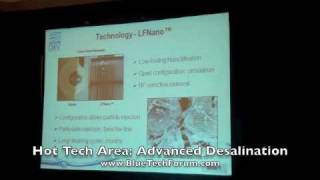
Good morning. My name is Michael Motherway with DXP Water Technologies. We are at in Tustin, California developing an interesting desalination technology. I didn't quibble with Paul when he put me on the desalination panel. But our technology, we look at it as an affordable membrane wastewater treatment system. It's a membrane system and therefore an osmotic membrane system that is desalting. But we can also apply this because of its characteristics to wastewater. It says wastewater will be of the highest value. We're calling this system the LF Nano. It was developed by a gentleman by the name of Diem Vuong. And Diem, in his last municipal sector job, where he was for 40 years in the municipal world, developed a dual pass nanofiltration system to desalinate seawater. So he had a lot of experience with nanofiltration membranes which are rather unique in the, in the membrane world and rather a niche in the membrane world. But the LF nano, the low falling nanofiltration is what he has developed. And what this uses is off the shelf thin film composite membrane. The TFC membranes as we all know, are extremely cheap. People think of osmotic membrane systems as expensive, but the membrane itself is commodity and very cheap. What's expensive about desalting systems is managing the fouling and managing the concentrate produced and that's where we have some interesting things here. The technology is essentially a membrane element in a pressure vessel with recirculation of the water within the vessel. And that recirculation provides a good cross flow and suspension of particles and good flow dynamics. There is no feed spacer in this membrane, as we know. The feed spacer grabs on contaminants and allows things to grow and plug up the elements there. Taking from Paul's analogy earlier about the chainsaw versus the butter knife, there are systems out there that do similar things to ours, but they're the chainsaw mentality. Whereas we have a far simpler system that can avoid the fouling with about a tenth of the cost of some of the systems on the market today, they use vibration or impellers between the membranes. So the selective removal of the NF membrane allows us to keep the osmotic pressure requirement very low. And that, along with this new concept we've been working on for about six months, is particulate and injection. Because of the open configuration of this membrane, we can go ahead and inject coagulant particles like diatomaceous earth is one example we've been working with. It allows it to bind up the very fine particles that would fall a membrane embed into the pores. They grab onto the particulate. We inject and you now have large particles that will fall on your membrane that they're easily removed and they keep the small particles defined from embedding into your membrane. This leads to very long cleaning cycles on these membranes in a matter of months rather than minutes with some of the low pressure membrane systems on the market today. Another advantage of this technology in wastewater treatment is that we're actually doing physical separation. And you'll get in your primary sludge up to 50 to 80% more energy. All the energy content, all the organics in that are rejected by the NF membrane. And if you're going to handle your sludge with an anaerobic digester, you have a whole lot more energy potential. So we think this will disrupt the market for digestion and energy production. This is why I think the next panel might be a good one for this as well. This is not an mbr. We're not doing biological treatment here. This is physical separation. What we're going to do with this technology, of course, when you can go and compete with membrane technologies, that's one thing, that's rather, that's one market. But we're also competing with secondary aerobic digestion. So that opens up a huge market with the Wastewater being one of them. These large macro markets, we can compete very favorably. But we're focusing on on early adopters right now. High value market entry points for us, including some industrial sites. We're testing at a cheese manufacturer here in California and we have a potential wastewater treatment play that we're looking at in Mexico. Currently distributed. This technology scales down very well. It's very simple technology and the downward scalability will allow small distributed wastewater treatment very affordably. Stage we have tested this technology at four different municipal sites and one industrial on all sorts of water sources. Wastewater sources, including a lake water source. Each of the pilots is about 400 square feet of membrane. And we have commercial projects pending. We hope to get to the first one this summer. We also have a Bureau of Reclamation study. They're going to purchase a small unit from us that we're finalizing the contract on that and we'll hopefully start that this summer as well. In terms of our strategy, we're early right now with the initial applications. We will be doing a lot more application engineering than we'd like to. We'd like to make these systems and sell them to the marketplace. But in the position where you have something new, you've got to do the soup to nuts. And that's what we're doing. We're talking to manufacturers of our components about taking their components one step further. In particular membrane. Membrane manufacturers can sell us rolls of their TFC membrane, but we'd like to talk to some of them about making the pockets in the format we integrate into our elements. And we have a partner we've discussed with and has good footprint in the dairy industry. We're testing one of their customers here in California and they make NF membrane and they also have a good presence in the dairy markets worldwide. So they make for a good partner that can do both on the supply side for us as well as introducing us to a market. We're also talking marketing. People downstream have a footprint in the tourism industry. Remember this system scales down very well. Very low unit costs for wastewater treatment. And a lot of tourist installations around the world are remote, not connected to any sewer grids. And we can help them quite economically to treat that wastewater. We're also looking at potential golf course reclaim water, desalting the reclaim water. We have some partners in that arena as well. So our go to market strategy is license manufacturing of components and getting marketing partners who have access to customers for us. And that concludes. I'll take any questions.
Hello, I'm Rick Stover. I appreciate the introduction Graham, he didn't mention that. I did my PhD work at university of California at Berkeley across the bay there in chemical engineering. So I just moved away last summer.
So it's cool.
Great to be back home again. Great to see Professor Sohn and Laura Shankar from the Bay Area. Desalatec was honored with Artemis Project Top 50 Award in a lovely private ceremony this morning. Okay, so I'm here today to talk about Desalatec, my company and its new technology. Next generation reverse osmosis technology by next generation reverse osmosis, the core process hasn't changed since the 1960s when Sidney Loeb implemented it and his initial installation in Coalinga. The process hasn't fundamentally changed and so this is really something new. Most experts would say that implementation of improvements in in reverse osmosis has really reached the point of diminishing returns. But what I'm going to talk to you today about is a substantial improvement in system performance and energy consumption that has potential impact on all existing RO applications. And so this is at least my definition of highly disruptive technology. So let me get right into it. So disposal Soltec, the company was founded to commercialize closed circuit desalination. In my next slide, the technology slide, I'll describe what that is from a process standpoint. It's a membrane water treatment technology. It's applicable to all existing RO applications and many nanofiltration applications. And it offers 20% lower cost of operation. So that rolls up cap cost and operating cost for desalination. Big component of that is energy. So we've computed up to a 35% reduced energy in seawater and in brackish RO systems. Also lower capital costs with a smaller footprint potentially depending on how you play the opex Capex trade off all of this with better membrane performance and a system that has greater flexibility. The technology has already been operating in commercial installations for over two years. So it's a proven technology and it's patented with patents actually issued in 70 countries already in several war in the application state. So this is a simple schematic that shows a conventional RO membrane array. You string membrane elements in series to get the recovery you need. Only each membrane element can only do so much recovery. So if you want higher recovery, you need to have more in series.
As.
You go down the line of membranes. The water concentrates as you're taking permeate out. So at the end of the line, away from the pump there, it's the highest concentration of water, highest concentration of salt, and the most difficult to get more fresh water out. So you need to apply pressure, sufficient pressure at the front of the membrane array to make the last membrane elements productive. You need to overcome the osmotic pressure of the tail elements. Well, that means for one, you've got a highly pressurized brine stream shown with the red arrow there that you need to recover energy from. And second, you've got compromised membrane performance. Your head element is going to be doing most of the work in this situation because it sees the highest pressure with the lowest salinity. Your tail element is not going to be doing much for you in terms of productivity. And it's also at most risk of scaling because the highest salt concentration and the low flow. Contrast this with a closed circuit process and what we've done here is taken the most productive membrane elements out of the conventional RO system and put them in a closed loop. 100% of the concentrate is recirculated back to the feed of the membranes. And so this operates with high cross flow set with the circulation pumps shown here. It's a hydrostatic process. So every drop of water that the high pressure pump injects into this closed loop comes out as permeate. We're not creating a high pressure brine stream. So there's no need to do energy recovery in this system. It's 100% productive in terms of the output of the high pressure pump. And one of the best features is that it in this batch process, if you start with a charge of feed water, then the initial operating pressure is just above the osmotic pressure of the feed water. That pressure builds up as the salinity builds up in the loop. But then once you reach the final salinity that you're going for with the desired recovery, you flush the system out and that lowers the pressure down again to just above the osmosis pressure of the feed. So the pressure profile for the closed circuit process is shown with the blue curves. Starts low and builds up to meet approximately meet the operating pressure of the conventional system and then drops back down again. Big energy savings is in that reduce pressure. The big membrane savings is that we don't overwork the head membrane elements. And our membrane elements are highly productive, all of them with high cross and then finally the system. The salinity in the system goes up and down so it doesn't allow for biofilms to stabilize and form and it tends to disrupt scaling as well. So we're seeing outstanding membrane performance in the system. I guess the final comment is I started saying that the number of membranes you need to have in series in the conventional process dictates your recovery in the closed circuit process, just the amount of time that the recirculation goes for. So recovery is highly adjustable and you can achieve very high recovery with a single stage of membrane elements. Here are some pictures of running plants. They look a lot like conventional RO plants because they're made out of all of the same equipment. We just put them together in a different way. The results that we've seen with these running plants are it works and works. Steady state production. We do, we have confirmed the energy savings with real field test results. We do see the improved membrane performance and high recovery for brackish system. Up to 95% recovery in a single stage, highly flexible operation. Standard equipment. We're not introducing new equipment here, so it's easy to do this reduced capex. And we're already working with clients, collaborating with some market leaders, including GE on a project in Israel, looking ahead. So our goal is an ambitious one. We are out to lower the cost of reverse osmosis water treatment universally everywhere it's done. And so what we offer is this proprietary technology. Initially we're doing some direct sales of RO units, containerized units, package plants. Ultimately what we'll do is license the technology through companies that already build RO systems. If you can build an RO system with a conventional process, you can build it our way with the license. And so commercialization has begun. We're venture backed and we're backed by Aqua Agro, it's an Israeli venture capital fund. This year we're looking at getting going with retrofits. It's highly possible to retrofit an existing RO system to demonstrate our technology. But ultimately, of course, we'll be building new systems to take maximum advantage. That will go into more and more OEM partnerships, hopefully and some joint ventures on larger plants. But ultimately we'll just license the technology and that's it. Thank you for your interest and attention.
Well, thank you very much for our speakers of this session. I think, Rick, you gave the prize for being closest to time. You got it within one second.
Because.
We have a great big swamp down here on a laptop which is blinking numbers at us all the time. So although you're all very calm out there listening to us, we're all very, we're on tenterhooks here to see how close we're going to get to the allotted time span. So one of the things that probably strikes you about hearing about these innovations, and one of the things that strikes me is that a lot of the innovations we're hearing about are enabling innovations for others of the technologies.
So.
The application that Rick was talking about there would enable higher permeability membranes to be used in RO more effectively than current RO designs would allow. And there are a lot of synergies that would be possible from innovations that we've heard about from all of these speakers and speakers that we had at our conference here last year. So if you have any questions of the speakers, please could you raise them in the breakout sessions between the main sessions. We thought that the question time would take up too much time if we tried to have it within the sessions themselves. Don't forget that we have a form to fill out in order that you don't forget what you thought about all of the presentations as we went through. It would probably help if you filled it out as you went along. Difficult to rank the presentations, obviously, when you're only hearing the first one. But as we go through the day, you should get a better feel for how a presentation is going to sit against others that you've heard. So please fill out the forms, give us a bit of fun at the end of the day to present the awards. So we've now finished this session on advanced examination. We're going to go on to our next session and I believe, Tim, you're the moderator.
Yes.
So can I hand over to Tim and his and his presenters for the next session? Thank you very much.










