BlueTech Forum 2011 - Hot Tech Area - Produced Water and Decentralized Treatment and Reuse
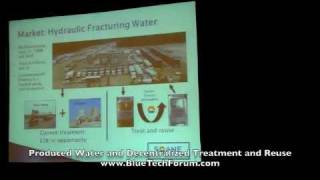
Four companies presented technologies for treating produced water, a high-salt waste stream from oil and gas. Vivian Drake's ion-exchange process targets a $100 billion global market at 18-30 cents per barrel. Gerhard Forstner's system gasifies solids into syngas and electricity, while Ned Godshaw's thermal process handles water with 100,000-300,000 ppm salt at 20-30 cents per gallon.
Chapters
Session.
So with regards to produced water, the term has become increasingly more common. It contains high and variable levels of petrochemicals, salts, organics and nutrients and therefore requires specific treatment. Decentralized treatment is also becoming much more commonplace and as we are increasingly facing the challenge too to provide abundant amounts of clean water with a few to reuse. So today we have four very innovative technologies in this space. The first presenter will be Vivian Drake, founder along with her husband Ron of Drake Technologies. Vivian is going to present on their ion flow technology which looks at treating influence with a high total dissolved solids concentration using commercially available ion exchange resin. After Vivian, we have Gerhard, the CEO of M2Renewables. Their technology is concerned with firstly the removal of fresh solids using the M2 Ore micro screen and then the remaining suspended solids and dissolved organics are removed using the M2 ore modular filter system. Following Gerhardt, we have Ned Godshaw. He's the chief executive officer of Altela. Altela are a water desalination company and they're using a thermal dehumidification technology that is concerned with the treatment of produced water from the oil and gas industry. And last but not least, we have David Sohm. He's the founder and CEO of Sohm Technology. They're a recent startup from Cambridge in Massachusetts and today David is going to present on their technology which uses polymer and monolayers to treat produce water. And so I would invite Vivian to start the presentation.
Good morning everyone. I'd like to thank Imer for the introduction and I would also like to thank Paul o' Callaghan and Steve Klus for the invitation to talk about our new technology. I am here, as Emer said, as the COO and co founder of Drake Water Technologies. We are located in Helena Breakwater. The LLC was formed in 2006 with some investment money from family and friends. A lot of us get started and then in 2010 we received what we considered a sizable investment from a major oil and gas corporation. Now you ask yourself why in the world would a large oil and gas company invest in some little PO dunk company in Montana? Well, I can tell you why. We, we actually had the audacity to ask them there and they told us we know that water is going to be the new oil. We started the development of our ion flow technology about a decade ago, originally looking at the coal bed methane produced water treatment arena. Ron Drake, the inventor is here and I would invite you to visit our exhibit out in the hall. We actually have a working model of the technology, but this is not your grandmother's ion exchange. Instead of treating water or running water through ion exchange beds, which is a traditional ion exchange process, we actually dose resin to the water. We basically trick it. We're in the kinetic regime of treatment, not the equilibrium regime of treatment. We have many, many added advantages in our technology, One of them being dialing in response. Removal of the ionic species or the salts that we wish to remove gives us great advantages in that we don't have to regenerate as much. We don't use as much regenerate, which is generally an acid or caustic. That saves money. We also only have about 5% of the ion exchange in process at any one time. That's again a real cost savings. Because we're working in the rather remote wilds of Montana and Wyoming, at least originally, we knew that we were going to have to have a mobile and portable technology. You take the treatment to the water, not the water to the treatment. Saves a lot on infrastructure costs. In addition, we knew it was going to have to be modular and scalable because in Covid methane there is a decline curve in which you initially produce large, large amounts of salty water, but over time that declines and you end up producing more gas. So you move modules on and modules off as they're needed. We have a very, very small environmental footprint. And when we leave the site, you can't even see that we were there. And in the case of produced water treatment, we produce a brine byproduct, sodium sulfate, which is a saleable commodity. It is a truly continuous process. And again, I would invite you to visit our booth. We had an interesting directive in that our process was designed to clean up very large volumes of slightly polluted water. That's 1,000 to 10,000 TDS. Not many people can actually address that market. And indeed it is a worldwide market. There are currently 17 countries around the globe in various. They're in various stages of developing their coal bed methane or coal seam gas in Australia, Their reserves in the Powder river basin in Montana and Wyoming, for example, we know that over 40 billion barrels are going to be needing treatment in the next decade. That's a very large 8 billion dollar opportunity. In Alberta and Queensland, we looked at the markets there because they are actively developing Covid methane. We know that they're going to need at least 75 billion barrels of treatment with the global market of over $100 billion. So some people have told us, well, you're in a niche market. We look at these as huge markets. But about a year ago, the price of natural Gas in the United States fell to below $5 per thousand cubic feet. And the gas company we were working with at the time and were prepared to deploy our commercial unit to told us, you don't need to come until the gas price bounces back up. Which left us in rather an unfortunate position of losing the client. We haven't lost them, they just don't want us right now. So it forced us to start looking at other applications for our technology. And as it turns out, it's tremendous. We have the ability to clean up waste streams, reject streams from nanofiltration, reverse osmosis, electrodialysis. We also can beneficiate irrigation, especially salty irrigation waters to protect soils, as well as treating some of the saltier or industrial water supplies to protect equipment. So we really expanded the markets that we can address the stage that we are at. Our company's been in business for six, seven years now. We have field demonstrated our technology at five separate locations in Wyoming, all very remote. We have a full scale 300 gallon per minute unit, commercial unit ready to deploy. And we have people are also now asking us, well, will this treat frack water, frac produced water. And the answer to that is no, it was not designed for that. However, our company is in the process of developing a new patent pending process called salt flow. Completely different than iron flow. But we're very excited about what we can do with the iron flow technology. As you can see in the lower right hand picture, you see the circle around that one unit. That unit treats 10,000 barrels per day, day and multiply that times 42. That will tell you how many gallons we treat in a day. So our strategy for going to market is that we are looking for strategic partners. We're looking for alliances that are either manufacturing or service providers that are interested in licensing or joint venturing. Quite honestly, we're open to almost anything that makes sense to get our technology launched in the global arena. The paradigm that we are very familiar with is in the Powder River Basin in which you charge an access fee to lease a unit. Our only competitor in the Powder river basin was charging a million dollars. We could get away with charging $450,000 versus the $160,000 that it cost to actually build the unit. But the real money comes in at the water treatment feed. We have a gross margin of greater than 50% because we charge 18 to 30 cents per barrel for treatment, depending on the amount of salts we're removing. Nobody else can do this. We have this ability for this dial in. So it is a gross Margin and there are also other fees you can tackle such as relocation fee. But with that I'll turn it over. I want to thank you all for your attention and as I said, please come visit our exhibit.
Thank you Vivian. Good morning. Everyone is awake after most of you I guess. I saw most of you at dinner last night. Thank you Paul Ima for putting this on together with ivf. It's a wonderful conference. Thank you all for coming. My name is Gerhard Forstner. I'm the CEO of a company, ENGDO Renewables based in Southern California. So around in the urban area.
I have control.
Very good. So we talk a little bit about our technology, what we do. We got a very informed panel here. So I don't need to go too much into details about wastewater treatment. But I would like to propose to you who have not seen our technology show you what we do differently through conventional technology. Our system really consists of three major components, if you will. The first one is what's called HEMA introduced micro screen. It's a 300 micron belt filter screen which we use in lieu of clarification. Primary clarification in a treatment plant followed by a modified continuous back flow upstream media filters, sebum filters and to remove suspended solids mostly and phosphorus going into a biological treatment. With the premise of removing the solids upstream of a wastewater treatment plant. You can really significantly reduce your footprint. You can reduce your energy requirements on the plant and reduce using your operational cost. The performance of our system is typically as tested has been screen plus the filters. We remove about up to 96% of the suspended solids. We remove phosphorus to non detect levels. DoD remover just with the physical mechanical chemical step is about 35 to 40%. We take those solids which we move from the microscreen at the very first step. So you imagine you take the screen and right after your bar screen you take the solids before they undergo biological transformation. Remove those solids, dewater them to about easily 35% dry solids. Take this material which really very much looks like toilet paper for the most part it's cellulose material which has a BTU value of 8,000 plus minus. And we take this material, dry it in a dryer to 80% and then go into an ultra high temperature gasification process. And I go through the technical specialty in a little bit here. The company was founded by Ken Steadman in the late 90s and the way he started was he had the license for the Dynasant. Most of you are familiar with the parts and Dynasend Seabump filters. And he used the filter an hour north of here for really testing of heavy metal removers. So he used the filter and he found he removes copper, zinc also. Oh, by the way, we remove phosphorus. And he said, wow, that would be great for wastewater treatment. What are we gonna do though with the wastewater? Can we remove wastewater straight into the filter? And of course he tried it. He's an inventor and the issue was of using large particles clogging up the filter. So he said, okay, I need to have a belt filter screen in front of it. And so he approached a company, Norway, a Salzness filter which was developed really for salmon farms. They used it for river sea outfalls where they removed the debris waste from salmons. And he said that's a perfect combination. Let's use the filter with the first screen with the filter and see what it does. And that's how we started out really. And we found out the kinetics updates biological activity. We can accomplish much more with less energy on a smaller footprint on a biological side by removing your larger solids up front. Then we had the problem. What we do with the solids, we create lots of solids. And we found out, okay, let's see, is the solid worth anything? Because it's fresh solids, it's not really wasted with a larger biosolids is the BTU when we're good. And sure enough it was good. So we found this gasification technology. So our market is really, it's a classic market. Our market is really every municipal treatment plant in the United States for the wastewater treatment. A portion of it is more. The smaller plants on the gasification really go opposite medium to larger plants. The technology really goes. We're looking at primary treatment replacement, clarifier replacement or really new plants, developments, commercial developments, cruise lines, this kind of thing. So really a full treatment plan on a new build or parts of an existing treatment plan with an upgrade on the primary clarification. Our target customer is the classic model. We have the three Cs, we have a consulting engineer with the contract and we have our client, our market. Vivian talked a little bit about it. I mean the latest number for it is in the United States now. It is a 200 billion number to upgrade the system where it should be by 2020. The latest number I read yesterday is 395 million for wastewater and about 390 for water. So that's what needs to be invested to bring us to the standard where we need to be by 2020. So it's unbelievable and I don't know if Obviously it's going to be a challenge for for those municipalities to get us there. Our yearly need investment need is about 30 to 19 billion. Those are figures from the EPA globally. Currently the expenditure is about 35 billion. Obviously you know this number should be probably close to a trillion we believe because only 10% of the wastewater currently is treated. 90% of all wastewater worldwide goes untreated into our ocean. So stage. So we are a little actually we are quite along quite a ways. We have two existing installations. One is both in California, One is in the high test at a 3 million gallons per day system Adelante where we have a system the microscream plus the filters. We have another installation in the center here at Fontana. That's a smaller plank but there we use. We replace primary clarifiers with our screen. We go to a trickling filter and from a trickling filter we go to a secondary filter. The water is used for cooling tower make up for cooling towers for steel mill. So the owners for largest commercial warehouse operator they run the plant through United Water. And they sell the wastewater to the steel mill for their cooling down water makeup. It's been in operation for about three years. On the right hand side you see our plant in munich. It's about 10 minutes from Munich airport. It's really a MRF facility. They use refuse waste and gasify it. So all kinds of debris goes in. There's wood, there's municipal waste, some solids. It's a 25 ton per day system generating about 1.3 megawatt electrically net power output. Really the key to that system is to that technology is that we use a very high temperature. We use 1250C or 2500 Fahrenheit which allows us to go up with furans, dioxins, neutralize those. But also we do not create any byproducts. We have no char, we have no tar, no by products. All we're left is with 6 to 7% ash. And coming out is a syngas 62% hydrogen and about 31% carbon monoxide which then can be liquefied to hydrogen. Or we can go through Fisher drops into C6, C12 fuels. Or you methanize this and create methane to run in GE chamber of our caterpillar engine. So again classic model. We're using reps. We go with reps through the market. We also looking to work with strategic partners. Could be Veolia, could be Suez, Siemens, ge, some larger companies. Right now the way we have gone to the market, it was A direct sale to United Water. Both plants, they had an incentive to reduce the cost so they kind of cut, if you will, a purchase order and they're running those plants. Business model is really, again, we provide systems and components to customers, working together with engineers, contractors and system operators. And that's my part. Please see us, we're right around the corner on the left hand side. I'm here with our VP of sales, Greg Laffey, and we'll be happy to answer any question you have. So thank you very much. Appreciate it.
Good morning. My name is Ned Godshaw and I too want to thank Craig and Dr. Moran for a kind invitation this morning. Before I get into the first slide and try to give you a brief overview of technology, I want to do it to not start with technology technology and simply point out for the audience because most of you are very sophisticated in municipal water drinking water, but highlight the fact that this produced water varies from those markets in two general ways. First of all, Dr. Graham mentioned one already. It's the most difficult water to treat probably in the world. It not only is very high TDS we deal with, we start at 100,000 TDS. We concentrate typically 150, 200, 300,000 TDS. But it's not only the salt, as Dr. Oren mentioned, it has all sorts of contaminants in it, B techs, volatiles, radionuclides. It's the most difficult water to treat economically. And the second point though is why? What on earth would we have started Altunnel six years ago to set out to deal with the most difficult water in the world is because of the price point, which is the second point I want to leave you with if you remember nothing else. For those of you not familiar with the produced water market, as I get on a later slide, that typically, unlike the municipal water price points where you're at maybe a tenth of a penny a gallon or a hundredth of a penny a gallon, these oil gas producers, our clients typically think in terms of paying you 20 cents a gallon, 30 cents a gallon. So it's two orders of magnitude higher price points. So that basically at Altello we got started because we're what we call flaming capitalists. That's like John Dillinger said, produced water treatment is where the money is. Like John Dillinger's when asked about robbing banks. Why do you do that? That's difficult too. It's because our operating cost is on the order of 2 cents a gallon and we charge 20 cents a gallon. So there's a Tremendous profit potential. So if you remember only those two things, that's what I'd like to leave you with as understanding. The produced water market is very different from most water treatments. What we decided years ago, meaning the radiance when we started Alzella to attack exactly this market, produce water, is that we looked at basically the way Mother Nature does it. Mother Nature, if you think about it when it's raining here in the bay, or if it's in the that water comes from the ocean unpottable. So we all know that. But to extend the analogy, think about it really doesn't matter if you run outside and catch a raindrop on your tongue. It really doesn't matter if that water came from a very, very polluted part of the ocean. So Mother Nature does two things very well and we mimic that. She evaporates water. Note that when she does off of the surface of the ocean, that's the active desolation right there. And she also does it not using electricity, which is the way we all do it. Man either if you're talking about a membrane based process like reverse osmosis, or the more conventional technologies of thermal distillation like nvc, msf, med, if you're familiar with those acronyms, all of those technologies, man made by man, use pressure. And because they use pressure, you need a pressure vessel. If you have a pressure vessel, you wouldn't need to make that other metal to contain that pressure. So you have innately a very high capex, because that metal now is kind of the dumbest thing to put next to that is brackish cruise water. And so your capex goes up very high innately in all water desalination technologies because that metal has to be made out of very solid materials. Mother Nature doesn't stop right there. Let's look at the optic side as well. If you use pressure again now you need a pressure pump. There's only one form of energy that runs a pressure pump and that's electricity, which happens to be, according to the second law of thermodynamics, the most expensive form of energy we have in this man. Mother Nature does not decel water. If you follow the analogy back to the oceans, she's been doing it perfectly for four and a half billion years using no electricity. So we mimicked that by simply copying her process of evaporating water off the ocean and condensing it back on the other side of a 200 micron thick piece of plastic. So because we don't use pressure now, we've kind of Set the world on end, at least in the desal world. And we said let's use plastic which doesn't corrode, doesn't foul and is very, very inexpensive. And by using low grade heat instead of electricity, we condense that water back and we get to stonewall cleanest rainwater, no matter what the water source that you start with. Again, a few of the comments on the market. Again, we are dealing with the most highly challenged water. The main problem is getting the salt out, the very high TDS salts. And we're not talking about the vegetable salt or potato table, we're talking about very difficult mixed contaminant salts as the first speaker mentioned. So we've attacked the market in the oil and gas space, specifically the Marcellus. Many of you may be following the story. Marcellus shale play in Pennsylvania, New York and West Virginia is getting a lot of attention because billions of dollars have been spent while they only have people to lease land there for the thousands of wells that are going to be drilled that the Pennsylvania Department of Environmental Protection just two weeks ago said thou shalt stop taking that salty water and simply diluting it at POTW and putting it down our clean rivers and streams. And so this has opened up a phenomenal market. We think we could not have been better timed to start a company with a radical technology six years ago. The stage of the company is we have 34 employees. We manufacture this unique thermal distillation desalination process using inexpensive plastic. By the way, it's the same plastic you see in disposable signs, real estate signs and for political purposes. That same inexpensive plastic is what we make our product with. And therefore it's like we innately have a very, very low capex business or product. We also uniquely, when we started the company knew that the other half of the problem was not just technology solution, but the permitting process, the regulatory process. We had national labs, every university and oil and gas customers. Everyone said you can't clean up this drinking this water to drinking water standards. It's just too dirty, you can't put.
It on the ground.
And so because we didn't know any better, we went and did it. So we have the first ever permits in the states of Colorado, Pennsylvania, New Mexico River Basin. We formed a number of important strategic partners with those oil and gas companies and we are now operating our first plant in Pennsylvania does about 100,000 gallons a day straight from 400 barrels a day for the oil and gas people in the room. And we're building our licensing, we're building our second plant. And that's our strategy going forward. We are a service based business model for the simple reason that the oil and gas companies, our clients, our customers really don't want to be in the business of buying winches. They just want to extract that oil and gas out of the ground in places like the Marcellus and the Phenotype Basin of Cedar, Colorado. And so we provide them the service. If you think about it, their way of dealing with this problem right now is to hire a guy who brings an 18 wheeler truck and cars it oil. At the end of every month, they write him a check. We made it easy for them to adopt our technology by doing the same thing. We provide the service as well as we become a manufacturing company. And with that, be happy to chat with anybody after the session.
Thank you.
Good morning.
It's a pleasure to be here. And I would like to thank Paul Craig for the invitation. I'd like to talk to you about Sun Energy. We are a clean tech company operating in the oil and gas sector. So clean tech for fossil fuel sounds like an oxymoron, but there's a lot of potential contributions that one can use by bringing cutting edge science to a stodgy industry. Well, what is the butter knife? Instead of using chainsaw, which could be applied as say centrifuge, high pressure vessel, high energy distillation, for example, or huge banks of RO membranes, we try to look at the problem microscopically. Our butter knife is really nanoscopic. In fact, we use a pair of polymers that could be best described as two halves of the molecular Velcro. They like to find each other and they bind to each other very well. One we call activator. And the activator has functions of homing in and latching onto very, very small particles, colloidal particles, gelatinous particles, bacteria, even multivalent salt ions. The other half are developed were is what we call tether. Tether has a function of holding in onto heavy particles like sand, like pulp, like de. So we use the activator to sequester fines, to sequester ions in a dirty solution like a sludge. We use the refuse, the coarse refuse of mining operation. In the case of oil sand in Canada, tar sand, there's a lot of sand. We can use pulp as a heavy particle. And when the two streams are separately treated, they're brought together just by a simple mixing tank. Something magic happens. The sludge that you see on the lower left hand side, that's like a brown pea soup, can be immediately clarified in A matter of a few minutes while the water is still hot. Allowing you to return the hot water back to the beginning of the extraction process. And the solid, which is consolidated, we call the ATA solid. The big particle we call anchor drags this small substance out of the solution into a consolidated solid in a matter of a very short time. One could walk on the solid, one can drive a truck over it. So it's using chemistry to do mechanical engineering things. We have two markets we are addressing in the oil and gas field. One is the Canadian oil sand. This is a gigantic problem. The legacy ponds are 70km kilometers square, visible from space, toxic wildlife. The lifespan of this can be hundreds of years if I mitigate it. And every day in the current operation, 10 million barrels is discharged into the sand. You can see this pipe discharging this brown pea soup into the thales pot, together with the lost heat. As you can see as the scene, there are a lot of operators. Oil price right now is over 100 bucks. It's a very profitable business. We believe we can use standard mixing tanks, standard settling tanks, pumps to accomplish very rapid separation. Not only to remediate the produced water to today, recycling the heat back to the beginning of the extraction process to form a closed loop, but also in the long term to remediate legacy ponds. The operators today have on their books billions of dollars in reserve to remediate these ponds. You can imagine the technology can be used for not only oil sands, but also coal mines, mineral mines, all kinds of phosphate, for example, potash mines, A lot of mining operations as well. According to our very simple calculation, even at the use level of ppm, tens of ppm or polymer, because the polymer's tethering other particles is non layer. This polymer sales potential could be in the billions of dollars remediate all the ponds. This is a very big problem. The second area we're addressing is a new emerging area. As you know that the United States has discovered a lot of gas in the reserve thanks to horizontal drilling and thanks to hydraulic fracturing. But hydraulic fracturing uses a tremendous amount of water. I think something on the order of 8 trillion gallons per year being used. The flowback water is contaminated. We sequester only the pivotal contaminants such as ferrous ferric bacteria, soluble oil, suspended colloidal solids. We allow salt, monovalent salt, to be returned to be made up with fresh water. Because hydraulic fracturing with slightly briny solution can preserve the well formation without swelling. So there are double advantages of not using what we call the Boil of the ocean approach to treat hydraulic fracturing flowback. We've done some pilot. You see on the lower right hand side the brackish water, brownish after our remediation becomes clear. Not drinkable yet but can easily be reused for refracturing stage of development in the oil sands. We're doing two pilots in 2011. These scales are on the order of Olympic sized swimming pools. The gangway was we hope to fill with a consolidated solid. You can walk on it. Very exciting opportunity for us. We thank the Canadian government for contributing to the funding of all stages of development.
Fragwater.
We've done two pilot demonstrations successfully in two different locations. We have secured a strategic partner for commercialization with us. Finally the last slide. We still have 10 minutes. I'll spend 10 minutes on this slide. I want to say that this company is made of a bunch of geeks from mit. I was formerly a professor at UC Berkeley and I miss teaching. So it gives me a great chance to give you this presentation today. We have been funded by private equity in the form of Intervale and also Chevron Venture. Chevron has been very big supporter of us and we're hoping to deploy our technology to mediate ponds owned by Chevron one day sooner or later. In addition to water treatment. This is really a company comprising chemists and chemical engineers. We have filed more than 50 patents. There will be a tsunami of patents coming out in a few years. Not only on water but also in variety of chemical uses for the oil field services sector as well as enhanced oil recovery. Very excited about this company. Our model is not to go to the market alone. We're just a technology company. We form JDA's strategic partners with either service providers or the ultimate customers that is the oil companies. For the early adopters, they get either period of or geographical exclusivity as well as most favored nation status pricing. We retain all IP rights funded by our investors and hopefully one day we license or sell out our technology packages. In certain instances we have done toll manufacturing of the chemicals to supply the industry in OFC oil. Chemicals model or service model? Thank you very much.










