BlueTech Forum 2011 - Innovation Partnership Models
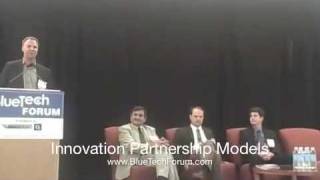
GE, Grundfos, and Veolia shared how they turn water innovation into business models. Grundfos targets 50% revenue growth from new technologies by 2025. All three emphasized that startups need paying customers, clear value numbers, and simple solutions to break through regulatory and internal hurdles.
Chapters
Three great giants here to talk about their innovation and how they execute. So having come from, we have Thomas Edison company, which is famous statement, innovation without execution is hallucination. So that's represented by Steve Cluse. Then we have, you know, I'm going to go through alphabetical order with Grundfos, one of the most innovative companies in pumps, and they'll share some innovative technologies around what they are doing with open innovation and disruptive models. And then finally we have Veolia, which is actually doing a lot of very interesting stuff and I'm sure they're going to talk about it, but can we go to the first slide please? Next one. Okay, let me quickly talk about disruptive innovation and open innovation. It's not just about having a great innovation, it's about having a business model that goes with the innovation. What I found lacking this morning, I mean, I want, I mean I keep saying that in every conference is nobody talked about cost. Every company which presented here, I said we were sitting and saying where is the cost? So that's the first thing, you know, you're asking for money. Please be, you know, why are you different? And so when you talk about not just innovation, but to have a business model that is workable, you need to know what the cost is. So for the companies who did not share the cost numbers, please do, because that's important if you're trying to raise money. And nobody talked about competing technologies. And also, you know, when they're talking about financials, nobody talked about a little bit about, you know, what they are doing with respect to, you know, how they are raising or whatever it is a little bit more. I think financial numbers are extremely critical when you're trying to raise. So can we go to the next one, please? Oh, I'm sorry, I haven't seen this one. Okay, sorry. Today and I've asked the panel members to talk about disruptive innovation. What are the transformational technologies that they are seeing, what they are doing about it? Open innovation, reaching out beyond their own fence, like organic growth versus what they are doing by partnering and bringing in external technologies to do something innovative. And of course all of them are in the acquisition mode, which is very good for the startup companies. So guess what? They're going to cut a check. So these are some of the few players who have cut some big checks. So you know how they do it, why they do it, and they'll share something about that and how they are partnering with global partnerships and alliances. You know, you've got Harry come and talk about how they are opening up their utilities. And American Water talked about how they are partnering and so on. When you do this there are each models how to finance it. So they'll talk a little bit about how they're helping partnering with these companies. Whether startup companies are having issues with respect to raising money and so on. And of course most importantly it's a regulated industry. So especially when you're talking about municipal drinking water or wastewater or desalination it's you dispose anything. It's highly regulated. So how you're managing the government relationships and the regulations to drive the change and bottom line finally financial innovation, financial engineering. It's not like juggling your books or cooking your books. I'm talking about how do you actually try to make a business model that makes money in the whole thing. So I'll give you start with a couple of examples and then.
It'S a.
Little bit busy slide. But it's very important when you talk about disruptive innovation it can dramatically change the way things are done. I thought I'll give you some examples. Lipitor which was made in the traditional methodology and with biotech cut down the manufacturing cost by 7 0%. That's the way it's going biotech. So that needs to. That type of disruptive innovation needs to happen in the water industry. That's how it's going to change the game. The next one you're talking about corrosion coatings using cheap metals, carbon steel and trying to replace titanium. That's a significant opportunity. There are companies in the Bay Area doing that. We talked about biopharmaceutical major changes that are happening there. I'm not able to see some of it because the timer is hiding it. So I've got to turn the sign or reduce waste. I think Harry talked about resource management the entire resource. One of the things which is very critical is people are looking at energy or water. It's like a balloon squeeze one side, it goes the other side. We have to look at energy, water, waste and environment. All of them. You're talking about cutting down total energy consumption, water consumption, reduction in waste and also reducing the environmental footprint. If you don't do all four, you don't have a product. And that is the game changer technologies. That's what's going to happen. I would love to hear the team to talk about that. And stevia sugar is another one. Why it is now everybody talk about pricing squeeze. It's very important. It's getting tough and competitive in the water space. People talk about water prices going to go up. I'm just waiting for that to happen. It's slow, but very, very slow. I'm seeing gas prices going up, but I'm not seeing the water prices. I wish water prices went up the same rate as gas prices, the same thing. People need to increase their margins. So there's a lot of challenges around that. When you talk about extracting energy, a lot of people talked about extracting energy from wastewater, a lot of organics, a lot of energies in the wastewater. We really need to look at technologies which addresses all kinds of waste. Every time I hear companies, they say, okay, give me this specification wastewater, I can handle it, but you need to have a much broader to be able to handle wide range of wastewater. And every time when you have wastewater, you also have a sludge screen to go with it. So you need to have not just a wastewater treatment technology, but also sludge management technology integrated. I was very happy to see there are some companies today which presented some technologies in that particular area. So I see a significant value proposition. When you try to do solid and liquid waste management and of course, hazardous waste management, that's a big, big thing. There's nothing like waste. It's only value that we have not captured yet. So we absolutely need to start looking everything as a resource, how we can capture it. So with that, I'm going to basically move on to the speakers. Let me start with Steve Clus. Steve doesn't need any introduction and GE doesn't need an introduction. Steve.
All right, thank you very much, Ramesh. So a little bit about GE and how we think about innovation. And innovation may be kind of a keyword for not invented here, not invented inside of ge. We know that there's more R and D being developed outside of GE than within. GE's a big company. We do a lot of R and D related to water within our water business as well as in corporate, arguably as much as anybody else in the world. But still, the amount of R and D we do compared to the global total of R and D is just a teeny, teeny bit. But the good news is most of that other rd, maybe not the stuff Veolia or Siemens, but most of the other RD is accessible to us if we're smart and we go about it a wise way. So we can think about really the global R and D, much of that is really can be viewed as an extension of what we do. So there's a lot of work that happens at research institutes, universities, startups, and so on. We can at least theoretically access all of that if we wanted to and if we could work that up if it makes sense. And something that's unique about GE I think is that we are really focused as being a technology provider. We sell products and services. What we don't do is big, you know, we're not an epc. We're not going to be taking bids for big seawater D cell projects. We own some seawater plants, we have some build own operates that we run. But our business model going forward is not to take jobs, not to be big, you know, big bids, do the whole thing. We don't do that. We want to have the technical components that's the heart and soul of that treatment technology and sell that as well as services. So as a technology provider, it means that we gotta have great technologies, great products, and we were built by acquisition. Some of the companies that we acquired had different degrees of maturity, like Paul's maturity curve that he showed. So if you've got relatively mature products in some areas, you have to make sure that you, you innovate both with your core technology development internally, which largely is spent on keeping as fresh as you can in existing product lines, but then also in other areas outside of our existing product lines, in adjacent areas. And so our model is to scout for innovation and scout globally in the main hubs of innovation, to consider getting engaged early. As ge, we have an unfair advantage that we've got tremendous resources inside of the company that we can assess early stage ideas with a degree of confidence that others might not have because we've got such depth of resources and capabilities. And we do put those to work. We do a tremendous amount of techno economic modeling. You know, if you come up with an idea, somebody has an idea for a new, say, desalination technology, fracked water technology, wastewater treatment technology, it's difficult to really assess that one technology on its own by itself. You have to look at it against state of the art what's done today as well as many other ideas. So you essentially have to say, all right, we're going to attack this area here and then gather as many of those ideas that are out and then, you know, model them, put in the effort to figure out which one of these seems like it has legs. And as ge, we have that capability and we're trying to use that more and more to be able to place bets early. So sourcing innovation. So on this slide we've got something we call hubs of innovation. And it's just to say where there's, you know, the water innovation is Mostly happening. And this isn't exact, but it's just to say maybe there's a guy in Kazakhstan somewhere that's got a really great water technology. But it's really tough for us to go there and be local and get on top of it. But we can recognize that, you know, Israel is a hotbed of innovation Harry's talking about. And the neat thing about Singapore is we're seeing indigenous innovation start to come out of Singapore, developed in Singapore for, not just for Singapore, but global. And so these stars are where we've got people that are, you know, GE folks that are digging in, looking at local innovation. We can source innovation, we can, we can work more local. And you know, I think it says 202 companies that we're tracking right now. It's 208 different, you know, companies at different levels.
Engagement that we're tracking that provided the water coming out of the shower head might have come out of a grunt of pump. So we are all over. So we're the best kept secret. We're always in the basement. We do have made a few acquisitions here in North America over the last five years. We have acquired Peerless Pumps and Paco Pumps. For those of you who are familiar with that. We are 18,000 people in the company today and we are a Danish company in the US we have a revenue around US$500 million and the ambition is to take that into US$1 billion in the next five years. Are we going to be able to do that all by organic growth?
No.
Are we going to need some partners to do that with? Yes. And that's why we're here to talk to you as well. So we actually, we actually more than pumps. And since we are private company and we are debt free, we can take some other risks when we talk to startup companies. I think we probably have maybe a different model than GE has and Veolia. We look more long term when we do investments and we also, when we do acquisitions, we probably look at a different value set and a different value propositions as when you look typically from VC into making acquisition and making an investment in a company. So what was done? Yeah, we want to be more than pumps, but we have actually we want to do something about that. And two years ago Gunfoss drafted an innovation intent. And this innovation intent talks about what Grundfos is going to be in 2025. And I think this is important because this is going to drive the company into a new pathway. We still want to be number one in pumps globally, but One important feature is that we want to have 50% of our revenue growth coming from new technologies not invented today. And we want to have one third of our revenue coming from other products and pumps. So are we going to go into aerospace and rocket science? No. So we're going to stay somewhere in the, in the water space and in the energy space because we all know that those two are linked together. But that kind of sets the bar of where we want to be as a company. And then how are we going to do that? Well, when we look at these new opportunities, it's definitely a fact that it has to be around putting sustainability first. And we want to be there for a growing world and we want to pioneer new technologies. Are we going to do that again all by ourselves?
No.
We need to open up and work with other companies to achieve those goals right here. It's obvious. And then it's all about. When you talk about innovation, it's about getting to the customer in new ways. As far as. Because innovation is many things. It's not just about technology, it's all about also business models and the way you get out to the customer, customer. And I think when you speak to companies like CoinFoss and you are a startup company, what we can also bring to the table besides investment and research and technology capabilities is also we actually have that path to the customer. And it's also through partners like the old and GE who are some of our friends and customers so their customers, customers, the end user that the path to that when you are a startup company is significant. We heard earlier today that having a great technology won't make you rich and famous. You actually need to get to that customer and having access to the channel and work with companies like us who know the end user and have that path that can be a game changer. When you talk about this and then when you talk about innovation, there are certain procedures and mechanisms that need to be in place because otherwise you will hit the. Hit the oops sign. And when we talk about innovation in big companies, Steve, you talk about it's slow and bureaucratic and that what it is. And I think if you need to. What you have to do when you have to gear an organization to do innovation, you have to do things differently outside your core business. So what we have done in one. I just want to spend one minute on this because it's significant when you, when you go into achieving those goals, which I just talked about before, is that you need to have a structural fit inside of big operations like WinFoss and other companies. You need to have a dedicated team and you need to learn the processes about doing innovation, otherwise you will not succeed. It's important that you have the upper management dedication to do things differently outside the core business. Then it's of course important to generate some concrete themes which you're going to be working around. For example, we have a theme around sustainable water solutions in high performance buildings. That's one theme. We have a number of other themes as well. If you don't have that, you're going to be bogged down with all these opportunities coming in and you're not going to get nowhere. It's important also then when you have these themes in place, you can scout for new technologies and you can scout for startup companies and that will eventually lead into these opportunities which will then run through your innovation, discovery, incubation, acceleration process and then it's all about managing uncertainties because that's really what it's about when you do innovation. You don't know everything and you can know everything in such a short time to keep the pace. What I have found in gunfas is that creating a strong network and, and get new friends as I call them, will really help you pioneer some of these new technologies. You can't just do that by reading reports which we might have given input to or do market research and desk research. You really need to go out and get plugged into networks like this when you start a company and also when you're a large corporation to get access to the deal flow and find these new companies. And then it's about when you then go back back home, you talk to group management. You have to remember they also still running the core business. So how do you sell a new innovative idea? You just met this great startup company, you have the great technology, you think it's going to be a game changer, it's going to be disruptive and you come back and you got to sell that to group management because eventually they're going to write the check and they think, hey, it's not a pump, we're not interested. So but that was just an example. That's really, you got to go through this phase also in larger companies is to actually make sure that something like this will actually happen. And then when you look at the other side of the dotted line, then you look inside the company and you talk to your colleagues and say, what about us? I mean we're doing business development today, we're looking for new opportunities. So they're not really part of the breakthrough and disruptive technology. So that's just some of the obstacles you can see. So again, a recommendation to startup companies, when you talk to these larger corporations like are, make sure you talk to the right people because there are people in these corporations who don't know what other people are doing in disruptive innovation as well. And then also when you do innovation and you have your innovation team, you work with the shared services in these large companies. So one good example is that you go up to the legal department and you find the startup company and how do we evaluate the value of this company compared to typical acquisitions? So again, you use shared services in your company today, but they're used to the core business and the way you've always done business. So again, that's some of the things you got to work through as well. So really what I would like to leave this area with is that I would like to say a few examples and I would like to take a look at this picture because it seems that like GNA and Goldfoss, we are looking for new opportunities. But if I was a startup company, I would look towards us and I would in the area where you are trying to create a business, find out who are the big players and you look at venture capitalists to get your funding. But also look at the big companies who's been in this area for many, many years and try to reach out to them and see if there could be a partnership generated. So I'll also turn the binoculars around and look the other way. One of us have been at this for, for a couple of years and we have done a few things. One, we have started up a water technology center in California, which I'm heading up. And this water technology center looks actually for startup companies. We look to work with academia and we look to tie into VCs so we can syndicate investments with some of these startups. So we're doing a lot of the same things as GE is doing and we found out that we can do this remotely from the headquarters in Denmark. We, we have to have a separate setup out here in California, which we have done. So we can also host these startup companies that can live in our offices. We can build the first prototype for them. So very much an open invasion and open environment where we can build these things. And then we will find out how this materializes as we go along. We have made a small investment in a smart metering company here in Silicon Valley just recently. And we are also looking into other investment opportunities in the commercial building. So we already Walking the talk and getting more into this environment.
Thank you.
Thank you. And I have a really fun job. I get to work with all of Veolia and Oliveulia may be somewhat surprising to you for everyone in the room, you're very familiar with us in water. I like to joke with my French colleagues that Veolia is the biggest name in water since Jacques Cousteau. But we're actually much more than water. We actually are the dominant player in each of our four business areas of water waste management, energy management, and public transportation. In fact, in North America, our largest NC is public transportation, where we dominate the market. And the nice thing about that is that there are a lot of crossover technologies. So we have the opportunity to do open innovation internally. So our energy group, which runs an astounding 118,000 installations around the world, they have lots of cooling towers. So our water technology folks are happy to design systems for that and they can operate it themselves or our water operating company can operate that for them as a service. There's a big theme of recovering value, energy and materials from waste. And that's we have a lot in common across our waste group, our water group, and even our energy group in areas such as gasification, as well as in looking at biotechnology and how we can transform these materials, materials into valuable materials. So the nice thing is that we have scale, we have scope. We're also almost everywhere. We actually have a cloaking technology. So usually we're invisible to you. Only on conferences and in certain occasions do we actually decloak ourselves. And most people are really surprised. They go if you're like, wow, you're huge. And you're everywhere.
You're right.
Running the Marguerite system here at Stanford, you're running Phoenix, you have Super Shuttle, you're running the wastewater treatment plant here, the solid waste in the Bay Area. And we didn't know you as Veolia, but one of the great strengths of the company is actually being a services company. And that's actually somewhat different from Brundfos and GE Water, that while we do have a very large water technology company, we have an even larger water services company that runs an astounding over 5,000 potable water systems, municipal systems worldwide, and over 3,000 wastewater systems, in addition to a number of industrial systems. So we are arguably the largest platform to deploy clean technology in the world. And again, as a primarily a services company, we usually don't have a horse in the race. So we're very easy to approach. And even in water technology, where we have a very Strong group that does on occasion compete with the GEs and seamens of the world. Those people happen to be the most active in the open innovation model. So they are the ones that are most actively looking for new technologies that make a difference to their business. So that's why open innovation is in our nature. We have done this historically in a somewhat organic way. We're very decentralized and typically we do this at the business unit or division level. And we found that that doesn't really meet our needs and doesn't meet the needs of our customers. And we need to have something that can scale to our needs and to our customers needs worldwide. So a year ago in February, we launched the Violi Innovation Accelerator, which is basically an industrialized process where we have standardized systems. We have a group dedicated to running the Violi Innovation Accelerator, our research and innovation group, which is actually not research and development, because generally they're not paid to invent stuff, they're paid to identify and evaluate stuff, stuff that we can then deploy. So the people who are usually the not invented here people are the people who are backing open innovation. So we have 850 researchers. Their job is to take the stuff that the Innovation Accelerator is identifying and evaluate that so we can go very quickly into de risking the technology and possibly deploying that with business units across the world.
World.
So this is a radically different approach for us. And strangely, it seems as though it's a radically different approach in general. We've gotten a lot of great receptivity, both from startups as well as from what we call the Innovation network. The innovation network right now is heavily populated with investors, but also with service providers whose job it is to go out and find meaningful innovations around the world. And then they feed that to us. And we work in both a reactive way of they're feeding us, and we will filter through that. We also work in a proactive way. So we have a process called technology roadmapping, where at the business unit level, we look at the business strategy, map it onto technology needs, create basically shopping lists for technologies, and then work with our innovation network to go hunting for those technologies. So there's the fishing, which is the reactive part, and then there's the hunting, which is the proactive part. But all of this is oriented to giving our business units fundamental advantages in the marketplace that results in greater revenue through contracts for technology as well as services, and squeezes a couple percentage more out of the margin. So we were talking about disruptive technologies. We're certainly interested in disruptive technologies. We're also really interested in incremental technologies. So if we can squeeze a couple percentage of cost over a couple of decades, which is a typical contract engagement, we're really happy. That's really meaningful to us. So a lot of things that actually falls off the plate for investors, that can be our main course. We're not afraid of technology risk. Even though it's really easy to take something that's already commercially available and deploy that, we're great at that. We're really happy to do that. We can go really early. We can even go beyond the twinkling in a professor's eye and say, I have this insight. Where does this insight take me? We're happy to engage even at that level. Again, we have fantastic laboratory facilities, amazing piloting facilities, not just in Europe, but also in the United States. And as you can imagine, a lot of those are dedicated to water technologies. So that's a key resource that we have. Another aspect that is perhaps somewhat surprising and different from geunfos is that historically we only had basically one tool in our toolkit to engage startup companies and that was a checkbook. We've locked the checkbook up for the time being and we're saying that outcome of just 01 nothing or acquisition may not be in everybody's best interest. In fact, we're not even going to invest in companies as a minority or even majority investor. We want to talk about what works, what doesn't work, and help the entrepreneur take their technology as far as possible. We will. And I think another theme that's been identified throughout the conference and just spoke to it as well as Trevor in the prior panel. The big value that we provide in many cases is that bridge between the innovation and the marketplace, which is certainly non trivial and arguably the most important gap that any entrepreneur has to address. So the idea is that getting innovation to market is not limited by financial resources. We don't need to be the investor in that, but we can provide our unique resources and de risking it at the technology level, at the operation level. In many cases, entrepreneurs actually may hire us to operate their facilities. They focus on their technology and we help them grow really quickly by being the operator of that technology and helping to manage operating risk as well as commercial risk. We can be the sales channel for that. So there are many different outcomes. We're looking for win, win, win situations. Our client wins, we win, and our technology partner wins by thinking more creatively about how to structure the deal, which could be a very simple relationship. We're a customer or it could be something much more deep than that, that where we're a co developer of the technology and we can always take the checkbook out and acquire or invest if that's what it's needed. So that's a quick update on VOA today and look forward to your questions.
Thank you very much.
We have a few minutes left, but I would like to ask a specific question with all the three panel members. What is the biggest single biggest stumbling block that you see in getting the cutting down the cycle time for collaboration? I was talking to Heinrich yesterday and we brought one as legal and like that. What are the other things that you see to kind of cut down the cycle time to make it faster? I'll start with Hendrik to go first.
Well, I think that what I would also talk about in my presentation is, is the group management. So even though the group management have kind of put the carrot out there to go for it, you still have to come up through their evaluation board and be estimated as, okay, we have now discovered this idea or this company and then we got to take it into incubation. That means they got to get the checkbook up to fund the next investment. And that kind of cycle. And those questions that's coming from Guru mentioned might push you back again and you got to expose some more uncertainties and get those covered before you can go. And then I would also say that internally organization, there's a lot of stakeholders and a lot of chiefs who think they also would like to get involved so they can also work down the process.
Bill?
Sure. So with the VLA Innovation Accelerator, we have a three step process. The first, which I call a SNF test, is really fast. It's one week. The second, which is a paper study, is just four weeks after we get the data. And so actually in many cases, in those first two steps, we're much faster than the entrepreneurs. And we're usually drumming our fingers on the table, waiting for the entrepreneur to get back to us. The third step, the critical step, is really the commercial engagement. It's after it's been vetted by our technology teams and it's time to go out and kick the tires, look people in the eyes and see can we do business with this organization and what's a good model commercially to engage. That is where things can can take a longer time. And the complexity that we face, which is perhaps somewhat unique, is that we have so many different vectors, we have so many different business units with varying interests. Some just want to be a customer, some want to acquire it before we finish the evaluation. So for us, I think the challenge is getting those vectors aligned and getting to that final, what we call stage, step three decision more quickly.
Steve, I think it's just, it's two things. It's figuring out is this a good deal to do, and then secondly, having a strong internal champion. So, you know, figuring it through. This is, you know, going through what are the economics, how can we engage, how can we make money? Do we, are we sure, you know, to some degree confidence that this technology is a good technology and it seems like it can have good advantage. So, you know, you think that through. And then from what I do, I need one of, you know, a champion in one of three areas. Either one of our product line leaders, we've got like 10 different product lines, one of those product line leaders or one of our vertical, we've got like seven key market verticals. We've got vertical leaders there, mining, oil sands, you know, et cetera, or a regional leader. And a regional is a key region. Not North America is not really a region, but, you know, in a key emerging region, middle, Middle East, China, for example. So I need a champion, one of those areas that's jumping up and down saying, yep, this is it, great, that's a business champion I can work with. We got this story pulled together, then we can go.
If you were to give advice to the startup companies here, quick sound bites, top two things that you would make your job easier and also help them to fast track. What are the top two things that you tell them? Hi, Rick.
Proof of concept. And the first, paying customers for pilots.
Proof of concept. That means they have to show that to you or is it you're going to be partnering with them to show that to them?
I mean, if they can show that to us and they can also show that actually that pilots have been installed and the customers actually paid for those, that's a great advantage to move ahead, Bill.
So keep it simple. Both on the technology side as well as on the business side model side, we see a lot of Rube Goldberg types of contraptions and there may be elements that have greater value than the whole. So don't be afraid to rethink things to simplify.
Quantified value proposition, that's the toughest thing to do. What is really the value proposition? Quantified value proposition is really, really tough. And then if there's something number two would be is companies can be very focused on, on what they do, what they have, but they don't know that there's Kind of other stuff that is trying to tackle the same solution and get them to be a little bit open and think about those other ways. And that fits back to the quantified value proposition, why that value proposition is the right one.
Now, shall we put them on the spot? They have looked around the world for technologies and so on. So I'm going to ask them a prediction. What do they see as the top two technologies in the water space the next 10 years? I'll start with Heinrich. So two technologies that you see are going to change the water industry. What are they?
I'm going to say three, and I'm going to talk about three areas. So I think the first one is smart water metering. I mean, to get a price on water which will actually make these business models for water reuse and desalination. To make that happen, we need to have a price in water, to have a pricing water. We need to know how much water we're using real time, in your face data. Two is water quality. So enable for us to implement reuse equipment and desalination equipment. We need to have technologies in place about water quality. Red light, don't drink it, green light, it's okay. Today, that process of getting that information takes too long and it's too costly to go to the lab. So equipment and technology can do that real time. And then three, eventually reuse equipment. We are a big believer of implementing reuse equipment. So reuse the water we have already used on site for secondary purposes. I think that's really the three key areas that we are focusing on.
Bill?
Well, I'll throw out two classes of technologies. One, building on Hendricks, is smart grid for water. In fact, we're looking at smart grid for X. And we're able to transfer a lot of technology that's being applied to energy we use in our energy business, to transportation and waste, as well as water that's really hot for us. And that's the whole ecosystem there. The sensors, how you power them, how you transmit the data, how you crunch the data, how you bring it back into process control. So that is. That's huge for us and that goes across all of our businesses. So it's easy for us to scale on that. Second, which is a general class as a theme earlier, is resources from waste. So we are hugely focused on this. We've announced some deals recently along these lines as well in the wastewater area. But we're doing this not just for municipal systems. We're doing it for industrial systems, particularly in mining and oil, oil and gas and we're also combining resources across the company in gasification and looking at technologies in many cases they've been kicking around for a couple of decades. But now either conditions have changed or there are some incremental improvements that make a difference. So anything that gives us greater value and helps us squeeze a couple extra percentage points over a couple decades is really exciting for us.
Steve, quickly data analytics, I think it's really important. There's a lot of data you can, you know we talk about smart water, smart everything but even new industrial type solutions, just mining all that then bring that back to a control system and kind related number two would be analytical and sensing technology specific cheap rapid sensitive technologies and then that helps give you that intelligence to go back to data analytics and controls.
Well I want to thank but I'll have the last word my opinion on this. I think we need to quick start moving water around and basically distributed water systems. I think you're going to see a major transformation in on site treatment and reuse is going to happen more and more. And I would like to thank IVF, O2 Environmental and the entire great panel members. They've been a great sport, they participated. I want to thank them for a wonderful job.
Thank you very much.










