BlueTech Forum 2011 - Water Utilities Embracing Innovation
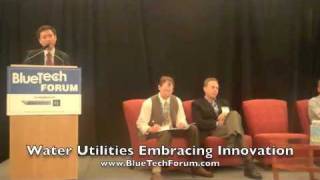
Water utilities struggle to adopt new technologies, a problem called the valley of death. Singapore's PUB uses pilot projects and university partnerships to test innovations, while American Water deployed a smart valve that recovered $230,000 in revenue. Utilities need clear proof that new tech cuts costs and energy use before they'll take the risk.
Chapters
We're for cruel engineers, and we do primarily municipal water and wastewater work, and most of it in the United States, a little bit in the Middle east and Australia. Now my job is to oversee our advanced treatment technologies. And I'm very excited, by the way, to have a lot of discussion on the wastewater treatment. And there was biosolids and fantastic stuff. It's very interesting to me the differences between the industrial and the municipal market. And especially as it applies to moving technologies forward, the municipal market is very hesitant to adopt new things. And that kind of leads me to my single slide, which I've been told there is this technology valley of death. And this was our perception of what that is. You have a multitude of ideas out there, fantastic ideas, and very few of them actually ever get through and become implemented at the full scale. And that's something that I am continually trying to do, is to bring these new ideas forward for our municipal clients. But it's very difficult for a number of reasons. And what I want to do is rely upon these experts here to provide their perspectives on how they have shepherded projects forward, brought new ideas into their fold of how they do business. So let me go back one to our speakers there. You've got their bios in your handouts, and so I encourage you to read them. They're pretty impressive and they're fantastic group. I've known one of them for a good bit. Matter of fact, Paul Gagliardo showed me some of the initial excitement and got me interested in the business back many years ago when he was down in San Diego. I took a tour with him and looked at the membrane and pond, the hyacinth ponds, and that really got me going in the water reuse business. I would like to point out what I believe is our biggest challenge moving forward in the municipal market and the biggest need, and that is technologies to take wastewater and convert that directly into pollutable water. And right now, that is happening across the United States. Some of it intentionally, some of it unintentionally. The intentional projects are the ones that get all the focus. And what you're going to see in the next 10 years is a movement not just from wastewater to potable water, where it goes through groundwater or reservoirs or other natural processes. But you're going to see the movement of pipe to pipe, taking the wastewater, treating it and putting it right back into the potable water system. Matter of fact, there's two projects in the United States that are moving forward with this right now. So anyways, with that as a background, we're going to have Harry, see, he's the director of technology and water quality office at the Public Utility Board in Singapore, renowned for the new water projects, I believe three of them. Is that right? More than three. He keeps building new treatment plants, so he's very well known in the water reuse business for sure. And then we have Paul Gagliardo. Sorry, Harry. Is going to have a formal presentation. And then after Harry, we're going to open the mic and let Paul, who's the manager of innovation development in American water, he's. He's going to have some time to air his thoughts. Trevor Hill is President CEO of Global Water Resources. He'll have some time to tell you what he thinks about bringing technologies into the municipal marketplace. And then we should have time for questions from the audience. Paul, do we have a mic?
I think we'll be able to get one.
Okay. Either that or a shout out real loud. So this, I think is the first audience interaction of the day. So we'll see how this goes. If it goes badly, then we'll just shut you off. And I have a few questions as well. So with that, Harry, let's get you going here.
And there we are.
Thank you, Harry.
Thank you, andy. Basically, about Singapore, I think if you look at the slides, you can't find where Singapore is. We are very tiny, I think, vulnerable. And then being tiny and vulnerable I think is strength because it forces us to think out of the box, right? It makes us to look for innovative solution to solve a water problem. Because if you go by conventional way, we are doomed. I think you go by who achieved one of the most scarce country yet. I think what we did is we turned our warranty into strength in a way to solve our water problem. Now, new water example, we came to know about it in 1998 when it came to us. In fact, the idea is from us, not from us, but what we think is we look at, I think we like it, we tested it, it works. I think within, I would say eight, nine years, we increase our capacity to about 120 milligrams, which makes up 30% of the demand. And eventually, as we go into our master plan, we hope to grow it even further now with this new water in terms of the technology because we have enough working experience, confidence, potential of the technology. Now we have extended membrane technology into water treatment, desalination, pre treatment, RO, of course, in new water. And within eight years, eight, nine years, we have increased our treatment capacity to about 1.2 million cubic meters a day or 1.2 megalitres a day. So basically this is what we do to solve our water problem. So basically idea is good, we believe in it, we'll do it in an accelerated program way RIT approach. We are more into pilot testing and demonstration and basically pilot testing, demonstration. When we did the way, it has its advantages because in a way it removes a lot of unknowns, not only from the utility point of view, but also from the, from the technology provider point of view. So in a way reduce risk and you reduce risk, you get better price and lower risk. And when we come to idea, involvements of our operating departments are very important. So from day one we get our operating department to be involved. In fact, we will identify a team and get them to lead the team in terms of the research. But you notice that I will show you the next arrow that we move where when we run our ideas and we need some fundamental shift in our thinking, we start moving upstream to try in a way to change the direction of some of the research in a way to solve our long term problem. So some of the things we are doing here in the short term is solve a problem, but it's not there yet. So we need something better. So we are beginning to move upstream to try in a way to shift the direction of the research, hopefully in a way to solve our problem. So we work quite closely with universities, whether locally or overseas, in a way to get new ideas. Our research is basically problem centered. It must have a problem. That's why we do research. We are not looking for a solution, looking for a problem, but more problem looking for a solution. So a problem can be short term, it can be long term. So we try to solve problems short term and long term. And basically when we look at the whole thing, when you do all our research, basically our focus is more on efficient use of resources, energy. I think you hear a lot about it that's now this morning. Chemicals and basically waste in a way we view waste as not as waste, we view waste as a resource. And basically in a way to solve our problem. And then if someone comes to us with new ideas or anything, basically the idea that we are interested in is basically how can you make us operate better or make our system more robust. So basically what we do is that if someone come with an idea to us, we will how do we put into our existing system and try to evaluate it upstream and try to evaluate downstream based on basically is the total assessment of the idea. Because sometimes some company idea is a single process itself may be good, but if you arrive at low value, you need to do something upstream and downstream. Then as a total system, it doesn't make sense. So that's why in the end, when we look at the thing in a way, what management will say is that can we do more with less? I give an example like membrane bioreactors. Five years ago someone came up with this item technology. And basically what we do is that now we put it into our existing process, which is the one on the top, right? So in a way we see the attractiveness of technology. We can eliminate three steps and put one. We look at the whole process itself opportunity for automation and derive efficiency our system, right? But at that time, five years ago, any membrane director supplier come to us. They'll say that energy is 1.2 kilowatt hour per cubic meter. So if you evaluate as a total system itself, as a utility, we will not use the technology because in end the energy use is much more than before. But we see the value of the technology. So the downside is energy. And that's why in end our research helps us to define our R and D goal in the sense that we need to drive down energy. We have a target number to meet. If we meet the target number, then we know the technology at least is technology neutral. And after that we enjoy all the benefits. But I think it got better than we expected. So if you look through all the timeline and the thing I think we drove down the energy down to less than 0.4. And so now what we have is that many other companies, we work in many other companies basically in a way to let main directors also from a utility point of view, we also prefer to have many suppliers. I think our project wise we have enough projects to enough to have many players. Even our tiny island in Singapore. And these are all the benefits. We got better quality water, smaller footprint. Overall energy is less 0.115 compared to 0.7 as a total system. And from that example context, I'm already saving in terms of us is maybe about 2 cents per cubic meter. So can you imagine it's let's say 120 million gallons per day or 500 megalitres a day. The savings enormous for we are utility, we don't, unlike other utilities, we actually manage the whole water cycle. To us, water is not is water. It's not wastewater or used water, it's not sea water, it's not rainwater, it's water. So this way when we do research, we try to derive all efficiency throughout the whole Waterloo. That's how we Keep our develop new water resources at a lower cost. Well, not at low cost. Low cost is the wrong word. Affordable cost. Right. And through operationally everything derived efficiency and keep our costs affordable. So what do we need for successful R and D from a utility point of view? We have a roadmap to have the guide on R and D direction to solve our water problem. Always challenge conventional thinking or approach. Can we do better than what's currently being undertaken? Then talk about intellectual property. We are not fighting with intellectual property. You can keep it. We only want to use the idea as quickly as possible so that we derive our value downstream. When we apply the idea of technology, then the last talking about trust. Trust is very important where hopefully when someone comes with idea, as long as the science is right, you may be ahead of time. But in terms of don't oversell. So this is a roadmap that we developed over the years to solve water problem. So we have this roadmap. This roadmap is not something that is cast in stone. It kept on changing the depending on any emerging issues or ideas or somehow better idea and things. We always update this technology roadmap. We even have roadmap for desalination. Look at RO itself. You hear a lot about RO being energy intensive. We have a short term goal to drive the energy to 1.5. We achieve some of them in terms of example, like membrane distillation, where we make use of. Like I said, we don't treat waste as waste, but waste as a resource. We use waste and we keep the energy down to 1 kilowatt. Lateral chemo dissolving, which is done by Siemens. In a way it was a challenge call. And I think within five years we hear about less than 1.5. But of course this is still energy intensive, although we still lowered down. So our long term goal is a theoretical number. A lot of debate about that number is impossible. It's good to have impossible number to give you a challenge goal, right? Whether I meet it doesn't matter. But as a drive down, energy down is a target. And basically remember I mentioned earlier, I told you that now we're trying to in a way influence the upstream research. So we are funding projects in terms to go back to nature, to understand nature. Maybe nature has a better way to help us to extract water from the sea. So we study the fish, we study mangrove swamps, wastewater. Based on the science, there is enough carbon source in the wastewater to power the wastewater treatment plant. So in a way we have this roadmap in a way to drive 80% energy efficiency in five years, five, six years. And in long term to make the wastewater treatment plant energy sufficient. From the sludge point of view, from the biogas point of view. And everything I mentioned earlier about challenge conventional thinking, I give one example here. This is RO cleaning. The conventional thinking is that okay, you clean RO membrane. It's one direction you need to down the RO train to clean and you use chemicals. Now this idea is not from us. This idea is from Professor Boris Lindemann from Israel. So his idea is basically using osmosis in a way to clean the membrane. And we talked to him, we get him involved, collaborate with him. The proof of concept, we proved that it works. But when it works, the salt content initially was high. Based on it's recommended. So our value to the idea is basically is from the operator point of view, how can I bring down that number such that from operator easy to handle. So when I put down there 64 kilogram for every 8,000 kilometers a day plant capacity, initially we are talking about 640 kilograms. So for 640 kilograms point of view, no operator will want to touch the idea. So we drill down the thing to 64 and now it become a manageable number. Then if you look at the chart itself, the pressure is much lower, right? So we're talking about 15 to 20% lower pressure. Energy is saved, alright? And basically 15, 20% translate to us from that point of view. From 8,000 cubic meter day plant, we are talking about maybe about $200 a day, $300 a day, right? Converts 64 kilograms of thing. And the other point of view is that we also increase the production capacity and less chemical use. IP policy. We are utility. We are not into own technology to compete with other technology provider. We are user technology. So anybody come to us, we are not fighting with ip. IP owns by the provider inventor. And basically, as I mentioned earlier, PUB aims to benefit downstream.
Trust.
Because I think we built a Tanjun neutral. We don't compete, we collaborate with many people. I used these slides last time to show how to get ideas. But these slides were in a way to get this many people working for us. I always believe that because we more or less instill a level of trust between each other. In a way we create a win win situation. Test bathing. We are very open to our facilities being open for testing our new ideas and everything. And the value of this test bathing is basically you can more or less evaluate your idea while your technology against existing technology in real water is a direct comparison. Now this is where we do all this rad basically and all these figures are independently derived. We got IP consultants that come in to audit us and check on us whether we did anything right. And these are the numbers. I think you look at the last number, we invested about $60 million in R& D and based on just cost avoidance, efficiency and everything, we are talking about $200 million a year. So more or less we pay back for R and D effort, investments. So question is, why are we doing all this? As I mentioned earlier, we are a tiny island. So in a way we want to be energy sufficient. We have to be energy sufficient to survive. And while doing that we are mindful that we must keep our water affordable. That's all I have.
Thank you. I'm tied in well. 2 Comments I had spent some time in Singapore back in the late 90s working with Harry's group back in the day when he didn't have all of this roadmaps laid out. It seems awfully complicated, but I know these guys are very organized and do a terrific job. One thing I'd like to mention, in your pyramid you showed anaerobic mbr. In the next five to six years American Water has developed an MBR system, anaerobic MBR that reduces energy usage by 57% over existing facilities. So we'll have to talk about that later. You can move that, you know, you can move that pyramid up a little bit and kind of get some more savings real quick. One of the other interesting things you know about is a very well defined roadmap and protocol. That is one thing that's very different that American Water does. American Water water has an innovation program of one person, that's me and I think that's a good start. Hopefully we'll add to that later on. But there is no formal roadmap. I'm kind of a random access innovator. I look at all things that come in and try to provide. Give everybody 15 minutes, see if that idea makes some kind of sense and we can fit into our asset base. So as our program develops, it's only been around for less than two years, hopefully there will be more of a kind of formalized process where things will move forward. Now that being said, innovation really, to embrace innovation you have to embrace change. One of the key things from a utility perspective is there has to be a change agent at the executive level. If there's not, nothing's going to happen. A lot of times regulations drive innovation. Some new rule on a contaminant comes out and we have to Meet that decontaminant level and that forces some innovation, some new things to happen. In our case, we are driving innovation through performance metrics at the various facilities and the various operating entities that we have. And those performance metrics then encourage the operating companies to try these new technologies even though many of them are not going to work. Typical venture capital firm may have a 2% hit rate, which is about the number I'm hitting. About 200 ideas I've looked at and I'm actively working on about four now. There's been a lot of talk about how long it takes to get get innovations incorporated into water utilities. I'll tell one story. Back in June of last year I was introduced to the CEO of a company called mbala. They do essentially demand side regulation services. That's too complicated to get into right now, but it's essentially a smart grid, electric grid, water, energy nexus, whatever terminology you want to use. Technology. We have executed contracts, done a demonstration test, deployed the technology and executed equity agreements with the company within one year. So we've deployed a new technology in a water treatment plant that the operators are happy with, that the ISO, the independent system operator is happy with, that, innovators happy with within one year. And I think that that is really key to driving these things forward. Mark was talking about HTI has been around for 25 years and they're still working at it. And that's. I know one of the big difficult things with the innovators is how to get these things into the market as quick as possible. So what we do is we try to set up validation, become an early adoption and move those things forward. But it has to come from the top down. You have to have that impetus from the top down to encourage the operators to try it. And then you have to have those operators who are also innovative to accept that challenge and to work through the various issues. I don't know what that clock means over there. I'm going to ignore it. I just keep saying numbers change. The guy set it up to 20 minutes before. I don't know what, what's going on. Another situation that we had that, you know, just another success story over the last few months. We have a situation where, and again it's kind of it related where there are multiple customers off of one service line. So there's a shut off valve at the service line. So if one of those customers don't pay their bill, you can't shut them off because you shut off multiple customers. We deployed a technology, it's basically remote, remote Controlled shut off valve operated with an iPhone app that was installed for about $100 per unit. We installed 1,000 of these valves over the last couple of months. 850 of those customers, we obviously installed them in places where the customers were not paying their bills. 850 customers, as soon as we installed the valve, they paid their bill. The other 150 customers, as soon as we shut off their water, they, they paid their bill. So we had received over $230,000 of back revenue. Essentially I've written it off within three months of deploying this technology. Again, it's an example of we have a problem. We look through the, you know, everybody has their list of new technologies that they try to deploy. I looked at my bag of tricks, pulled those ones out, try to deploy, deploy them and test them in the facilities that we have the problems. And we're making progress in a very quick manner deploying these new technologies really under a true collaboration. As Harry was talking about. We want, we're technology agnostic. We want the companies we partner with to succeed. We want them to bring value to us. But also as American water being a proxy for the water industry, we want then to those innovators have to roll those ideas out to the rest of the asset base around the United States and around the world. And if those companies are successful, then we're going to be successful as well.
So let me chime in a little bit on the technology adoption cycle front. Back in the late 80s I used to work with John Coburn who's in the room and we together installed the very first mbrs for municipal water reuse. And that was a very challenging process selling it to the municipal sector. And I think one thing to remember first is that at the end of the day you want to access the US municipal market. It's 85% dominated by the water market in the US is dominated by municipal entities. Guys like Harry are extremely rare in the US that is to say I've never found anyone like Harry in the US and guys like Paul are great like chop liver, let's face it, between Paul's company, my company and all the rest of the investor owned utilities combined, the market cap is $10 billion. So a rounding error in the context of the US size of the US market. So then the question becomes what's your business model? What's the channel to market? And through the 90s after being we had some success bundling and packaging from a consulting perspective, Xenon Technologies and others. Out of revenge and frustration, I entered the Utility business really to buy utilities so that we could change the technology footprint. Now I sound more like Harry than Paul or others. And ultimately then became early adopters of technologies. From that utility perspective, we could, because we were tech savvy and sort of forward leaning, started to bring in technologies that you hadn't seen too much in utilities like we had tower Red Ami 6 years ago and many, many other technologies around water reuse. And because we're a regulated utility and we have capital, a balance sheet, that was one way to start to see how these technologies could move forward. When we started our new business, Fathom, which you heard about this morning, we started with business model, channel to market concepts. And so talk about disruptive. In this US municipal market, really there's only two channels to market. Through engineering firms or through rep and distributor networks. The engineering firms, as was mentioned earlier this morning, and there's a few exceptions, maybe Carlo is one of them. But typically they're not very incentive to adopt new technologies. And in fact, in the last five or six years it's been better. But in the 90s, it was very, very difficult to have an engineering firm specify an emerging technology. And the rep networks who are out there, and there are many of them really had a difficulty time getting paid to specify a new technology. And so what you have is a huge market. Everyone wants to be in that market. It's extremely difficult market to crack into. So we did something very unusual. We built a call center, an inside call center. You might know that we're advancing smart grid for water and basically AMI and those technologies around reading meters, correlating the data and then defining the data in such a way that we could present that data back in real time to consumers. To do that, we needed to access the municipal market. But historically, 10 years ago, the market was all about water quality. Now in the last five years, it's all about efficiency. You can't talk about quality to municipalities. They're not interested right now. We what they're interested in is saving money. So we built a business model that was directed to municipal decision makers, managers of cities. And we made them indifferent to the technologies by bundling and packaging this offering in such a way as to give them visibility to the economics. We put an inside call center in. Our guys make 1,000 outbound calls a week to municipal decision makers. We're making pitches every day to municipal decision makers, municipal finance guys, city managers, in some cases public works directors. And then the model is an outsourced service for back office processes that all municipalities do and most do poorly. Reading meters, billing customers, managing remittance, things that matter now since the downturn in the economy and you know, with pleasure. I report that this model is working extremely well. We 10 x' ed our business last year. We'll 10 x again this year. But I think what's most important about this discussion today, you've heard me say it at other conferences, we were at one a few weeks ago, is that there's not now a shortage of technologies in the world water sector and there wasn't 20 years ago. There is a shortage of guys commercialization expertise. There's lots of technology guys. There's very few guys who are very focused on commercializing technologies and shortening the sales cycle. It took 10 years to get submersed fiber membranes from bench to full scale municept. 10 years. Most companies will run out of cash before they get to the mainstream market. So we have to find ways to shorten that adoption cycle and move the technologies into a scalable platform much, much more quickly so that we can get an investment thesis for the guys in the room who are trying to figure out how to invest in this space. And guys like Harry and Paul. Paul and I think Global's on that list, are utility owners who are leaning forward and trying to adopt technologies as rapidly as we can. But from my perspective, I'd like to see more discussion on commercialization of technologies, channels to market, business models that are disruptive so we can break the cycle a little bit in terms of how things have always been done, which are totally frustrating and start doing things that are a little bit unusual, like having companies like the two gentlemen sitting beside me leading the market and then seeing those, the benefits of those spin off to other like municipalities with similar, similar issues. So maybe a bit controversial, but those are my views on the thing. And I think it's very important that we start introducing in these conferences that dynamic. Let's talk about challenge to market, let's talk about disruptive business models and see if we can't compress that hideously painful sales cycle that we all deal with.
So we just have a few minutes here. Paul. I know we'd like to go longer. Do you have an extension? Can we get an extension? No. So I guess, I mean what I'd like to do is follow on Trevor's thought there and ask Paul and Harry and even Trevor, you can respond yourself. You know, I've seen a number of very exciting technologies that have had initial startup money, have brought technologies across the Atlantic to the United States, done demonstration Testing, their investors start getting impatient. The first facility isn't built yet, and at some point they pull, pull the plug. And this, whatever treatment technology might have had a 20, 30, 40% savings compared to existing systems. So is there any advice to the inventors to try to cross that valley of death? And how do you get to be in that 15 minutes of fame on your death pole where they can have.
An opportunity to succeed? Oh, yeah, they get 15, 15 minutes even if they've got a piece of crap. I wouldn't know until the 15 minutes is up. I mean, that is the key question. The way I like to go about it. I mean, American War is not an altruistic company, but we really believe in true collaborations. Both sides have to put some skin in the game. We're willing to do all the testing on the product and define success. Success criteria on a new idea that says, okay, we'll test it. You give us a piece of equipment, we'll test it, we'll run it through its paces. If it meets this level of performance, then we will move forward and become an early adopter of that technology so that the innovator knows that there's an end game where there will be a product will be put into place if this criteria is met. And so we work hard at the first, defining the experimental plans, defining the criteria for success. We get everybody internal in the organization to agree to that and to the innovator, and then we move forward. And if the test plays out and things work and the success criteria is met, then we move forward with the engagement to procure the equipment or procure the system. So that's one way to try to leverage the testing and the eventual outcome of successful deployment of the technology. So we try to link those things together so that the innovator is willing to put time and effort into it as we are, because they know they'll get something out of it. And if they believe their product works, they shouldn't have an issue with putting some skin in the game.
Okay. I think talking about the value of death, I think any new ideas start from a low base. So basically, cost to you is maybe relatively high. So imagine, you remember earlier in my presentation that I'm more focused on is on resource utilization. Basically, if your system is utilizing resources efficiently, there should be a market. All right, so I'm not that concerned about capex initially. So if in fact, we are even prepared to even pay 10, 20% above current conventional CapEx to get the idea of the market. Because if you look back historically go back history, you look at ro, its reverse osmosis, I think, 10, 15 years ago, you're talking a few times per element. Now you're talking about, I'm getting it for about, I think, US dollar, maybe five, six hundred dollars per element. Right. And it's better quality, lower energy and everything. Right. So in a way, you must have faith that the idea is good. Resources are used efficiently, the market will grow, the cost will come down. So our part to play in this valley of death, especially as utility, we're prepared to pay a premium over your current capex, over the conventional capex, so that we can move the idea forward. All right. That's what.
Paul, I think we have to wrap up this session.
Sure. Yeah.
So I guess, guess we have the transition here. Thank the panel. I appreciate all the.










