BlueTech Forum 2012, Fireside chat with Menno Holterman, Models for Success.
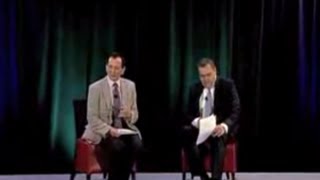
Menno Holterman, former CEO of XFLO, describes how the Dutch membrane startup grew to 30% global market share by narrowing focus to four applications and leveraging Norit's sales network after acquisition. He emphasizes realistic timelines: 12-15 years to market for water tech, not the startup fantasy of overnight success.
Chapters
And welcome to this more informal session. As you see, we're sitting in nice comfortable chairs, looking relaxed rather than standing up at the podium. I'm Graham Pearce, I'm a specialist membrane consultant with my own consultancy. I'm also part of the O2 environmental tag group. XFLO has been an important company, XFLO and NORRIT in my professional life. I've been in membranes for 30 years and membranes and water for 20 years. And near the start of that whole period I first became aware of the startup of xflo. It was a shell funded venture. At that time I was part of a BP funded venture. So we looked across the channel with great interest at the activities of our Dutch colleagues and xflo proceeded for 10 years or so, was then purchased by Norrit. Soon after that purchase, Menno Halterman, my guest here today, joined the Norwich Group and that saw the growth from minnow status to top of the food chain in a sort of 15 year time frame which led to the purchase of the company by Pentair. So what we're going to do in this discussion is look at the perspective of the acquired and in the next session when Phil Ruchigo and other colleagues are talking about M and A activity. Phil is from Pentair and he will provide us some perspective as the acquirer. So I'm now going to introduce you to Mena Holterman. He has started as a young engineer within Norwich, but had a a meteoric rise and some important posts before he became CEO. So he saw the growth of xflow from or the growth of the Norrit grouping there, from its humble beginnings to a very large company within for the water industry quite a short time scale and we're going to investigate in some of these discussions what the issues.
Were.
That were faced by Norrit and what things they did right to get such a growth of value. So Meno, could I start by asking you to give us some idea of your own CV and fill us in with your perspective of the timeline of XFLO and norit.
Thank you very much Graham. Thank you all this afternoon for having this opportunity to share some of our best practices. I finished university, graduated in Delft University in 1995 and then started working for Heineken. That's also water. And after three years I got the opportunity to join the NORIT group, becoming a managing director of one of the recently acquired NORIT companies in the beverage space. So I joined NORAD in 1990, basically two years after NORIT started. A fairly impressive acquisition strategy and maybe it's interesting to go back to those days because what happened, Norit was listed at the Amsterdam Stock Exchange since if I'm well, 1956. And it was a stable, a stable share. So if you would love to earn a little bit of money after you retire, then not only invest in companies like Shell, but Norit was a safe bet. And then the IT bubble. You probably will recognize that the IT bubble was really harming technology companies on the stock exchange in the early 90s. And the former board of directors in 1995, 1996 had to do something because the share value of Norit dropped tremendously. Think in dollar values from about 30, $35 all the way down to 5, $6. So there was an urgent need to do something because there were hostile takeovers somewhere on the horizon. And the board at that time decided to diversify. And nord, being the leading supplier of activated carbon in the world, got a lot of questions from investors. Hey, what about membranes? There were a lot of conferences like this where membranes were presented as the new holy grail and also as a potential replacement for certain membrane or for certain activated carbon applications in the wastewater field. And nord, being a very successful supplier of carbon to wastewater treatment, had to defend its position. So it was for Nord an interesting opportunity that diversify into the membrane space and the membrane field. And it acquired in 1996. Xflow ICflow was founded, like you mentioned, Graham, by another technical university of three universities in the Netherlands in technology, the second largest university in the Netherlands after Delft, as a startup company in 1984. And two gentlemen discovered the purification properties of capillary polyatosulfon membranes. And they really, like many startups, they have tried to please every single customer or potential customer. They have done trickloads of exercises, they have analyzed hundreds of different, different types of water and they literally had more than hundred proven applications based on the xflow membrane in the drawer. Unfortunately, they were not making money. So we took the company fortunately in 1996 and consequently we have been able to turn this company into the most leading ultra filtration membrane supplier in the world. And when I was able to sell XFLO to pentair, close to 30% market share. So that's, that's quite a substantial gain in a relatively period, short period of time. And I'm sure we will discuss later about the traditional lead times. You need to convert an initial ID into a viable commercial product. So one of the, one of the lessons we have learned, I have learned is that after acquiring, we have decided to focus focus on four applications which were important for XFLO and for the NORIT group. At that time. The first application was drinking water, wastewater, beer filtration and wine filtration. And today, in three out of the four fields, the XLO membrane is indeed the leading a membrane application. So focus at least is one of the lessons we have learned. We decided to leave all the other 123 options somewhere in the drawer. We kept the keys ourselves and we got the team focusing on those four applications. And indeed we were able to turn XFLO into a profitable company within a year after acquisition.
So Meno, if I could look at some of the issues then that you encountered during the growth and the development of a company, I'd like to hopefully address three themes. The first is the theme of the single product or single technology company, which XFLO was in comparison with the balanced portfolio, which a lot of investment companies like to see a balanced portfolio of products so that you're not overly reliant. And how do you think NORIT obviously brought the established company, but when it finally came to the sale Pentair, I'm sure everybody else who was interested in Norrit was really interested in the xflow membrane for the ultrafiltration application, weren't they? So how do you see this balance between the one trick pony and the balanced portfolio? How important were those other businesses and products of Norrit to the growth of the business?
It's an interesting question. I think the balanced portfolio is essential, is crucial to ultimately achieve substantial growth. We were able to grow year after year with a compounded average growth rate of 15 to 20%. And what I remember from my 14 years of Norit is we were active in different industries. In the municipal market, in the diesel market, in the industrial market. And in all those years, some markets were up, other markets were down. So if you have a portfolio which could serve different applications, different industries, then you're minimizing your growth risk from a geographical point of view. We decided with XFLO to focus first on developing European projects, European opportunities. So the real breakthrough of XFLO came when one of the 10 drinking water companies in the Netherlands decided to apply the XFLO membrane for a full scale expansion plant with a capacity of close to 85,000 cubic meters a day. And then in 1999 we were very blessed because the Cryptosporidium outbreak in the United Kingdom gave very nice opportunities, provided very nice opportunities to the icflo because ICFLO at that time was the one and only approved membrane to be applied in the UK and then when in the Middle east after the war, it was decided to become more independent for the supply of drinking water. Some very, very large projects were decided for membrane technology and fortunately XFLO was the winner of those kind of bigger projects.
And do you think the sales channels though, of the other companies like the carbon, did the sales channels help you in the sale of membranes?
Yes, I'm a strong believer that once you already have a customer, you should try to keep your customers. So it's much more affordable to sell different products to the same customer than to always look for new customers. And that has been a very important, let's say, part of our strategy. And yes, Activated Carbon proven company was existing at that time, more than 80 years, knew its way around the world. We were Activated Caron was in that time active in more than 100 countries. So it was offering big opportunities for the Xflow sales team to talk to the same customers which were already served by the Norit Activated Carbon team. So yes, that was an important benefit for the group.
And so moving on to our second theme then, I want to look at the sales growth and profitability because clearly in growing a company, making it attractive, if you can show sales growth, that's fantastic, but if you're showing sales growth and losses, that's not quite so good. And so I think you did a remarkable job at striking the balance between sales growth and profitability. And I mean, could you say a little bit more about what your sort of thoughts were in striking that balance?
I fully agree. Selling is easy, making money is, is a challenge. I think the volume is playing an important role in the membrane market. And what we have decided over time is to make sure that we could supply a high quality product, always in the desired quantity. So when we saw that the ultrafiltration membrane applications were applied in bigger and bigger projects, we made sure that we could supply having sufficient production capacity available to produce a high quality membrane. So that was important. And we saw that many of our competitors were not having sufficient manufacturing capacity available. Second, and that I think is the ultimate, was the ultimate overall success. It was all related to innovation. I think the team was never satisfied with the results achieved. So the product was improved not only once or twice, twice, but over the last 15 years the product has been approved, applications have been approved. So continuous innovation has been very important in order to stay ahead of competition, avoid that low cost competitors were really becoming active in the field where XFLO found its niche.
One thing that xflow was known for was success in very Very large projects, very high profile projects. But we all know that the profitability of those projects can be a little bit disappointing. Yet you manage to balance that with clearly much more profitable, low key type of activity to keep the profit levels at a well supported level.
That was indeed a balancing act. But I think in general margins are better in smaller industrialized projects than on the larger reference type of projects. In the municipal field, also in the industrial space, very often the customers, once you show them a certain return on investment, they are willing to look at the tco. So the total cost of ownership of the membrane, very often in large tenders from municipal projects, still the decisive factor is the price or the investment cost. Only for the XFL membrane, it's important that you really look into the operational cost and looking into the full cost for production over the next 10 or 15 years that the membrane is going to be applied. And every time when we could convince the consultant and the end customer about the tco and together with great pilot results, XFLO was or the customers were also willing to to pay a little bit more for a better product compared to some of the competitors.
And I remember that a few years ago you had the job title of Chief Growth Officer for the company, which is. That's quite an unusual sort of board level position in a company. I haven't come across that before in other companies. Maybe it happens, but that sort of shows the priorities. I mean, what did you feel your mission was? I suppose to achieve a lot of growth.
Now we went through several changes of ownership over the years. In total, five in 12 years time. And in 2007 when a new private equity company came on board, which was based in London, they wanted the board to really be outspoken of their growth ambition. So the appointment of a chief growth officer was helping them to be very transparent to the outside world, including the customers that Nord was really looking for ways to grow the company and being successful, or being successful in growing different applications and bringing continuously new technologies to the market. And growth for NORIT not only means global presence, because when I left last year norit sold into 170 countries around the world. So not all the countries in the world were covered, but it was a remarkable step from 80 countries to 170 countries. But growth was also very much depending on the success of the innovation. So we were able to shorten the time to market. Each of the different business units within NORAD had to bring two new innovations a year to the market. So every year there were new products to be sold to the Customers. So expanding customers, customers around the world, bringing new products alive, that ultimately was a recipe together with what I call an innovative spirit. I think the people in Norit had were quite young. I think the average age is somewhere around 36, 37, which is compared to other companies, rather young. So yes, they were making mistakes, I was making mistakes. But there was a lot of drive, there was a lot of passion. People were really fighting for the jobs, for the projects and the team wanted to be part of a winning company. And this winning mentality I think has been very, very important. And of course we are not selling shoes, you're selling technology. So knowledge ultimately is important and I think I've heard it a couple of times today from different speakers. But you need to have the passion and the ambition to educate your customers, especially if you bring breakthrough technology to the market where there's always a lot of resistance to ultimately apply an ultra filtration membrane which is not worldwide used or being the standard when XFLO came to the market.
So on our final theme, I just wanted to quickly look at this issue of intellectual property and patents. You had a good patent position from the initial founding of xflo. I've always been a bit intrigued that you have taken a more laid back approach to guarding your patent portfolio than some others when threats were posed from the outside with which did happen from time to time. And I don't think those threats didn't in reality materialize. But some other companies have taken a more aggressive protection of their patent portfolio. How do you see the importance of patents and this whole question of how to respond to threats?
Of course patents are very important, especially for the valuation of a company. However, we didn't have a very big legal department in NORAD to protect patents. I personally believe that the best way is innovation, making sure that your invention, your product is better than others. And don't forget, as soon as the patent is granted, what is it, 18, 20 months, all the information, the secret is on the street because it's all listed in the document. So we have, for example, on the membrane production, we designed the manufacturing equipment ourselves, we built the membrane production equipment ourselves and those were part of the trade secrets within the group and they have been very important for keeping the advantage compared to any of the competitors. So I believe patents are important. However, making money with technology is more important and speed ultimately is I believe, the best way to stay ahead of complex.
So just in final conclusion here, what would you say would be a realistic timescale that an investor coming in now I mean obviously xflow came into the market before the market existed. So 25 years it took from Exflow being founded to the sale. I guess timescales would now be quite a bit shorter, but maybe not as short as some people would hope.
Yeah, I think we are not here to disappoint any of the investors, but we have to be realistic. And as a chairman of the Netherlands Water Innovation, Water Technology Innovation Board, we just have finalized the research and checking the average time to market in the Netherlands of all the different technologies coming to the market over the last 25 years. And the average is 12 to 15, 15 years. And I very often get questions, could you do that shorter knowing everything we know about xflo? Yes, maybe one or two years. But to cut that type of period half is almost impossible because we are in an industry which is regulated where you have to prove your product which is conservative to a certain extent. You simply need time before a technology is being accepted and then worldwide adopted. And being the standard worldwide Simply takes you five to 10 years. You can try to do it smarter or faster, but even Steve Jobs took 10 years or even longer to get his product ultimately on the table of each of the consumers.
So in 10 seconds, what does the future hold for Menno Halterman?
I'm not ready for my retirement yet. No. I'm very keen to share the best practices we have learned over the last 15 years. And I'm at this moment of time trying to help startup companies and medium sized companies to overcome the so called valley of death and built another leading and winning water technology company.
Good. Excellent. Okay, Mana, thanks very much.
Thank you very much.










