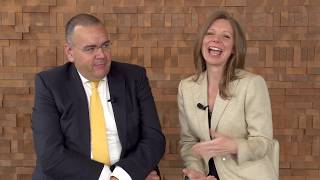
In this interview recorded at the BlueTech Forum in Vancouver, Waterworld magazine host Angela Godwin speaks with Menno Holterman, CEO of Nyhaus Industries, about the growing trend toward decentralized and mobile wastewater treatment. Holterman explains that many industrial clients prefer decentralized solutions to avoid large capital expenditures, lengthy permitting, and to meet immediate needs, often planning short‑term deployments that end up lasting much longer. He discusses how utilities are not direct competitors but their flexible tariff structures can affect the attractiveness of decentralized options. The conversation moves to corporate social responsibility, where Holterman notes a genuine shift toward climate‑change awareness, especially among listed companies that outsource water services to focus on core activities. He cites a recent trip to India as an example of how inadequate policies lead to waste and pollution, underscoring the need for education and proper solutions. Finally, Holterman addresses water reuse, highlighting mandatory reuse policies, cost considerations, and varying industry acceptance—food and beverage firms remain cautious about direct product contact, while refineries and steel mills are more open to using reclaimed water for boiler feed, makeup, and cleaning processes. The interview paints an optimistic yet realistic picture of the market forces shaping decentralized water treatment and reuse.
Chapters
Hi, I'm Angela Godwin with Waterworld magazine coming to you from the BlueTech forum here in Vancouver, Canada. Joining me today is my guest, Meno Holterman. He is the CEO of Nyhaus Industries. Menno, thank you so much for joining us today.
Thank you very much. Pleasure.
So I know that you kicked things off today with the thought leadership roundtables and one of the topics that you mentioned is this notion of decentralization. I wanted to pick your brain a little bit about that and find out what does that mean and what is its impact in the marketplace?
At this moment of time, we see a lot of positive developments around decentralized and mobile treatment, driven by the time normally to put fixed infrastructure in place, but also a lot of clients, industrial clients, for example, who don't want to go through a big capex improvement or a big capex approval procedure or, or long permitting procedure and have an immediate need and they decide then to first implement a decentralized solution. And what we also witness is that a lot of these solutions are planned for six months or 12 months, but in many, many cases they stay for a much longer period of time on the site.
Interesting. Do you experience any pushback from the utility space?
That's a very good question. Of course, if you look at our scale of operation, we will never compete with any utility. However, traditionally, if you're a smart, let's say, producer of wastewater, then you negotiate not only with the technology provider or the rental company, but you also start negotiating with the water board or the water company. And in a lot of countries, we see that their tariff structure is flexible. So we are very often not competing against another solution provider or hardware provider, but we very often are competing against municipalities which are dropping down or water boards which are dropping down their tariffs.
Interesting. Let's talk a little bit about corporate social responsibility. We hear that term, you know, tossed around quite a bit. Is it genuine or is this just corporate window dressing? What's, what's kind of going on there? What are your thoughts?
We really believe we are a global operating company. So I have the pleasure to visit a lot of areas around the world and we definitely see that companies, a lot of companies, a lot of countries are taking the effect of climate change seriously. However, the scale to do that is so massive that some really don't know where to start. And the same we see also on multinationals, we see a big difference between family owned companies and listed companies. Listed companies with a very strong focus on roi, trying to invest only in their core activity and then looking More and more for outsourcing of, for example, water as a service or data as a service. So, yeah, we see a lot of developments. However, I'm positive, more positive than a couple of years ago about the understanding and the sense of urgency which we see in a lot of places around the world.
Do you think people are starting to realize that that link is very real, that climate change to water management relationship?
Last week I was in India, for example, and there you see what is the result of not having any proper policy in place. There's a lot of waste, there's a lot of water, there's a lot of pollution, air pollution. And the government is realizing themselves that it's time for action, how to organize that action and how to put then the right solution in place. That is, of course, where we come in and where we have to help and educate our clients to make the right choice.
Excellent. One final question before I let you go. I want to talk a little bit about water reuse and your thoughts on whether that is or is not being widely adopted and if so, why.
We see in a number of industries at the moment, we see a change, a policy change, change to mandatory water reuse. Every drop counts. That is basically the real policy today. But still, in certain cases, it's an expensive solution. So it's our challenge as a solution provider to develop the right application against the right investment and operational cost and at the same time, work together with the client to find the most suitable applications for water reuse. In the food and beverage industry, we still see that there is some hesitation that some of the reused and cleaned wastewater is immediately reused and in contact with the product. But we see in other industries, refineries, steel mills, that they are more willing to look for water reuse in terms of boiler feed, water makeup, CIP water makeup, all kind of applications where it's not directly touching the core product of the client.
Yep, that makes a lot of sense. Excellent. Meno, thank you so much for your time today and your insights. We really appreciate it. Wish you all.