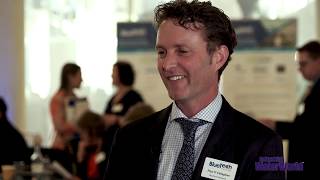
In this Waterworld magazine interview recorded at the Bluetech Forum in London, host Angela Godwin talks with Paul O'Callaghan, founder and CEO of BlueTech Research, about the 2019 conference theme “Innovating Towards Resilient Water Systems.” Paul explains that the theme reflects growing climate‑change concerns and positions water as the key medium through which impacts will be felt, urging the sector to adapt to both water scarcity and excess. He describes the choice of a UNESCO World Heritage garden venue, noting that natural surroundings foster creativity, relaxation, and open‑spirit collaboration. The conversation then shifts to the evolving makeup of the event’s audience, highlighting an increasingly diverse mix of utilities, corporate water users, technology providers, and financiers, underscoring that no single solution exists and that collective effort is essential. Finally, Paul shares details of the “Brave Blue World” film project—a hopeful, optimism‑driven documentary aimed at countering doom‑laden water narratives. He outlines partner support (WEF, Suez, DuPont, L’Oréal, etc.), production across three continents, upcoming post‑production, and planned screenings at major industry and film festivals slated for September, positioning the film as a catalyst for broader public engagement with water solutions.
Chapters
Hi, I'm Angela Godwin with Waterworld magazine coming to you from the Bluetech Forum being held here in London. My guest Today is Paul O'. Callaghan. He is founder and CEO of BlueTech Research. Paul, thank you so much for joining me today.
Pleasure, as always.
It's always great to see you and this event this year, as always, it's just been a fantastic event. You obviously have put tons and tons of effort and time into it. The thing, the theme is what I wanted to ask you about. It's interesting this year. Tell us what you're focusing on.
Sure. Well, the theme is innovating towards resilient water systems. And it came about through talking with our partners and our sponsors. And climate change is becoming just more and more on the agenda. And water is really the vehicle by which we're going to experience climate change. So we wanted to reflect that and look at how, as a community, we can respond to that, respond to this changing environment, which hopefully be part of the solution and adapt it to too much or too little water.
And it's interesting that the environment that you mentioned, the venue that you've chosen this year, is just. It's beautiful. Tell us about sort of what your thought process was behind that.
Yeah, we're thinking about where we'd like to host the event. And I began to think about how our environment influences how we feel. And we feel more creative and relaxed sometimes when we're in nature or energized in a busy city. And here in gardens, you're in a very natural environment. It's a UNESCO World Heritage Site and it creates a certain ambiance where people are within an environment where they're more relaxed. And we wanted to create an open spirit where people would be able to engage and come up with solutions.
Absolutely. And speaking of engaging coming up with solutions, I noticed you have quite a lot of end users here this year, and you typically do, but this year it seems like you've got quite a vibrant group.
It's been a really interesting evolution of the makeup of the audience or the community that come to BlueTech events. And we have more and more utilities coming to the table and corporate water end users coming to the table. I think it's a reflection of the fact that no one person here has a solution. There's no. It's not one technology. It's a community working together. Utilities with corporates, with technology providers with financiers. So I think that's part of what's happening.
It's fantastic to see that collaboration happening. You know, between those groups and before I let you go, one of the really fun highlights this year was a chance to take a look at the trailer for the film that you've been working on, Brave Blue World. Tell us a little bit about what you have in store.
Sure. It's part of an exciting journey that we're still on. It's a film which came about through talking about how we need to tell stories about what we do to communicate more effectively as a group. And we feel that there's a lot of negativity out there about water, a lot of apocalyptic tales of doom and gloom. And yet for those of us here, we wanted to tell a story of hope, optimism, things that are engaging. And we were fortunate that a number of partners got on board with that vision. Water Environment Federation, Suez, Dupont l', Oreal, and we hope, many others. And we're currently in production, so we've been filming in three continents so far. We have another three to go in the next month or so. So clocking up the air miles for sure. Then it'll go into post production and the magic will happen. And in the fall, at the end of September, the project will be completed and will be launched. We'll have screenings at weftech, at Aquatech, Amsterdam, Web Summit Film Festivals, and hopefully it'll reach a wider audience and start to get people more excited about what we can do to help solve water problems.
Absolutely. That sounds wonderful. It's certainly an ambitious project, but as you said, the water industry isn't one to celebrate its own victories. So it's nice that there will be a voice, a catalyst for that and showing all the good that's going on in our industry.
That's very much the hope to be part of a broader impact campaign.
Fantastic. Well, we wish you all the best of luck with that and with the conference, and we thank you so much for joining us today.