Innovation & Entrepreneurship for Water Constraints
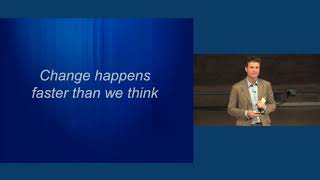
Paul O'Callaghan argues that water scarcity is solvable not through new technology but through systems-level rethinking. Sydney extracts drinking water from sewers, Hong Kong flushes toilets with seawater, and California is already doing direct potable reuse. The real barrier is shifting from centralized 150-year-old infrastructure to decentralized treatment and recovering nutrients from waste.
Chapters
So in my talk, I'll focus on some ideas, some images and stories that hopefully will help you conceptualize and wrap your head around water and how it relates to food. My role in bluetech is to look at how we can solve water resource issues through innovation. And there's a. Water problems exist. There is a certain amount of capital, both human and financial, that can go around to help solve those problems. And we try and make that capital more efficient by reducing risk, by understanding where are the needs and what are the potential solutions. So I'll challenge a few commonly held assumptions about water. One would be that there's a shortage of fresh water. So if I could take a show of hands, how many people in the audience believe that there's a shortage of fresh water? Very good, kind of majority, I would say. And the second one, perhaps even is stronger. That water is essential for human life. Show of hands. Okay, excellent. Well, we'll delve into that a little bit. And the third thing I'll look at is whether desalination is truly energy intensive or whether that has changed through technological innovation. So there are many drivers for change in water. They're well understood, they're well mapped out, including urbanization, population growth. And we've heard about many of these today coming from different perspectives in different areas, from aging populations to urbanization and buildings, climate change, and indeed water scarcity. One of the important pieces of our work is to understand how those drivers are going to impact the sector. So we've mapped out more broadly themes such as decentralized water treatment and reuse, zero liquid discharge, resource recovery, nutrient recovery, harnessing energy, both chemical and thermal and kinetic from water. Now, one of the first things, I suppose, to ground any view on water is to say that our current water system, what we have today, is very inefficient and wasteful. And it's not surprising because it wasn't designed with efficiency in mind. In fact, it was scarcely designed at all. If you ask the question, is the system that we have today intelligent design or evolution? It's almost definitely a case of evolution. It evolved over a period of about 150 years, starting in cities like London and Paris around 1850, when they built sewers to get water into the sea. That's where the old English word sewer came from, seaward. And that grew from a world where there were maybe 2 billion people, mostly rural, lacking in modern technology. And now we have a world of 7 billion people, mostly urban, starting to bump their heads up against resource constraints. And yet we keep swimming in the same Direction trying to make the same system work when really it won't fit. So if the current system won't work, what will a future water system look like? Well, if you could imagine for a moment a futuristic water system, we'll call it Brave Blue World. And some of the elements of that will be that in cities we will drill into sewers and mine them for water for use. Where cities on our coasts, where most of our people live anyway, will use seawater, not fresh water for flushing toilets, where along with your recyclables, people will collect canisters containing nutrients recovered from urine. And where our wastewater plants are net producers of drinking water resources and energy. And you say, okay, how far out is that? Is that 10 years out? We looked at the spaceships earlier on from films in the 80s. So how far out is this vision? Is it 10, 15, 20? Well, everything that I just described is already happening today somewhere. So in Sydney and Australia, somebody asked who owns the water in the sewer? And the city said, oh, we've never been asked that before. It turns out it's public property. So a company applied for a license to extract, treat and sell that water. And it turns out you can have a profitable business doing that. In Sydney, Australia, they were selling it to irrigate sports pitches. In Hong Kong, they have been using seawater to flush toilets for many years, for well over a decade. In Europe, in research groups in Switzerland, they are working very closely on phosphorus recovery and nitrogen recovery from urine. And there are plants now which are net energy positive wastewater treatment plants. And with the drought in California, you're seeing a discussion around things like direct potable reuse, which would not have been possible six years ago. But people are changing and shifting their thinking. So it's happening. And much of what needs to happen actually is more of a shift in thinking as much as technology, really. We have the technologies we need today. There will be improvements and there will be breakthroughs, but much of what's needed is systems level change. So I want to go through maybe three uniting themes that run across the water sector. It's a very fragmented industry in terms of technology, so we won't delve into all of those today. But number one I mentioned the first myth was that fresh water is scarce. Yes, only 3% of the world's water is fresh. Most of that is locked up in ice or underground or in the atmosphere. And yet we still only harness a small portion of the annual renewable fresh water. If you look at it on a global level, the issue really is of there's not enough water. Where we want it, when we want it, it's availability. And that comes back to the fact that although water is perceived as a global issue because it affects everybody on the planet, at its heart, it's very much a local issue. We have to deal with water city by city, town by town. It's not like oil we where you can ship it from the Middle east to other parts of the world. So that theme of local will lead to decentralized treatment. Water reuse, rainwater harvesting, point of use, treatment, source separation. A second theme is how we can provide water services without using water. And this speaks to that second idea or myth that water is essential for human life. Yes, it certainly is. But we've taken that idea, the fact that we need 2 liters of water a day to survive. We've taken this concept and we've extrapolated it to mean water is essential for everything that we use water for. And it's not much of what we use water for. You don't need water. It's a service. This is a picture of a toilet on an airplane. It works in a vacuum, and yet it achieves the same net objective. Waste disappears as quickly as possible. Cooling water is another great example. It's a huge user of water, and yet the goal is dissipation of heat. There are other ways to do that. Even in industry laundries, we're seeing Nike Patagonia investing in supercritical carbon dioxide, textile dyeing and laundries which don't use water. So I think certainly a number of the solutions there can be solved by using different types of water. And even in terms of agriculture, there are possibilities to use salt water or brackish water to grow plants. So it doesn't necessarily have to be fresh water. The third idea which we see across the system is systems level efficiencies, rethinking efficiencies more at a holistic level. And I use an example given by Amory Lovins of the Rocky Mountain Institute where he describes using a chainsaw to cut a pound of butter. Now operating within the system, you can try and make that chainsaw more efficient, better at converting energy, or if you stand back, you can say, is there a more efficient way of achieving the goal? Could we use a butter knife? Much of the innovation in water has been incremental, sustaining innovation within a system that really is a little bit like this. A lot of the new thinking is stepping back and coming up with different approaches, looking for butter knives. And there are many, many opportunities Such as that, which gives one ground for optimism. It's often said that water moves relatively slowly, though I think change happens faster than we think. Even in my career I graduated in 95 and in some of my first jobs, 96, 97, a technology called a membrane bioreactor was being talked about as if it was something very new. It was cutting edge. If you knew what an MBR was, you were certainly at the leading edge. Ten years later, by 2005, that technology was accepted, proven. Ten years later, again, it's a commodity technology, a mature technology. And we see the same things with desalination. It's now mainstream and I think we're going to see the same thing again with decentralized, distributed and direct potable water reuse. Now, we've been talking about the current system and the future. Now one of our roles at Bluetech is to try and help entrepreneurs, investors, researchers identify the best opportunities to either invest research funding in startup companies or to launch new technologies. In doing this we want to be fact based, analytical. But one of the challenges about the future is there's no data. And Clayton Christensen, author of the Innovator's Dilemma, put it quite well. He said, the only way that you can look into the future because there is no data is you have to have a good theory. So we've certainly focused some of our effort on trying to predict and model what have we seen in the past. How long has technology adoption taken, how long has disruptive innovation taken to penetrate into the market? And look at the accelerators that can speed this up and the decelerators which can slow it down. Because timing is everything when it comes to technology in any of the areas we've heard about today, if you're carrying out research, you want to be at this early stage in the technology s curve. If you're a start up, you want to be just where it's about to pick up and inflect. If you're looking at acquisition, you're looking at much later. There are many great companies, but not all companies who start the race make it across the finish line. When you look at the ecosystem of water technologies, we track maybe five or six hundred new technology companies. When you look at the distribution of those, a very high proportion are pre revenue early stage. And then when you move into that, you know, 1 million to 2 million to 3 million range, there's a drop off because it's a very dangerous place to be as a company. You need to get your revenues and get out across to where you're seeing, you know, 10 million to $100 million in revenues as quickly as you can. And once you get across that chasm or across the valley of death, you're in a more sustainable place. Some of the technologies that we see are going to break through would include anaerobic membrane bioreactors. And if you plot how these installations have been increasing over the past few years, you can anticipate it's quite likely just to go through an inflection point and increase rapidly in the next five or ten years. So the focus of this session is on food and water. So before I get to food, I'll just say a few words about the urban water issue. Water is made up really of urban, industrial and agricultural. As three key uses of water. The urban challenge is relatively easily met. It's actually not an intractable problem. There are solutions. Some of these will be direct potable use energy and resource recovery and using alternative energy for desalination. The real elephant in the room is water and agriculture. It's where we use 70% of our water. We use 22% in industry, approximately 8% in urban. There are relatively few silver bullet solutions which can exist to help address that issue. One that I mentioned are halo fights or salt loving plants. And this again challenges the idea that we need fresh water for everything. People are starting to grow potatoes, quinoa on brackish water. And if we can do that, you can really go a long way towards addressing that food water challenge. There are many. Three minutes. Perfect. There are many investors who are looking to know where should I invest or researchers, where should we focus our research and development. There are four metrics I'd like to point out here. One is acquisitions, second investment, third disruptive innovation, and fourth, intellectual property and patents. When you look at those four metrics across different technology areas, you can see membranes is quite high in all of these areas. It's a high level of activity for acquisitions, investment and disruptive innovation using advanced material science. In the middle you'll see sensors and it this Internet of things, the integration of machines and big data, very much of interest to large corporates right now. A high level of acquisition activity, a relatively low level of investment, which says to us there's an opportunity there. You can also look at thematic areas and say where is the money currently going in water? And these include energy and resource recovery, low energy desalination, energy efficient waste water treatment, smart water, two technologies I just would like to highlight that I think are particularly interesting and noteworthy. One is an example of biotech, biomimicry using aquaporin membranes. Each of us uses aquaporins to filter water in our kidneys. There's research to take those out, embed them into membranes and use them for water filtration as a very selective way of filtering water. There's a Danish company, Aquaporin has been doing quite well and making very good progress on that. A second would be supercritical water oxidation. This would be a game changing technology. It uses a fourth form of water. It's not a liquid, it's not a gas, it's not a solid. When you put water under temperature and pressure, it can go supercritical. Then you can do things like destroy organics, generate energy and recover nutrients in a very effective way. So in summary, where there's big change, there's big opportunity. And those drivers are causing us to reevaluate our current water system. Much of what we've seen to date is sustaining innovation, but really what we need is more disruptive or open innovation. And that typically comes from the outside, not from the incumbents. And certainly we're seeing that from startup companies, from advanced material science, biotechnology and it. So with that I'll hand over to the next speaker. Thank you very much.










