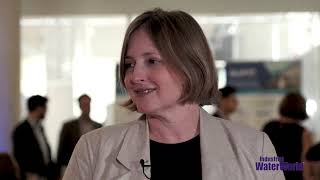
Susan McKay of Sarah Helix describes a DNA-based process that creates ultra-fine pores in ceramic membranes, letting them filter dissolved solids at high speed. The technology could replace plastic membranes in industrial water recycling, cutting energy use and enabling near-complete water reclamation.
Chapters
Hi, I'm Angela Godwin for Waterworld magazine, coming to you from the BlueTech forum here in London. Joining me today is my guest, Susan McKay. She is with Sarah Helix. Susan, thank you so much for joining us today.
Thank you for asking me.
Now, membranes. So membranes are not really a new thing necessarily in the water industry, but your technology kind of has a new twist on it. Can you explain?
Yes. So in the past, we work in the ceramic membrane space. So in the past, ceramics have always been occupied a niche in the membrane market. So they are very robust, they can tolerate very high temperatures, and so they were used in very specialized applications. But what Sirihelix has done is for the first time developed a ceramic membrane that has that same robust material properties, but has the added value of having a very tight pore structure. And what that means is we've taken ceramic membranes down to the nanofiltration regime and beyond. So it allows, for the first time, ceramic membranes that can remove a lot of dissolved solids.
Interesting. Now, the name of the company, Sar Helix, is sort of an homage to something special in the technology community. Can you explain that?
So it's the way that we've been able to leapfrog what had always been a technology limit in ceramics, which is how to make those pores that small. And what we were able to do is incorporate a biologic material, actually DNA. And we worked out the chemistry so that we could get the DNA into the ceramic material, apply it as a coating to the surface of a ceramic filter, and then burn out the DNA, in which case it left the very small pore structure all the same size and very highly linear. So it gives us a very high throughput ceramic membrane with the small pores less than a nanometer.
That is really cool. So now at this conference, like at a lot of conferences in our industry, we hear a lot about the circular economy. What role do you think membranes play in sort of having that come to fruition?
A very important role. So there's two things you're trying to do in the circular economy. You're trying to reclaim almost nearly all the water that goes into a production facility. So you're using water to make products and to manufacture. And you want to be able to reuse that water and recycle it through the plant, nearly 100% of it. And so what you need are technologies that can help purify the water as it goes through the plant, but also not use a lot of energy to do that, because they're trying to balance the energy, the carbon footprint, with the water footprint. So membranes are known as a way to sequentially remove contaminants from water in a very low energy impact process.
Excellent, Excellent, Chanel. Going forward, if you were going to look into your crystal ball a little bit, what sort of advancements to membrane technology do you think could be the most impactful?
Well, I think similar to what we've done, where you take different membranes made out of different materials. So the majority of membranes worldwide that are sold are made out of plastic. So, number one, they're coming from a resource that the world is trying to limit. But more importantly, they have a limited range of applications. And so if you're trying to put membranes to recover water under all sorts of conditions and do it in a low energy process, you're going to want to use make membranes out of materials that are very robust. So, like ceramics, inorganic materials, you know, carbonaceous, like graphene. All those sort of advancements are using different materials to make unique membranes.
Interesting. Awesome. Well, we'll have to watch that and catch up with you in the future and see how things have played out. So in the meantime, we wish you all the best of luck going forward with your technology and thank you for being with us.