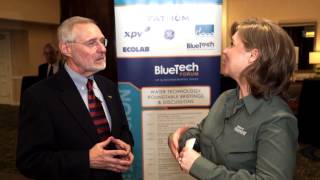
Dr. Glen Daigger discusses how wastewater plants could become resource-recovery factories instead of treatment facilities. Phosphorus, essential for fertilizer, may run out in 100 to 200 years. The Gibson Water Factory in Australia already operates like a manufacturing plant, showing what's possible.
Chapters
Hi, I'm Angela Godwin with Waterworld and Industrial Water World magazines coming to you from the BlueTech Forum in San Francisco, California. Joining me today is my guest, Glenn Dyger. He is a professor at the University of Michigan and also the president and founder of One Water Solutions. Glenn, thank you so much for joining us.
Thank you. Thank you for asking me.
So I wanted to catch up with you because you've had a long and very distinguished career in the water industry, and I want to know your thoughts about what events like the BlueTech Forum can bring. What kind of impact do they have on the industry, do you think?
Well, this is really a very important forum because it brings people that are actually looking to. They're focused on bringing new things into our industry. And these are folks that have no choice other than to do that, to bring those new things into our industry and our profession. And we really need those new things. We really need to move forward. Yep.
Now, tomorrow you're going to be giving a talk on nutrient removal and recovery. What are some of the emerging trends you're seeing in that space?
Well, the, of course, the first and foremost is phosphorous, which is the recovery of phosphorus, which is a scarce resource. The estimates vary, but something in the range of 100 to 200 years at least, the currently economical sources of phosphorus that can be economically recovered will be exhausted. And, you know, you and I can't live without phosphorus. So that's really one of the. And the fact that it's really taking the industry by storm. You know, the water is an area where people, you know, people in water, it's a very interesting profession, but it's also peopled by individuals that want to do good.
Right.
And I think phosphorus recovery really represents that, that this has become available and that people understand that this is a good thing to do and are really embracing it.
Yep. And, you know, it actually segues really nicely into my final question for you, which is, you know, wastewater treatment plants are undergoing a transformation of sorts to resource recovery facilities. What do you think the wastewater treatment plan of the future looks 20, 30 years down the road.
Wow. It's going to be totally different. Totally different. It's interesting how important a word is, isn't it? It is resource recovery versus wastewater treatment or sewage treatment. And these things convey messages that have just impacts that carry through in such interesting ways. So no, we're going to be factories. One of the very interesting projects I did in, it's a facility that's operating now in Australia was the Gibson Water Factory. And not only does that plant do different things, but it looks differently. And this idea of a factory or of a resource recovery facility. Yes. The facilities that we used to call wastewater treatment plants, the things formerly known as wastewater treatment plants, will look much different in the future than they have in the past. People will operate them differently, will do different things, and will accomplish things that we just haven't even dreamed of at this point.
Well, it definitely is exciting, for sure. We appreciate your time today. Thank you so much for joining us. Wishing you all the best of luck going forward.