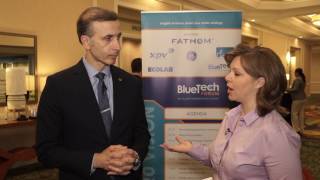
Emilio Tenuta, VP of Corporate Sustainability at Ecolab, explains why water has become a material business risk for multinational corporations. He describes how companies can map their water use through hydraulic footprints and use Ecolab's Water Risk Monetizer tool to quantify physical, regulatory, and reputational risks in dollar terms.
Chapters
Hi, I'm Angela Godwin, chief editor of Waterworld and Industrial Waterworld magazines. I'm here at the BlueTech forum in San Francisco, California. My guest this morning is Emilio Tenuta, he's VP of Corporate Sustainability for Ecolab. Emilio, thank you so much for being with us.
My pleasure.
So I wanted to catch up with you because I know that one of your specialties is addressing water risk, corporate water risk through sustainability. But what's driving companies, do you think, to really take a good hard look at their water usage?
What we're finding is that water, over the last 10 years, people have identified with the fact that water is really material to their business and obviously with the megatrends. Water scarcity and water quality challenges around the world have really taken hold and people are recognizing that they have to take more proactive actions. And so that may look like goals, public goals that they may have around water management or even, you know, this concept of risk and stewardship which says that they're find that physical risk and then enough water to operate in enough quality water to operate, but then also regulatory risks and reputational risk, all having to be managed by these large national multinational companies to really make sure that they're viewed as a good steward when it comes to water management.
Right, that makes sense now. So if a company wants to go down that path and curb their water usage, how do they go about understanding how much water they are currently using in their processes?
Great question. So, you know, to my earlier point about you establish goals, then you have to have a strategy to go after those goals. And so the challenge has been for years is cascading that down to the local operational sites. In an industry, you know, there's been a lot of tools, a lot of expertise that's, that's been developed to really footprint facilities and their water usage. Now we've gotten so sophisticated where we not only do what they a hydraulic footprint, which shows where all the water is flowing from a physical perspective, but then also the chemistry, the water quality, which is a very critical component because it allows us to know how to begin to look at solutions to help reduce, reuse and recycle opportunities within the facility.
Interesting. So now if a company is trying to decide the cost versus the benefit of implementing some major water saving initiatives, are there tools to help them do that strategically?
Absolutely. And I think you bring up a great point. We often talk at Ecolab, Nalco Water, the eroi, the business case around water, it's challenging unless you have significant energy reduction where it substantiates the decisions. Pure water reduction projects are difficult to do because the business case simply isn't there. And so one of the things that we looked at is creating tools that start to quantify risk related to water use within a facility, within a given watershed and begin to look at monetizing it so that business people can start to really think about it in their terms and looking at the full value of water as opposed to just what we see in the annual water bill. And I think that's gone a long ways recently. To really help people start to manage that risk, we created a tool called the Water Risk Monetizer. That's public available. It's@waterriskmonetizer.com and it helps any water user in the world understand their risk and then monetize it on a unit basis.
Wow. Wow, that's fantastic. Excellent. Well, Amelia, we thank you for your time today and appreciate, you know, stopping by and chatting with us and wish you all the best of luck going forward.