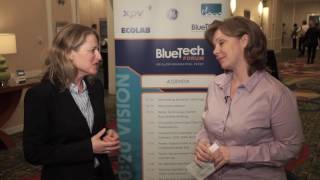
In this BlueTech Forum interview, Angela Godwin speaks with Paula Kehoe, Director of Water Resources for the San Francisco Public Utilities Commission (SFPUC). Kehoe explains how San Francisco is diversifying its water supply through a suite of technology‑enabled programs: long‑term conservation, recycled‑water treatment for irrigation, groundwater augmentation, and non‑potable water use. She highlights concrete results, such as a per‑capita use of 44 gallons per day and a 65 % reduction in potable water consumption at SFPUC headquarters via an on‑site “living machine” wetland treatment system. Kehoe notes that recent state policy shifts toward localized water‑conservation mandates will not alter SFPUC’s strategy, which continues to rely on voluntary 10 % reductions. She also discusses a 2012 SF ordinance that permits building‑ and district‑scale water reuse, and a partnership with the U.S. Water Alliance to launch a national Blue Ribbon Commission aimed at creating consistent policies for on‑site water reuse across the United States. Throughout, Kehoe emphasizes technology as the critical enabler for both operational efficiency and policy development.
Chapters
Hi, I'm Angela Godwin with Waterworld and Industrial Waterworld magazines coming to you from the BlueTech Forum in San Francisco, California. Joining me today is Paula Kehoe. She is with the San Francisco Public Utilities Commission. Paula, thank you so much for being with us.
My pleasure. Thank you for inviting me.
So, you know, there's been a lot of talk about the drought in California and with the prolonged dry conditions. I want to know from you what role technology has played in being able to diversify your water supply portfolio.
Well, San Francisco, like many communities throughout California, is actively diversifying its water supply portfolio. And we're doing that through a number of programs, through a conservation program, a recycled water program, a groundwater program, and a non potable water program and all of those programs. What's key to those programs is technology. For example, in our conservation program, we've been doing conservation for over 25 years. We've been focusing on efficient technologies that people can install in their home or their business in order to save water. Today, for example, our residential per capita is about 44 gallons per person per day, one of the lowest per capita rates in California. We talk about recycled water. Obviously, technology is very key in terms of being able to effectively and efficiently treat wastewater to produce tertiary treated water for irrigation of our golfs and parks, our golf courses and parks in San Francisco.
Excellent. Now, recently it was announced that there'd be a change to the mandatory water conservation strategy in the state where it's going to be more of a localized approach. Will that change at all your strategy for diversification or.
Actually, it's not going to change our strategy. As I mentioned, we've been doing conservation for over 25 years in San Francisco. We will continue to do conservation in the future. We will continue to ask our customers to conserve. Certainly last year was a good year in terms of precipitation. However, we are still recovering from the drought. So we plan to call on our customers to continue a 10% voluntary reduction in water use. And we're looking looking forward to the same success that we've had for the past several years.
Excellent. Excellent. Now, in March, I know you announced a commitment in conjunction with the U.S. water alliance to promote on site water reuse. Tell us a little bit about your successes, your experience in that space.
Yes. So San Francisco, in 2012, we actually established an ordinance to allow for the collection and treatment of a variety of different kinds of water water sources that are produced in buildings and districts. For example, in our headquarters, we have installed a living machine, which is a series of engineered wetland treatment cells they're basically large planter boxes on the outside of our building. But those aren't just planter boxes. We are capturing all of the wastewater we produce in our building. We're treating that and we're using it to flush our toilets and our urinals in our buildings. So we've been able to reduce our potable water consumption by 65% as a result of that treat on site water treatment system. And so we've done that in San Francisco. But we're also working with many communities throughout the and our partnership that we're really excited about with the US Water alliance is establishing a national Blue Ribbon Commission. And our goal is to develop consistent policies and guidance for states throughout the country.
Excellent. Which is a great idea, especially if something like this is new and it's sort of taking hold. Now is a great time to establish those best practices.
Yes, right. And one of the key barriers to actually accelerating on site water treatment systems is policy and the lack of policies. And that's why we're forming this commission to develop consistent policies throughout the country.
Well, we wish you all the best of luck going forward with that and we'll be watching and hope that you have every success. So, Paula, thank you for being with us.