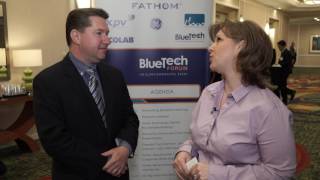
Ralph Exton, CMO of GE Water & Process Technologies, discusses how IoT and data analytics are shifting water management from reactive repairs to predictive asset management. He points to the Flint crisis and America's D-rated water infrastructure, which needs $1 trillion in replacements over 25 years, as proof the sector must change. GE's Ecomagination program sets internal sustainability targets and partners with customers on water-saving solutions.
Chapters
Hi, I'm Angela Godwin with Industrial Water World and Waterworld magazines coming to you from the BlueTech Forum in San Francisco, California. Joining me today is my guest, Ralph Exton. He is with GE Water and Process Technologies. Ralph, thank you so much for being with us.
Thank you for having me. This is terrific.
Well, we wanted to catch up with you because you are going to be participating in a panel discussion later that's talking about IoT and big data and sensors. How much of a disruption are these technologies likely to have in the water market?
Well, I think, look, the water market has been evolving quite a bit over the last several years. I think this is another part of the evolution. The disruption, I think, is more in disrupting the status quo of the way we've always done things. Let's take, for example, what's going on in piping and distribution of water utilities. Right. Highlighted by what's going on. What happened at Flint, very unfortunate situation. But I think it brought to light that, wow, there is a lot of work that needs to be done and we can't continue to do things the old way that we've done it. Meaning, for example, a pipe breaks, let's go fix it. Well, of course you're going to go fix it when a pipe breaks, but how can you be smarter about that? How can you think differently about managing that asset, the asset of which is piping and distribution? The reality is that, you know, there's lots of problems with today's current infrastructure. American Society of Civil Engineers gives it a D rating. You know, American Waterworks association says it's going to be a trillion doll, 25 years to just replace it in kind. If that's the approach that we were going to take, is that the right approach? Not so sure. I think if you now start to think about what's going on and this conference here is highlighting it tremendously. What's going on in terms of the advancements in sensors, the advancements in the collection of data, and then being able to use that big data, perform data analytics, write algorithms, bring in other sources of data into the equation in such a way that you are now able to make smarter decisions more predictive about what is going to happen and approach it that way. I think it is a game changer. And how big of a disruption that is. I hope it's not a huge disruption. I hope it's just a natural progression in the evolution that we've been going down in the water industry as a whole.
Sure, sure. And in this case, disruption wouldn't be A bad thing.
It could be a good disruption. Not at all. It would be a great disruption.
So to change gears a little bit, I wanted to talk about Ecomagination a little because been very involved in that effort. And so for people that aren't too familiar with what that is, can you tell us a little bit about it?
Yeah. So, I mean, over 10 years ago now, in fact last year we celebrated our 10 year anniversary of the launch of ecomagination as GE. It's a big GE corporate initiative and, and it was the first of its kind to be as bold as it was in terms of, look, not only is GE making a decision to be more green company, but we're going to help our customers to be more green and protect the environment as well by investing research dollars into technologies that will operate more efficiently, more clean if you will protect the environment more, help our customers save water, help our customers reduce greenhouse gas emissions, you know, across the board. But the way that we approached it was, you know, we don't want to just like sell the next technology that does that. We want to prove it to the world that we're going to adopt these technologies ourselves. We're going to set our own internal goals about how we're going to reduce greenhouse gas emissions, how we're going to reduce our own water footprint. And we put out very aggressive targets and it's a say do ratio. We kept beating the targets and then just kept increasing it on ourselves. And at the same time we kept increasing our investments in developing newer technologies that we're able to do that for our customers as well and we're able to keep track of that in a big way. So I think it was the metrics that made the difference and very successful program. We've evolved it over the years to not just be about inventing the next green technology, but to also partnering with other companies that want to go down this journey with us, you know, to help develop new and big projects that make a big impact on.
Right. And I think it's important, like you said that, you know, you didn't just say, you know, here's how you can do it, you guys did it also.
Exactly. And I think that's, that was the, I think that was the important differentiator in the, in our approach to not only being a green and sustainable company, but helping our customers as well.
Excellent. Well, we wish you all the best of luck going forward with that and thank you very much for joining us today. We really, really appreciate it.