TechXchange - Fireside Chat with Andrew Benedek
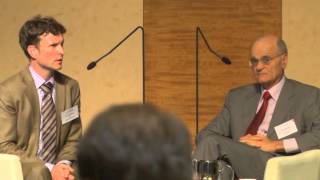
Andrew Benedek built Xenon by funding a profitable environmental lab that subsidized membrane research, avoiding venture capital entirely. He picked small land-development projects as his first market to sidestep entrenched competitors, then shifted to distributed wastewater systems and energy recovery. His core lesson: sometimes innovators must self-finance to bypass broken procurement processes.
Chapters
We will commence a fireside chat with Andrew Benedick and talk a little bit about the story of Xenon and also the the ever evolving story of Andrew's latest company, Energia. This is a part of the day that I've been looking forward to and somewhat nervous and excited about at the same time to have the opportunity to chat with with Andrew Benedick and explore the story, I suppose, of Andrew's history in the water sector and also the ever evolving story of the latest company that Andrew is leading and providing some vision for. Energia, I guess by way of introduction. Not that Andrew needs an introduction, but Andrew founded Xenon in 1980, brought what is perhaps some of the most disruptive technologies to the market of the past 20 years. Low pressure membrane filtration, membrane bioreactors. When I graduated in 1995, 96, MBRS were talked about in hushed tones as something that if you knew what one was, you somehow had an inside track. Ten years later they were mainstream and now they're a commodity product. I think that shows that the water industry can and does adapt new technologies if it's done right. Xenon was sold in 2006, so some of the other accolades worth highlighting are Andrew received the Stockholm Water institute prize in 2003 and of course the Lee Kuan Yew Prize here in Singapore in 2008. So perhaps we could begin. When we chatted a few weeks back, I asked you what was it that made you first think about doing something in water? And you mentioned that there was a vision behind it that I think maybe sustained you and the team through the journey.
The interesting question that I often ask myself how the hell did I ever get through the beginning? Because I see so many companies faltering and somehow we got through it. And when I look at what I had at the start, it was anything that you would expect to have to be successful. First of all, I was a Ph.D. mark one against me Mark two I was a professor. That's even worse, as my friend Sasha likes to say. And furthermore, I had no money other than a mortgage on my house house to start with, which is kind of a crazy thing to do. And I had no idea of business. I read a book on business. That was my beginning. What I did have is a desire to change the world, which has always been what fueled me, wanting to improve the world. And in particular I thought we could end water pollution if we could recycle water cheaper than to treat it, put it in a river and then treat it again. And to do this, I thought, membranes is the way to go. Now, you would think I'd be an expert on membranes at the start, but I wasn't. I just figured if nature can use membranes as elegantly as it does, that somehow I'll figure it out. Now, I have no idea how I had that courage, but maybe it was naivety, real naivety, not having all those things missing. I was truly, truly naive. I've never taken a business course, so given that naivety, perhaps I can understand. But what I did have is this belief that somehow, some way, we can make membranes that will, in fact, be cost effective for recycling water.
And I think that intelligent naivete probably allowed you to see past those thousand gatekeepers of the past that we heard about this morning. You weren't laid down with that. You mentioned. I asked about ip. You said there's lots of great things about intellectual property, but perhaps one of the best things for Zenon was to have competition.
Well, maybe, if you don't mind, I'll fill in the blanks just a little bit longer. So what? That vision, interestingly, was good enough to attract good people. And in the end, it's good people that get together with a passion and a vision. These kinds of people can move mountains. And what you got to have is an ability to learn from your mistakes, to get up whenever you fall and just stick to it. But you also have to have a way of financing yourself. And here is where I got lucky. Being as naive. And I'm telling this story because it may be helpful being as naive as I was at that time, I was driven, and still am, by technology. And I really wanted to have GC mass spec. Imagine you're starting to make membranes, you have no money, and you buy a GC mass spec, which was pretty expensive back then. It still is, but now, once I had the GCMS spec, I read in a book that you should make profit centers. So I said, okay, will make a laboratory. And this laboratory, thanks to the fact that I didn't run it, John Coburn did, who is now part of xpv, was very successful. It made a lot of money because no one had an environmental lab. So then I had, on the one hand, a business that really was a business, another one which I could sink money into to develop membranes and get through the decade of trials and tribulations.
Seems to be a core part of your philosophy is to have a product, sell it, generate revenue, and then use that to fund the R and D. Exactly.
So having analyzed what worked and what didn't, work. I truly believe that the only way to survive in this business is either you have a product that's saleable and in parallel you improve that product so you have a competitive advantage of significance, otherwise you can't build a good company, or you have investors. And when it comes to investors, the problem is that no investor would ever Finance A naive PhD who was an ex professor. And they shouldn't, because people like me do all kinds of stupid things, you know, for the sake of technology.
I think you'd almost say that you wouldn't have succeeded if you had to wait on VC funding to do what you were doing.
Well, I would have been fired within probably two or three years at the most had I succeeded getting VC funding.
Right. I don't know what we should take from that for the investors in the room, but perhaps a company that has a product and is already generating revenue, and that's also a model that UTS is employing.
Right. So in this new model, Enugea, I began looking for a company which has lots of experience, lots of references, decent products, but doesn't have an unfair competitive advantage. Because if it did, I couldn't buy it. Right. So I had to find a company that I could buy, could get going, get to know the market. And then in parallel, I started investing in what I call the unfair advantage.
I think, you know, the naivete is one side of it, but you also sort of a different way of thinking, an analytical way of thinking perhaps, that you brought to bear to developing your business.
Good point. You know, I. We were chatting yesterday, in fact, among some colleagues that I respect, about the disadvantage of being a PhD and a professor. It does have advantages too. So I can't deny that the problem is that you got to understand that technology alone is not where it's at. And if you refuse to do that, you're in trouble. And it took me 10 years to really get that. On the other side, if you're good enough to get a PhD and good enough to be a professor, perhaps you do have some exceptional brain power to work with. So in the end, that plus all the labor of getting a PhD and being a professor should teach you about technology. You should be able to understand that.
So there are positive sides to it as well as, as you could say, lacks on the business side of experience. Ten years, it was a journey that evolved. And do you think that that vision was what sustained the team and yourself through that period?
Totally wasn't money. We didn't overpay our staff, we couldn't Afford to. It wasn't even success because frankly, for the first 10 years, virtually everyone thought we were crazy. That's how these kinds of technologies are. Membrane, you're putting it into wastewater. Are you crazy? That was usually the response people gave.
Me is that where ultimately having some competition was a good thing. So you weren't a lone voice in the wilderness.
Well, you know what? It's very interesting. I truly believe that if you have, if you're a technology company, pure technology company, the challenge is competition. And most PhDs or technology people, I shouldn't knock PhDs. Technology people, when they start a business, they are seeing that they have a technological advantage. They usually don't translate that advantage into a competitive advantage. And even if they do, they don't understand that it takes very little for a competitor who has an established sales force to copy or improve even on that technology. So it's a very risky investment to focus purely on technology. That's why my model is different. Right.
And you also. Another part of your philosophy I think would be a finding a beachhead market to maybe launch into initially and then develop from there.
Right. So my apologies, I didn't quite finish one of the threads. What I meant to say, we really got lucky because we chose a market sector which first of all was out of the limelight. The sector was development land development projects which were small MBRs where the developer was an architect or a developer who didn't give a damn about what the technology. So I didn't have to convince consultants that we have a better mousetrap. Right? Yeah. But what we had to do is just make it work. So that was great and that avoided competition. But amazingly, even once we started promoting it, as I mentioned earlier, people thought I'm kind of crazy or we are. And so we didn't have a true competitor out of the US or Canada for the first 15 years, only out of Japan. Eventually the companies that were doing the little household things, the apartment blocks the night anyway, so they migrated toward a larger scale and they became ultimately our competitor. Kubota in particular.
Although maybe the technology is a thin premise that people will improve over time and catch up with you and get around patents and circumvent them. The first mover advantage did seem to be quite sustainable for quite a period of time.
Well, if you're doing something where the market is limited, the big boys don't care, so they leave you alone. Eventually, as you start going upscale, competitors come in. So the most dangerous competitor that entered the market was Memcor, which was Owned by then by us, Filter. So Memcor came in and they read our patents and they found that there was a hole in the patent. What they didn't know is that in parallel with that, we were correcting those holes, but fortunately for us, they actually came into the market. Because in the municipal business, you need a competitor and you need. In this case, this was the largest waste water company in America. They were basically endorsing the craziness of putting low pressure membranes into sewage. So the market increased significantly. Their product didn't work well. So what they've done is actually increased our business. Now, had I planned that, I couldn't have done it better. I was just lucky. Sometimes you got to be lucky. That's a big thing. We always have luck or we have bad luck, we have good luck, bad luck. And one needs to make the best of both or the best of each, right?
Yeah, yeah. And hopefully get just about 51% good luck.
Well, if you have only 50% good luck and 50% bad luck, but you minimize the bad luck and you get the hell out of every advantage that you can on the good luck, you're going to do well. Yeah.
And in terms of maybe also perhaps talking a little bit about Energia, you mentioned that when you received the Lee Kuan yew Prize in 2008, you said, what can I do for my audience? You know, what's next on the horizon? And I think there's a vision there too, and it'd be interesting to hear about that and how maybe the worlds are merging between waste and wastewater.
Yeah, actually, I focused on three areas. Interestingly enough, I see at least one of them here. I talked about one thing that I still don't see very much, which was distributed systems. I truly believe that we need to think about distributed water, wastewater in particular, wastewater systems. Because there's so much money in distribution, pumping around. And in a world where we want to reuse water and we have a technology that exists and can function without a lot of people. Membranes, MBRs. It should be commonplace to have distributed and not central systems and save a great deal of transmission costs. I'm yet to see that really catch on, although people talk about it. The second one was membranes, and in particular I talked about aquaporins. And today we heard a presentation, but that was 2008. We're now into 14, so six years ago, and they're about a year away from making anything commercial. So that's classic. Seven years.
Yeah. To get a product and probably perhaps another 10 to get it out there.
10 to get it to the point of having four or five references, 15 to the point where people specify it. Right.
And that would be one of your definitions for when is it commercialized? When somebody specifies it, yeah.
So you don't have to sell every single job the hard way. Create it, in fact. But back to your earlier question, the third area was a very simple analysis. I looked at sewage. I looked at the amount of energy in the organics thermodynamically, and I realized that we actually have all the energy you need in the feed to the wastewater plant. However, we normally put in much more energy than we get out of the feed. In fact, at that particular time, 85% of the digesters making gas in the US were flaring burning the gas and are using it. So it's almost shameful to waste resources. Then you start looking at the whole picture and you realize that especially this was 2008, so times got pretty difficult. Not much later, but you start to realize that the old model of building bigger and bigger centralized systems, we just cannot afford that even in the developed world. And we have to start thinking about cost effective ways of handling wastewater. So if you start doing that, you realize that the biggest cost in wastewater treatment is energy and sludge disposal. So hence I thought there's a real opportunity. When I looked at anaerobic digestion, this technology hasn't changed in decades. It basically wasn't designed to make energy, it was designed to get rid of sludge. So I thought one could improve on that and secondarily one could get more energy out and also avoid disposing of sludge into landfills. In other words, convert that to a usable product, fertilizer. So I set up Energia with this vision and went about systematically assembling the technologies, evolving the technologies, creating when we didn't have it, or buying it when I could, and created a global company in this space since 2008 and they've.
Launched a hybrid membrane product which is quite interesting.
Well, it's kind of a hobby, you know, I love membranes. I think it's an overcrowded market. But when I saw an opportunity to do something better than anyone has ever done, that's another mountain to climb. And I started climbing.
That's what sustains you through it, I'm sure. And do you see that the worlds of like waste are converging and the lines are being blurred between say, solid waste, organic waste and wastewater?
Well, once you start looking at a wastewater plant as a, as sometimes people are starting to call Them a waste recovery center as opposed to a waste treatment center, disposal center. You start to look at the energy and you know, you get some energy out of this and you can reduce, somebody said 2% earlier today. I think it's closer to 1% of nation's energy is used for treatment, but that's still a significant number. But you can do a lot more energy if you find a way to get organics, whether it's Greece, unfortunately, Greece is not a commodity that you should digest. I think you should make it into biodiesel or you can bring food waste which are a little more complicated but has plenty of energy. And if it goes in a landfill, all it's going to create is methane in the atmosphere. Even if you capture some of it, you still. I'm a believer, I admit it in climate change. I hate to put things that can degrade into a landfill. And I think we can cost effectively bring it as and mix it with sewage sludge, co digest and actually create energy in excess of what the sewage plant needs.
And I guess that's part of that vision which will sustain the energy team now through that journey. And you mentioned that hunger was an important ingredient as well. And I wonder if you have any advice for the young entrepreneurs out here who are commencing that 10 year journey.
At least that's an interesting, interesting question. When you look at someone like Olivia Lum. She was an orphan who immigrated to Singapore and I think surviving as an orphan gave her enormous drive. All of you who know Olivia know that she has enormous drive. Now I wasn't an orphan, but I wound up on my own at age 13 due to the Hungarian revolution. So I also had to learn to survive and I think that stood me in good stead at Zenon. When all those issues happened, I never looked at them as okay, now I'm done. I said, okay, I got to learn from this. What did I do wrong, how can I go forward and how can I do actually better than I did before? I always took every failure as an opportunity to improve. Now if you are growing up in a system that supports you and this I think is a danger in Singapore, Singapore companies are well supported here and you don't learn to survive. Sooner or later you're not going to.
As I said, a company that learns to generate cash or they don't. Well, Andrew, having I would say to do what you did and to bring a transformative technology to the industry, I think any lessons we can take from that are certainly very valuable. I think with that I'd like to maybe ask the audience to thank us for what has been a very insightful discussion. Thank you very much, Andrew. Thank you. I'll just check with our chair in case we have perhaps time for one or two questions from the audience.
Sir, you basically bring up a problem of our industry. Just think about it. Let's say you are building in a new area. There's going to be a consultant. The consultant is going to specify things that he knows, which normally means not something that's innovative, or if it is, it's been around for a while because he doesn't want to stick his neck out. And he may not even know what is innovative because that's not the field he's in. He's used to doing things the way they usually don't. Second, even if should the consultant be really keen to innovate, somebody's got to finance that. And there are all kinds of restrictions. Let's say it's a World bank project or an IFC project, you're going to have restrictions on what you can innovate and what you can't. So basically it's not going to happen in conventional delivery. That's the reason it's not happening. I tried at one point when I didn't get busy with energy, yet I tried to convince IFC to actually set up a fund and a program for doing this, and I was willing to even contribute to financing. Didn't happen and I lost interest. But what I think will have to happen is that should you have sufficient funds, you could drive the innovation. So as an example, we have a great deal of innovative technologies that we are installing in the US right now, where we don't want to argue with consultants, we don't want them to believe us because I think it's going to take too long. So we say to our client, please, you take zero risk. We finance it, we build it, and if it doesn't work, it's our problem. And then we hire the consultant, because you always need a consultant and we ask them to design what we want designed. All of a sudden we are the client for the project because we're financing it. So that's a good way to move quicker. Given my age, I like to go quicker.
I'm sure, at all stages. You did. Maybe one more from the back there, please.
Hi, I just want to hear the view about matching innovators with investors in the space of crowdfunding. I don't know much about crowdfunding. I know what it is, but that's about it. But my gut reaction is that that may not be suitable for millions of dollars or many millions of dollars. It may be suitable for smaller, easier to understand things if you're going to. Which is my domain, my space. If you're going to revolutionize or change the way things are done, you really need either a very intelligent investor or you have to have your own funds.
Hopefully some of your former colleagues in Zenon who have gone on to be investors are part of that population. Could I perhaps ask the audience for a warm round of applause to thank Andrew? It's been a pleasure speaking with you. Thank you, Andrew.










