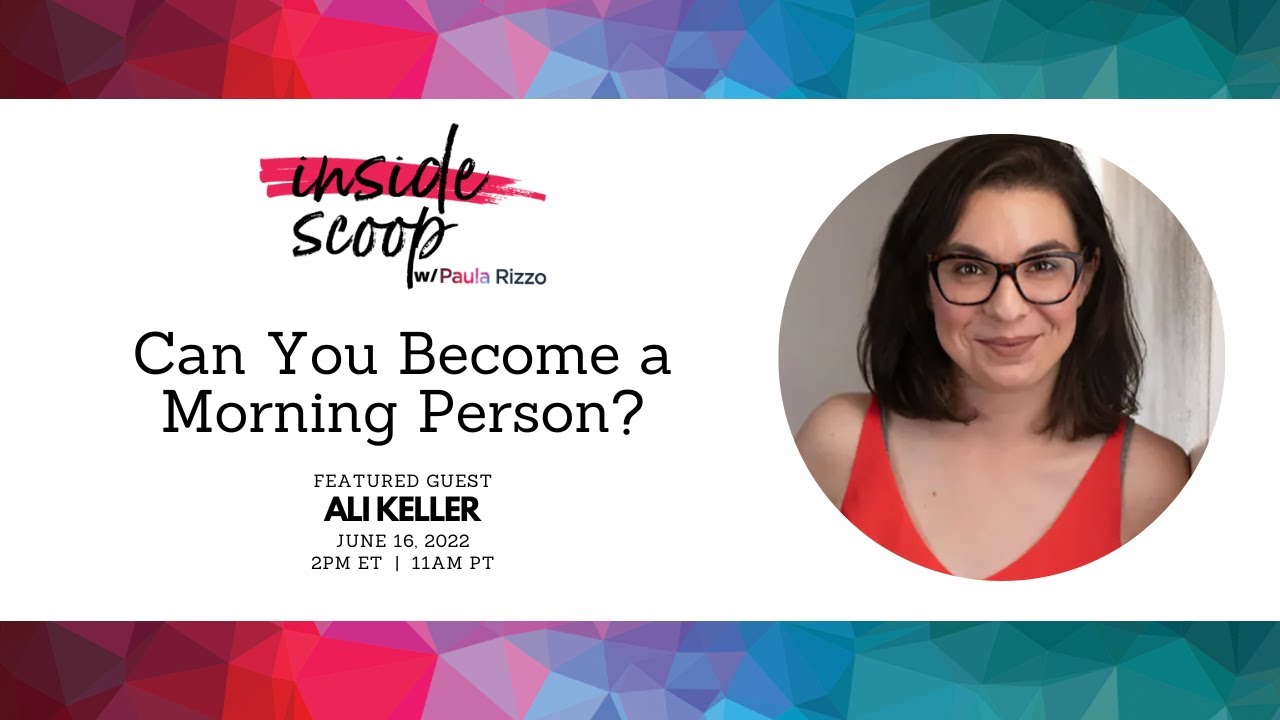
In this Inside Scoop episode, host Paula Rizzo interviews producer‑writer Ally Keller about the possibility of becoming a morning person and how early‑day habits can boost creative productivity. Ally shares her personal transformation from a late‑night worker to consistently waking at 4‑5 am, describing the training process, the benefits of uninterrupted focus, and the mental edge of working while sleepy. They discuss the downsides—need for earlier bedtime, social friction, and the risk of tying self‑worth to output—and how to mitigate them. Practical tactics are offered: incremental time shifts, setting up an automatic coffee maker, defining a clear purpose for the morning, and using list‑making to clarify priorities. The conversation also covers boundary setting and communication with colleagues who operate on different schedules, as well as strategies for maintaining energy throughout the day (breaks, afternoon exercise, task batching). Ally mentions current creative projects, notably a dark comedy theatre piece, “Kristin the Place,” illustrating how early mornings fuel substantive work. Throughout, Paula promotes her List‑Making Starter Kit and LinkedIn Learning courses on productivity and boundary management.
Chapters
Hey there everybody, I'm Paula Rizzo. Welcome to Inside Scoop. What if I told you that there was a way to write your novel this year, or like the guest I'm gonna have on today, write 3 films, 2 plays, a musical, and produce 3 more movies this year. It's a lot, right? Well, it sounds a little too good to be true, but the secret is by becoming a morning person. I know, I know. Don't groan. Record scratch, right? I'm not a morning person myself, so of course I'm skeptical of this. And I'm like, I don't know, not so sure. I'm pretty productive myself without being a morning person. But I assure you, there is a way to do this where you actually enjoy being a morning person. We'll see. We'll go through it together. And for those of you who are morning people, I know you're probably like high-fiving and so happy that someone is talking about this. But for the rest of us, we really want to know how can we maybe use the mornings to our advantage? I'm totally intrigued. So we're going to be talking all about that today with my great guest who I'll bring on in just a moment. But before we do that, I have a free gift for you that I know will help no matter if you're a morning person or a night person or whatever it is that you are, in-between person. Uh, it is my List Making Starter Kit.. And you can grab it at paularizzo.com/list so that you can be more productive any time of the day. I'm also a LinkedIn Learning instructor and I have several courses that I know will help to keep you on track. Some about list making. There's a QR code right there that you can click and get right over to that on LinkedIn Learning. Check that out. And there is also a course on how to set boundaries and protect your time. There's a QR code there for that as well. And this is what we're talking about. This is the most important part of this. How do you actually make the time to become a morning person because you have to schedule it out. You don't just, you know, magically wake up one day and you're like, oh, I'm totally a morning person now. I mean, I would imagine that's not how it works, but we're going to hear all about it in a second. So if you have somebody who you know could benefit from this, tag them below. I want to hear from you. Leave your questions, leave your comments. We want to hear about it all throughout the show. And if you're watching the replay, please do that too because we're going to continue to check the comments below. So tag your friends, let them know this is happening, and we're gonna have a great convo. So without further ado, I'm gonna bring on today's guest, who is Ally Keller. Ally is also the producer of this very show right now, so she's usually behind the scenes. So Ally, welcome! Thank you for coming from behind the camera.
Yeah, thank you so much for having me. It's a little weird to be on this end of it, but it's very fun. I'm very excited.
I know, and this all stemmed from, you know, Ali and I have been working together for almost a year, which is so exciting. And, uh, you know, we were talking about productivity and how we get things done, and you mentioned that you get up at like an unridiculous, ungodly hour to, to get things done. And I was like, wait, what is this now? And many people are intrigued by this fact about you, right?
Yes. Yeah, a lot of people are very surprised when they hear about it. Yeah.
So what is your routine?
Um, so I usually wake up around, um, 4, 4, between 4 and 6 in the morning. Um, usually it's between 4 and 4:30. Um, but if I have to be up a little bit later that night, uh, the night before, it'll be closer to 6. Um, but yeah, usually between 4 and 5 AM every day I get up, I have coffee, I start writing, um, and that's my day, kind of goes from there.
Wow. And I, I failed to mention because I got so excited, I just wanted to bring you on, but you are a writer and producer of many things, not just this show. Uh, you do lots and lots of things in the entertainment field, and so you are constantly creating, and you find, I'm guessing, that the mornings are a good time for that. But you weren't always a morning person, right?
No, I definitely, definitely was not a morning person. Um, I— it was— took a lot of training, uh, and a lot of, uh, work. Um, similar to like if you feel, um, jet lag after a trip and you kind of adjust to a new time zone, it's very much a long process of what that was for me. Um, but I basically— like, I used to be up much later until like 1 AM, 2 AM, and realized that that wasn't really when I was most productive. It was just kind of when I had time to do stuff. And then as I started paying more attention to when I actually functioned best or when I had the most energy, which was in the morning when I got good sleep, I decided to kind of train myself to, to put my productive time in the morning and then inch that back further and further after having a great time on set being like up really, really early. And I was like, oh, I function way better like this. When I can, um, to push myself to do that all the time.
I say, right, so, you know, I talk a lot about finding your own productivity style and how to make sure that you are doing things that you, uh, you know, are optimized for the time that you're, you're working, right, of something, which is very important, uh, to know yourself and to do that. But you have literally trained yourself to do that in the mornings now. I, I used to be a morning person. Not really a morning— I mean, you know, when I worked in TV, it was like you had to get up and go to your job and you had to be up early. And I have now become like allergic to hearing the alarm clock. I think I still have PTSD, you know, alarm clock PTSD, which I think is a term that I'm gonna coin right now. And so I'm very like allergic to the idea— even travel, which I love to do, I'm very allergic to doing it so early in the morning. Uh, but you have found many other benefits because I know you also do travel very early in the day. So what are some of the benefits for people like me who are like, but I don't want to? What are those benefits for you aside from productivity, really?
Um, I think one of the things, uh, that I love the most about it, um, like it— if you— I had to get up at 4:30 once by accident, which is how I discovered this in the first place. So if you do it once, you might fall in love with it too. But if not, I know it's very early, so that's okay. But one of the great benefits is nobody talks to you. You don't get an email about a sale at that time 'cause nobody assumes you're awake. You don't get text messages, you don't get phone calls. It is just you and your own thoughts, which is really, really rare since with social media and emails and working remotely and people can get to you all the time. So I happened to be up on set one day really early 'cause I had a writing deadline before the shoot and, and, just realized that it was, uh, like the one time on this particular set that I wasn't dealing with anybody else. I wasn't dealing with anybody's problems. I wasn't being interrupted. And I was like, oh my God, how can I hold on to this? Um, and then realized in, uh, doing it at home that the same was true with people's communication with me, which was great. Um, so that's something I really, really love. And also because like I'm a morning person. I love doing it now, but also—
well, you— now you— now you do. So this is interesting. But now you do.
Okay, I did it. Now I— now I definitely do. And part of that is because— and like, it takes me a lot of alarms to get up still. Like, it's pushing yourself to get out of bed. But because I get to start the day really slow, I get to start the day really sleepy, I am so non-judgmental about the creative work I'm doing in the morning because I don't have the energy to be critical of my own work. Whatever comes out comes out. It's going to have a ton of typos because 4 o'clock in the morning, it doesn't have to be good. Um, so I get to start the day with stuff that's exciting to me, and it puts me in a really good mood. So then when people start bringing me problems or tasks or other things throughout the day, I feel like I've already taken care of myself.
Ah. I love it. There's so many things there I want to pull apart a little bit. You know, one of the things is about, you know, being creative in the time when you're a little bit sleepy. We did a, uh, an episode of Inside Scoop with Suzanne Kingsbury, who, you know, is a, is a wonderful writing coach and who talks very much about how your brain is working differently when you're sleepy. And so you don't judge yourself, so it's a pretty nice time to do creative tasks, uh, you know. And, and also it seems like you're getting an endorphin hit early. It's like when people, you know, go and they exercise or whatever it is, and they get themselves motivated and going, and they need that— those endorphins to start going. For you, the endorphins are being creative, right? But somebody else, it might be going for a run or doing whatever. So what, what could you do in the morning to sort of, you know, uh, like preload your day? And, you know, I do have to say, I did do this a bit when I was working as a producer at Fox News for many, many years. You know, I didn't have to be in until 9, 9:30-ish or whatever it was, but I would still get up around 6 6:30, and I would do yoga, I would drink tea, I would read the newspaper. And it was the slow start for me that really was helpful, because otherwise I do not like jumping out of bed and starting like, you got to get up, take a shower, and go. I don't like that. That is very— I'm— I don't— I just— ah, it's not a good way to start. So maybe that is why I'm such like a lazy later person now, because I just don't want to do that. But you can do that early, you're saying? Uh, what about the negatives? Because I want to hear about that a little bit. Uh, we're all like, this is shiny and wonderful, and you know, let's be realistic here, Ally. What are some of the negatives?
Um, realistically, the negatives are, uh, in order to do this, you really do have to prioritize your sleep. Or if you're gonna get up at 4 o'clock in the morning, you got to go to bed pretty early. Um, so there are times where I have to say no to things that would have been fun if my priority has to be getting the work done tomorrow, the next morning, or knowing that when I'm out with friends for somebody's birthday, I will be a little tired by the end of the night if we're supposed to go to dinner because it's just later for me. It's not really a negative, but I definitely get called grandma a lot by my group of friends because I'm in bed early and they know I get up really early. That's what I have to do. So for me, the biggest negative is sometimes saying no to stuff because I prioritize sleep because I— it— you can't do this if you don't get the 8 hours, you don't take care of yourself in that way. Um, and the other time, I think the other negative is just— I think the downside of being productive and, and priding yourself a little bit on being productive is making sure that you're not tying your self-worth to your productivity. There are times in the morning where I I don't like what I'm writing very much, or I thought it's not feeling great, or that idea I thought I would have after a good night's sleep I didn't get, or I wasn't able to get my whole to-do list done the previous night, and so I'm a little bit not feeling amazing when I wake up. And I think to remind yourself when you're starting so early, in the same way where it can feel amazing to take care of yourself, if you don't get your stuff done, to not beat yourself up about it, because sometimes that's just gonna happen. Um, everybody has off days. So it is like, as much as it can propel you in a really positive way, it can also be tricky to be like, if you feel like you weren't as productive as you wanted to be, you can't let that ruin your day either, because sometimes that's gonna happen.
That is, that is a very good note, because it's like, I was supposed to be productive, I became a morning person to do this, and now I'm not doing it right, you know? I mean, we just were so hard on ourselves for so many things. You know, don't, don't, don't beat yourself up about not having a productive morning. It happens to all of us. And, you know, really being able to, to reframe, uh, you know, how we feel about, about ourselves and our own productivity and what that means. You know, for so long people have equated busyness with being productive, which is not, not the case at all. You know, that needs a little bit of a rebrand there. Uh, we have a bunch of people saying hello, so I just want to pop them up real quick just You know, we have some LinkedIn.
Hello.
Good. Good afternoon. Good afternoon. Hello from LinkedIn. Hi. Hi. Hi. Thank you all for joining. If you have questions, comments, things you want to know from Ali and about productivity and becoming a morning person, please leave them in the chat boxes below. I want some, some concrete ways to do this because it's one thing to say like, OK, you should be a morning person. And then it's another thing to actually set yourself up for success. So what did you do specifically to start this and how long ago did you start doing this?
Um, I started doing this— so when I woke up really early, um, on set, it was 2017, um, and I wasn't, uh, fully in control of my schedule then, so it was a little bit like sporadic. I could do it when I could. And then I was able to really shift, um, all of my projects, all of my jobs. I got into higher positions, so I was able to be in control of the scheduling of meetings and stuff a little bit more. Around 2019, and that's kind of when it became a regular part of my everyday. And then— and that took a lot of adjusting. This is definitely a recommendation to use it if you have it or buy one because they're not super expensive. But any coffee maker that can— you can set the night before to automatically brew is definitely something that gets me out of bed in the morning. And also it's like a nice little form of self-care where you're like, oh, my coffee's already made. And like, that's so nice. Then you start with like a nice little thing. And also it gets you out of bed because you realize you're going to waste a whole pot of coffee if it gets cold while you're sleeping, um, which is very nice. Um, and to also do it little by little. Like if you right now are waking up at 10 AM, it's going to be really hard to jump to 4 o'clock in the morning tomorrow. Um, it's gonna be really, really rough. You can do it, but you might be— you would have to be a stronger person than I was at the time. Um, but it does a little bit feel like getting ready for a time shift on a trip, where go to bed a half hour earlier, wake up a half hour earlier. See how you're changing your time zone.
You really are. Yeah.
Um, so it's just like, uh, a little bit of, uh, that stuff, which is more logistical. And also I think Getting really clear about what you're getting up for. It's something that I think I was doing a little bit naturally. And then when we started working together and I was reading Listful Living and Listful Thinking and writing out your priorities and what you really wanted your life to be and how it made me connect to it even more, which is to me, my time in the morning is my time and I love it and I get to do what I love during that point and I don't want to sacrifice anything for it. So I feel very connected to that, which is such a great reason to get out of bed every day. So whether it's this or like you want to get up to cook all your food for the week at this time or write your novel or do something else, exercise, whatever it is, like to really find the reason because that's going to get you up more than being like, I am like, I don't pride myself on getting up at 4:30. It's something I do and I love it. So I talk about it. But if it's like, you want to get out of bed to say you're a morning person, that's going to be a very uphill battle. But if you want to get up for something that you love, it'll get easier with time.
Yeah, I think it's important to have the priority in mind, right? Like, what is it that you're going to be doing? Because otherwise you really— there is no point, you know. I— and I do like to get up and have an easy early day, but my day is— it starts much later than you. I get up at like 8, you know, which is like late for a lot of people, but I don't do my first— my first meeting until 11:30. Purposefully. It's not that I'm like laying around doing nothing, it's that I'm doing other things, you know. I'm doing the things that I want to do for me. And so that's, that's how my day has sort of evolved. And you really can, you know, to your point, you can train yourself to do these things. Um, we have a bunch of other people saying hello, so I just want to give you some shoutouts there on, uh, on LinkedIn. Thank you so much for being here. If you have questions, leave us, leave us some, some questions in there. We'd love to Love to answer those up for you. And Ali, I want to ask you about working with non-morning people. Obviously, you and I do not work at the same times. So how have you been able to navigate that when you know that somebody else is not really on your time zone?
Yeah, I think that's a great question. That's something that it sounds like it would cause a lot of headaches, but I think it goes back to the basics of communication. Communicating with the people that you work with and to make sure that they know when we'll be working and they know when to expect to hear from you. I think it's why we end up working well together because I work a little bit later in the morning before your meetings start and I'll send you things and then I'll get notes later in the day and can keep knocking them out. And when I'm doing productions, it's something I'm very clear with my teams on, which is unless we're on set and the, it is happening during the week, You won't hear from me between 9:00 PM and 7:00 AM. And a lot of people are night people, so I know that's when they send their emails, but they usually don't wake up till later. So you'll get your answer by the time you wake up the next morning. I just won't email you at night. And what's funny is I thought people would be much stranger about it and much like, no, you need to be emailing me back when I email you, or this is not how I function. But what's funny is if they know, they're very comfortable and at a certain point you don't even— it gets easier for you to protect your own boundaries because people know. So a lot of times now with people I work with, they ask, they're like, oh, can you meet at 8:30? It might go a little long. We know you go to bed at 9. Is that going to be okay if it runs until 9:15? Or like, no, Allie can't do that, she's off at 9. And I don't even have to say no, I can't do that anymore. Um, but I think the better you communicate it to people, the easier it is, as long as they know what to expect from you.
Yeah, I think that is the key, right? Like, you know, we talk about boundaries, we talk about, you know, I have a whole course on, on LinkedIn here all about boundary settings. If you're watching on LinkedIn, uh, there's a whole course, uh, if you, if you go to linkedinlearning.com. Um, but we also, you know, talk a lot about, um, you know, boundaries and, and people being okay with it. Like, it is not as big a deal as people think, as you, as you make it to seem for yourself. Like, I can't do that, I'm not sure. It also depends on what level you are in your career, in your job in the office, you know, it— I get it, it like depends on who you are exactly, but try it just a little bit. Just try and see, you know, you might be surprised with what, what actually, you know, comes up. We have a question from LinkedIn that I want to bring up, uh, for you here, and it is from Jorge, who's asking, tips to keep your energy up until the last part of the day. Huh, what do you think, Ali?
Uh, that's Very, very good question. It's a very real question. I definitely get that energy dip right around 3:00. So the show's at a good time today because you're catching me sort of at the last part of my peak energy for the day. Um, but I would say this will also take a little bit of awareness practice when you're first starting to inch your day up, but it's like very strategically placed cups of coffee throughout the day so you're not over-energized, um, throughout it. And also Building in fun things that like keep you excited. So there's— I build a break into my day where I watch TV for half an hour. I exercise in the afternoon because that gives me a burst of energy for a certain point. And right after I exercise, I have a cup of coffee to keep me going. And knowing that like in the same way that people talk about like have a bedtime routine to like train yourself to go to sleep at the same time every night, I have like bursts of energy routines throughout the day where it's like, at this time I do this and this gets me excited and this is the next thing. And also doling out your tasks. So the things I'm doing at the second part of the day take less energy. So I'm never caught in this situation where I'm feeling like, oh, I'm working too slow. I'm, I don't feel like demoralized because I'm not getting something done. I am, I've kind of trained my schedule to be more like just emails, just responses, stuff that it's okay that I'm not trying to like mentally really figure out at that time. So I—
lower energy stuff. Yeah, and that is very important to be able to stack your day to meet your productivity, right? So, you know, this is something that I talk about in Listful Thinking and Listful Living actually more so, you know, um, to be able to talk about how how you work best and where, you know, where you should put things in your day. If you're just starting to do this, I like to think about it as a before lunch and after lunch, uh, you know, set of tasks. What are you— and notice yourself, that's the thing, you have to start to notice how you feel at those times of the day. Your, your body is actually geared to do more when you're hungry because it is like this primitive thing where in the old days, you'd have to go hunt to get your food. And so you actually get this like burst of, of productivity energy to like finish up what you're doing right before lunch. And, and I have found, and I try and use that time because then I get hangry like right then. So it's like, okay, I have something, I, I gotta get it done and I don't want to do it, but I'm going to do it right before I step out for lunch so that I know it's done. And that for me, doing that will really help. So you have to kind of like get to know yourself, get to see where you want to put, you know, your, your, your, your parts of your day and all of that. Um, we have another question here that I want to, I want to grab here. Um, or maybe it's a comment. Um, Kai is saying, uh, I have a co-worker that, uh, that swears by trying to get a morning workout before your day kicks off. How can you train your mind and body to build exercise into your routine? Well, you did talk about doing it in the afternoon in a time that works better for you. It doesn't have to be the morning, right?
Yeah, for me, the morning wasn't the best time to exercise because I, I don't know why, like, I get like a quick burst, but it wasn't enough to sustain me through the morning. And I started to feel like, just like I was really happy and then switching into work, like, it just wasn't the right flow for, for my brain. But I do think it works really well for people because the way that writing feels for me, which is like, this is my meat, this makes me feel good, this is what I want to do right now. I think people feel that way with that adrenaline jolt from exercise. My, my energy drops a little bit harder after that, in the way that, uh, Paula, you were just talking about with like eating food and then you get a little bit sleepy or something later. Yeah, that happens a little bit, which is why I'm like, exercise and then coffee to kind of fight that off. But when I was doing it in the morning, I was like, done for the day, like done for the day attitude after that. So I do think if it works for you, it's great, but I like to use it a little later in the day as like a mental break. My body can get up from the chair, I can do something else really quickly. And that's something I did. I work remotely now, so I can do it in my house, but I used to work around the corner from a SoulCycle. So I used to just take my lunch break, shower there and come back. Um, which I think works really well too. But again, it's— you don't have to be a morning person. Your morning is technically whenever you get up. Um, so finding that part of the day where the exercise can launch you in being more productive rather than making you too tired to keep going, right?
It's just sort of like, where in the day can you fit it in that actually works for you? And, and using these things that you do like to do as a reward. I mean, it is nice to be able to say like, oh, I'm really excited I get to do this thing, you know, or I get to meet with this person, or I get, you know, you mentioned watching TV for a half hour or an hour or whatever it is. Um, those things are important to build into your day so that you don't feel like, oh my gosh, all I'm doing is working, and I got up so early and I was working from the beginning of, of the day, and, you know, on and on and on. Um, well, talking about work, what are you working on now when you do get up at 4 AM in the morning? Uh, what are some of the projects that you have cooking up?
Um, so right now, uh, I'm writing a couple projects, which I'm, I'm very excited about. Uh, thankfully now that things are reopening again doing a lot more theater, um, and, uh, I have a reading of a show coming up, um, this weekend, which is internal just as like a developmental thing, um, but later in June, uh, I have a show coming to IRT at, uh, in New York City if anybody is around, um, it was— it's called Kristin the Place, it was commissioned by a Norwegian theater company, uh, at the end of last year, it'll be premiering in Norway in the fall and be in New York for 2 weeks It's about a group of 5 guys who come together for their friend's housewarming party, and their inability to build an IKEA wardrobe kind of sets one of them off. He has a little bit of a breakdown, and it's kind of these 5 friends realizing that they care very much about each other and don't necessarily have the emotional tools to support one another or themselves. And the commission is largely driven by the mental health crisis, uh, for young men in Norway. And also globally, young men have the highest suicide rates. Um, so we're really excited to be doing the piece. We hope it starts a great conversation, um, and hopefully it will help some people. Uh, it's a comedy, a dark comedy, but it is a comedy, so it's not total downer. Um, and you can use the QR code on the screen to go to the ticket link, and you can DM me at @alliekeller47 on Instagram Instagram, um, to get a discount to the show. Um, we're really excited about it.
Yeah, that is very exciting. I mean, and it's, it's waking up early for a very good cause, for a very good purpose. I mean, it, it's nice to be able to, to do all of the projects and things that you're working on anyway, but this is really— has a really great hook to it, which I know you are, are very, um, you know, in tuned with and very much want to, want to do special work with. So I applaud you.
Yeah, thank you.
All right, well, if you have other questions, everybody out there who wants to be a morning person, thinks they might want to, dabbles, if you try it out, let us know. Leave some of the comments in the, you know, comments below. Uh, Ali will, will continue to be here. You just might not see her on camera, but she'll be here. Yes, exactly. Uh, so thank you, Ali, for sharing, for sharing your intriguing part of yourself as being a morning person. I appreciate it.
Thank you so much for having me.
Yeah, of course. And, you know, for all of you watching, thanks for being here. I do have my list-making starter kit for you, which you can check out if you go to paularizzo.com/list, and you can learn all about how to get more done than you ever imagined morning, noon, or night if you check it out right there. Thanks so much for watching, and we will see you next time.










