Creating Engaging Virtual Presentations with Alexia Vernon
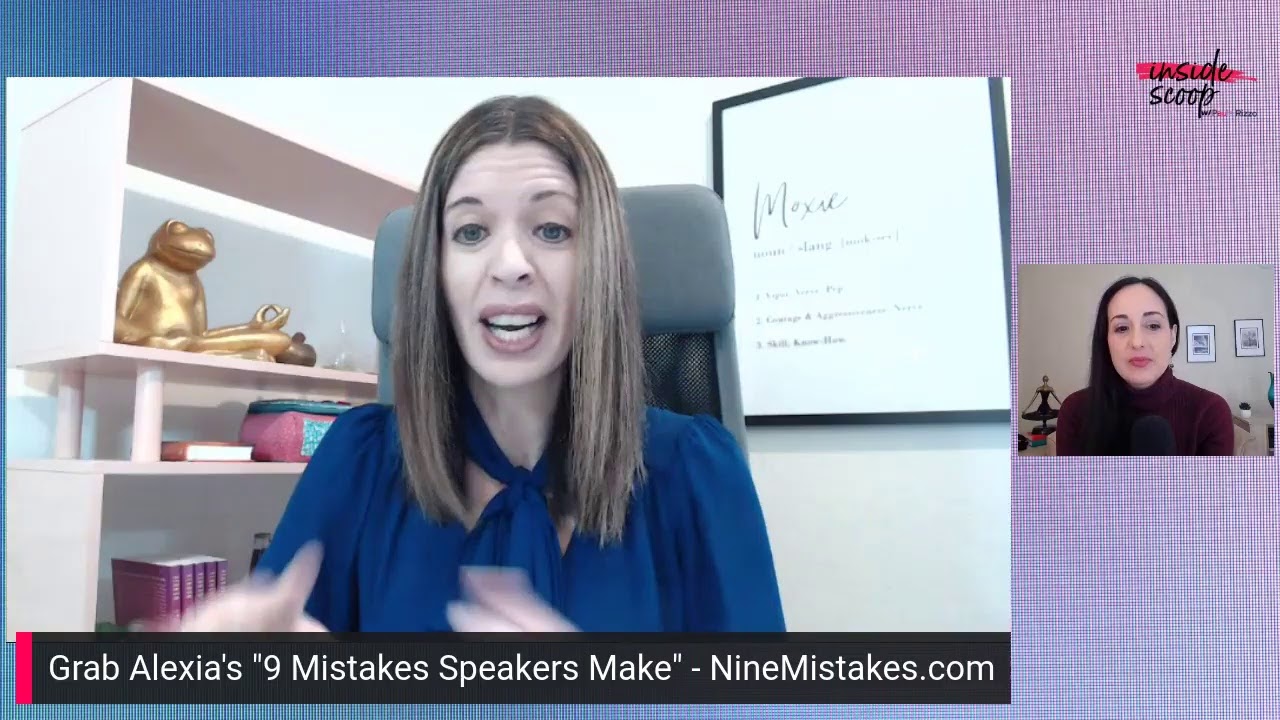
Alexia Vernon explains how to move beyond slide-heavy webinars to create real connection. Start with a clear intention for what the audience should take away, then reverse-engineer your talk around stories and interactive moments like polls and Q&A. Use slides to support, not lead.
Chapters
Hello, hello! Welcome to Inside Scoop. I'm Paula Rizzo. I'm thrilled that you're here. We're talking about a topic near and dear to my heart: speaking and how you can up your game with virtual presentations. It's not enough to just show up on that Zoom call as a speaker and start talking away. No, you need to be able to put a little bit more pizzazz into your presentation, and I have a guest today who's going to tell us how How to do it. She's an amazing coach, speaker coach, and I'm going to bring her on in just a moment. But I wanted to remind you that if this is a topic that you think that somebody that you know would be interested in, please tell them to join us right now. Tag a friend or share this with your network, someone who is interested in speaking or who is a speaker and who's looking to change how they do it, whether they're used to being in person or they just want to start doing this. Because a webinar is not always the answer. You're gonna find out about that in just a second, but I wanna also make sure that you know all about my freebie on, if you go to paularizzo.com/checklist, you will be able to get my go-to, how to become a go-to media expert. I have spent years and years as a television producer, and so I've booked lots and lots of experts. I help people to be better on camera, you know, to produce their own videos and all of that, but I have distilled some of my best tips into that checklist. So that's at paularizzo.com/checklist. I'm also a LinkedIn Learning instructor, and LinkedIn Learning is pretty great. If you haven't checked it out yet, you can learn how to do all kinds of things. And I actually have some courses on note-taking. I have a course on list-making. I also have a brand new course on boundaries. Imagine that, setting some boundaries for yourself. So if you go to paularizzo.com/linkedin, you'll be able to check out all of my LinkedIn courses. 'cause there are 4 of them, and you can check those out, and all of them are under 30 minutes, so you can watch them and learn so much, hopefully, as well as I listen to all the courses on double time. That's just a little trick that I use, so you can actually find out even more in half the time, which I absolutely really, really love. So it's time for you to meet my special guest. Her name— there she is. Her name is Alexia Vernon. Thank you so much for being here. You are someone who, uh, I met recently, but you're also a LinkedIn Learning instructor as well. So you have a course all about communication and, uh, I'm thrilled to have you here so we can talk about digital stuff. How can you be better on camera? So talk to me a little bit about why we should not always default to the webinar.
I am thrilled we're starting with this piece because I find that with so many of my clients and people I speak with. Immediately when I start talking about virtual presentations, there's an assumption, oh, I get to hide behind a slide deck and not have to have any human communication. And that couldn't be further from the truth. People right now are hungry to have true genuine connection with speakers, with leaders, with business professionals. And when we craft a webinar, by which I mean we are primarily looking at creating a slide deck that moves our presentation forward. And even if we're on video in the corner, fundamentally we're not having that deep connection with our audience. We're not giving a transformational presentation. In the back of our heads, we're thinking about how do I move people to make a purchase typically by the end.
Right.
And so it's not to say that there aren't similarities, but what I recommend instead is creating the same kind of transformational presentation you might do if you were speaking in person. And this is not only for motivational speakers, this is for business professionals as well who are seeking to have connection with their audience. And to— I'm sure we're going to dive more into this, but really privilege being able to speak with the audience you have rather than speaking at them, where you're giving them a system and a million different points And instead, really helping to meet them where they are and then giving them a pathway, but also inspiration for how to be able to take action afterward.
I love that. It is very much difficult, though, for people who haven't done it before. So, a lot of times people feel like, oh, I'm talking to no one. I'm not sure if anyone's listening. I'm not sure if there's— are you in there? That's why we ask people to leave comments and to make sure. So Chris is here. I'm going to give a little shout out to Chris Russo, who's watching on LinkedIn. He says, I agree. I've been saying been saying this for many, many months. No more webinars and hiding behind the slide deck. It's true, people want to connect with you, not with the pictures. It's very different than when you're in person. You can sort of have that in the background, but now we're this big to people, you know. It's this tiny little area here. So talk to us a little bit about, about that, how to prepare these, because it's not enough to just show up and expect that, oh, you're going to be great. Prep goes into this. So how do you outline it so that it's very compelling?
Yes. So the same thing that makes a webinar successful, having a strategy and the right preparation also applies, uh, for doing a successful virtual presentation. So you're not off the hook just by saying, I'm not going to do a webinar. I recommend that you begin with the end in mind, by which I mean, how are you seeking to call people to take action at the end of your presentation? Now, This does not mean what do they need to buy. That is one form of taking action. But I'm actually meaning what do you want them to be able to do differently as a result of the information you shared?
Got it.
If you're able to identify by the end of my presentation, my hope is that people will develop this new habit. They will have the foundation of a new skill set. Maybe they've just had an aha moment that can now start a chain reaction of positive results they take. From that point, then you wanna reverse engineer what are the things that you wanna say? What are the stories that you wanna tell? What's the evidence you wanna provide? What are the questions you're going to ask to be able to move them to that final destination? Now with a transformational presentation, the advantage is that you don't only have to wait until the end for traditional Q&A. If you're doing it right, people feel like you are speaking directly with them throughout.
Ah, so do you, do you tell people to take questions in the middle?
So I recommend that you think about different ways to be able to engage people. So that's that audience engagement piece. One way is that you might have a few different places where you take Q&A, so you can extend an invitation and say, please use the chat, and if it's something that I can integrate right now, I will. I love to go one step further and recommend to people who are speaking that they actually take people on video at various points and do what I would call a mini hot seat.
And here's why.
If your goal is for people to recognize that you can specifically help them, and let's say that you are a coach, a consultant, a business leader where you don't have a product or a service that you're not attached to. But like people are actually getting support from you. Well, gosh, if they experience that support in real time, or they don't have to be the person in the hot seat, they witness who you are as a coach consultant giving advice. Yeah. That's going to be really compelling. So that's another thing that you can do is maybe at the middle point, take one person when you're illustrating a principle. And then at the end, perhaps you have a couple more.
Oh, this works. This works. I've seen it work. I've done it. I've done it quite a lot in multiple presentations. I've done it both. When I'm in person. And it's so funny, Alexia and I were both speaking at the Alt Summit last year, and I am the last live speaker she ever saw perform in 2020. Can you imagine?
Wouldn't it be funny if you were the first person I saw live in 2021?
Oh my gosh, I love it. We'll make it a goal. So, but, but it's true to be able to show people the secret sauce of what you do. The presentation I was giving was for media and how to make sure that you are a go-to media expert. And I bring people up and I hear their pitches and I basically workshop it with them. It's the same thing when I do media training speech, talks. I bring someone on and I do some media training with them right there live. So people get to see how I work with people and how I, my whole thing, right? How I work, how I come up with ideas, all of that. So it's sort of the secret sauce there of really showing it. Without saying, "Oh, by the way, this is what I do for a living." So it's a nice way to kind of bring people that information. You said something a bit ago about intention, really setting the intention for your talk way ahead. So that's the first thing. What do you want people to get out of your talk? What is the transformation? I think that's so important and people don't think about it. They just think, "Oh, I want to just tell people a whole bunch of things that I know." So how do we get people to first figure out the intention and then put it together in the way that, that you had said.
I'm going to use today as an example. So before I showed up for this interview, I thought about what do I want someone to be able to do differently by the end of this conversation? And, you know, 15 things could potentially come up there, but I always recommend you hone in on one. And what is the foundational principle people need to understand, because if they want more, they're going to connect with you for more. And when you give people one thing and you go a little bit more deeply into that one thing, it's much more likely they're actually going to be able to take action and see the results. So my answer to that question was, I want people really to understand how to be able to show up to a virtual presentation and speak to the conversation in the heads and in the hearts of the people who are there to be able to connect with them. So I know in the back of my head, then I have to give 3 or 4 different examples throughout. I need to speak to the resistance people might be having to actually doing that. And I need to make it feel simple because when something feels simple, it's doable. And then we make the change and we move through the discomfort because I recognize there's probably people here who've been doing a lot of the presentations with a lot of slides where they pop on and do some questions at the end, but Essentially their audiences, whether it's a very small audience or a large audience, doesn't actually feel like they connected at any point throughout.
Right.
So we talk about some of those things, one of them being asking questions at various points. Now, whether you answer that question or whether you recommend somebody reflect on that question, when people have a moment to pause and think about the information, It can help with keeping them front and center and not being distracted in all the ways that, of course, we can be distracted. But it also makes sure that they're taking account of their learning. So to model this principle, I would say for anybody who's watching right now who knows that they have an upcoming presentation, I'd love for you to pause and to think about what is the number one thing you want people to be able to do differently at the end of that presentation and write that down for yourself.
Yeah.
And then a follow-up question, I'm only going to give you one for right now so we can keep moving along, would be for people to be able to make that change, what's the most important thing for them to experience from you during that presentation? Now notice I didn't say learn from you. What do they need to experience from you? And if you're anything like me, it may be that You're not perfect. That what you're teaching is not something that came naturally. And so maybe you show an example from your own life of where you struggled, but how you rectified that and what you learned and how you're moving forward.
I love that. So twofold, right? First is the intention of what do you want them to take away from this is number one. And then your second point is to, to really think through what is the thing that they can do, right? How can they take something away from this? That's, you know, a very simplified way of making a huge transformation in people's lives because this is big stuff that we're talking about. A lot of the time, people are learning to be more productive or learning to be better speakers or whatever it is that you're teaching them. But thinking through, I love this, the audience is first. It's the same thing with media pitches. When I teach people how to pitch media, think about the audience that you're talking to. How can you best serve them? This is the same thing with speaking. What do they need? What is it that you would be able to give them? Maybe your stories that you tell or whatever are different depending on what the audience is. Don't just tell the same stories because you know that's a good story that makes you look good. It might not actually help. It might not be, you know, something that, that, that person needs to hear to make their transformation. It is about them. It is not about you. I'm sorry to tell you all.
I'm really glad you brought up stories because stories, I don't think anybody would contradict that stories make for a really powerful speaker irrespective of what your subject is. But I find that when people are speaking on camera, particularly if they can't see their audience, we oftentimes don't tell stories because we're not getting that feedback. And that's what moves us into a professorial role where we're over-educating and under-transforming.
Yes.
Even if you don't have an audience to play off of, there's some things you can do with your stories when you're speaking virtually to make them more effective. So you've probably noticed by now, I love saying begin with the end in mind. It's the same thing for each piece that you're gonna bring into a presentation. So if you have a story, rather than saying, this is a great story because it shows how a client overcame an objection, instead begin with what's the aha moment you're hoping to you're hoping to prompt at the end of that story. Because let's say that the, the discovery moment you want for your audience is that if they are able to set aside 5 minutes at the end of every week to plan the next week, then they're gonna be able to get a lot more done. Notice I haven't said anything about story yet. I know what the principle is I wanna show in the story. Then it's gonna be so much easier to select a story that shows that. But at the end of that story, ask a question because that's what turns it back over to an audience. So if that were my expertise and let's say I shared a story that illustrated that, I'm not going to want to say at the end of my story, now go out and take 5 minutes a week because that doesn't really create transformation. I'm going to turn that into a question. Imagine what it would be like for you if at the end of every week you had a bit of time to be able to think through what next week is going to look like? How might that shift what Monday mornings feel like for you?
And that's very, very specific. So that I love too, because it's, it's not enough to just say, oh, how could you feel better? How would you be happier? How would, like you said, on Monday mornings, how, what will change for you on Monday? So you want to bring people to that place so they can see themselves there. I think that's so important. And the idea of engagement, right? So you, you'd been talking about, um, uh, you know, the, the idea of asking a question, making this a conversation. I think that's a very smart way to do it. Uh, you know, oftentimes I'll have people answer questions, you know, put a "Y" in the chat box if you agree with us, or, you know, those kind of things to get people— make sure you're still there. Like, are they hearing you? Is this happening? Are we engaged? Uh, are there other things that make it easier for other people too?
So let's say you're on Zoom, because that's a platform where a lot of people are doing their presentations. And there's so many fun emojis now to be able to say, give me a smiley face, or give me a praise if you agree. We think that that's— that can be selfish and gimmicky, but it actually helps people if they know they're going to be asked to connect periodically, to not time travel and go somewhere else.
Aha, right. You want to keep them— keep them with you, keep them where— together here. I want to talk a little bit more about, um, there's a couple questions here, I want to pop them in, about talking to each person like like they're the only ones, being able to hone in and talk to people. It's something that as a media trainer, I get asked quite a lot about keeping your energy up, or if you can't see the other people, how do you perform in the best way? What do you, what do you think of all this?
It's a great question, Megan. And I recommend always thinking about literally what's the conversation likely going on for somebody who's listening right now. So I'm going to demonstrate with you, Megan. So that question, how do you make them feel that way? Now, Megan, you may be thinking to yourself, I want people to feel like I'm speaking to them, but I don't know what they're thinking in any given minute. So what do I do? And I know that tension really well, because even though I speak virtually a lot, it's a lot easier to be able to read an audience and be able to make those moment-to-moment shifts when I'm in the room. So here's what I do instead. I literally call out, Now you may be thinking to yourself X, Y, or Z, or if you are more experienced and you've been doing this for a while, you may be thinking about all the times that it didn't work and how to fix it. Here's what I want for you, no matter which camp you're in. Imagine for yourself what your ideal client is likely thinking. So there's lots of different people, but think about who's that person you most want to connect with and speak to him or her. Now I'm going to come out of this example for a moment to just talk about it. To speak to each person, it means that we're calling out what they're likely thinking. And some of that is the good thinking, but a lot of that is the fear. So I do a lot of speaking about speaking. And I will often say to people, you may be doubting whether speaking is something you want as a core engine for your business, because even if you've been doing it for a while, you still feel like there's a colony of butterflies flies that are flapping their wings inside of your body every time you open your mouth to speak? Hands up. And I know that because I still feel a lot of that sensation. Here's the good news. It's not that we're striving for it to go away. We're striving to have a different relationship with it. So instead of seeing it as something that's going to impede our ability to get our energy and our message across, it becomes something that we frame as Ooh, that's an indication that I'm in the game. So I'm going to come out of this example for a moment. I am always thinking to myself and using it to guide how I speak in my more formal presentations, but even something more casual like this interview. What's going on here, but also here? What are people feeling? And rather than just talking through that with expertise, how do I address it? And I find that even when we don't know literally what somebody is thinking, we usually get it more right than wrong. When we do that.
Yeah, yeah, it's, it's, it's noticing and being mindful of this and, and all of that. I want to bring attention to, to your technique, uh, and call this out a bit for people who might not notice it right away, but I notice it right away. Obviously, you're a very seasoned speaker. The pacing of the way that Alexia speaks is very pleasant to listen to, and you're drawn into when she's talking to us. This is very meta. I'm, I'm talking about how the speaker is speaking, uh, but do you notice how pauses. I always try to get people to do this when they're giving great information or things that they know have to, have to sink in for the person to actually comprehend and get. You want to— don't be afraid of pausing. Don't be afraid of silence because it's so powerful. I call it, you know, the power of the pause. Give it a second and then continue talking. So often people will just tell you everything they know and run through it as fast as they possibly can. But this is a technique that obviously you have trained for, for a long time to be able to do, you know. Is that something that you teach people to, to be able to do as well?
Yes, indeed. Whether you are speaking virtually, uh, or whether you're speaking in person, the more you are prone to feeling a lot of sensation in your body, the more important it is to train yourself to pause. And I imagine when I'm speaking, putting a period at the ends of the sentences that I'm speaking to remind myself to breathe, because I am not somebody who naturally has a slow rate of delivery, nor am I somebody who naturally comes to public speaking with a lot of confidence. It's taken a lot of work, uh, and a lot of practice to be able to have a much more healthy, productive relationship with speaking. But when we talk about engaging people online, vocal variety is particularly important because we don't want to be up here and too big all the time, nor do we want to be too quiet. We want to have levels.
Sure.
But what happens when we periodically pause and smile? It reminds us to connect back with our audience. It gives us a moment to ask, hmm, based on what I've said, what are they likely thinking? And of course, one of the other benefits is we weed out filler language. When we slow down our delivery, we're much more likely to be able to weed out the ums, the likes, the so's, you knows, because those happen when our brains and our mouths are out of alignment.
Totally. And you just need to slow it down so you don't fill every second with words. It doesn't have to be. It's actually much more powerful if you don't do that. And if you watch very seasoned speakers, their pacing is pretty slow for the most part, depending on, you know, maybe it's faster if they're talking about something really exciting or their story warrants it, but for the most part, it, it makes you seem as if you're in much more control of what you're saying and purposeful in the words that you use. Uh, Megan really enjoyed your answer, so she says, I like that, it's a different relationship. And she also says, uh, I like you may be feeling or thinking this and not shying away from the fears that viewers have Reading our subject, engaging with the viewer. Yes, it's all about engagement. Uh, one of the engaging things— thank you all for power— power of the pause, Robin says. Hello, Robin. Uh, it is the power of the pause. You gotta let that sink in. Uh, Megan says shutting up is hard. It's so true. It's so much more fun to just fill the sound— just fill the room with the sound of your voice incessantly. Uh, and There's one here from Chris who is talking about distractions when we're presenting. Okay, so as a— to get very meta on this, I am clicking all the buttons at all of the times right now, right? So when Alexia is speaking, I'm the one putting the little, the little font on the bottom. It's a lot to be speaking, to be hosting a show, to be, you know, presenting, and also looking at the comments. And being mindful that there are people talking to us right now. It takes practice, a lot of practice. And what I would say, and I want to hear Alexia, what you think as well, is don't overdo it. Don't try to do all of it at the same time. Uh, you know, you'll see now what I'm gonna do is I'm gonna put Alexia in the big box and I'm gonna make her the big one. Do you see? Now I'm looking at the comments while I'm doing this, while she's going to be speaking about it, which I'll let you do in a second. Now the camera's on you. Uh, now that gives me a second to be looking at all of the comments. So what do you think about, about this? Because there's a lot of things that go on for a virtual presentation.
I am somebody who is really easily distracted by technology, and if it's a virtual presentation that's particularly high stakes, I will usually have a team member in the background who's helping me so that I don't distract myself from what I'm really here to do, which is connect with my audience. However, there are lots of times where, for whatever reason, I I still need to be able to read my own chat. I draw attention to the fact that I'm going to pause and read the chat because I'd rather be transparent about what I'm doing than try to mask it and look awkward. So if I were here by myself, I would say, keep the responses coming, I'm going to check in for a moment and see what's coming up, so that then when you see me turn my head, you know why. And then I'm going to say, keep them coming, I want to start addressing some of the themes I'm Right. And that way I don't make it a big deal. But at the same time, it's also telegraphing, um, for myself. Like, I'm reminding myself, this is what I'm doing right now. Right now I'm choosing to get back into the content. If I need to share my screen for a reason, I'll say, bear with me for a moment as I share my screen. The content's good, so don't go anywhere. Sometimes I'll throw in a little joke to keep people engaged, but, um, yeah. Yeah, it can be a lot, but I always remind myself what matters most. This, am I first and foremost, um, 100% connected with my audience? Because if I am, they're not going to go anywhere.
Yeah. You want to keep them connected and excited and engaged. And to that point, I'm going to take down Chris's question and there is another question that I'm going to go to. So, you know, because I am breaking my my eye gaze. And that's very important, is to have, to have this ongoing conversation with you, to see that I see you, you see me. I'm looking directly in that camera because I know it looks better, but now I'm going to break that so we can talk about what Elena has to say, which is— Elena is here. She says, I love the concept of figuring out how, what you want them to experience first and then finding the appropriate story for that. It is a very good way of thinking about it. So I'm glad that you brought that up, Alexia, because stories can be overused and underused.
And sometimes the wrong story is used for a particular audience. And I'll give an example of this. One of the principles I talk a lot about in my signature speeches is the on-again, off-again relationship a lot of us have with our voice and how to be able to claim our voice and get out of story when we have one of those mishaps. Now, there's a lot of different stories I can tell that all lead me to being able to demonstrate that same principle. One of them is about being in grade school and getting headgear and giving a speech where people laughed at me. Another example is speaking up in a staff meeting early in my career and having my voice quaver. Another is postpartum depression at the peak of my business success, and more recently, having thyroid cancer. Cancer. Those are all very different stories. And so I begin with what is the takeaway that I want for my audience? But then the next step is taking a step back and asking, who is this audience? Yeah, I'm delivering a women's leadership keynote and I'm on stage for 45 minutes. I'll probably go postpartum depression. If I'm speaking to a CEO forum, I may not choose that option. Instead, I'm going to choose a more business example.
Sure. Yeah, it's really important to choose wisely, choose those stories very, very wisely. Um, and you know, we have Alexei for a few more minutes, so if you have any other questions, please leave them in the chat and we'll be able to, to check those out. But I want to ask about slides because I was just watching a presentation where the speaker, you know, she was teaching about this and teaching about how best to use slides in your presentation, and she said something really interesting about how, you know, you should be leading the slides, the slides shouldn't be leading you. And so often you see the opposite of that. So how do you train people to, to do that? What, what is the best practice for, for slides?
I resist asking the question slides or no slides because the truth is that the answer for most of us is usually somewhere in between those two poles. That even if you're using slides, how do you use them? I love the— whoever it is that you referenced, I agree completely— how are they supporting what you're saying? And usually they're supporting by not being used the entire presentation. So I will often start on camera. I'll mention there will be times where I'll be sharing slides when there's relevant information I want you to see, but I'll also be coming back 100% on camera. So if I'm telling a story that might be a couple minutes, I'm never having slides up there. Oh, because I want you to connect with me, and then I'll quickly, uh, zoom right back in if I want to share another principle. If I'm doing hot seats Sometimes I do interactive training where I might be taking a few people on camera and we're actually doing an exercise together. During any of that, I'm 100% here. And then in terms of using my slides, I'm striving not to have people reading lots of things. I love to use an image and have a line on it that makes people giggle for a moment. Sure. Or I might share a recent news article, and we're not reading the news article, but I'm simply referencing it, and then I'm talking about it. Occasionally, if there's a 3-step process, like when I'm teaching how to tell stories to move people to take action, there's 3 steps. I have a pretty image that shows step 1, step 2, step 3, and how to be able to do that. But the key again is always asking, what's going to support me both connecting with my audience and moving them to take action? And for me to put something on a slide and for me to decide I'm going to share something, I have to be able to answer both of the those questions, it does. Because if in any way it doesn't, then I need to, to do something a little bit differently.
Yeah, I love, I love the idea of, you know, having it sort of in your mind that if, as a programming note, if this is something that I'm going to be talking one-on-one with someone or demonstrating with them, I'm going full screen. I'm getting out of my slides so that I can connect with that person. Uh, you know, or if you're telling a story in the beginning or in the middle, Go full screen. Do not be showing your slides because you want that connection to happen. I was just talking to a CEO yesterday who I'm media training. I was watching one of the meetings that he was leading, and the whole first part, his intro, was in a, like a slide deck, and there was nothing on the slide. It just said, I don't know what it was, like meeting or, you know, whatever it was. And, and I was like, oh, but I didn't get to connect with you because you were this tiny little teeny thing in the corner. And I so wish that you would have just been full screen. So I love that you're saying that because it reminds me me too, to also do it and practice what I preach. But in, even if it's in the middle of the presentation, like giving the, the permission to say you can get out of the slides at any time. You don't have to always be in your slides, you know. Leslie is saying, always appreciate your insights, Alexia. So she's a, she's a fan, obviously, uh, which is wonderful.
And brilliant keynote speaker in her own right.
Ah, terrific, terrific. Well, I want to hear a little bit more. I mentioned at the beginning, uh, you know, before we wrap, about your LinkedIn Learning course because you also have a course on LinkedIn and all about communication. So tell us a little bit about that.
Thank you. So I love LinkedIn for as many reasons that Paula does, because it is a phenomenal place for, early to seasoned career professionals to be able to come to get educated, but also to get educated on the very specific topics where they need support. Communicating to Drive People to Take Action is titled, exactly for what the course promises. It's helping people be able to look at all of the verbal communication they need to have, whether it's a high-stakes conversation, a negotiation, giving feedback, or sculpting a presentation, and giving you lots of specific instruction for how to be able to do that to make sure that you're persuasive, but at the same time you don't come across as salesy. It really feels like you're coming across as heart-centered but without losing that high impact. Oh, I love that.
That's so great. Yeah, you can check that out on LinkedIn Learning. Uh, both of our courses are on there, and there's so much I'm constantly learning myself. I feel like I just, I love it. There's anything you want to learn, you can, you can learn on LinkedIn.
One of the benefits of being an instructor is you get to take all the courses you want.
I know, I know. It's actually the, the, the, the keynote thing I was just telling you about was on LinkedIn. I just remembered it was the thing I was watching was on LinkedIn Learning. So this has been fabulous. Thank you for, for joining me. If you go to 9 Mistakes you'll be able to get Alexia's 9 Mistakes That Speakers Make, which you definitely want to grab so that you can avoid those mistakes for sure. We'll continue the conversation in the comments. Even if you're watching the replay, please leave your questions below. We will be watching. We will make sure that we answer your questions and get all of that good information out to you. Please share this with your friends. Tag someone who you think would be into it. Alexia, thank you so much for being here.
Thank you very much.
Of course. And I will see you all soon. If you want to check out my checklist for becoming a go-to media expert, go to paularizzo.com/checklist, and I will see you soon.










