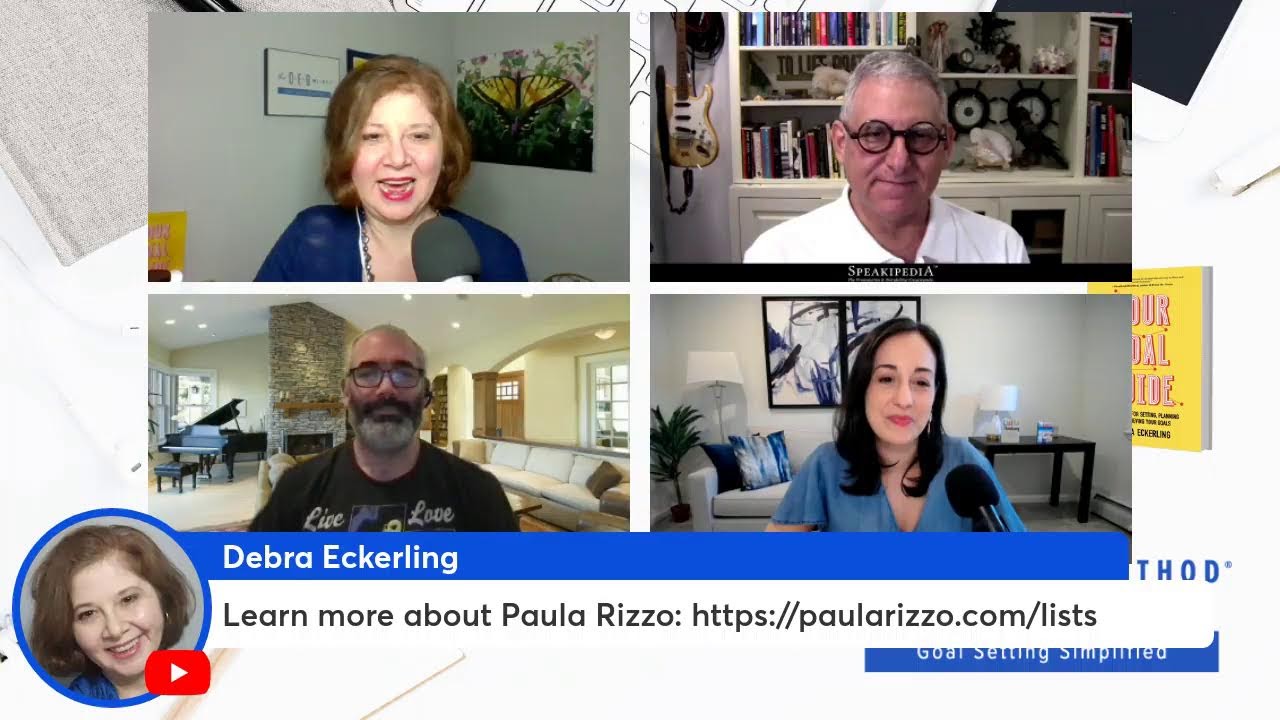
Paula Rizzo, Dave Bricker, and Mike Roderick break down pitching frameworks. Rizzo uses Hook, Twist, Takeaway for media pitches. Bricker's CAST CALL system centers the listener's needs. Roderick's AIM model emphasizes unconventional outreach like phone calls and video notes over email.
Chapters
Welcome everyone, thank you so much for joining me today. I'm Deborah Eckerling, author of Your Goal Guide and creator of the DEV Method for goal setting simplified. You can't reach your goals on your own, you need your people. So every week I bring together 3 of my people to have a fun, engaging, and informative conversation. Uh, today we're talking about pitching, which is— I think it's one of those things that If you're in business, if you're a consultant, if you're an author, if you're an anybody, something that you need to know how to do because people don't know how you can help them, what is the point? Okay. That sounded really, really direct. And I— unless people— whenever I bring together my guests, unless it's on purpose, they don't know each other. Today they don't know each other, but they all have Robbie Samuels in common. So big shout out and thanks to Robbie for connecting and in the case of Paula Rizzo, reconnecting us 'cause Paula and I were angle authors together and did some events and boy does the virtual time fly. It's been ages. And then we've got Dave Bricker and Mike Roderick also offering their important insights into this conversation, this thing that we love and maybe not so much. Hitching. Uh, thank you if you're tuning into this live as Goal Chat Live or watching the replay. You may be listening to us as the Goal Chat Podcast on the Marketing Podcast Network. No matter how you found us, we're glad you're here and choosing these all-important pitching goals. Before we jump in, I would love for you all to take a moment to just introduce yourself and say, you know, why you're here and what it is about the topic of pitching that you're so excited to talk about. Dave, let's start with you.
Well, most of the people I work with have what I call the smart person's curse. They have brilliant ideas until they try to explain them to somebody else. So I'm Dave Bricker. I am the business storytelling expert. If you want to say it, share it, or sell it, bring me your story and I'll help you tell it. As for pitching, I know that Sales in general is, oh, that's the S word, right? It makes a lot of people uncomfortable. And yet we're all selling every day. Anybody who's asked for a job or a date is selling. Anyone who's put a child to bed or coaxed a dog into a bathtub is selling. So it's something we all need to get good at.
I love how visual and also how different those examples are wonderful to have you, and I'm really excited to have your more than two cents on the topic. So thanks, Dave. Hi, Paula.
Hello, good to see you again. Thank you for having me. I am Paula Rizzo. I'm an Emmy Award-winning television producer. I have two books about productivity, Listful Thinking and Listful Living. So I really, really, really love lists. Uh, lists are the way that I have been able to not only have a career as a television producer for years and keep things going where I was getting pitched a lot, uh, and then I would have to pitch those stories up the food chain to be able to get it on TV. Um, but now I, I own my own business, so I'm a, you know, an author, a media trainer, a LinkedIn Learning instructor. So I'm doing a lot, but I also then as a business owner have to pitch, have to, you know, pitch for media, I have to pitch for business, have to pitch. So it really never, never stops, uh, in all phases of my life, I guess. Uh, and I'm also working on a novel right now, so I'm right now in the, the mix of pitching to find another agent because my agent only does nonfiction. So I am really in the thick of it right now.
So I guess it's a really good example of even if you're like never done pitching, is that like always— I know there's like an acronym that I'm completely missing, but even those who are most seasoned at pitching, it's a skill you need no matter what it is. That you do. And even as Dave said, putting kids to bed or putting the dog in the bathtub, it could even be— we could even entitle this conversation persuasion, but we're not. It's pitching.
Very true.
And, and so important in whatever element, personal and professional. So great to see you, Paula. Glad that you are here. Mike, I am also glad that you— well, I'm glad you all are here. Mike, who are you? Please share.
Sure, so I'm Mike Roderick. I run a company called Small Pond Enterprises. I went from being a high school English teacher to becoming a Broadway producer in under 2 years, and I became very, very fascinated after that with the topic of access and how do we get access to anyone. So I'm always really, really interested in sort of digging into access problems, thinking about sort of how we present ideas, how we share ideas, and what gets people to pay attention, because I believe the thing that gets us access is interest.
And it sounds so simple.
I mean, it's— yes. And I think that, you know, the most, you know, powerful things are very simple, but they're very, very nuanced, right? There's so many elements to just what people are interested in and what they're looking for that we could go down rabbit hole after rabbit hole with it. But ultimately it comes down to if I can make you interested, then access is going to be much, much easier.
And I love your, your backstory. I mean, it, it really is a lovely representation of what I'm all about is, you know, change when you embrace it. Anything is not only possible but probable.
Yep.
So exactly.
Well, I'm really feel like let's just dive in and have some playtime here because isn't that what these conversations are all about? So let's back up just a little bit because I have to ask the boring basic question. What is pitching? Dave, wanna kick us off? I feel like I should be doing like a baseball metaphor.
Well, for the moment, and we can get into the nuances, I'm going to equate pitching with sales. And sales is the process of changing the conversation from price to value.
Hmm.
Again, simple. Uh, Paula, do you want to add to that?
Well, my world of pitching is a little different from media pitching, right? I mean, it is sort of sales because you're selling yourself, you're selling your idea, you're selling your book. You want to, to, you know, be the one who's the expert who's talking about it. Uh, so pitching in that way is It's really about, you know, taking your ideas and hoping that somebody likes it, you know, and then having that access to be able to say, okay, great. Then I can go and talk about it, you know, on a podcast, on television or wherever else.
Yeah, I would definitely sort of like pull kind of these things together. And I think that ultimately pitching is a, very, very solid communication of the value that you can provide. I think if you can clearly communicate the value of whatever it is that you have to someone else, then you're going to have a pretty good experience in regards to them being interested and wanting to talk about it.
Mm-hmm.
It's— and again, it sounds so simple, but it's really not simple. So let's, let's go into the nuance because it's okay, great pitching, showing how you help other people. Um, what is the next level beyond that, I guess?
Well, I always think about it as being of service. How can you be of service? To someone else with what you know, because then that sort of takes the pressure off of you being judged for what you're doing. It's not totally about you anymore, right? Let's take the ego out of it. It's not about you. It's not about your book. It's not about all these things. Who can you help? Who is the audience and how can what you know change their life for better or for worse, right? The thing that you're going to tell them, how they're going to change maybe their eating habits or how they're going to— whatever it is, you'll be able to help influence people in that way. But if you look at it as something that you have to share to be of value, I find that it's a lot easier because sometimes people have the imposter syndrome or, you know, whatever it is that's stopping them from doing whatever the pitch is. If you sort of put that lens on it, it definitely makes it a little easier.
And, and if I can riff off of that a little bit, this idea of pitching being relationship building. Pitching is not, hey, give me money or buy my product or whatever. People don't really buy products and services on an emotional level. They buy the values of the people who are offering those products and services. And if you can make them feel listened to and understood authentically, those relationships form, discussions of price become largely irrelevant, and it's that personal connection that they're buying. Hmm.
Yeah, I would add that the thing I like to say about communication is communication is the very first thing we learn. We come out and we say like, "Hey, I need food," right? And it's the one thing we never truly master. We are always students of communication. We're always trying to figure out what's going to be the best way to communicate this, the best way to explain this idea, this concept. And I think that when you think about this idea of the nuances of pitching, going to what Paula is pointing out, it's about really taking the time to understand the world of the other person. You want to try to see things through the other person's eyes and then communicate it to them in the value that they're most interested in. The thing I used to see a lot when I was producing on Broadway is that whenever somebody would try to sell their show, they would always spend all their time talking about how great the show was and not enough time talking about how the show was actually commercially viable and how it could actually work as a Broadway project. So I think it's that piece of you've really gotta spend the time understanding the other person, which totally ties into what Dave's talking about with this idea of relationship building, 'cause we build relationships based on commonalities between us.
And when the conversation is not about the buyer, when it's not about the buyer's customers, when it's about you. So much of pitching is full of what I call the I infection. It's I this and I that. And people shut down. Seth Godin said it very well. He said people don't want email, they want me mail. You need to talk about them.
Yeah, love that.
Well, it really goes to, uh, the frame of mind. And I am totally about the mission and the value. The DM the Dev method is determine your mission because you can't get what you want unless you know what that is, what you are about, what you are striving for. But you're almost doing the people that you are pitching to a favor by being able to communicate what it is you have to offer to them.
Yes. I always tell my clients, how dare you keep this to yourself? You know, how dare you not tell them what you know? You must. It is your mission to tell people how they can be better or whatever it is. But also these things take time. And I think that's the part that people don't want to hear is that those relationships do not show up overnight. Right? It's not a cold email. You know, sometimes, sometimes it'll, you'll send an email and someone will catch somebody at the perfectly right time. And they'll say, yes, this is exactly what I need. This is what my audience needs, whatever. And it connects, but a lot of times it's a really slow burn, right? You know, and so that could be, that could be, uh, very frustrating to people who just are starting to pitch, uh, and knowing that you have to continue to do this over and over again with different people for a long amount of time.
And go ahead, go ahead, Deb, if you want to add.
I was just gonna ask the next question, but did you have a yes and?
Yes.
Yes, because I've written a lot of email campaigns and I won't write an email campaign that's less than 12 emails long. And I think of it as leaving flowers on their doorstep and doing a ring and run. At some point they're going to wonder who keeps leaving flowers on my doorstep. They're going to be waiting to answer the door when you knock. And you have to send, you have to leave a lot of flowers before that happens. And you have to offer value with every communication. It can't be BMS, buy my stuff, or whatever other word you want to substitute there. It's got to be, I've got something for you, you can use. Here's something to think about. After a while, they'll want to reciprocate. And that's how that works.
So is a not-so-secret admirer courtship going on here? Yes.
Yeah.
Well, this dovetails really well into the question I was gonna ask a minute ago, which is what are the elements that go into an actual pitch? And I know it's different for different elements. So let, let's start with you, Paula, and the whole media pitch.
Sure. So I always like to say there are 3 parts to the perfect pitch: the hook, the twist, and the takeaway. So the hook is all about the hook. Why now? Why is this important? Why do we care, right? The twist is, how is this different than everything else that I'm hearing about this? What is the newness of this? Or what is it that's a little bit novel? And then the takeaway. What is it that I'm going to take away, literally take away from this segment or from reading this newspaper article, that will change my life? That I will be able to do this, this, and this tomorrow, and I will see a change. I will see something different. So the hook, the twist, and the takeaway.
And so how do you get started with creating that?
So I think, you know, being your own producer is very important because a lot of times people are so interested in like, oh, I wish that I could be on the Today Show, or I wish I could be on this, or I could do that, whatever. Okay, great. That's awesome. Uh, but that's not gonna happen overnight also, right? They want to make sure and see that you've done other things, that you've been featured in other places. And now, like, we're on live right now on so many platforms. This is unbelievable to me.
You know, I spend—
oh, close to 20 years in television news where we were the only ones who were allowed to go live. Like we were the only ones who had that technology. And now we all have it right in our hands. We could do it at any point. So there's no reason why you shouldn't be your own producer and be coming up with your own things to talk about, your own videos, all of your own stuff. So a lot of the interests and the things that you're talking about can then be turned into pitches. I do that all the time where I'll write, you know, a blog post or something. And then I'll take that and I'll say, you know what, this is, this is interesting enough to have the hook, the twist and the takeaway. Let me turn that into something that I can pitch elsewhere.
Do you, and I love this, can you just give a quick example and then I'll let Dave and Mike talk?
One of my favorite examples, when I was a TV producer, I was covering health and wellness news for a very, very long time. And one of my favorite pitches was about how stress was actually good for you. And the author of the book, it was called, now I'm forgetting, but her name is Heidi Hanna. We became friends for years. I interviewed her for both my books because I just thought she had such an interesting twist on how stress manifests really in your whole body. But she was saying how you could use it for good, how you were able to harness it and really make that moment matter and really use it in a way that would not be terrible for you, right? So you could use it in a really good way. And I thought, huh, that's very interesting. Let's dive into that a little bit. And I've never forgotten that pitch ever. It was a great example.
I love that. And it goes back to the simplicity. When you know who you are, what you do, finding the goals within it for the pitch should be simple adjacent, right? Okay, Mike, what's your take on what goes into a pitch?
Yeah, I think a pitch, um, ideally needs to be referable. And in order for something to be referable, you need to have an AIM, which is accessibility, influence, and memory. The very first hurdle you're always going to have is accessibility. The second you make somebody feel stupid or feel like they don't know what they're talking about, they're probably going to turn— they're probably going to tune out. Influence— a lot of people think influence is about me persuading you to do something, but influence is truly about you doing something without me asking. So why are you going to do something without me asking? If it gives you something, if it does something for you. So if you present what it is that you're pitching or sort of sharing as something that can be useful to that person, because people love to feel useful, they hate to feel used, right? If you present it as useful, then there's going to be that level of influence. They're going to want to talk about it. But the final piece, and this is super important, is, is it memorable? Is it super, super easy to remember? Because there are so many things that get left that are really, really great just because we couldn't remember it and share it and tell our friends about it. So if we can make it accessible, influential, memorable, if we have a good aim, I think that's really what's gonna create a solid pitch.
That's awesome. And you know I'm gonna ask you for an example.
Yeah, yeah. I mean, I think there's been a lot of really interesting ones that I've seen sort of over the years, but I think I think that probably the most interesting, I'm trying to think of one that I was like really just kind of blown away by, maybe in the Broadway world. Actually, I'll use probably the most, like one of the easiest ones, right? Which is Hamilton as a pitch, okay? Now, Lin was working really, really hard on Broadway and lots of different types of things. But it's really hard to get a show off the ground. Now, he had In the Heights, which gave him a little bit of a, you know, which gave him a little bit of a push. But what's the— what, what is something that's just completely accessible that like everybody recognizes and everybody knows about? American history, right? So that's your first— that's your first thing, right?
Yeah.
Now, from an influence standpoint, when he went to these other producers he already had In the Heights, and he had the ear of Obama. Like, he had, he had presented this thing as a— so if I'm gonna go out and raise money for that, it's gonna be super, super easy for me to do it, right? And then if I then go to whoever I'm reaching out to and I'm like, yeah, it's this, it's this American history musical, but by the way, the whole thing is hip-hop, Yeah. And think about how easy it is. Every— like, there are people right now who can tell me word for word a Hamilton lyric. And Dr. I think it was Dr. Dre said, uh, hip-hop was like the first form of social media, right? Where it's like, it's so easy to remember, it's so easy to, to carry. So when he was going and pitching Hamilton, pretty easy pitch. Because it was accessible, it was influential, and it was memorable.
I love that you just started out, well, when Lin-Manuel Miranda was doing Hamilton. I just need to call that out. But really also a very strong example. So thank you for that, Mike.
Yeah.
Dave, what comes to mind?
Okay, for pitching, I have a method that I call the CAST CALL system. C-A-S-T CALL. So the C is what is the conflict? We identify with an authentic conflict. And by authentic, I mean something that's related to something survival level, food, love, shelter, sex, status, safety, family, community, things we really care about. If I say, don't you wish you had a Ferrari? That's not an authentic conflict. So we have to identify those things. And then, what we do is we agitate the conflict, not the person. And unethical sellers will try to make you feel bad about your conflict. And that's the dark side of pitching. Then, we present a solution. Then, we envision the transformation. And we follow with a call to action. So, there's 3 acts and a conclusion, if you will. So we ask that question that they'll say yes to. So as an example, I might say, don't you wish you could finally finish that book? Now, some people are going to think, I'm not writing a book. That's great. They're not my clients for this exercise. That's fine. Qualify people with that question. And then someone's going to say, yeah, I really wish I could. Then I'll agitate. That conflict. Are you going to leave that half-finished manuscript sitting in your drawer for the next year, or are you going to do something about it? Okay. Yeah, maybe I'd like to do something. That's motivating, right? That's aspirational. Then we talk about the solution. What if you had an insert program here that would connect you to a group of people, accountability partners, editors, blah, blah, blah, whatever it is. Then there's the transformation, the T. Imagine that 6 months from now you could be sending out Amazon links to all of your friends. Want more information? Visit me at getyourbookfinishedalready.com.
Amazing, and I love that you kind of integrated that example in there, but it— going back to pitching is simple, But you need to figure out the things in order to make it simple. And I guess it's like an add-on slash follow-up question. Yes, I just verbally said the word slash. How do you make yourself stand out? Because everybody, you know, pitching is great. But as we've already discussed, everybody needs to, if they're not already doing it, in order to continue to sustain/grow their business?
I mean, I didn't invent lists. I just talk about them more than everybody else. You know, I've basically made myself the authority on list-making from, you know, putting out so much content, giving, giving, giving, what Dave was saying, you know, to be able to sort of set yourself apart. Do people give the same, the same, you know, advice that I do? Maybe, but I have my own little twist, right? It's a little bit different. And I think the other part too is that a lot of times, you know, people will say, oh, well, There's so many people already doing that, teaching people how to be more productive. There's so many people who are teaching people how to write books and all that. But think about it. If you're a consumer and you're interested in that, you're not buying one book on that. You're buying all the books, right? You want to know everybody's method and how they do it and how it's a little bit different. So having that scarcity mindset really does not work, right? You need to be thinking, okay, this is something that needs to be said. I have a different twist than everyone else. And your people will find you, right? Like Dave was saying too, this may exclude some people if they don't want to write a book. Okay, fine. It's okay to exclude people sometimes too.
I love that. Well, and especially your list, I'm goals, and we did a couple book events together because we both feel very passionate about getting things done, but doing it in our unique ways. So really good example. Thank you for that. Dave, what about you? How do people stand out?
A speaker friend of mine said it very well. Dr. Margarita Gury said, when all else fails, just pretend to be yourself. Wish I thought of that.
I love it.
And there are so many people out there trying to sound like someone else, trying to use formulaic approaches. They're, they're just saying, hey, do you need a virtual assistant? Do you need someone to work on your website? BMS, BMS, BMS, buy my stuff, buy my stuff. There's no warm-up. And if you just be yourself and try to build relationships with the people you want to be in a relationship with, that's really all there is to it, because not many people are out there doing that, even though that's the only thing I know that works.
And this is why I love this show so much, because one of my things, and I said it before, I'll probably say it again, is you can't reach your goals on your own. So what better way to have conversations and highlight people who know things than bringing them all together? So thanks, Kate. Mike?
Um, so the way I like to think about this is that most of the time, whatever the concept is, whatever the idea is, there's what I like to refer to as doorway thinking. Where basically everybody decides like, this is the door that everybody else is going through, so I'm going to try and go through that same door. What we want to do is we want to engage in Windows thinking. In Windows thinking, what we do is we think about, well, what are all of the variables here? What are all of the different ways that I could potentially approach this? I think that so, so often, and actually there's a really interesting Broadway story about this, where there was somebody who was trying to get a hold of Kevin McCollum. And Kevin McCollum is the producer of Rent, and he worked on lots of like very, very popular sort of Broadway shows. And they talked to one of their mentors, and they were like, I just don't get it. I have emailed him over and over and over again. I've let him know that I want to have a meeting, and he's just not getting in touch with me. And the mentor turned to him and said, Kevin never reads email. You absolutely 100% have to call him. If you don't call him, you are never going to get a meeting with him. And it's a perfect example of Windows thinking where basically it's like, okay, everybody's doing this, but what is an angle or an approach that's going to completely change the way that somebody is perceiving this? And think about all the things that you get. Think about all the pitches that you get. Most of the time they're the same thing because everybody's sort of engaging in this doorway thinking. And just think about the last pitch that you got where somebody did something creative, where they sent you something or they did something weird with the way that the email was done, or heck, somebody recorded a video or sent you a voice note. It's so, so rare that somebody thinks about that from that particular angle. And I think that that can be so, so powerful. And we don't take enough time to ask ourselves, like, what are the windows? How do I look for the windows in whatever the pitch is, whatever the presentation is?
That's fantastic. And I keep thinking the telephone. Yeah, that is like the best window that people don't think about because we're so used to the emails and the IMs and the whatever else is. But how— but I'm always so happy when somebody suggests a phone call instead of a Zoom. I love my video meetings, but I get so excited because I could like talk to somebody on the phone, like in the olden days. Right?
But that's getting abused. That's getting abused too. I get all of these phone numbers from numbers I don't recognize. It's like, one, two, hang up. Because a real person will say, hey Dave, it's so-and-so. When you get that, that pause, you know, they're sending it over to some switchboard Right. It's like, you have to be— there's, there's a lot of, of pitch assault that happens over the phone too. We have to be very, very careful with, uh, going through these windows is great as long as we don't break the glass.
I love that.
Very well. And I did have someone, and I started, uh, maybe actually I think it's about a year ago now, because these shows are— I bring together my friends and then I just kept getting pitched people who I didn't know. And I'm like, this is great, but I need to meet you so we could be friends, so you could be on. So I do these monthly mixers once a month for potential guests. But prior to that, I got a pitch. Somebody sent me a video, and behind her on the screen was, um, the iTunes with my show on it. So it was one of those, you know, hey Deb, love to be on your show, we know each other through this person. And like, even if it was a fake out, that you know, she put my show in the background, it still caught my attention. Yeah. And again, it was before I started doing these meet and greets. Okay, mutual friend, you did your research, you did your homework. Gold star. Come on on.
Yeah, for sure. Something a little different, just like, you know, make yourself stand out.
Yeah. So what other windows can we not break? Any other creative ideas for calling attention to yourself?
Yeah. Remember to kick some ass, ask. And what I mean What I mean by that is, for example, someone hires me to speak. I don't just show up and do a canned presentation. I ask them, what are the takeaways, the outcomes for the audience? Can I speak with a few people in your organization and get an insider's perspective? Is there something I can get permission to find out about and make fun of? Maybe the CEO's got a car that everybody makes fun of. If I, as a speaker, bring that up on stage, stage, they can't believe I know about that. It's, it's taking the time to ask questions and customize it. And whatever it is that you're offering as, as a service, look, if you, if you're making Super Balls, they're all the same, right? You don't have to do a lot of customization. But if you're in a service and support, a consulting, training, speaking industry, asking those questions is going to set you apart from someone who says, By my program.
Kick some ass. I love it. And it's— I like the ask question because— redundant much? Because it can be— it's a useful tool, I think, not just for presentations, but really for any situation, you know, such as, for example, dot, dot, dot.
Yeah, I mean, I'll just throw out there the ask that basically raised, I would say, 90% of the money that I raised on Broadway and has brought me most of the opportunities in my life is the indirect ask, where rather than asking somebody to do something for me, I ask them if they're willing to be a thought partner with me. And basically what I'll do is I'll basically say, here's the problem, here's this thing that I'm trying to sort out, and I'll ask them, do you have any ideas? Because you limit the things you get in life when you limit other people's creativity. And the second that I just like let somebody creatively think about whatever the problem is, I have gotten introductions, opportunities, like you name it, things have happened as a result of not saying, hey, can you introduce me to so-and-so, or hey, can you help me with this, or hey, can "Can you do this for me?" But saying, "Hey, this is the problem. This is what I'm trying to sort out. And what do you think about it? Do you have any ideas? Do you have any thoughts?" I can't tell you the number of times that that has just led to all sorts of very interesting things.
Ooh, I like it. It's like—
In the world— I'm sorry, Deb, go ahead.
No, it's like backdooring it, right? It's like, okay, I have this idea. I do have this, it's almost like a little tangency thing, but I believe you, we don't use the word should, but it's important in this case. You shouldn't ask for feedback unless you have some idea of what you're creating, because I think, so you need to be a little bit more direct in it. But I think saying, you know, I'm working towards this solution, what do you think? I, in even starting this conversation, I said we're going vague because let's see what rabbit holes we go down. That's where all the fun info comes in. Yes, Dave.
Well, there's, there's a little maxim in the world of fundraising, which of course is highly pitch and sales oriented. They say if, if you want money, ask for advice. If you want advice, ask for money. And When the university wants to build a new stadium, they can put it out to all of their donors, but their top 5 donors are the ones who provide most of the money. And what they do is they invite those people into a meeting and they say, we'd like to show you the model and the plans. We want to get your input because you're such a supporter of the university. We're not asking for money today. And pretty soon one of those people says, What would it cost for me to have my name on that stadium? And it's all done. They're asking for— if you want money, ask for advice. If you want advice, ask for money. And it's sales pitching. It has a lot to do with partnership and collaboration, as Michael was saying.
This is great stuff. Uh, do you wanna— do you have anything to add to the ask question, Paula Rizzo?
Just that everybody likes to be asked, you know, for their opinion. Everybody likes to be the expert. Everybody likes, you know, so to shine the light in that way. I mean, it's great for networking. It's great if you have a show or something, you know, podcast used to be like such a great way to network with people, right? It's like, oh, that's somebody I really want to connect with, but I don't know them. And nobody I know knows them, but let me invite them on my podcast. So then I can just sort of, you know, schmooze with them a little bit, give them a, you know, a someplace, a pedestal to sit on and go, go on and on about their opinion. And I get to know this person. I mean, it is a really smart move, actually, I have to say.
When I first moved to LA, I was writing for a local paper, and this was, this was over 20 years ago, so, um, it was before everybody was blogging and everybody had social media. But at the time, it was great because I met so many people because I had this little, oh, I'm let me interview you. Oh, can I go to this premiere, etc.? And now everybody has that capability because what does it take to, uh, create a live show or a podcast? Or even if you're still one of those people who like words, you know, blog interviews, everybody there— or Substack is a huge thing right now. Everybody you need to meet is on the other side of a a question and again goes back to what are you doing for them? Oh, I would love to feature you on here, or I'd love to ask you this question. So it goes way back to the beginning of the conversation. The pitch isn't about you. I love that, me mail. It's about the person that you are helping. And before we jump into goals, because I do want to give some people some takeaways, What stops people from pitching and what advice do you have to get them out of that mindset?
Mahala? I just think people think it's been done and they think, why me? Why do I have to be the one? Not why do I have to be the one, but it's just like there's so many voices out there. It is hard to break through and to think about how am I different, right? It does stop people. Imposter syndrome is the worst. I mean, we all get it. It's not just, yeah, look, we are all successful people. We've all done a lot of things, but it pops up for everybody every once in a while, comes back, right? And so that's something that definitely is difficult and can stop you for sure. And I think also a lot of times people don't necessarily see the value of it, right? Beyond just like, oh, I get to sell one book or I get to do this or I get to do that. Like the big picture thinking is sort of lost sometimes when it comes to pitching. People look at the short term, right? Like, oh, if I just do this one thing or whatever, and they're not looking sort of at the bigger picture, the bigger goal, it's a little bit tough, I think.
So the solution is own that you know the things and look at it for long-term gain.
Yeah.
Mike?
Yeah. Um, so I like to think about this, um, from— I call it the tennis novice versus the tennis pro. Um, so tennis novice, uh, misses a shot, and the second that they've missed the shot, the game is over in many cases because they're so worried about the outcome. They're so worried about are they going to win the game and they get in their own head and usually they lose. A tennis pro misses a shot and says, okay, I missed a shot. Where did I miss the shot? They look, they try to figure it out. They, they, they watch the game even if they lose and then they keep going. And most of the time what tends to happen is that we end up making ourselves a slave to the product as opposed to a student of the process. So when you make something a pitch, so big in your mind that it is everything. If you don't get it, you will feel crushed. You will feel like you have nothing. But the second that you start seeing failure as new information and you approach it from that pro mindset where you're basically like, oh, okay, I like— what can I learn by the fact that this didn't work? The second you make yourself a student of the process, it's just now, it's just every at bat is new information for you. It's, it's, it's no longer promotion. It's no longer pitching. It's market research. You're just learning the whole time. And I think like once you get into that frame of mind, you stop getting in your head about, oh my God, this has to be the biggest, you know, the biggest thing.
Great, great take on that. Going also back to like owning it, you know, this is you, this is what you love. Let's see what's out there and what you need to learn to get to the next phase.
Exactly.
Dave, what do you think?
So often we get pitched hundreds of times every day, and usually we get hit by the ball. And if you look at what's out there in terms of What forms our impression of pitching? We listen to this kind of Ronco pocket fisherman, high-pressure marketing. And then at the end, it's like, some assembly required, batteries not included, all models are 18 years or older, may cause nausea, dizziness, or vomiting, blah, blah. And it's like, wait a second, I don't want anything to do with that. I don't want to be part of that. And people feel they grew up with that ABC model, that always be closing, which I like to change to always Be caring. So if you are engaged in a sales conversation, the goal is not to get the person to part with the money. The goal may be to determine that they're not a good fit and let them go so they go and refer you to someone who is a good fit. It's a long game, relationship building. And I feel I've had a very successful pitch session when at the end of an hour of positive engagement, say, I'm not really the right person for you, but let me refer you to someone who is. That's a win.
First of all, thank you. ABC, always be closing. That was the acronym that was like stuck in my head that I'm like, I know it's something. That was the something. So thank you for the Psychic Friends Network. Follow through on that one. Everything just ties in so well together. And, and I'm with you. I, whenever I'm in a conversation with someone, it's like, okay, what can I keep on my radar for you? And then whoever it is, they'll say whatever. And then I'm always surprised when I don't get the question back. So I mean, raise your hand, you, we've all been there, right? But I think part of that, it's a different kind of question. But most of the time, I'd say 90% of the time, you're going to get the question as a response. But when you keep that in your mind, you know, how can I help you? They're gonna want the same. And it's all about building your tribe out, getting those warm introductions, and also what warm introductions you can make for other people.
And networking is a great example. Most networking is not working. And the reason is because Everybody comes to sell and nobody comes to buy. And I recently facilitated an exercise where I asked everybody to lead with a weakness or something that they need, something that they're looking for. Because now you're not just talking to the person in front of you, you're talking to their whole network. And we couldn't pry people away from those conversations. It was very, very effective.
And I know that Mike leads a networking group as well, and that's pretty much the philosophy.
Lead with a need.
Yeah, yeah, exactly. I mean, we, we started, uh, Generous Entrepreneurs in Media. We started it back during, uh, COVID, and basically what we found was that so many podcasters and podcast guests never got a chance to like connect after the initial sort show. So we were like, you know what, why don't we get a bunch of podcast guests and hosts together and just give them the opportunity to get to know each other? And, and, you know, if there's a fit for somebody's show, great. But it's really about like, get to know each other, figure out how you all can help each other and support each other, and, you know, just have conversations and see kind of where it goes and like what types of opportunities can can come. And that's the, that's the thing. It's a very, like, there's, there's been lots of people who have kind of copied what we, what we've done and then turned it into like a pitch fest where they're selling their programs or, you know, whatever the scenario is. But, you know, to this day, we literally are like, come hang out, you know, we're happy to teach you something, share something with you, and then send you on your way. Like, you know, so yeah, that's the way I like to look at it.
I think more magic happens when you're not forcing the magic.
Yeah.
Love that. Yeah.
And whenever anybody asks me what my favorite networking event is, I just say this, you know, bringing people together and having these— and Paula is a great example. I haven't seen her in a couple years, but hey, come on my show, let's catch up. And why not help other people in the meantime?
Uh, did you have anything to add on the whole networking Yeah, I just think that it, you know, it, it's hard when you go into a networking situation and you instantly see it, you know, here comes— this is, this is the pitch, right? Like, they don't really care about list making. They don't really— I mean, it happened to me all the time when I was a producer. I was like, nobody likes lists that much, you know what I mean? Everybody wants to be on the national show that I'm producing. I totally get it, you know. But I will say there people from that time in my life that I am still friendly with. Publicists, experts I interviewed, doctors who I, you know, worked with, whatever. I mean, unbelievable people who have been friends with me through this whole time. So it's like, oh, it wasn't just because I could put you on TV, right? Maybe a little bit of it was, but it eventually became a friendship, and it eventually became things back and forth. Like that woman Heidi Hanna, I mean, she's the reason why I became a LinkedIn Learning instructor. Years later, I had left TV. We weren't even working together anymore. We weren't doing anything. And she was like, hey, they're looking for somebody who does things on productivity and list-making. I thought you'd be great. And I was like, oh my gosh, this is so great. So I mean, that, that was a thing. We had worked together 10, 15 years before that. So it's, it's really nice when those things come, come together. But you, you really have to see different types of people in that way.
You know what I mean?
Because there are some people who come in right with the pitch and you you know right away, it's like, nope, this is not gonna be a long-term thing. Definitely not.
Like, business card, business card. Really? Why didn't you just burn them?
Yeah, right.
Recycle them all, put them to some, some good use.
Yes.
Oh man, sometimes you will meet someone who's a good one and done.
Yes.
But I think for the most part it is about continuing relationships, continuing conversations, and seeing where things go and grow. Wow. We could do like a whole nother hour on this. I may just have to have you all back. I don't often repeat panels, but I kind of feel like maybe we might want to do that. But in the meantime, I would love for each of you to gift a goal to the audience. So what is something that they could do today, tomorrow, immediately to get, get better with the pitchin'? Dave, you want to start us off?
Stop talking about yourself and start talking about the person you are serving. If you're talking about prices, processes, ingredients, and data, you're not talking about people. If you're not talking about people, you're not telling stories. If you're not telling stories, you're not connecting. And if you're not connecting, you're not selling.
Okay, so the goal is to stop talking about yourself?
Yes, not about all that other stuff.
But it's going back to what we were talking about earlier. It's like, what is the value you have to offer?
It's the value you have to offer has to do with their impression of the value you have to offer them. I can tell you I can talk about the services I have to offer. That's about me. I can talk about the transformation I will deliver in terms of the goals that you want to accomplish, and that's a different conversation. You're going to listen to that one because it's about you.
Got it. So you want to connect with them, but you want to connect with them on the bigger picture, right? You are not telling you You are having conversations, you're sharing stories, you're playing— I don't want to say visual ping pong because then it's mixing too many metaphors, but you're painting a picture of what could be for them.
Transformation. You want to take them on that journey from conflict to transformation.
Easy, right? Again, with the word simple. Awesome. Okay, Paula. Goal?
I want everyone to make a list. Of course, I can't help myself. Make a list of the questions that you're always answering. What are the things that people are always asking you? And that way, a lot of times experts, you know, people who are pitching anything, think, oh, this is the thing people really need to know. They— I'm really good at this. They need to know this. Sometimes the thing that you know the most is not what people care about the most, right? So think about what is it that everyone's asking you? What do they come to you for? Make a list of that and start, you know, producing some content around it or do some pitches or whatever it is. But that is the real secret sauce right there.
I love that. So it's real— it's such an important distinction too, because I, I can go on as many goal rants as the next person, uh, but you're right. People have the same questions and they're not necessarily the ones that I think.
Yeah, I'm always like, oh, I'm gonna dazzle them with this thing and they're gonna love it. And it's like, no one cares, you know? It's like, oh, I'm not— you know, oh, this is what they care about. So you really, you do need to listen. I mean, you know, the same as Dave— what Dave is saying, stop talking about yourself and start listening.
And lists, uh, you know, I agree, lists, journaling, getting thoughts out of your head and onto the page, it's So powerful because there's just so much playtime in your head you can do and be effective. Mike?
Yeah. I would say make the goal at some point, whether it be this week or in the next couple of weeks, to step out of what I call the longest line. So every time you read something that somebody wrote or see somebody and think to yourself, Well, they would never respond to me because they're too famous or they're doing too much, or I'm— I don't have enough. You get in the longest line of all the other people who decided to not take that shot. So just once, step out of the longest line. Do that, do that outreach. And we've already talked today about all these innovative ways that you could do that outreach. Reach, the fact that you could research that person and reach out in a completely different, different way. How many people ask James Cameron about Piranha 2, right? Like, that's the thing. Like, there's so many opportunities with the— with those windows. So that would be the thing I would say. Once, whether in this week, couple weeks from now, once step out of the longest line.
Well, and then I think you're gonna get addicted to stepping out of the longest line, right? Because 'Oh, it worked. Well, I'm gonna do this again.' Is that what you're tricking people to doing?
I cannot tell you the number of times I read a book, just emailed the author, right? Saw somebody on TV, found them on the Book of Faces, and was like, 'Hey, totally random, saw you on TV.' I literally— there was no word of a lie, There was a woman who was on a cooking show, and I was doing a cooking competition for one of the theater projects that I was working on. So I found— saw her on the Food Network, messaged her on the Book of Faces, and had a judge for that cooking competition the following week.
And now we're, we're going back to the asking. It's not about the pitching, it is the asking. And, and I don't know if, if you know this, I also do a show called Taste Buds with Deb. So anytime food comes into this conversation, it makes me super happy because—
love it, right? Yeah.
Oh, wow. This is amazing. Amazing. Friends, where can people learn more about you in all that you do?
Dave, best way to find me these days is at speakypedia.com. Speak ipedia.com. And of course, I'm in the usual social media places, LinkedIn, etc.
Fantastic. And Paula?
Yes, if you go to paularizzo.com/list, you can get my list-making starter kit there. But I'm also a media trainer, um, and I work with authors, of course. Uh, and I, I hang out mostly on LinkedIn, I would say, and also Instagram. Those are my two faves.
Fantastic.
And Mike?
Yep, you can find me at smallpondenterprises.com, and I am also on the LinkedIn all the time. I'm always having conversations on there, so definitely feel free to say hi and, and come hang out.
And I am @thedebmethod everywhere, and you can get the recap to this and the links to this and other conversations at thedevmethod.com/blog. And I always put in the LinkedIn links as well as the website links because that really is the best way to start the conversation. Say that this is where you met, you saw, you know, maybe you are one of the long lines you want people to get out of. Someone's going to reach out to, to one of you or us. So like I said, go to thedevmethod.com/blog to get that. Um, and I am live every Monday at 4 PM Pacific on Facebook, LinkedIn, and YouTube. And you can also subscribe on iTunes or your favorite place where you listen to your podcast to Goal Chat on the Marketing Podcast Network. Oh my goodness. What final word of— word or words of wisdom do you want to leave our audience with today? We'll go, we'll go reversey this time. Mike?
Sure. Um, everybody's a celebrity to somebody, but celebrity is relative to everybody.
Say that again slower. I love it so much.
Everybody's a celebrity to somebody, but celebrity is relative to everybody.
So you are a celebrity and everybody else is too.
Exactly.
Nailed it. Paula, final thought.
Don't be so hard on yourself. I feel like we really, you know, when it comes to pitching, it's hard. It's hard to feel rejected. It's hard to feel like, oh man, you know, I really thought this was going to be the thing that was going to get through and people were going to love it, and then they didn't. But you can't be so hard on yourself. So, you know, keep going. There's one out there for you.
It is a long game for sure.
Yeah.
And we're not just media, not just writing books, not just selling yourself. It's the whole thing. If you're doing this thing that you love, you've already invested this time and energy into yourself and your goals, which is great. So keep having that faith and keep going. So I love that. Thank you, Dave. Final, final thought.
Enjoy the journey. If you keep getting better, if you keep growing, stop worrying about where you are not and, oh, I'm not where I want to be yet. Yes, set those goals, but enjoy the journey because it's— it's when the journey's over, so are you. Just if you put one foot in front of the other and head in the right direction, the top of the mountain has no choice but come to you. Enjoy the views on the way.
It is so apparent, just for you, but for all of you, why you are so good at what you do. Because, you know, your analogies, amazing. Your media tips, Paula Rizzo, fantastic. Your gusto, Mike, it— you put those all together and you've got really the perfect pitch. When you are comfortable with yourself, but also knowing that what you're doing is going to have an impact on the world. I think that really is the recipe for that perfect pitch. Thank you again, Dave Bricker, Paula Rizzo, Mike Roderick. Thank you for tuning in to Gold Chat, whether you're watching live or the replay or listening to us. We're here to inspire, to motivate, The hitching, the life you want, your goals, they're all within your power. So go out there, go for it, because we know you can do it.










