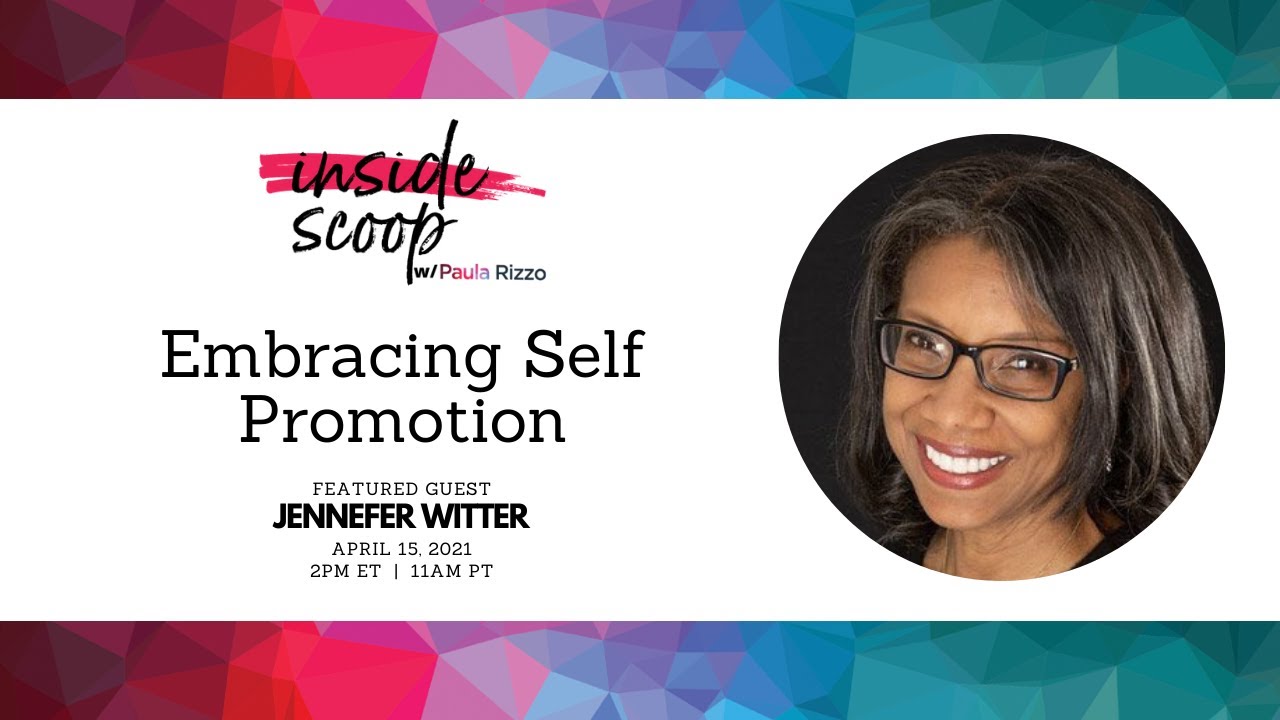
In this Inside Scoop episode, host Paula Rizzo interviews publicist Jennifer Witter to demystify self‑promotion and show how to turn discomfort into a strategic advantage. The conversation covers why sharing achievements is essential, how to craft a clear personal‑brand statement, and how to treat yourself as the CEO of your own company. They discuss concrete tactics for turning a single media or speaking opportunity into a cascade of visibility—re‑posting clips, repurposing content across platforms, tagging relevant people, and using the placement to secure further speaking gigs. The duo outlines how to build and maintain an editorial calendar that targets a manageable list of contacts, emphasizes authentic, helpful tagging, and warns against spamming. They also address etiquette around asking for permission and direct asks for sharing, highlighting the importance of authenticity, consistency, and nurturing weak‑tie relationships that can be activated when needed. Throughout, they share real examples (e.g., leveraging a TV appearance for LinkedIn posts, using a book‑voting campaign) and provide actionable resources such as Paula’s checklist and LinkedIn Learning course. The episode ends with a call to action for listeners to engage via comments and to reach out to Jennifer’s firm for further support.
Chapters
Hey, welcome to Inside Scoop. I'm Paula Rizzo. Thanks for being here with me today. We're talking about self-promotion today, and if it makes you cringe, I want you to stick with me because we're gonna fix it. I promise, I promise. If you feel like, oh, I don't want to toot my own horn, I don't want people to think I'm too boastful or too, too much of myself or whatever, We're going to feel a lot better about it today after we talk to my next guest who is going to join us in just a moment. She is a very seasoned publicist, so she's used to helping people toot their own horn and be able to get the information out about who they are and what they do and why people should care. So we're going to talk all about embracing self-promotion today, and I want you to tag a friend, put a Y for yes. In the chat box below if you've ever had an issue with this, if you've ever sort of had that cringeworthy moment where you're like, I'm really excited about this thing that I did, but I don't want to boast about it. I'm not sure how I feel about this. So tag a friend, uh, here in, in the live stream so that we can answer your questions live. We'll be able to do that with you. And if you're watching the replay, do it anyway because we're going to check back and make sure that we answer all of your questions. If you go to paularizzo.com/checklist, I have something really special for you there where you can actually get my checklist on how to become a go-to media expert. And media these days, it's not only TV anymore. Right now we're talking about doing your own videos, producing a livestream like this one, whatever it is that you want to be seen and be known for. If you go to paularizzo.com/checklist, you can absolutely check that out. And you know what? Speaking about tooting your own horn, I'm going to toot my own horn just a little bit for just a second because I'm super excited about this. I'm a LinkedIn Learning instructor and my course, The Power of Lists, is now on Delta's flights. I'm in-flight entertainment. Isn't that very exciting? I'm thrilled to be able to help people on the go learn more about lists and productivity. So if you go to paularizzo.com/linkedin, you can see all my LinkedIn courses there and, you know, you can take them while you're while you're in the sky, which is actually pretty, pretty amazing and pretty fun. Uh, so, and in speaking about self-promotion and how to do it better, I would love to introduce you to a wonderful, fabulous friend of mine. Hi, welcome, welcome, welcome! Jennifer Witter, welcome!
Hi, Paula, it's great to be here.
Thanks for being here with me. I mean, I know this is the problem that a lot of people have. We have to embrace it because otherwise, how the heck is anybody going to know anything about you? Uh, but how do we kind of get— wrap our minds around changing how we feel about self-promotion.
You know, that's one of the things I have come across in my career in publicity. And sometimes a lot of people, they are so shy about talking about themselves. And as you said, it's like, I don't want to toot my horn. I don't want to be boastful. But this is what I say to, to my clients, to my mentees, to, to anyone who hesitates. It is. No one will know how great you are until you tell them. They're not going to know it through osmosis. And with women especially, we feel that our work will speak for itself. And that doesn't happen. You have to go out there and tell people exactly what you did. And don't think about it as being boastful. Think about it as you are sharing your accomplishment, your achievement, what you have done. So when you look at it in that bigger picture perspective, it will make you less uncomfortable going out there and rightfully claiming what is your success. Because again, don't expect your boss to say anything. Don't expect your mentor to say anything. Because they have a whole lot of things on their desk already and it's just you. So one of the things you need to do, and this ties in with personal branding, and it was Tom Peters who said it, and Tom Peters was the person who coined the term personal branding in a Fast Company article in the 1990s. And he goes that everyone must think of themselves as me, Inc. That we are this CEOs of our own company. So you need to go out there thinking you're not a staffer, you're not this, you are the CEO of Paula Inc., Jennifer Inc., Maritza Inc., whatever.
Sure, sure. What a good way to kind of reframe it and think about how, you know, you can, you have to tell people, you know? I mean, and that's the thing too. It's, you know, as a TV producer for years and years and years, people would say, you know, how do people get found by the media? It's like sometimes they do get found. But not always. A lot of times they're pitched to us. They're pitched. We know about you because you told us that you exist. And another way to look at it too is that what you're doing can be of service and be helpful to other people. So why not tell them?
Yes. I mean, you know, don't, don't be shy. And as I was saying, take ownership of what you have done, because one of the things about personal brand, what a personal brand is, is defining who you are, what you are, what makes you different. And it helps to elevate you from everybody else in the room. So when you were in television and you were getting pitched Mary or Joe or David, you would find out about them and what made them unique. You wanted to get them onto your program because they show that they were able to do all these things. But you wouldn't take someone who was under the radar or not even on the radar. So it's not only about career advancement, it's about visibility that can be morphed into many different opportunities that you can take advantage of.
Ah, so that's the key here, right? It's that we're building. So it's, it's like, great, you had one wonderful thing happen. When you start amplify— talking about it, it amplifies that, and then you can turn it into other things. So talk to us a little bit about that. Like, what can one opportunity opportunity, whether it be, you know, a media hit or a class that you're teaching, how can that sort of mushroom out from there?
Oh, I always talk about it with my clients and I say, we're going to take this media opportunity, we're going to take this speaking opportunity, and we're going to put it on a horse and ride it until the horse cannot run anymore. So, you know, just don't think that because you have this media opportunity or you have this speaking opportunity that everybody knows about it. No, they don't know about it. So let's just focus in on a media opportunity to make it easy. If you get a media opportunity, what you can do is once the, the piece airs, you get the link for it and you can put it on your social media, put it on LinkedIn, on Twitter, on Facebook. And if you don't want to say, oh, I was on this show and make it sound boastful, you can do something along the lines of You know what, I was on, uh, so-and-so's program and I was so honored to be on it. I spoke about this. Here's the link. I would love to know what you think about it and if you found it of value. So that way you get to show that you've been on this program, that you were selected, and then you have a call to action. You have people coming back to you saying, I really liked it. So send it to your network. Then what you can also do is to send it to a non-competing outlet. And what I mean by that is that you can take it, you're on television, take that link and pitch it to a newspaper, pitch it to a radio station, because it shows that you're an expert. Remember TV, they don't take just anybody. They want somebody with expertise. Sure. And what I have found is that more and more, even with podcasts, um, with television, they want to see that you are able to speak in soundbites, that you don't get flustered being on air, that you can keep on message. And then last but not least, with that media opportunity, you can use it to get speaking engagements because again, it's underscoring that you are an expert in this area. And I just filled out a speaker form and they asked, where have you spoken? What have you done? And so I included these links that supported my expertise. So it's not just you saying you're great, but it's this piece of video that's giving you the much-needed third-party credibility.
Mm-hmm.
Yeah.
And that's it. It is credibility. It's a, it's a, it's a to say, hey, look, I was picked already. So there's that. But then there's, there's also the element element of, uh, you know, showing that, that you can do it, to do the actual work. When you're talking about, you know, television, 100%, you know, when I was picking experts as a producer, it's like, I want to make sure they can do the job that I'm asking them to do. So I want to make sure that they're succinct on camera, that they look good. So, you know, sending me a clip of you as a podcast host, uh, not exactly what I need to see you doing, right? I want to see you in the role that I need you to be filling. So for media, absolutely. Um, for speaking, definitely. Uh, do you have, do you have like a best practices kind of, you know, like how much is too much or anything like that? Because I love a good editorial calendar, so I have, you know, my stuff like, yes, ready to go. I, I like to plan and all of that. What do you think is, is too much or too far away from the, from, from when it actually happens that it's no longer useful? Any thoughts on that?
I think unless the topic is specific, let's just say it's about Valentine's Day, you obviously can't use it during the summer, but a lot of topics are evergreening. And what I do with my clients and my own placements is that periodically I'll put it out. Let me give you an example. April is Diversity Month, and I appeared about a year ago on the ABC affiliate in Washington, DC, talking about implicit bias. Now, again, it's 12 months ago. It's now April 2021. And what I did was I put it on LinkedIn, I put it on Twitter, and I got several thousand views on it. And so you can use it to adapt to a specific time, or you can just put it out there. And if it's— if there's a topic that's come up that is relevant, I call it issues of the moment. Let's just say 6 months ago you talked about racial justice, and now with the anniversary of Mr. Floyd's passing away, and if it's appropriate, you can put that piece up there and tie it into what is happening into the environment. So you have to be strategic. You don't want to put it up once every other week because people are going to go, enough already, I saw it already, you know, don't you have anything else? Strategic about it and put it on different platforms, because not every platform— when I say platform, I mean social media platform— um, you get, um, people to, uh, read it in different settings. And never forget about tagging and hashtagging, and that way you get directly to the person you want to be in front of. And again, as I said, you can share it with your network and say, oh, by the way, Hey, this I think is of interest to you and I wanted to resend it to you and think, and I think that you'll find it of value. So you definitely can stretch out a placement for a very long time, as long as you don't become a pest about it.
Yeah. You don't want to be a pest, but also, you know, you mentioned some good things about tagging people and being, being, I always say, you know, how can you be of service with what you know and really think about that? You don't want to just tag everybody because you're like, oh, it'll expand my reach. Really be strategic about who you tag and why you're tagging them. Is there a reason for it? Do you want their input because you talked about something that's also their expertise or they also talked about it or you mentioned them in the clip, which I find to be a really great way. You know, I've done this with my books. When you mention an expert or you interview them, they're more likely to then share it because, you know, it's important to them to be seen in that way. So, you know, think through how do you, how can you do this in a way that's very strategic, but also helpful because you don't want to spam people.
No. And I love what you just said. You have to be mindful of what you're doing. And you said something earlier about your calendar. And this is what I advise in my own presentations, because in addition to the Borland Group, I'm a fairly active public speaker. And I say, you know, put together a chart and divide it up by month. And list out the people with whom you want to connect. And it shouldn't be like 50 because that's just too much. Do like 10 people, 5 to 10, that's enough. And then month by month, place what you are going to connect with that person so that you see exactly, okay, it's Thursday, I am going to connect with Farnoosh. Um, next week Wednesday, I'm going to connect with Rachel and this is what I'm going to do. So that way you're mindful, you're getting the information out, and whatever reason you're connecting with that person, eventually the objective will be achieved.
Yeah. Yeah. I love that. I love, I love really thinking through who do I want to connect with? Why do I want to connect with them? And then put it on the calendar that you actually do it. Like very, very smart. That's how you create, you know, these great partnerships and, and, you know, to, to be able to have people who know you and like you and trust you. Now. And then when you do have something really big to promote, or, you know, a class or your book is coming out, it's not like you're just going to them for just that purpose. Create that network now. I mean, that's what I've done, you know, with everything, you know, through the years. I haven't just said, oh, you know what, my book is coming out, can you help me? It's like I've been friends with these people and talking to them and helping them with their promotions for years. So it's strategic.
Oh my gosh, I could not agree with you more. I have developed relationships with people I have never met I've never spoken a word to them and it's all internet-based. It's all social media-based. And I make sure that I authentically share their information because you can see through when somebody is doing something just to get that, that get. You have to be, as I said before, thoughtful, mindful. If Leslie is doing something that I agree with and I think can be of help, I am absolutely going to share it.. And when something of yours is shared, you automatically know who is sharing it. I mean, that to me is the highest compliment. So by creating these relationships, they're called weak tie friendships, by the way, you can go back to that person when you are ready to make the ask. And it's not a cold call, so to speak, because you already have that, that relationship that you can fall back on. But The key thing here is that you have to be authentic. You have to be consistent. You have to be real. Yes.
Yes. And kind. You know, it's a kindness that you're sending. You know, you're saying, hey, you know what? This might be of interest to the people that I know too. And you don't always have to wait for someone to ask you to share something to share it. Right? Like to be able to—
sometimes you do have to ask.
Sometimes you do have to ask. Right? That's another thing.
Well, you have to get permission sometimes. Right. Right.
Exactly.
Is if it's on social media— we've been talking a lot about social media— if it's put on the platform, to me that is public information, right? And if they don't want a large, a large group of people to see, there are parameters that you can put around it. So if it's out there and there are no parameters around it, um, then you can share it, um, with others. But I do agree that in certain instances you do need to ask permission, just to be honest.
For sure.
If you have that little question about it, uh, then listen to that inner voice and ask before you do anything.
Yeah, absolutely. And also, you know what, like, remembering that people are very busy, and you know, there may be a time when you want to promote something and you're really excited about it, and people are not just organically going to share it. Right? So you may have to also ask your network personally, one by one, not in a blast email, and be able to say, listen, you know, I just did this exciting thing. I'm really thrilled about it. Could you share it with your network? Would you put it out there on my behalf? Because not, not everybody will just do that on their own or know that you want them to do it.
Two things: never assume and don't be afraid to ask. And I always say this. You need to ask. You will get 100% of nothing if you don't ask. If you ask, you'll get 50%. And I have a very quick example. It was my book. And one day, it was a Sunday night, this woman tweeted me. And she goes, "I just voted for your book." And I didn't even know my book was up for an award. So I went, thank you. And I looked and I found out that my book was in this category for an award. And I had 2 votes, me and this woman.
And I was like, oh no.
Oh no. I was like, oh no, I'm not going to go down without a fight. And the deadline to get all the votes in was that Thursday. And I went to my entire network in the United States, in Europe, in Asia. And by time the closing, the deadline was that Thursday, I got 300 votes.
Oh, wow.
I came in second. And so that's an example because with these people, I did ask them one by one by one, but it wasn't like I haven't heard from her in months. These are all the people that I had kept in contact with as we talked, shared information. Shared their information and kept the conversation going. And in that instance, it worked for me.
I love it. That's awesome. I'm going to look at some of our comments that have come through. There's some questions here as well. Uh, Deneen is saying, yes, build relationships over time. And she's also saying Jennifer absolutely does what she says. She does. As someone who knows Jennifer for a long time, she does. Absolutely. Marika, Uh, she says, Jennifer always hitting it on the nail, terrific points across the board. Perfect, that's so sweet. Linda Ryan, hello, nice to meet you too. I used to work with her daughter Jessica. We worked together at Fox News for a very, very long time. Thank you for being here, appreciate it so much. Um, I want to talk a little bit about personal branding. I mean, I know that you've already, you know, mentioned it a bit, but The elements of the personal brand, of the successful brand. Let's dive into that a bit. And if anyone has questions, please put them in the chat box, uh, cause we'll be able to get to those here. And if you're watching the replay, we'll be able to, you know, check back and, and, uh, make sure that we answer your questions there as well. But talk to me a little bit about the personal brand and what goes into it because the, this promotion part, putting yourself out there is only one piece of it.
Yes. Well, you know, with personal branding, I think it's critical for everybody to know exactly what it is. You don't need to be an entrepreneur. You don't need to be an employee. Regardless of who, what you are, what station you have in life, you need to have a personal brand. And what a personal brand is, is who you are, what you are, what makes you different. And Jeff Bezos said it the very best. And as we all know, he is the founder of Amazon. He goes, a personal brand is what people say about you when you are not in the room.
Ah, uh-huh.
You have to have clarity because we think we know how we're communicating ourselves, right? But as we're communicating, is that information being received in the way we want it to be received? So I leave the room and they'll say, Jennifer's great in advertising. Well, I'm not in advertising, I'm in work relations. So your personal brand has to be crystal clear about what you are, what you have to offer. And that is the, the nexus of a personal brand. And there are many components of a personal brand. It's how you speak, it's how you dress, it's, it's your presentation of the, the information. Yeah. And the way you get to a personal brand is to create a personal brand statement. And it's very short. It shouldn't be like War and Peace. The first sentence should be as snappy as possible because remember, we're meeting a lot of people and whether it's on online or in person, we're one of many people. So when you walk away, you want that person to remember who you are and you also want that person to remember exactly what you do. So create that personal brand statement. And then the other thing is, is that you just can't let your personal brand sit. Um, you have to live it. It has to be threaded throughout everything you do, whether it's in LinkedIn, whether it's on your website, whether it's on your resume, you know, wherever you are, your bio. That personal branding statement has to be spread through because you are subtly underscoring what you are, who you are, and making sure that your messaging is clear. And then last but not least, you can't let it get stale because think about it, 3 years ago, you know, are you in the same place as you were 3 years ago? You have to keep your brand fresh. You have to keep it to the moment. Does it mean that you have to change it every 2 months? Absolutely not. What you should do is to review it like at the end of the year when it's a little bit quiet around the holidays. You may need to tweak a little bit, you may need to change it, but you should always keep your brand as up to date as possible, especially nowadays when things are going at supersonic speed and you don't want people to come to you and say, oh, I thought you were X, X, and X. When in reality you're doing something totally different.
Yeah. And it's okay for you to change that too. You know, I think a lot of times people feel like, oh my gosh, like I went and I've created this whole brand around XYZ thing and my website looks beautiful, but I don't actually do that anymore.
You know?
And they have sort of like this apology about their website. Like, oh, I'm in the middle of changing that. That's going to go away. Cause now I'm, you know, I don't know, a professional juggler or something completely different, uh, you know, from what they've done before. But This has been so fabulous. Thank you so much for, for being here and for, you know, giving us all of your fabulous nuggets. I so appreciate it. And anyone who wants to get in touch, they can, they can find you at theborlandgroup.com. Um, and just, you know, real quick, if you just talk to people a little bit about what, what, how you work with clients so people will know, uh, you know, that you're the one that they want to, to reach out to.
Oh, thanks for the opportunity. Well, the thing about the with Franklin Group is that we do not consider ourselves as your vendor. We are a member of your team, and hence your success is my success. And we really look to become part of your company, your group, so that when there is any kind of work that you need, you know that you can turn to us and there's a level of trust because we know your business, we know your work, we know what you're doing. So that we can execute it. And then the other thing is that, yes, I'm the CEO of the company, but I just won't appear when I'm pitching the business and never to be seen again. Once we have the business, I am always here, I'm always available, and I make myself as flexible as possible to meet your schedule because we are here to assist you. So whatever we can do to help you achieve achieve your goal, we're going to make it happen.
I love it. Well, absolutely check out Jennifer at theborlandgroup.com. Jennifer, thank you so much for being here. You're awesome. You've helped so much. Everybody is loving you in the comments. Excellent session. Love it, love it, love it. And if you continue to have questions, if you're watching the replay, absolutely leave those in the question boxes below. We'll be able to get to those for you. Thank you for being here. Very much appreciate it. And, you know, I'll see you guys all, you know, all soon on the next, on the next time.










