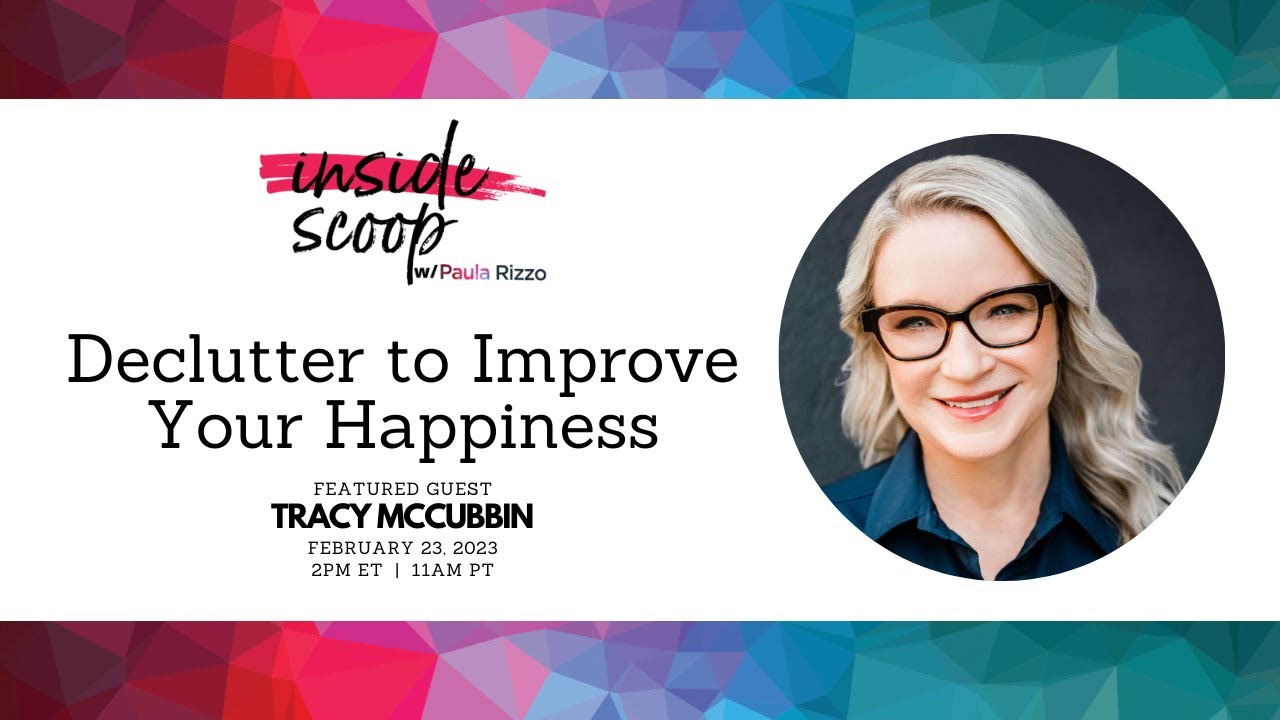
Professional declutterer Tracy McCubbin explains how clutter blocks happiness through seven emotional drivers like seeking connection and confidence. She distinguishes everyday clutter from hoarding disorder, and offers practical steps: run an Amazon spending report, switch from saying you "need" things to "want" them, and try a five-minute daily declutter.
Chapters
Hey there, welcome to Inside Scoop. I'm Paula Rizzo, and you just got a sneak peek right there of my guest behind the scenes who may or may not be able to help us with lots of clutter going on in our lives. And be honest, are you sitting around some clutter? Did you like shove some things into some, into some drawers just before you got on a Zoom call or somebody came over? I mean, I'm guilty of doing it myself. To. Like, I love organization, but it takes work. It takes time and it really does affect your happiness. There have been studies done time and time again. I have done a lot of, you know, talks and been on media and things about that, you know, because, you know, I love lists, of course. And, you know, to be able to declutter, you could start with a list, which I love. I'm going to talk all about how to declutter to improve your happiness with my guest who you just got to see. See a little sneak peek of in a second. She'll be here in 1 minute. But first, I want to tell you about a freebie that I have. It is a list-making freebie, which will definitely help you to stay more productive and, you know, make sure that you get the right things done. And sometimes decluttering has to go on the list. So if you go to paularizzo.com/list, you'll be able to get my list-making starter kit. I'm also a LinkedIn Learning instructor, and I have a lot of courses on LinkedIn. One is about enhancing productivity in a hybrid work environment, and I have many, many others there on productivity and even media media training too. So if you go to paularizzo.com/linkedin, you can check out all of my LinkedIn Learning courses and learn along with me. And as you're watching this, if you have questions, if you know somebody who has been wanting to declutter, please put some comments below, tag them, share this around. We would love to hear from you. And even if you're watching the replay, we'll get back to you on any questions that you have in the comments. So without further ado, I would love to bring on my author friend for many, many years who I knew before she was an author, actually. Tracy McCubbin is here. Hello, welcome!
Hi, Paula Rizzo!
Hi! So you have a brand new book. This is not your first book, this is your second book. This one is called Make Space for Happiness. I'm thrilled.
I'm so thrilled. It's just, oh, it's been so well received. And after post-pandemic and kind of everybody dealing with literally the stuff in their house. I mean, we were so confronted when the lockdown happened.
Yes.
Either we had too much stuff and we had to figure out how to live in this space, or we had kids that had to be schooled from home, or two people that had to work from home, or parents moving back in, or kids moving back in. So it was so confronting around our space.
Yeah, absolutely. And I want to show your books, put your books up there because we do have a QR code if anybody wants to grab the books. The new book is Make Space Making Space for Happiness. They're on the left. And then the original book is Making Space Clutter-Free, which are both fantastic. And you and I have known each other for many years. Actually, I, I don't even know how many years, but I was a, I was a producer at Fox News and you did not have any books and I did not have any books. And it was just sort of like we met up, we did some segments, it was so fun. And you're in both of my books, Listful Thinking and Listful Living.
So yeah, I love it. Yeah, I think it— I think we go back to like 2016. Yeah, a long time. It's great. I've been following you and you know I love a list.
You do, I know.
And it's so interesting because one of the things that I help so many clients, especially my paper book, my paperwork bugs, yes, is I help them declutter lists. Huh. Which is really interesting because I see people who like have lists over here and have lists over here and old lists and, you know, there's a piece of important information and what if I get rid of it? And so one of the things that I work with you know, is getting lists into one place. Oh, and that, you know, so that they're not like on a legal pad and on a notebook and on your phone.
You need the capture place that this is where— how do you feel though about— and I want to talk about your, you know, how you got into this work for sure, but, but what do you feel about— like, I still make my paper, paper lists, and now I've gotten better because I'm, I'm happy to now throw it away and be done with it. But there was a long time when I'd be like, oh, but there might be a note on it that I need. So then I started to you know, take pictures of things and then, then release it into the garbage. You know, what— how do you feel about the paper?
I do paper lists too. My whole life is on a legal pad. It fits in my bag, my work bag. I, um, for me, the journey of crossing it off, um, moving it to a new list the next day. So I try every— either at the end of every night or first thing in the morning to re— to redo my list because I think of them like you, very fluid, right? They're a living, breathing document. They're not set in stone. So, you know, I'm a big fan of the paper list. Sometimes when I'm traveling— now, it's interesting, I have found this when I'm traveling or I'm on a job site, I'll write it in my digital notes and then I'll transfer it to my paper. But I like paper.
Yeah, I mean, it does do something different in your brain, right? It solidifies it in a different way than if you're just using, you know, your apps and websites and things. But, you know, the book, the new book is about happiness specifically, which I love. And I want to know a little bit more about your personal story. I mean, this is something that you really have not shared, maybe in little tidbits through the years, but never in this way. So would you share how you got into this decluttering biz and how it affected your own happiness?
Sure. So I had been working as a personal assistant for two different people and I loved it. It was just great. And I was solving problems all the time and everything was different. The last person I was working for was a television director, and we would have hiatuses when we weren't working. So he would recommend me to his friends, "Oh, my assistant can help with that. Oh, my assistant can help with that." And these jobs started to come, and immediately they were incredibly emotional. Like, my grandparents had passed away and I have to clean their house out, or my boyfriend's business has failed. And I just had this understanding. Part of it was I was very close to my grandmother and I helped close out her estate and I kind of helped her as she aged and did her taxes. So I was very in that. And I just had a real knack. And it took me— this is the funny thing about life, Paula Rizzo. It took me a while to put this together, but I am the child of a hoarder. My dad is an extreme hoarder. He's 83 and we're still dealing with— we're still dealing with it. He's still dealing with it or not dealing with it. And I had a client who was a psychiatrist say to me, sort of asking me this exact question. And I was like, offhandedly, "Well, my dad's a hoarder." And he was like, "Stop." And he was like, "You know, you took your psychic wound and you made it your life's work." Like I had this empathy because I have watched someone my whole life struggle with their relationship with stuff. And, you know, for people who don't know, hoarding disorder is very different than everyday clutter. We can actually have a lot of clutter and not have hoarding disorder. So if somebody's listening and they're worried that they have hoarding disorder or someone they love, please, please, please get mental health support. Talk to a professional. It is an anxiety disorder. It's a bit of an addiction. It's very, very different. There's a lot of amazing resources, but I just want people to know that if that's something that they're concerned about, that information is out there and help is out there.
Yeah, I mean, it is important to make the distinction because, you know, people throw the word around flippantly, you know, but it is, it is an actual thing. But, you know, it's amazing because you, you are able to go in with a different perspective. And, you know, as a TV producer always, and now, you know, as a media trainer and I'm helping people, you know, with their books and talk about what they know and all of this, so often people do not talk about their personal story and their personal connection to the thing because they don't want to— I don't know, they don't want it to be out there, they don't think it's that relevant. And it's sort of the thing that makes you the most relatable because people will Hey, she actually really gets this.
Well, and the thing that I realized when I started talking about it with my clients, because I've had my business, my decluttering business, in addition to being an author for 16 years now, when I started to say to clients, it's like I can say with complete authority, your house is not the worst house I have seen. Yeah. Like, not even close. Like, I have seen the worst. Like, right. You know, so I really have an understanding and I really understand. Understand the struggle. So when I was able to lean into it and know that that's what got me here, it made me even better at my job.
Oh, I love it. I love it. Yeah. And I'm sure people feel much more comfortable, you know, around you and with you and all of that. And, and, you know, now with your books, you're able to take this message much, much further, which is, which is wonderful. But there have been a lot of studies out there, you know, the correlation between stress levels, cortisol levels, and stuff, right? When you have a lot of a lot of stuff around you, especially women, it really boosts those cortisol levels to spike and makes you really stressed out. But what about happiness? How does clutter and happiness, how does that go together?
Well, so that's great. So one of the things that I saw during the pandemic, as we all did, driving around Los Angeles when I could get out of the house, I was like, look at those packages on everyone's stuff.
Oh yeah.
Like people were shopping like drunken sailors. It was— and then when we opened up and I started working again, that I was getting these calls like, everything I decluttered before, I bought again and then some. And I was starting to like, all of a sudden it started to come together for me where I was like, you know what, we can't talk about decluttering if we're not talking about acquiring. We're not looking at it because that clutter has to get in somehow.
Yes.
You know, there's a rare case that you inherit a house, but we bring it all in. And so I was like, this is so interesting because we are over shopping. And we're coming out of this very difficult time. And it's not fixing anything like this shopping, this acquisition. So I started to really do research on happiness and where does it come from? And how can we to use a word, how can we hack it? How can we change it? And that I just started to notice that there were these sort of 7 reasons that people were buying to fix themselves and it's not working. Yeah.
Right. Because it could be that instant gratification to get the box and you get the thing and you get excited about it. It's like, man, I don't even really need this. It's just really exciting.
It adds the dopamine. So you get a dopamine hit. It lasts for 17 seconds. Wow. That's it. So then you're like, well, that didn't work. I got to buy something else that made me feel good. You know, it's very similar to like the third glass of wine. You're like, oh, the first glass made me feel great. The third, no. The, you know, the fourth cookie. It's all the same biology. And that's what's so fascinating. And, you know, just quickly, people need to understand that we are hardwired as hunters and gatherers, right? So when we were living nomadically, 3, 4, 500 years ago, when we found a pear tree or an animal, we got, we got hit, a hit of dopamine to tell us, grab all those pears, try and kill that animal. We haven't evolved out of that. So we still get that same hit of dopamine when we go to Target as if we killed a woolly mammoth. We haven't readjusted. So we need to understand that what we're looking for, what we think is missing inside of us, isn't going to be found shopping.
Yeah. Wow.
Wow.
Well, you've now built on the first book. So the first book really tapped into the clutter, what you call the blocks.
Clutter blocks. Yeah.
Clutter blocks. Which, by the way, the first book, Making Space Clutter Free, was supposed to be the last book on decluttering that I would ever need. And yet now there is another one. So yeah, tell me, what am I now? I love it.
I bet. Hold my feet to the fire. This book is about acquisition. It's not about decluttering. It's about looking at what you're bringing into your house. What are you shopping and why are you shopping? So the first book was about the clutter blocks, which were these 7 stories that we all tell ourselves about why we can't let go of the things we don't want, need, or use. But this book is about the clutter magnets. And it's so interesting. And the way I describe them is like, imagine you think you have this little piece of you missing. It's almost like in the shape of a puzzle piece. So maybe you don't feel connected to people, or maybe you don't feel strong self-confidence, or maybe you want more free time. And, and so you buy all this stuff. I like to see it. It's like this magnet that you You know, buy all this beauty cream or buy all this and you try and fill the hole and it doesn't work. So what the book does is it looks at what are you trying to fill? Why it's not filling that hole? What are you trying to magnetize and why it's not working and what you can do to magnetize those feelings?
I love it. So it's like there is something missing and it does not be filled with these other things. So let's go through 3 of them. These were my 3 favorites in the book, which I have right here, of course, and everyone should should grab the book. But the first one is, the clutter magnet is true connection. So what is the deal here?
This one to me sums up the pandemic because we were all taken out of our social lives. We were all taken out of our tribes and we were like, oh, well, as long as I'm shopping, I'm connecting with people. And this can show up in that you and a friend go retail shopping, but you don't really— retail therapy, but you don't really connect with each other because you're not really talking about real stuff. I just did a consult with this lovely woman who has some health issues, so it's harder for her to get around. Pandemic locked her down. Her shopping has gotten out of control, self-professed out of control. And she's like, and I was like, well, you know what we— and she's like, double whammy, retired. Yeah, right before the pandemic, stopped being able to go to church, start watching church on Facebook. And stopped playing bridge. She's in her 70s. The things that she did went away, and she started— so the first thing, first thing, first thing, I was like, can— is church back in person?
Yeah. She's like, yes.
And I'm like, can you mask up and go to church?
Yeah.
And she's like, we can. And I'm like, how about bridge? And she's like, oh well, there's a monthly game. And I'm like, start once a month.
Yeah, you really need to replace those things. Yeah, exactly.
And then you're getting a connection, you know, you're realizing like Oh, I had coffee hour after the service and I'm getting to talk to people again, or I'm bitching about our husbands at bridge. And all of a sudden that you get those same feelings. So that one is just—
it's, it really is interesting. But also thinking about like pandemic and how we were, how we were shopping, how we were doing things. It was like, you know, you were also sending links to your friends. Like, hey, I just bought these amazing pants. You go get them too. You know, like that was part of the connection was that we were buying the same things or making the same food.
Exactly. But the thing about that kind of connection is it's not lasting, right? You don't remember what pants you told your friend, but you remember your friend saying like, I'm having a hard time. My kid just got diagnosed with a learning disability. I don't, you know, that's what you remember. So, and I want people to understand too, I'm not saying don't shop. I'm, I love pretty things. I like a vintage Gucci purse. Like I understand, but What I want people to do is not replace it for other things. I understand the purpose that it serves. And then, you know, get honest about what's really going on inside of you.
Yeah. Well, what about strong self-confidence? Because that's another one of the clutter magnets that you talk about in the book. And it's a big one, huh?
Yeah. And it's really, you know, aimed at women. I mean, I have to say this whole like anti-aging I don't want to anti-age. I want to age because if I'm anti-aging, I think I'm not here anymore. I don't want that. So, you know, it's really this languaging around you're not enough. So this mascara, this skin cream, this serum, you know, all these things will fix you. And that's where your confidence will come from. Look, I live in Los Angeles. I have a lot of celebrity clients. Yeah, I have a lot of women who are aging who were big stuff. You know what, people grow older and they look beautiful. And if someone had figured out the secret to anti-aging, they wouldn't be selling it for $29.99 on Instagram. Like, we would know. So we're trying to get our self-confidence. And look, a great blouse and a pair of jeans that fit you, they are gonna, you know, they're your armor and they're gonna make you go out in the world. But if you're not doing the, the things that give you confidence. Like, you know what gives you confidence? Helping someone else.
Yeah.
Being there for someone else, being an ear for someone else, doing a favor, driving, you know, to the grocery store for your neighbor who can't get out. That gives you self-confidence. Then you want to throw a pretty sweater on it. Fantastic. But if you're looking for all those potions and lotions. Yeah. It's, it's fleeting. It's bleeding.
Yeah. And then, you know, you just accumulate. So that's the whole point here, is to figure out like what your, what your tendency is, which of these things you tend towards. It's like, huh, it's almost like a mindful meditation kind of thing because it's like, before you buy, what are you trying to do here? Before you grab—
exactly. Now I talk about that in the book. Like, if you find yourself in a store, online, and sort of going crazy, what's really going on?
Yes.
Like, what happened today? What are the icky feelings that you have that you're trying to avoid. I recently was in a sort of stressful, emotionally charged situation away for the weekend with a family member that pushed all my buttons. Yep. And we were at the outlet mall to add fuel to fire. And I bought like 3 things that were all on final sale. That. And I just got in the car and I was like so full of regret. I was like, why did I do that? I don't— like, one was great and I loved it, but the other two, I was like, what? What was— and I was like, oh right, I couldn't deal with the con— with the underlying years of difficult, you know, relationships. So I just was like shopping to avoid it. And it made me feel awful. Like, it made me feel awful. Yeah. And so I realized like when I went back, I was like, well, what could I have done differently? And it's like, I could have said to myself, this is going to be challenging. Yeah. So, you know, can you set a budget? This is your go-to over shopping with this person. Can you set a budget? Can you say, I'm going to spend $100 today? Make a smart decision. Like, you know, go into it a little bit pumped up and a little bit protective. Yeah, a little bit protected.
Yeah, yeah.
As Oprah always talks about, you know, that white light that you surround yourself with. That's right, exactly.
Well, it's, you know, being kind to yourself in many ways, you know, because you don't want to have that like hangover feeling at the end, like, ugh, why did I do that? That feels so icky. I don't even want this stuff. Now I gotta go return it, you know.
Oh no, final sale, couldn't even return it. Really regretful.
To add insult to injury. Uh, so free time, that is another one of the clutter magnets, which I am like, you know, I, I love a good easy, easy street shortcut.
But what do we mean? We all love it too, but if you find yourself buying lots of gadgets that save you time, yes, let's get realistic. Like, in— like, let's say you, you know, switch to a shampoo and conditioner in one bottle. With that 5 seconds or 15 seconds you saved, did you actually learn Mandarin? Like, did you do something with that time? Yeah. So Yes, I love a hack. I'm with you. I love that. But if all of a sudden you are acquiring so, you know, an Instant Pot and an air fryer and a double duty, da da da da da, you need to look at it because all that stuff takes maintenance and it takes time. And so I think that ironically, this one, you sort of go like, oh, I've just bought all this stuff to save time and now my house is full of all this stuff and I'm managing it and it's taking up all my time. So I just tell people to, to be very buyer beware of things that claim to save you a lot of time.
Yeah, no, it's a good, it's a good point. I mean, I, you know, look, living in New York City, having very limited space, really has trained me to not buy things because it's like, well, we have no plate— we honestly have no place to put it unless this item has a place there is, there is no way that I'm going to now get it. And that's a new thing for me, you know, because in the past it was just, well, I want it, so I'm gonna get it and I'll figure it out later. But now, yeah, pre-plan. What am I going to do with this? Am I going to really use it? You know, and, and really thinking through, um, in that way. So there are 7 of these. We've gone through just 3 of them, but the rest are in the book. So I encourage everybody to check out the book so you can grab, um, just understand why you're doing what you do. It actually makes You make more informed decisions for sure. And so what is something else that people can do? Like once they do know, how often should you sort of like check in with yourself or what's the mechanism that'll really get people to change?
You know, I think it's looking, you know, one of the things that you can do, this is a tough one, run an Amazon spending report. Amazon has the ability to run a spending report. Run a report. What are you spending every month? Go through— someone was just telling me that they go through and they run their Amazon spending report, and then they make a little note on the spreadsheet. Was it worth it? Did I use it? Like, that's very confrontive but really, really, really helpful. Another great thing, and this is an easy one, and people can start today: stop saying you need X, Y, or Z. Stop saying you need— I need a new blow dryer, I need a new pair of jeans, I need the new Dyson Airwrap. You know, you don't. I'm gonna guarantee you have plenty of jeans. Yeah, just start saying you want. Yeah, that's okay. You can have wants. I want a new pair of jeans. And then sit with that. And then sometimes what happens is that want just goes away when you voice it and give it power. You're like, oh, actually, my blow dryer is fine. Yeah, I don't know that.
That's so great, like, to change— to change how you talk about these things. I I find that myself too. Like sometimes I'll be on Instagram, I'll be like, oh my gosh, it's so cool. I definitely, oh, I definitely want that. And then I like forget about it and I move on and I'm like, it doesn't matter. I didn't need that. I don't need a new shirt. My shirt is fine. You know?
Yeah. And that's such an easy switch to do. It's just a languaging switch. And it's also not beating you up, right? It's not like you're a bad person. You overspent. It's like, no, no, I just, I don't need it. I want it. I really, and then it sort of poofs away. And if you have this strong want, is there like, "Oh, you know what? Actually, I'm going to call my girlfriend and see if she wants to take a walk around the lake." Sure. Maybe that'll make me feel better.
Change the thing that you're feeling. What are you using to— And you have a freebie on your website if people go to TracyMcCubbins.com that they can grab. And this has been a big hit. So tell us about the freebie that you have on your website.
Fantastic. So if you go to TracyMcCubbin.com, I have— and Paula's gonna love this— I have a list of 25 things you can declutter in under 5 minutes. So each category takes less than 5 minutes. These are absolutely amazing. This blew me up on social media. I started doing these little things you can declutter under 5 minutes. Yeah. And it just went viral. It's crazy. And the amazing thing, Paula, is so many people DM me and they're like, I've been doing these and all of a sudden I've done my whole house and I didn't even notice it. Like, it's like, all of a sudden you're just like, I'm going to do coffee mugs, I'm going to do pens, I'm going to do bras, I'm going to do socks. And you just can do it like in the morning or on a Saturday or in the evening. And it's not this big time commitment. But as we all know, small changes add up to big differences.
Yes. Yes. It's once you get into the groove and you get that, okay, then this feels good and this was easy and it's not a big deal. And so you can kind of build that., you know, build that habit. So thank you so much for being here and for sharing all these wonderful tips. As always, so good to see you.
It's fantastic. Thank you for having me. I'm just, you know, I follow you religiously, so I love it.
Well, I have a freebie for all of you as well. I know Tracy's given you a lot of great stuff, but if you go to paularizzo.com/list, you can get my list-making starter kit. And again, if you have any questions, uh, you know, throughout this, if you, you watch this afterwards, you know, leave us some comments below. Thank you, Tracy, for being here. And, uh, until next time, I will see you soon.










