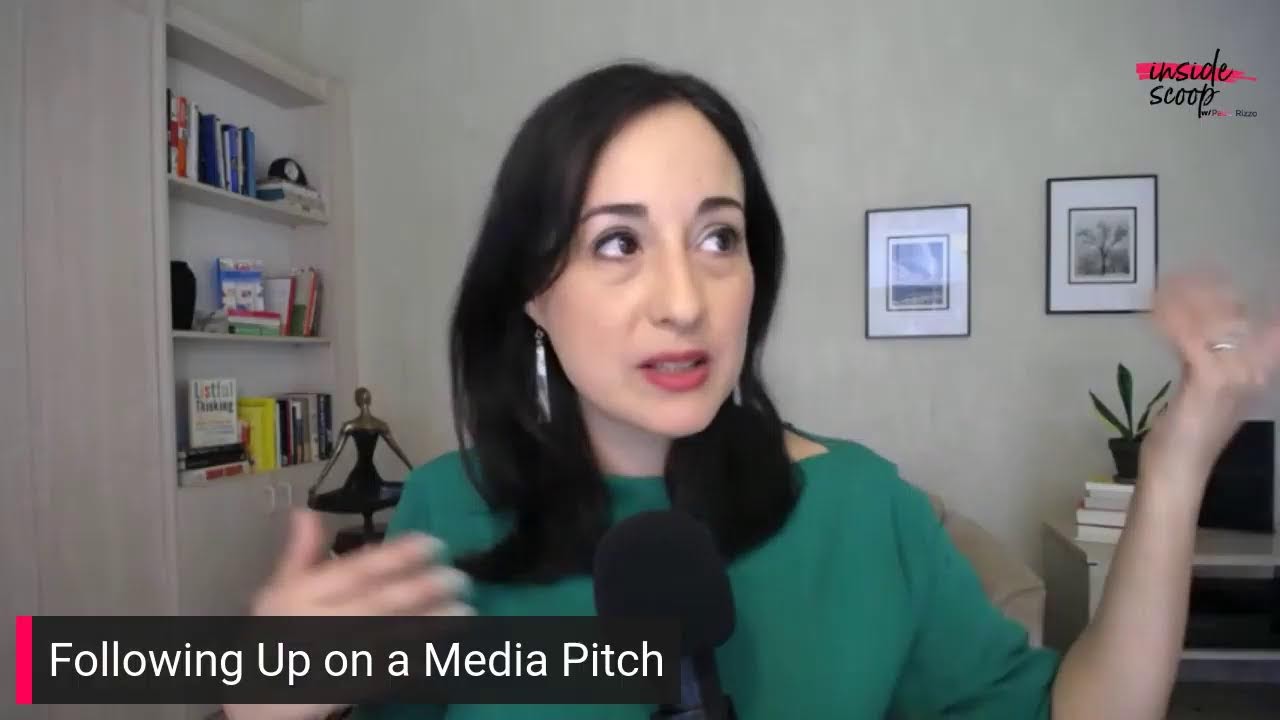
Paula Rizzo, a TV producer for nearly 20 years, breaks down how to pitch yourself to media. She teaches a three-part formula: hook, twist, takeaway. When pitches fail, create your own content instead.
Chapters
Hey there, I'm Paula Rizzo. Welcome to Inside Scoop. You have something that you're excited about and you want the media to know all about it, but how do you get the media's attention? Okay, so this is something that I have been asked time and time again. I have worked in media for— oh my gosh, it was close to 20 years as a TV producer, uh, in local and national news in New York City. And so I have received many, many pitches through the years, some good, some really bad, uh, some that became awesome segments and some that never saw the light of day. And now as an author, I have also been on the other side of this. I've had to pitch myself to media as well. And so I do talk about this quite a lot, and I try to help authors and entrepreneurs and experts to be out in the world and be able to talk about what they do and pitch media. Uh, so I'm going to give you my formula on the best way to do it. We're going to talk about the elements for the perfect pitch. But first, I have a little freebie for you. It is my checklist to become a go-to media expert. Now, this checklist is something that I put together, you know, as someone who's a TV producer for years. You can also check out my list making. I'm a big list maker, as you know too. This is, uh, my list making starter kit. Um, but this is the checklist. This is what— this is the goods for you. Uh, if you go to paularizzo.com/checklist, or you could use that QR code right there, you can check out my my list basically, because I can't help myself. All I do is list making, um, to, to find out, you know, what the media is interested in, how to get your message out there in a bigger way, and then how to get producers to continue to come back to you time and time again. It's something that as a TV producer, I knew, you know, the types of experts that I wanted to work with again and again because they made my life easier. Uh, and now as an expert, it's what I try to do to be able to get, you know, repeat Hits on TV to be able to continue to, to talk about, you know, my books, Listful Thinking and Listful Living, and what I know as an expert. So I hope that you check that out. I'm also a LinkedIn Learning instructor. And so you can check out my courses. Those are my books right there, Listful Thinking and Listful Living. And, you know, I have several courses on LinkedIn Learning that are based on those books. But I do have one course, External Communication Skills for Leaders, that is a media training course. You can check it out if you subscribe to LinkedIn Learning. You can use that QR code or go to LinkedInLearning.com and check it out for sure. And I want to hear from you throughout the show. If you're watching the replay and you're like, hey, I have a question about how to pitch the media or these elements of a perfect pitch, leave your questions below. Tag a friend who you think could be interested in this, who might have some questions or who's been doing this, or maybe you sent out a pitch and you never heard back and you're like, what is the deal? I'm going to tell you what the deal is and how to fix that. Okay. So let's go through the importance first of a media pitch. Why do you need a media pitch? Well, a lot of times people think, oh, well, the media, won't the media just find me? Hmm. They might, right? That might happen. That's a good problem to have. Uh, but as I work with many people, media training and, you know, working with them, they are terrified. If someone reaches out to them that way, they would say no. Even people who've done media before. Uh, I have a client who recently was asked to go on a major TV show, and she said she was not— didn't feel ready to do it. This is someone who's been media trained, who'd wanted to do this, and I pushed her. I said, you gotta do it, right? They found her, which is really exciting, but that's not always how it happens, right? You have to tell them that you're there. You have to have evidence out in the world that you talk about this thing. You know, I've been writing a blog post about list-making for 10 years. And so I became an expert in list-making and productivity tips. And I started to pitch media very early on before I had a book. That's important too. Don't wait until you have a book to do media. You want to be comfortable talking on camera. You want to be comfortable pitching media. You want the media to know you so that when your book comes out, you're able to say, hey, remember me? You really like my tips. Now I have a whole book about it. Can you have me on? It's a much easier sell if they already know you. So that is the importance here. You have to tell people that you're there, that you're available, that you want to do media. Okay. Now there are 3 elements to the perfect pitch, the hook, the twist, and the takeaway. So let's take each one individually. The hook. The hook is why now? Why is this idea, this story, this thing that you could talk about interesting right now. Let's take, for example, something I recently did, um, with PIX11. So Channel 11 in New York City books me quite often because I pitch them things that they're interested in. I know that their audience at 4 o'clock is mostly women. That's the demographic watching. And so I've recently pitched something for spring cleaning. As of this recording, this is— we're recording this in March 2023, and so it, you know, it's, it's springtime. People are starting to think about spring cleaning. So I pitched spring clean your digital life, right? Your apps and your email and stuff like that. That is the hook. That's the why now. Why should they do this now? So anything that has to do with what's going on in the world, or if there's a breaking news story or something that you're an expert in is happening in the world. You know, I don't know if you're a sleep expert and some, uh, you know, some celebrity says that they have sleep apnea, you better believe that they'll be interested in finding an expert on sleep. Who can talk about sleep apnea because now such and such celebrity has it. Do you see what I'm saying? That's the hook. That's the why now. So that's very important. And not everything has a hook. So sometimes you have to kind of give it one. Uh, the next part is the twist. So how is this different from everything that has already been written about it? Now take this with a grain of salt because there's, you know, there's no new ideas in the world. I realize that. However, if you were to pitch me something that was about stress and you tell me that stress is actually good for you, hmm, my ears perk up and I think, oh, that is an interesting twist that I've not heard before. And guess what? I was pitched that by Miss Heidi Hanna, who is a good friend of mine, author, uh, and she pitched me when I worked at Fox News. And that was the pitch, and I booked her again and again because she had a very counterintuitive way of thinking about things. So How can you twist whatever it is that is already thought about this topic? Okay. So we have the hook, we have the twist, and then the last part is the takeaway. So the takeaway is literally what does the audience take away from this segment? Okay. So for my digital decluttering thing that I did, uh, the takeaway was that I gave them very actionable deliverables of what to do with their inbox. What to do with all of the clutter that they had on their desktop. Here are some things that you have to go do right now. People may have gone and done them. I hope they did. I don't know if they did or not, but that is the takeaway. Right. And so with the stress example, the takeaway was that, okay, I don't have to be so freaked out by stress. It's actually there for a reason. Here's how I can harness it. And she told us how to do that and she told us why we stress and why we need it and all of that. It has that element of like, what do I do with my life now that I have this information? It shouldn't just be like, oh, that's a nice to know. I'm glad we know that. Right. You do need to have some sort of takeaway for the audience to then, you know, live their life differently. That's the whole point. TV, especially, you know, media is a public service. It's something that we're here to teach people, to tell people how they can live a better life. That I have always believed. So you have to be of service in any way that you possibly can as an expert. Now, if you have done all of these things and you say, but Paula, I did the hook, the twist, the takeaway, and I heard crickets. I understand it happens. Okay. But how do you follow up? The follow-up on a pitch is almost more important than the actual pitch itself. Unless you already have an established relationship with someone in the media, with an editor or writer or freelancer or producer, it's hard to get their attention. You know, they're getting thousands and thousands and thousands of emails legitimately every single day. Everyone wants their attention. Everybody wants what they have. And so they miss things. You know, I know myself as a TV producer for years, I would get a pitch and I'd say, oh, you know, that's really interesting. I really think that'd be cool. And then 10 other things happen and I completely forget about it and I move on and I didn't write it down. Even though I am a list maker, I didn't write it down. I didn't get to, you know, put it, put it on my list or whatever it was. And it just floated away. And it wasn't until the expert then replied back again and said, hey, you know, I was wondering if you were interested in this topic, and then basically repitched. So you never want to say, what did you think of the below? Because then that means that the reporter or the producer, whoever, has to scroll down and reread your pitch and re-understand who you are and all that. You don't want to do that. So what you want to do is basically repitch in that follow-up email. And so often that will get you looked at. So you want to give some time in between, a week maybe. If it's time pressing, you might want to do it a little bit sooner to do that, that follow-up. But really give the nudge. Maybe you want to do it once. I don't know if you want to do it twice. You could if you want to, but then I would leave it be. Then just say, OK, fine, I'm going to move on. But here's what you can do. The world is now much different than it used to be. You could create your own videos. And talk about that topic. Right. One of the things that happened when I was on PIX11 recently talking about my digital decluttering was that we had prepared for several different tips that I was going to give and we ran out of time. It's just what happens. And so there were two tips that I wasn't able to give. And guess what? I was like, you know what? I'm going to pick up my phone and I'm going to do some Instagram stories and tell people the other two tips that I was going to talk about because I, you know, I prepared them. Why not? So you can do the exact same thing. If the pitch doesn't work out, you can always create the content for yourself and then use that as a pitch later. The thing that's really great about following up and getting into the inbox of journalists is that you don't know when they might need you, right? So like they might not need you now and they might say, "I don't love that topic, but that person was interesting or they were good on camera or whatever it is." As a producer, I used to go through my email all the time. Like, oh, now I need a cardiologist to talk to about whatever. I would literally just put in cardiologist in my email because I knew somebody at some point emailed me about a cardiologist. So it's the same thing for you. You want to be in that inbox to be found. I hope this was helpful for you. Um, it takes a little bit of practice, it takes a little bit of, you know, patience, of course, but I want you to be thinking about it and to be doing it and, and, and to put yourself out there and not wait until, you know, the book comes out or the product comes out or whatever it is. I want you to be ready now. Uh, you could check out my checklist to become a go-to media expert, which will definitely help because it has a whole bunch of, um, you know, things in there of how to keep the media interested, how to get your message out there, and how to make, you know, producers really like you, become their go-to experts. If you go to paularizzo.com/checklist or use the QR code right there, you can check it out. If you have questions, please leave them below. I would love to answer them. And I'm thrilled that you're here. Thanks for joining, and we'll See you next time.










