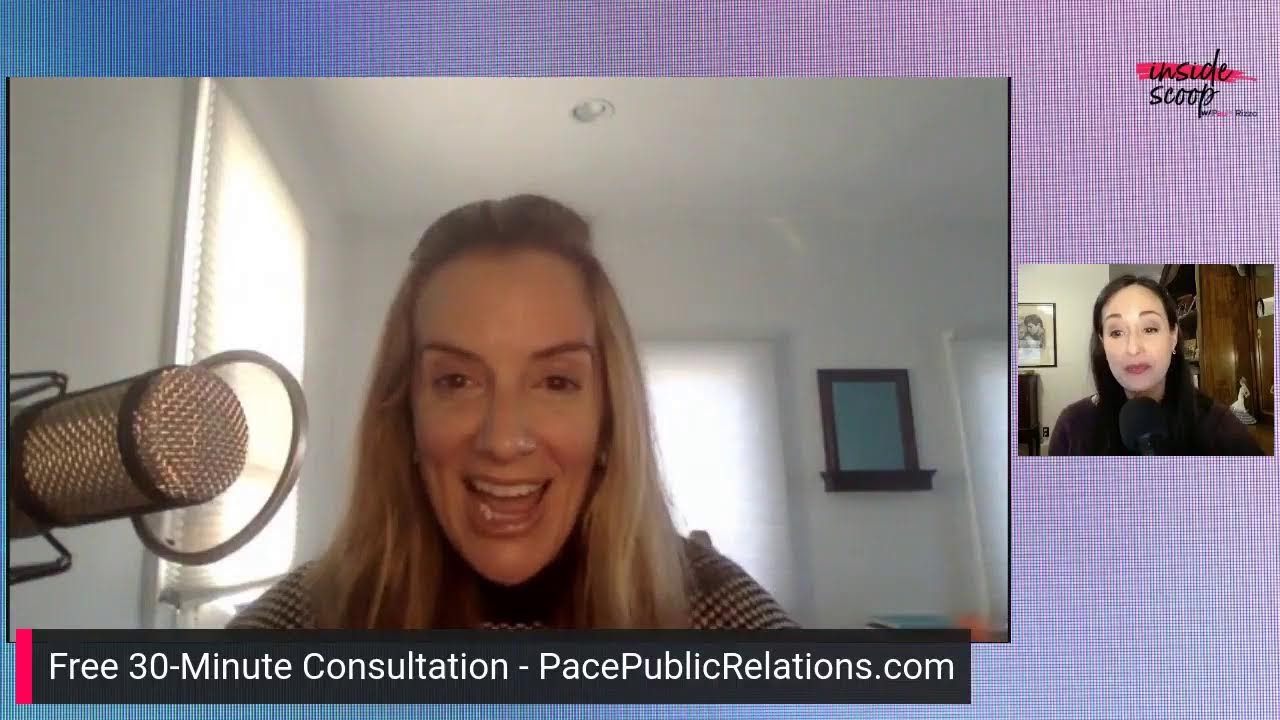
Annie Scranton, a PR professional, explains how virtual studios have made TV appearances more accessible and why a polished video clip is your best entry point to media bookings. She covers media training, building a media kit, and using each appearance for SEO and social sharing to amplify your reach.
Chapters
Hello, hello, hello. I'm Paula Rizzo. Welcome to Inside Scoop. Don't you hate it when you're watching TV or watching a news program and there are some experts on there and you're thinking, how the heck did they get that? How are they there? I know more than they know. I know, I know. Sometimes it happens, but you know what? You know how they got it? They put themselves out there. They pitched. They were able to say, "Hey, I know something about something." Maybe they're not the best of the best, but I'm sure you have some things to say. As a former TV producer, I have made it my mission to be able to help people who want to be known for whatever it is. If you're an author, if you're an entrepreneur, business owner, executive, and you want to be out talking about what you know. I want to make sure that you feel the confidence to do that because as a TV producer, it always really broke my heart to not be able to bring people in who, who, you know, they weren't savvy. They didn't know how it worked. They weren't able to look good on camera or they didn't know how to speak in soundbites and things like that. But we're going to be talking today about the future of PR because a funny thing happened during COVID-19. A lot of opportunities actually opened up. Because the world is not the same in so many ways, but also in how we communicate and how we get out there and how we spread our message. So I'm going to be talking to a friend of mine and a fabulous PR guru in just a second. I'll bring her in to say hello. Um, but I also wanted to tell you about my checklist that I have, uh, to become a go-to media expert. If you go to paularizzo.com/checklist, I have, uh, you know, a checklist being that I love lists, you know how I am, all about, you know, what can you do to put yourself out into the world, because a lot of times experts don't know what the first step will be. And I give you some, some tips there if you check that out. I'm also a LinkedIn Learning instructor and I have a bunch of courses there. And if you go to actually paularizzo.com/linkedin, you'll be able to check out all my courses. I have a whole bunch on list making, how to set up your remote office for maximum productivity. And, you know, I have some on boundary setting too, which is, you know, really great. So if you go to paularizzo.com/linkedin. Be able to check those out, uh, and that, that's the, the deal there. But today I want to make sure that I introduce the very, very lovely, the very fabulous Annie Scranton. Thank you for being here with me. It's so nice to have you.
I'm so happy to be here.
Thank you. Of course. So Annie and I go way back because you were also a TV producer. Tell everybody a little bit about your background.
Well, I started my career pretty much straight out of college working in TV news. I worked at most of the major networks, um, from Fox News, where Paula and I got to know each other, to Good Morning America, MSNBC, CNBC, CNN, HLN. Wow, basically all of them. And I was what's known as a booker, so I was responsible for finding the great guests and then booking them to come on and be interviewed live on the air, um, by our anchors. And I did that for the first 8 years of my career. Wow.
Ah, I, I didn't even know all of these wonderful things that you, you did. You were at a lot of networks, a lot of stuff happening.
Uh, I moved around a lot because it was, you know, I found, um, in TV, whatever show you were working on, you got really siloed. Like, if it was a political show, you only booked politics guests. If it was a crime show, you only booked crime. And also, just to be honest with you, you know, the only way to make money in TV is to keep moving because then you can sort of like play your salary against another network. And totally, you don't go into TV news for the money anyway. So that was part of the reason too.
Yeah, we learned that. We learned that early on. That's why both of us have our own businesses now. So now you, you own your own PR firm and you have multiple, uh, people working for you to be able to get the word out. And you and I worked together in that capacity too when I was still a producer at Fox News. I would work with Annie some of her clients. And I'm glad that we're, we're now, you know, on this next level of our, of our careers and being able to, to still chat about it. But, um, COVID-19 has changed so many things, as I mentioned, and the opportunities for PR have also changed. So tell me a little bit about what's, what's different now.
Well, I think one of the biggest differences when it comes especially to broadcast television is that all of the studios were closed and most of them still are, at least in some capacity. So now guests that you see on the cable news networks are able to join virtually, you know, how we are talking right now.
Yeah, you can be anywhere over Zoom or Skype or whatever.
And so it's really democratized that process because, you know, when I was, um, at my firm, if I was taking on a client and they were based in rural Idaho, you know, that's not going to be an easy studio to find for a network to find, and then they would have to pay for it because it's not commonly used. So now it's just been able to really level the playing field and allow a lot of other voices, um, to be out there on cable. Yeah.
And, you know, it's interesting too because, um, you know, one of the things that, that people would often say, you know, even when I was a producer, it's— they would say, oh, I'll fly to New York, I don't care, I'll come on my own dime. What a lot of people don't realize is that, you know, unless you're on one of the big shows, uh, they're not flying you in. You're coming on your own dime. You're gonna just show up because you want to be on that show so, so badly that you will do that. But now, right?
I mean, no, 100%. And not only will they not fly you in, but you could potentially pay your own way and get to New York, and then there's a major breaking news story, and then you get completely canceled.
And yes, exactly.
I've had clients in that situation, and it's like the worst, the absolute worst. But with news, I always say, and TV, I always say, until you are sitting in the chair actually doing the interview, don't even depend on it. Don't even count on it because there's so many factors.
You never know. You never— you really don't. And, you know, and a lot of times people will be like, oh, you know, well, uh, if you don't play the game the right way, you know, and if you, if you complain about it as the guest those producers are never going to book you again. You know, it's like they want to know that you know how it works, that you're able to go with the flow, right?
So I always say to clients that it's— you have to really— it helps to think of it as not a 50/50 relationship, but a 99-to-1 relationship. And you know, that may not be the right or best way to think of it, but in my experience, you have to— you know, the producers are the one that holds all the power, and so they're the ones that can control who comes on, who, who they put in front of their anchors and their executive producers. So, you know, it's, it's really to your benefit to do all the work, be as kind and cordial and helpful and flexible as possible. And then when you do get on the air, you're going to see such a reward and a benefit from just a 4-minute interview on a network. You're going to immediately see a return on putting in that time into it.
Yeah, for sure. And what about as far as, you know, the, the way that it works with the types of media that you're doing? So now anybody can start a podcast, anybody can do a video show, obviously, I'm doing it right now. You don't start at the tippy top, right? You're not going to be as a guest, you don't start on the Today Show or Good Morning America, you have to work your way up. So what is it that you tell clients to kind of, you know, get practice doing it? Because not everyone is a natural right off the bat.
So we, you know, there's a lot of different streaming networks out there, um, uh, like Cheddar or CBSN or Yahoo Finance that it's a little easier to get booked on than cable. And then the hierarchy would be then national network, you know, like ABC, CBS, etc. Um, you know, and there are also, I think a lot of times we put our clients on local TV, you know, wherever they're based. Um, you know, the, the point is, is that it's in easier booking if you've never done television and you don't have any broadcast experience, because the very first thing before you get booked that a producer will ask is, let me see a clip of, of the guest. I want to make sure that they have a good presence, that, you know, they don't have like their two front teeth missing, that they know how to string together a sentence, right?
Like, that's— I mean, as producers, you, you know, and you know because you did this for many, many years, you're looking, you watch that video, 15 seconds, and within 15 seconds you know, is this somebody I want to book? Is this someone I want I'm going to put up against my anchor, depending on what the segment is, right? Because sometimes, right, sometimes you want to make sure it's someone who has an opinion, who'll be able to go to bat for their opinion and not, you know, back down, because that doesn't make good TV. You want to make sure that if you're going to have two opposing views, someone's going to be really strong.
Well, that's exactly right. I mean, we want to be, we want to be providing to the producers on behalf of our clients the most compelling and interesting perspective and point of view. And sure, but then when when you get on camera, there's the performance aspect that you have to account for. And that is something that, you know, does come naturally to a lot of people, but you can— you do media training, like you can train and get better at it. Um, you know, like, but, but without that sort of, um, connect and the way to sort of be telegenic and sort of, you know, really speak to a larger audience, you may not get asked back, um, if you don't do a really great job.
Exactly. And that one clip that you have, hopefully that's very good, that will be able to be your, you know, your gateway to media because then media begets media. One media outlet sees that you were, you know, fantastic, then they'll want to book you too. They may find you on their own or you have to, you know, have a publicist or you're pitching yourself to be able to say, hey, I can do this job.
Well, exactly. And you know, there's more than one way to skin a cat, you know, to get on TV. Like we, an example I talk about a lot is one of our clients. Wrote an op-ed and we got it placed in The Hill. Then we pitched her to be a guest on Morning Joe on the topic of her op-ed. They booked her, she went on Morning Joe, and then we noticed two nights later The Daily Show with Trevor Noah played her clip from Morning Joe on there. So, you know, it just sort of is— it can happen in sequential order like that, you know. Um, and, and then you get so much more bang for your buck. Um, than just one, one placement.
For sure. But that's the key here is that you have to be open to these kinds of opportunities. You know, I always tell people, don't be a snob. If you think it's like, oh, that's a, that's a tiny blog that no one reads, or, you know, that's something that, you know, whatever, it's a podcast that nobody's ever heard of. It doesn't matter because producers and editors and bookers, they're looking at all kinds of media to find their experts.
And also like your presumably you're, you're doing media and taking on media opportunities for another goal, whether it's to sell your book or to get more customers or clients or whatever. And I can tell you from personal experience, you know, I, I put myself out there for brand awareness for my company, and I have had so many times doing much smaller shows or podcasts or whatever, and I get leads for potential clients. You know, we were just chatting right before we started. A client of mine years ago was an author. She had a book out, and we were so excited because we got her booked on Live with Kelly and Michael. It was at the time she did this whole segment with them. It was awesome. We were so jazzed. And then the next day she did a local talk radio show in Minneapolis where she's from, and she was able to track and found out that she sold more books from doing the radio show than she did major national TV broadcast. So that's the thing about media is that very unpredictable.
Yeah.
And, you know, you have to do a mix of a lot of things, um, to reach your goal. But absolutely, the smaller stuff has a lot of value.
Oh, for sure. And, you know, it, it's not that you have to start at the tippy top. And if you, you know, unless you're Beyoncé and you're selling a book, you know, you go on the Today Show, you're gonna sell some books. Everybody else is not going to sell books when they're on TV, for sure, you know, unless, you know, you're on one of those like home shopping networks where you're supposed to be selling things. Um, podcasts will be able to be much more, um, I think, right, you'll be able to, to, to sell more things through podcasts.
Well, I think when you're on a podcast, or I listen to a lot of podcasts, I tend to be much more engaged and really listening than if I have on, you know, a news program in the morning. I'm sort of making breakfast, breakfast, I'm running after my daughter, like whatever. But when I'm listening to a podcast, I'm either driving or out for a walk, or I'm falling asleep at night, and it's more like gets in your brain. But what I was going to say about TV, it's also there's so much, there's so many more things that you can do to sort of maximize your broadcast experience. So if you are fortunate enough to get on, say, the Today Show, of course there's going to be millions of people watching you in that moment. But afterwards, which even, what's even more important is the link, is the clip you're going to get.
Sure.
If you then invest a little bit of money in SEO, search engine optimization, you make sure you're putting it on social, you're putting on your website, you're sending it out in your digital newsletter, you're going to be able to make sure that even more people see it and you're going to see more benefit.
Right, exactly. So you want to be able to leverage that media hit. So even though you might think like, hey, oh, you know what? Not many people watched it or what, who cares? You now have this amazing clip that not only can you pitch more media with, but you can use it as an asset to, you know, be able to spread the word. And to your point, it's about brand awareness too. There's, you know, you can't really put a dollar sign on that, but for people to see you, they think, oh, you're everywhere now. I saw you did this and you did that and you're on that podcast. And, you know, it just really raises your, your level there.
That's exactly right. And it's also, to the point you just made, it also raises your legitimacy and your credibility. So there's nothing else that can, in the eyes of so many people, make them say, oh wow, she must be so legit, than if you were on CNBC or quoted in the Wall Street Journal or whatever, because those are real news outlets where they have to do research and digging and reporting. And, um, for many of our clients, it's helped them get new customers or new business because it sort of sets them apart and gives them that competitive edge.
Yeah, exactly. You just want to be seen as the person who's doing it, who's out there. We have a question that— from a— from someone who's watching live, uh, who's asking about your opinion on ebooks. And before I let you answer, I just want to give people a little perspective on, you know, back in the day when we were TV producers, ebooks were sort of new, self-publishing was new, and I mean, I don't know about you, but I was pretty snobby about who I would book in the beginning. It was like, I'm only going to book traditionally published authors and ebooks are not a thing. We want to see a physical book. The world has changed. So what do you think now?
It's definitely changed. And I mean, if you are in a position where you can still get a traditional book deal, of course that's going to be the best. But let's face it, the publishing industry has changed so much and they're not making money the same way that they used to. My opinion is right now is that if you self-publish and you have an ebook, as long as you position yourself and the book correctly, it can be just as impactful as having a traditionally published book.
Good.
So that's—
so there you go. You, you know, you can absolutely make your, make your dent however, however. You know, another thing too that, that I found is that, uh, in the very beginning when I first, you know, Actually, right before I left Fox. So I've been out of there for 3 and a half years now. And I'll never forget, one of my last bookings was Peter Shankman, who you probably know for years, is the creator of HARO, Help a Reporter Out. But he had just started a podcast and we identified him as a podcaster. It was probably the first time I had ever booked a guest where that is what we said he did, even though Peter Shankman does many things and he's written many, many books and things like that. But have you found that that also has changed? Like that you don't have to have a book, like you just, it doesn't have to be that.
Oh yeah, you, you totally do not need to have a book to be a credible expert or thought leader in the space. I mean, your resume and where you've worked and the experiences you've had will speak for themselves, and that will be what legitimizes you in the eyes of the media or a TV producer. However, having a book just adds to it. It also gives, gives you a reason to have create a sense of urgency when you're reaching out to a producer because you can say, my new book is about to be come out on such and such a date. And then there's that little news peg. Yes.
Yes. And let's be clear on what new means. How long do you think is a new book?
I mean, um, so I can pitch a book for— I can pitch the author as a thought leader years after the books come out.
100%.
I want it, but if I want to just get PR for the book or have a segment about the book, the week it's released, maybe, maybe it can last a few weeks, but it's, it's really right around the time it comes out.
Totally. And that's something that I think, you know, a lot of people don't realize, that, that in the media, new means really new. Like, once your book is a month old, 2 months old, it's old. It's, you know, it's out, it's out. Now there's 100 other books that just came out this week. So, you know, in, in the, in the world of TV news, we move so fast that it's, it's done, you know, that's it. However My first book came out 6 years ago and I'm still talking about that thing and I'm still being, being booked, you know.
If the topic of the book still has a relevancy to current news or current trends, you, you should still use that and you should still pitch yourself, you know, saying that it's the— you're the author of that book and producers will still introduce you as the author and show the book cover, um, if you ask them many times to do so.
Yes, exactly. You make sure you know what to ask for, right?
Exactly.
Yeah. Yeah. We're getting some, some wonderful love in the comments below. So thank you all for, for, you know, writing in. Jonathan says, "Great insight." Kate Hanley said, "Awesome tips." We had Connie who said this was great. So there's a lot of, you know, a lot of, a lot of PR love. And of course, you know, Annie is happy to chat with anyone who's interested to do a free 30-minute consultation if you go to pacepublicrelations.com. And Annie, I want to, if anyone else has any questions, please put them in the chat box for us. But, and we'll get, get to them. But Annie, I want to ask also about you as a business owner. You're using your own PR tricks that you tell your clients to do for yourself, to be able to give yourself some visibility and get yourself out into the world so people know about you. Tell me about your strategy around that.
A few things. My cousin is a whiz at SEO and I have retained her for years now to optimize our website, um, and certain, and certain keywords. So I think if you type in NYC PR firm in Google, we're on the first page, which is like pretty impressive considering we're not a massive PR agency like Edelman or whatever, you know. Um, I'm very active on LinkedIn because I find that for me that's where a lot of our prospective clients are on the most in terms of social media. Um, and I try I just do some media when I can, like this podcast, and I do various speaking engagements on entrepreneurship or media or women in the media, um, things that are very relevant to my space. But I think if you're a business owner and you don't at least carve out some time to really promote your business and yourself, you're, you're just leaving opportunity on the table.
Yeah. And, and you do have a podcast too that you host, and I've been a guest on it. Thank you very much. You're welcome. Uh, but you know, it's important to be the one leading the conversation too. You know, so that people see you and that they remember you. It's, you know, I always think about real estate agents. You know, you've probably gotten the postcards in the, in the mail, or if you live in New York City, you know, they've sold an apartment in your building and you get the postcards and they tell you, oh, we sold such and such for whatever. And you're like, I don't care right now, I'm not selling my apartment. But when it's time to sell that apartment, you're like, you know, what about that woman who I got the postcard from?
Well, that's a very old school way of doing it, you know, but it's To your point, that's, that's really part of PR is that it kind of has this intangible quality where, yes, you hope there's a direct correlation between interview and what will happen afterwards, but there's also this less quantifiable aspect of it where you are just getting in the mind, kind of getting in through drips and drabs of getting into people. And I've had so many people just just say, oh, I saw you post something on Facebook and it reminded me I wanted to reach out to you about this or that. And so, you know, you have to carve out the time to, um, to do that for sure.
And it's the new way to stay top of mind, you know. You see people and they, they pop up in your feed and, you know, they're like, oh yeah, that's what she does, you know. You just want to be, be where people, you know, need you.
I've had people from high school that I haven't talked to since high school, which is more than 20 years ago now, who, who then reach out to me and they're Oh, I know you do PR and the company I work for is looking for an agency. Can we talk? And it's so flattering, but I know it's because they see what I've posted. You know, it's as simple as that. Yeah.
And you're, you're, you're sort of training people to know what you, what to use you for in that way.
Yeah.
Yeah. Wow. Well, we've gotten a lot, a lot of love in the comments. So thank you to everyone who has, who has asked questions and, you know, for the replay as well. If you're watching this after it's live, leave us some questions or comments in the in the chat boxes below, and Annie and I will be furiously looking in there and giving you some tidbits ongoing. So thank you for joining us. And Annie, again, tell people what this 30-minute consultation would be like if they go to your website at pacepublicrelations.com. Oh, did I lose you? Maybe I lost myself. Oh no, I lost my Annie.
I'm so sorry, my internet, my internet just freaked out for one second.
I apologize. This is what happens. But you know what? This is a great opportunity, Annie. If this happens to someone in live TV, it is what it is, and you gotta just roll with it, right?
And I hope that I looked normal while—
You did, you were still smiling.
Okay, so, so smile. Always pretend like you're still on camera even if you think you're not. Don't start yelling shit and others in the background. Just, you know, just be, be like you're still on camera. And, you know, just also my advice too is like, it's— or my colleague Rose often says, it's PR, not ER. You know, nobody's lives are going to be lost in the making of this podcast. We will figure it out, you know.
Absolutely, absolutely. Well, the question I had asked was about the 30-minute free consultation that you offer. What, what will people expect for— should they expect from that?
Sure. So we started offering it during, um, the onset of the pandemic as a way to kind of give back as in any way that we could, because so many businesses were finding themselves in a situation where they were immediately losing tons of business and, and also maybe, um, recognizing an opportunity to pivot within their business. And so the consultation will be a chance for you to tell me about your business or about your, your business plan, your business model, and then I can offer hopefully some advice on how you can, um, slowly start to build media and start getting a buzz and attention for your company because there are many things that you can do yourself with if you don't have the budget to hire an agency.
Oh, that's interesting. So to be able to, you know, not everybody else is, is ready to hire a PR agency and not everyone should, you know, they might not be ready. And, and, you know, you want to make sure that you are in the best possible position to set your publicist up to get you some good bookings. Cause you know, I mean, sometimes people hire publicists thinking, oh, this is going to be it. I'm going to be on every TV show. And they're just not ready.
Well, I mean, you have to have the, the infrastructure in place before you can really go and publicize it. Meaning you have to make sure your website is all perfect. You have the social media handles set and ready to go, that you as a company can handle an influx of new business if the media leads to generation of leads for you. Um, and also timing is everything, you know, and So, um, a launch is always a moment to sort of create press, but it may be more beneficial in the beginning to go use those marketing dollars for maybe direct marketing or targeted ads or something. There's a lot of different ways out there that you can go about getting your brand out there, and PR and media relations is just one aspect of that.
Yeah, absolutely. We've been getting some, some good messages. Julia's saying, great reminder. Uh, Jonathan says, it's been really helpful to hear this from a PR practitioner in this era Metrics, not everything is tangible. Very true. You're not always gonna know, you know, and people might not even remember where they saw you, which is okay too, as long as you're there. Yeah, it's fine. It's— I mean, it's, it's easier if you, if you— for you to be able to say, oh, that was really worth the opportunity, I'm glad I did that. But you know what, you got to just keep doing many things. You just have to get it out there. Um, Peru says very, uh, very generous. Yes, thank you. And she'll be booking a consultation with you. So that's awesome. So if you see Paru. And Karina, totally agree, PR person here saying, you know, you guys are preaching the same language right there. And Paru says, so true about the postcard. Oh, when we were talking about the real estate agent. She met Annie in a previous life, but her CEO at the time did not have an appetite for PR. And now she's watching this and what she's thinking because she has her own business. She is now a CEO of a company, right? Like, life is true. Yes, amazing, amazing. Well, fantastic. And Annie, it's been a pleasure. Thank you so much for, for popping on with me and chit-chatting. And, uh, to be continued. Hopefully we'll be able to, to team up and do some other things that'll be fun.
And I have to say, it's really nice to be able to continue the relationship as the years go on and our, our businesses and careers progress. But thank you for having me. This was so fun, and I hope people found it useful.
Me too. Well, thank you, thank you, Annie. And to all of you, thanks for, thanks for watching, and I will see you next time.










