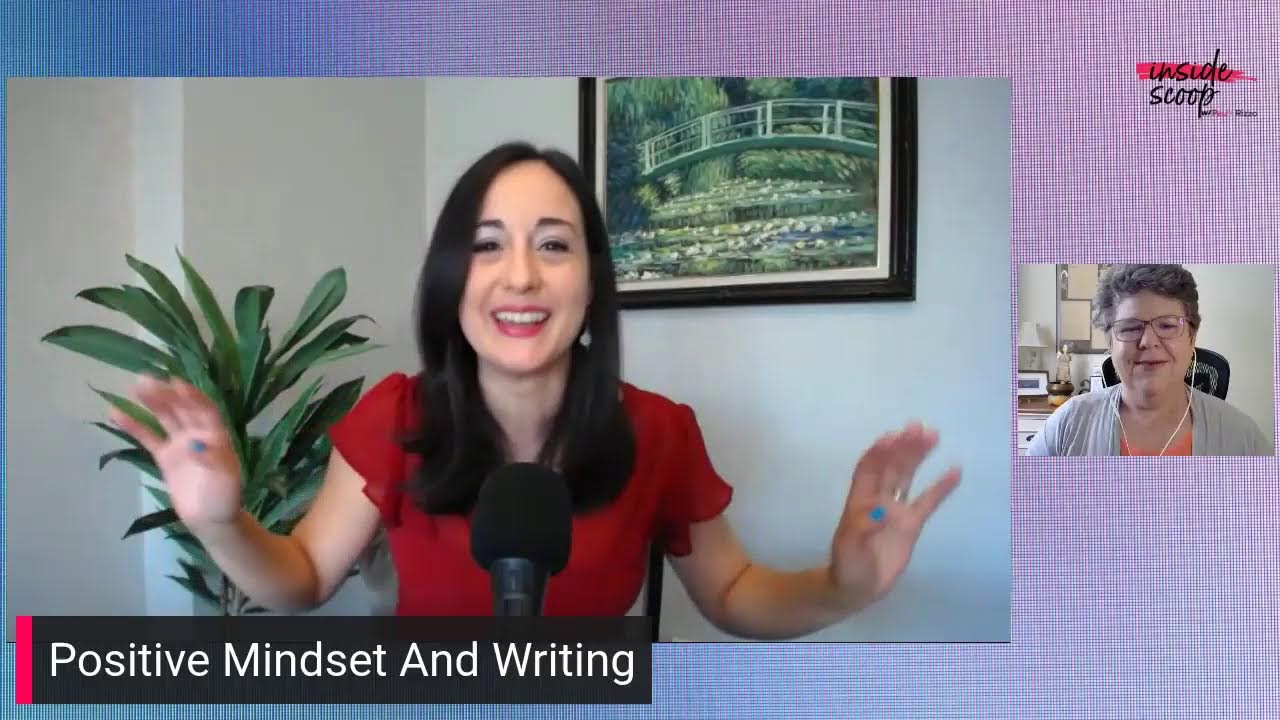
Paula Rizzo talks with author Polly Campbell about maintaining a positive mindset through micro-habits like two-minute gratitude exercises and mindful breaks. Campbell describes recognizing burnout in her dream job, reframing rejection with curiosity, and linking purpose to happiness and resilience through the concept of ikigai.
Chapters
Hey there, welcome to Inside Scoop. I'm Paula Rizzo. I know the to-do list is never ending between work and home and this and that and your hobbies and all the obligations that you have in your life. I get it. And we become sort of desensitized to it all, right? You just keep adding it and you keep doing it almost like a robot. And then we forget that we actually should be recharging. We should give ourselves a chance to calm down and Part of that is having a positive mindset. So mindset is a big thing and it sounds really easy. It's like, oh yeah, I'll just be more positive. Not that easy. I know. Uh, so I have an expert today who I'm going to bring on in just a moment to talk about maintaining a positive mindset in everything you do as you're creating goals for yourself, whatever it is that you have on your plate and being able to make time to recharge because that's the important piece that a lot of us miss. So I want to make sure we don't miss it. But first, I have a resource for you that I think you'll really like. It's my list-making starter kit. So if you go to paularizzo.com/list, you can grab that. And it's, you know, all things list. And if you love lists, I hope you join me over there because I have a few tips and secrets and things that I think will make your lists even better and less stressed. That's the important part. We don't want you to be overwhelmed. So you can grab that there. And I'm also a LinkedIn Learning instructor. And so I have a whole bunch of courses through LinkedIn Learning. All about productivity and a few about media training, because that is my background as well as a TV producer. But this one here, I think, is very, very interesting for this conversation, How to Set Boundaries and Protect Your Time. And you can use that QR code there or search for it on LinkedIn Learning. And the idea here is that, you know, if we're talking about positive mindset, if we're talking about making time for yourself and recharging, protecting your time is very important because there's going to be things that you have to say no to. It's not going to feel comfortable. It's not going to feel good, but you have to do it. And I— just trust me, when you start to do it, it'll start to feel better, and then you'll be addicted to putting boundaries up and protecting your time. So I hope you check out that course. And I would love for you to share this. If you have a friend or a colleague or someone who you're thinking, hmm, I think this person would really benefit from this conversation, just put their name below, tag them, uh, and, and send me questions. If you have questions, you're watching this on the replay, I'm always going to be checking. So leave a question below, tag your friend, be part of the conversation, and share it all around. I would so much appreciate it. So today I would love to bring on Polly Campbell, who is an author and a new friend of mine. She is the author of 4 books, she's a speaker, and she is a podcast host. Polly, hello! Thank you for, for being here.
Hey, I'm always looking forward to a visit with you, Paula Rizzo. I'm happy to be here.
I know, we became quick friends. I was on your podcast.
Yeah.
And we were just like, we want to hang out all the time, so let's just make up things to talk about. No, that's not true. We have some really good things to talk about here. So you have 4 books and the most recent one is very much all about mindset, maintaining a positive mindset around being recharged. So how did you get interested in this topic of positive mindset?
I've always been interested in personal development, but I call it practical personal development because I needed to find the, the little ways, the little tweaks I could make in my day while I was feeding the kid or carpooling or working to help me feel better. You know, it, it's been a lifelong learning process for me and a real interest area of mine, but I don't have, you know, $1,000 to go to a spa or a weekend retreat. I don't I cannot meditate an hour every day. It just doesn't work right now with my family, with my work. But you know what? I can take 2 minutes to do a gratitude exercise. I can take 2 minutes to go and wash the negative energy literally off my skin. There's some practices that you can wash your hands mindfully and change your mindset. I can do those little things throughout the course of my day to feel better. And When we feel better, we do better. And that kind of set me in the direction I wanted to go on the rest of my life. Yeah.
It's so nice because when you do see the difference that just a little bit makes, and that's— yeah, I think that's the big lesson here is that it doesn't have to be a week-long retreat. It doesn't have to be a 2-hour massage. It can be little pieces and things that you can fit into your day. And we have similar backgrounds because you worked as a journalist for a long time in newspapers. And I worked in television. You just are constantly going, constantly doing things. And so, it's nice to be able to— find ways to calm yourself down a little bit. And in your books, I want to just pop up your books there again so we could just take a look at all of them because you have been writing for quite some time. These are all of your lovely books. You can check them out at pollykampel.com/books and wherever books are sold, of course. But you recharged. Let's talk a little bit about purpose because if I were to give Polly a purpose, I would say your purpose here is to help people for sure, but being able to have a purpose in life really does increase happiness. I know this from studies that I've read and all of that, but could you tell us a little bit more about that? And how do people find it? Because I feel like a lot of times people don't know what to do.
Right. Well, and I think we make it too hard, right? You're exactly right. There's a lot of research now around this idea. Purpose helps us feel more fulfilled and satisfied in our life. It makes us happier. It makes us feel more productive. And we actually live longer because it can help ease our stress. When you're on purpose and something hard comes along, you don't sit there and beat yourself up. You say, well, this is hard, but this is what I'm meant to do. I'm going to keep on doing it. But we make it too hard. I think all we need to do is really identify our purpose. I don't think we have to go looking for it. I think we are living on purpose most of the time. Now, it might change in our expression of it. You know, when I was a journalist, the way I expressed my purpose was different than when I write personal development books than when I'm a mother. But I'm still on purpose trying to entertain, trying to inspire, trying to educate. That is my purpose. And I do that when I'm mothering, and I do that when I'm writing personal development books. And, and I hope I'm doing it here, you know, by when I visit with people about these ideas. So I think go into your life, look at the patterns of things that show up when you feel like you are having your best day. Now, it might not be your easiest day, Right. I think there's a lot of people that are activists in the world and, and feeding the world's hungry. And I don't think that's always easy work, right? Sometimes our purpose is really hard and really painful, but I'm sorry, my earphone keeps falling out, but it's when we are feeling like we have meant the most, when we feel most in alignment with our values, when we feel most connected to ourselves and to others. That's when I think we can start discerning the patterns of our purpose. When we're on— and your purpose can be delight, to delight. Yeah, to teach, right? It doesn't have to mean that if you— if your purpose is to teach, it doesn't mean that you have to be an elementary school teacher, and when you retire, you've lost your purpose. It means you will find other ways to express that purpose of teaching.
Yeah, yeah. I, I think part of it too is like also noticing yourself, and this is where people don't don't really check in after you do something. I started— when I started my own business, I was doing this quite a lot because I was like, okay, now I can, now I can really decide what I say yes to and what I say no to. It's not, you know, the work your boss gave you or whatever. So I would check in with myself and say, did I like working with that client? Did I enjoy that speaking engagement? Did I enjoy writing that book? Did I like promoting it? You know, and just check in with yourself to see what is, what is the stuff that's good. Because sometimes you think you know and you don't Totally no. And, you know, people do this all over the world. In my book, Listful Living, I talk all about ikigai. Have you studied ikigai, which is—
We talk about it in You Recharged. Yeah. You know, that thing that gets you going, gets you up in the morning.
Yes, the Japanese term. And it's very, you know, look, it's something that will keep you motivated to continue to go. So, you find your purpose, you're really excited about it, you're all into it, and then you burn out because you're doing too much of it. So, tell me about the You just told the story of my life.
You know, you asked me how I got into personal development. Well, these are the things I need to figure out, right? These are the things I'm working on too. And that's where I was. I created— I'm living the so-called dream job, right? I'm self-employed as a full-time writer and speaker. I love the work I'm doing. And I woke up in the middle of winter, which was dark and lonely and all the bad things here, right? And I had no energy at all. I'm like, I have my dream job. I have a a happy family, I have a great marriage, and I was burned out and didn't even want to go to work. And I was embarrassed about that because who am I? I created this circumstance for myself and now I don't even like it. And I've really had to back up and realize that, that writing was not my purpose. It was the education, it was the connection with others, it was the learning, it was the, uh, you know, inspiration I was providing. And at that time, I was doing a lot of writing that was really interesting, but I was doing it solely to pay the bills. And I thought, huh, I'm putting all my energy to this thing which is not in alignment with my— all my values, and it's taking me away from my purpose. It didn't have those other components. Now, I'm all for paying bills, right? I'm a writer. I need to make money too.
Got to do what you got to do, Polly. Yes.
You can align with your purpose while you're doing those things. And it starts with what you said. You got to start noticing. I didn't get up and quit all the work I was doing. I got up and I'm like, okay, what is draining me? What is taking me away from this thing? What is zapping my energy? And what is the smallest right thing I could do today to start boosting that energy again? Mm-hmm.
Yeah, for sure. And it does take these small, tiny little things that we can do to be able to, you know, get yourself realigned in a way. But let's talk about some of those. You talked about a few of them in the beginning, you know, 5 minutes of meditation. How do we identify what will work for us and what are some of those smaller pieces and things that you can work into your day? Well, really make a difference.
It's hard. And you and I have talked about this before in the sense that when we are feeling overwhelmed, the last thing we want to do is add something to our list, right? Yeah, we, we— the last thing I wanted to do in those dark mornings when I was reevaluating things was do one more thing when I was exhausted. So take the next best step and start with something you can do in 2 minutes, a gratitude list, or call it out, right? Just yell it out on the back of the couch in the dark morning. You just say, I am grateful for this couch. And be— to start looking at increments. I think you can get up and move your body, and I am not talking exercise, people. I mean, we know that's good for you, but initially All I started to do was stand up more, right? I just started moving my body. And then I became aware of the transitions in my day. So I would sit glued at the work table, working on the stuff that wasn't that meaningful to me. And finally, I decided, no, I'm going to get up and take a lunch break. Yeah, get up and walk around the block. I'm going to use the transitions of my day. Every time I go out to the car to run an errand or pick up the kid, I would do a little gratitude moment, or I would take a moment and breathe in the air. So it wasn't a about changing my schedule. It was about adapting my schedule to accommodate these 2-minute practices or these 1-30-second practices to really savor the moment I was in and search for the good. And when you challenge yourself to search for it, you start finding it everywhere. And that is a natural energy booster that changes our biochemicals. It makes us feel different in our brain, so it becomes easy to do the next time.
Yeah. And you know, I was listening to a podcast the other day and it was talking about negative things and how our brains are actually wired to latch onto the negative and to sort of ruminate on it because in evolution, we needed to know that there was a tiger coming after us and that's a bad thing. And so we needed to, you know, we didn't need to know that the flowers smelled beautiful. That didn't matter because it didn't, it didn't count towards our survival. So we are wired to sort of get the negative stuff and hang on to it. So we need to reframe that. Um, I have always been a positive person, seems like you have too, but it's not so easy for everyone. So for the people who struggle with positive mindset and maybe being able to switch this and say, okay, how am I going to do the positive? Like, I used to hate this couch, now I love it, you know, whatever. Uh, how would you suggest that people get started with that?
Well, first of all, I think it's okay to let yourself off the hook. You don't have to be wired for positive. You don't have to be positive all the time. I am absolutely not positive all the time. I think my choice is to not be negative all the time.
Uh-huh.
So I think the goal is to catch yourself in that moment and get curious. Don't be judgmental. Don't say, well, I got to think more positively, but just like, huh, I wonder why I'm noticing this. What else can I notice about this minute? And, and go looking for all of it. You know, we— it's okay to have negative feelings. What I don't want to do is dwell in the negative feelings. I want to notice them, notice the message, the cues that they hold, which is, hey, don't put your hand on the stove, that's going to burn you. Ouch. That's a negative feeling. Then I don't do it again. So use that information that's coming to you. If you need to get away, if you're feeling stressed out, then sit back and notice that. I'm feeling stressed out because I don't like this work. How can you reframe this? What can I learn from this moment so that I move more toward the direction that I want to go in my career or whatever it is? So I think often we think it's bad to feel one way or good to feel this way. I think our challenge and our gift as humans is to feel it all and then decide what's within it for us. And then I take a physical action. So if I'm really stuck and I'm reframing. I get curious and I'm like, okay, how can I reframe? I got a rejection the other day on an article I was writing and it hurt. I didn't like it. I was disappointed. I was surprised. I didn't like it. The very next thing I did is, huh, why am I surprised? What did I expect would happen? What were my expectations reasonable? Then that led me down the path, like, oh, maybe I can adjust this and get going. The very next thing I did after that was to write a new pitch for the same idea. I realized that there were things I could improve about that. So for me, it comes with an awareness, and then it comes with a minor reframe, a minor tweak of curiosity. I don't even feel good. I don't feel good about the rejection, of course. But when I'm moving into the physical activity, then, of writing a new pitch or getting up to walk around the block or putting a piece of toast in, then that physical activity takes me out of that stuck space and allows me to move forward.
That's a good trick. I like that. I like that. Because that is what stops people, right? That kills the creative process, rejection, right? You've done something, especially, you know, writers, you know, we're both trained as journalists. And so for us, I mean, we were trained differently. It's like, you gotta get something on the page, you gotta get something on TV. It's gotta happen. It's gonna happen with or without you. So we're working together, right? We're very deadline-oriented that way. But when you're working on more creative projects, things that are, you know, books and things, I work with a lot of authors. I media train them for their book launches. And a lot of times I meet them before the books are out and I tell everybody, "You got to start talking about your expertise, do media, do all of these things." And it's a hard road writing books, especially you're doing it yourself. It's a very lonely place to be typing and writing. And that motivation really needs to be there. But being able to use some of these, reframe your mindset is really helpful. How have you found that with writing and writing books? And these longer projects, you know, books do take forever to come out, so you're gonna be with this for a while.
Man, it is a long pro— it changes as I go, right? The first book, I was scared out of my mind, and then I started writing it, got really into it, and I had nothing at stake. I mean, I felt like I wanted to do a great job, but it was my first book. The books that have come after that have been harder because I have— I want to provide— I have higher expectations for myself, and I have to go and look at those expectations and, and Here's what I have learned, Paula Rizzo, that has helped me a lot, is it's that what I can bring as a writer is in the process of writing. It's the research I do, it's the interviews I do, it's the energy I bring to the page, it's a concern and care and commitment I bring. But once that book is done, it becomes a gift. And just like when you give somebody a birthday present, if I give them a candle that they don't like, it's up to them whether they ever burn that candle or whether they regift that candle or where they complain about that candle, but it's no longer my business. And I have learned that I'm going to give everything I can to that process of writing and create the best work I can for the readers and for the world and for myself.
Sure.
And once I, I'm done, it's a gift to whoever chooses to pick up that book, and how they use it is, is up to them.
I love that. That's such a great reframe, you know. It's sort of like the bless and release. Off it goes into the world. Do what you will with it. Enjoy it.
You know, I, I have to remind myself a lot of that though, right? Because it doesn't always come. These things I'm talking about with you, like I will literally put them onto my list. Paula Rizzo, I put them onto my list. Remember to get up at lunch. Yeah. Remember to release. Remember to go for a walk. Remember to take a break of quiet. I need a lot of quiet time to recharge. I actually write it down. So I give that time to myself like I would any appointment.
I love that because that's, that's a piece we start to say, oh, I should do that. Oh yeah, I'll get to that, whatever. But you really do need to put it on your list. Look, Polly does it. You should do it too. I mean, that's great. And there's a million different apps now that will ping you and tell you to do this and stand up and do all of these things. But it really is important to give yourself that little bit of break and rest and think through what your day should look like. I always give myself a lunch break because I get cranky if I don't have my lunch. Right. So I want to make sure you have a little bit. And I did that as much as I could, even when I was working in corporate America for someone else. You can do little bits of this. It doesn't have to be a lot. Well, Polly, this has been so helpful, such great ideas. I love, I love so much of what you've said, and obviously we will continue to be in touch. You have two podcasts, uh, which I am a guest on, which I love. So we're going to show those to everybody: Simply Said and Simply Write with Polly Campbell. There's the QR code there where you can follow. Uh, you also have a Substack, uh, so we're gonna make sure that people get signed up there. Of course, Polly Campbell .substack.com. And I would love for everyone to also check out your books, of course, if you go to paulicampbell.com/books. Paulie, thank you so much for being here.
Always a pleasure.
Yes, to be continued. Of course, I'm sure there's more for us to do.
We'll keep talking.
Yeah, absolutely. And I have a little freebie for you too before we go. I want to make sure that your lists are up to snuff. So if you go to paulirizzo.com/list, you can check out my list-making starter kit. Thank you for watching. Leave your questions below. Paula and I will have our eyeballs on those boxes and, you know, answer any questions you have. And I will see you next time.










