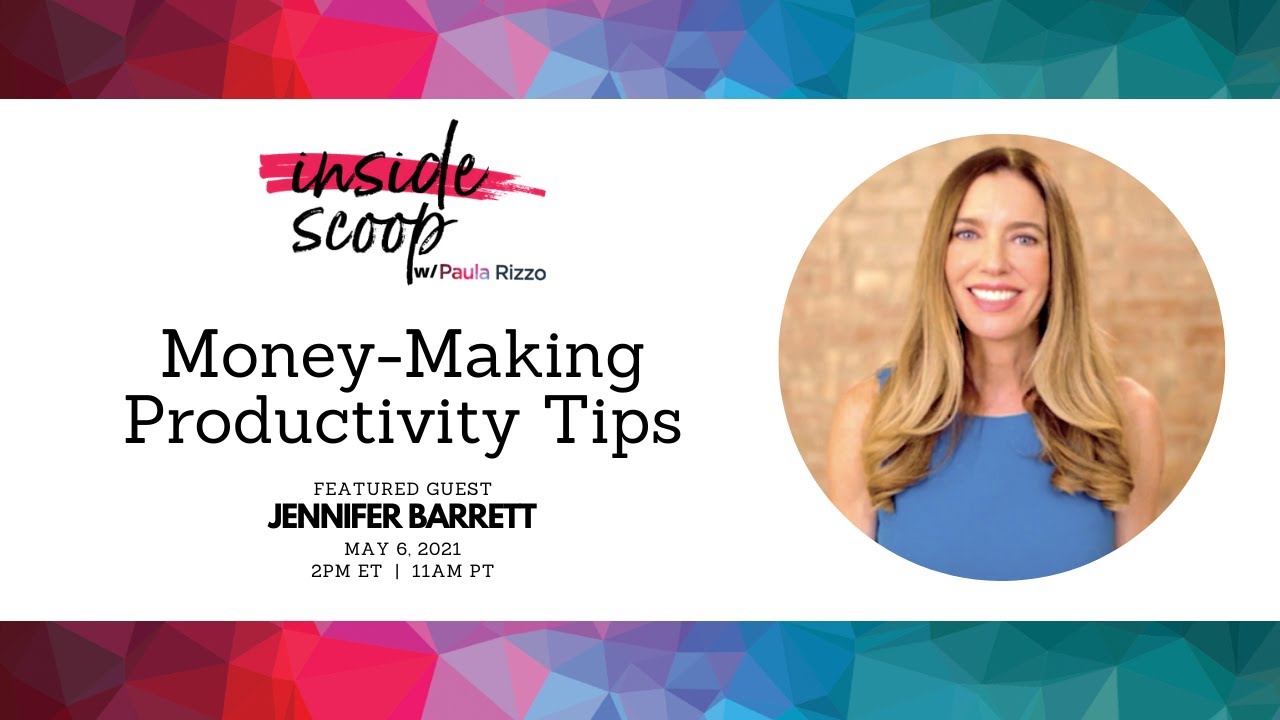
Paula Rizzo talks with Jennifer Barrett, author of Think Like a Breadwinner, about linking productivity to higher earnings. Barrett shares three lessons: focus on work that gets you promoted, control your calendar, and stop overworking. She also discusses simple index funds as a starting point for investing.
Chapters
Hey there, welcome to Inside Scoop. I'm Paula Rizzo. Thanks for being here today. We're going to talk about money, time and money, right? Productivity equals more money. If you're more productive, you can make more money. We don't want this to come at the expense of your health and your well-being and your time and all of those things. So I have a wonderful friend who I'm going to introduce you to in just a moment to give us some tips on how to actually use productivity to your advantage to make you even more successful in everything that you're doing. And, you know, make you some more money too. Isn't that kind of— isn't that kind of nice little byproduct there? I have a freebie for you if you're really interested in upleveling your productivity. If you go to paularizzo.com/list, I have a list-making starter kit there that I think you'll enjoy. And, you know, I'm also a LinkedIn Learning instructor. I really just love lists. I can't help myself. I just talk about them as much as I possibly can. And so if you go to paularizzo.com/linkedin, you'll be able to see all of my LinkedIn Learning courses. One is all about the power of lists to get stuff done. So you can take that class. And I have a bunch of other ones about boundaries and note-taking and lots of stuff that, you know, you would love to, to know a little bit more about, I hope. Throughout this broadcast, we'll be talking about, you know, money-making productivity tips. But I want you to ask questions. If you're here live with us, awesome. Leave those questions there. And if you're watching the replay, also leave some questions. We're going to be back here, you know, to be able to check those out. So absolutely ask questions throughout the broadcast. If you have a friend or somebody that you know who might benefit from this conversation, definitely tell them about this. I would love that. And without further ado, I'm going to introduce my friend to you. Here she is, Jennifer Barrett. She's the author of a brand new book. Called Think Like a Breadwinner. Thanks for being here, Jen.
Oh, thanks for having me.
Of course. So what does it mean to think like a breadwinner? What does that mean?
You know, really at its simplest, it just means making the kinds of choices with your money and your career that will enable you to support the life you want without needing to depend on someone else. So it's pretty straightforward, right? But it's not really the way that most of us women anyway were raised to think about money. And that's something I discovered both in my own life and in the research that I did for the book. So in the book, I really try to take that breadwinning mindset lens and then apply it to every aspect of your finances and compare that to the messaging that we often get. And not surprisingly, it's very different. Right? It doesn't match up. No. Right.
Right. Well, it's interesting because as I was reading the book, I thought, you know what? This is much, much like being an entrepreneur. The thought of thinking this way is very entrepreneurial actually. And as someone who owns her own business, I was like, "Hey, I'm doing a lot of this stuff already." How would you make that comparison between running a business and running your life? Yeah.
I mean, well, you're thinking about it. If you're thinking about it like a business, right? You're looking at what kind of revenue is coming in? How do I budget that money? And how do I make the best use of it to both cover the expenses that I have and also grow the business?. So it's not all that dissimilar to how I, I talk about, um, the way you can look at your paycheck, which is every time a paycheck comes in, it's really an opportunity to become less dependent on your next paycheck and to think about how you can take that money that's coming in and put it to use, not just to cover your bills, but to start building wealth on the side. So that gives you a lot of opportunities, gives you a lot more choices in your life. So as an entrepreneur, you take that money, you invest it in your business. So your business can grow. As an individual, if you're working for a company, you take some of the paycheck that's coming in and you invest it in yourself and your future so that it can grow and so you have more opportunities in the future, maybe to start your own business, but to buy a home, to start a family. There are so many different things that you can do with that money that you've invested. But that's a little bit different than how we've really been brought up to think about money as women, which is, you know, save a little for a rainy day, save a little bit for retirement. And you're good. And that's just not the case really for most of us. You know, in order to support the things we want in our lives, it leaves out all the decades in between, you know, these short-term savings goals you might have in retirement, which is so far away for many of us. And so, it's really important to think of investing not just for retirement, but also for all those things that you want in the decades before.
And it's one of those things, though, too, you know, I know at least for me, the idea of Oh, investing, it seemed so like, "Oh, I don't understand any of that. That seems like a lot." And as a journalist, I'm curious about a lot of things and I do a lot of research and I learn a lot, as much as I possibly can. But what I really love about the book is that it breaks it down and it makes it really accessible to be able to say, "This doesn't have to be hard." This is, for some reason, we thought it was hard and it's not. It really isn't.
No, it's really so straightforward. I mean, we can certainly make it complicated. You can try to day trade. But really, number one, I would caution against doing that. But number two, you don't have to do that in order to really earn good returns. You can literally just capitalize on the overall returns that the market has by investing in something as simple as an S&P 500 index fund. You can literally Google that, you know, find the ticker, invest in an exchange-traded fund that mirrors the index, and that's it. And if you do nothing else, you know, the S&P 500 index has returned 10% or more a year on average, 7 to 7.5% after inflation, those are good returns. You know, that allows you to double your money in about a decade. So that's significant.
One of the fun things though, as well, that you said in the book was about— I forget if it was your aunt or your grandmother. Now I'm totally blanking.
My nonna. Yes, my grandma.
Yeah.
Yeah.
Okay. Your grandma and how she was like, you know, buying stocks and doing things and, you know, worked out for her in the end and for your family. And one of the big lessons there was that she invested in things that she used. And that she liked and that she was interested in. And that for me was also like, oh yeah, why am I not investing in the things that we use every day that I'd be happy to see it grow because I'm actually helping it to do that. So tell us about that mindset there.
Yeah. I love that story so much. Um, and I actually, I didn't even realize, um, you know, all the details of it until after she passed. And what was really so interesting is that, you know, she had dropped out of the workforce when she had my mom and my aunts.. And then my granddad came back from a business trip and basically said, I met someone else. I want a divorce. Completely blindsided her. And at the time she'd been out of the workforce for a decade. So she went back to work as a secretary and she made a conscious decision that she wanted to be able to support her daughters. And she wanted to be able to support herself. And she wanted to make sure that they didn't have to take care of her in retirement. Now she didn't have a 401k. They didn't have a pension. So she knew it was, completely on her shoulders to do that. So she hired a broker. And just as you mentioned, I thought it was so interesting. Her whole strategy was, I am just going to invest in the things that I write a check to or where I shop, you know, any place where I am giving money to on a regular basis, I'm going to invest in it. So I'm not just a customer, I'm now an owner or a partner in that company too, and I'm benefiting from it. So you know, that, that strategy actually hit on so many things that are important where you're— when you're investing, which is to diversify your portfolio. So she was investing in utility companies, right? And she was investing in Coca-Cola because my aunt loves Coke. She was investing in retail stores. So it ended up being a pretty broad-based portfolio and she didn't touch it. She just regularly invested a little bit of every one of her checks. And when she passed, she had almost half a million dollars in that portfolio.
Wow.
She never even started investing until she was 46. And she was doing this on a secretary salary. So I think that just speaks to the power of getting in the game, you know, and just, just getting in there and investing and investing in a range of things and then letting it grow. And it's not, it's really not that complicated.
Yeah. And the lesson there too is to leave it alone.
Let it sit there until you need it.
Yes.
Let it grow.
Right.
Let it grow.
Keep excited to move things around. And they think that's the most exciting way to do it. That's the most dangerous way to do it. Just leave it there and let it grow.
Slow and grow.
That's right.
Slow and grow. That is my motto. I mean, I will trade in some stocks just for fun, but the vast majority of the money that I've invested is I treat it that way. Just put it in there, keep putting more money in, and just let it grow and grow and grow in the background of your life until you need it. And then that's it, and it's there for you.
Julia Andrews says, that is so smart.
Yes, we agree.
Thank you for agreeing with us, Julia. Uh, so I want to dive in a little bit on the productivity tips that you give in the book because there's an entire chapter, chapter 9, which was my— I have to say my favorite chapter. But 9 was my favorite, and I, you know, highlighted quite a bit in that chapter. Uh, but I want to talk about some of the lessons that you have in there on how productivity, you know, productivity can really help you to make more money if you look at it in the right way. So let's dig in. There's a bunch of lessons, but I want to pick the top 3. Um, the first one is put your efforts into promotable work.
Yes, this is a big one. And I will tell you, when I was doing the research on this and started looking at, um, some of the data that was there, I had some eye-opening moments myself, and I realized that I was doing some of this myself in my own job, um, and became much more aware of it, um, while I was doing the research. But essentially what it means is, um, you don't want to do work that does not directly contribute to the work on which you are being evaluated, the work that will lead to your next promotion, the work that you're actually getting paid to do. Uh, and that seems again very straightforward. Um, but research shows that not only are women more likely to take on this non-promotable work, but we're more likely to get assigned the non-promotable work. And Joan Williams, who's a researcher, has a term for what constitutes a big portion of this, which is office housework. And that is, oh, you know what, Jen, can you organize this meeting on XYZ? And oh, can you just call to make sure that we have the food in order for, you know, before the meeting starts? And do you mind just cleaning up here? Cause I got to run to whatever, whatever that office housework is. Oftentimes we don't even think about it and we just kind of do it. We're like, okay, I'll organize that. Or I'll organize that task force or I'll volunteer for this thing. And we're not really thinking as critically as maybe we should. We should about, wait, how am I spending my time here? And if I start spending my time on these things, what is it going to take away from? You know, what's the cost, the opportunity cost there? Because what often happens is that we just end up overworking and we spend all our energy on work that's not actually going to get us to the next level, that's not actually going to be recognized. It can actually take away from our ability to do the job that we were hired for and that we'll be evaluated for if we're spending a lot of time on this kind of work that's not promotable, often kind of low-profile work and even almost housework-like, which can detract, not even detract from the other work that we're supposed to be doing, but it can even shift the way that you're perceived in the eyes of other people in the office. So it is so important to be aware of that. And I think, you know, once you're aware of it, it's a little bit easier to deflect it, but it's important to be aware of it. And then there are ways to deflect it, you know, besides like, no, I'm not going to do it, but just reminding your boss or whoever is asking you to do something that it will take away from these other projects that are a higher priority. And that kind of shifts it in their eyes as well. So a little like jiu-jitsu there, a little verbal jiu-jitsu.
Sure. And a lot of those tasks too, you mentioned in the book, are the things that go unseen a lot of the time.
100%.
The things that like, hey, could you set up the conference room before the meeting? Yeah. Okay. So you go in and you do it. No one knows that you did it. Whereas, and women are much more likely to be like, sure, I'll do it to be helpful. Whereas men don't typically do those types of tasks because it's unseen and they know that. A smart strategic move. So what are the things that women should be saying yes to because it will be more visible?
Well, I mean, number one, you want to sit down with your manager and lay out the expectations, know what your KPIs are. I mean, know what you're going to be evaluated on. And then I would say like, look one step ahead, right? What's the next role that you want to have and what are the skills that you need to have in order to get that role? So you're thinking really strategically about, okay, I'm going to focus on the work, number one, that I know is core to my job that I'm going to be evaluated on, right? That's number one. Number two is when I have that, I mean, I'll be super efficient. And when I have that extra time, that extra time is going to go into either projects that are high profile and will allow me to connect with other people that will help me get that next job, or projects that will allow me to expand my skillset that will get me to that next job. I mean, that's really the way to think about it. It's very strategic, you know, but if you're not mindful, if you're not intentional about this, if you're not thinking strategically, it is so easy to allow other people to just fill up your calendar or make requests of you. And if you're not prepared to say, oh no, I've already got this thing that I'm working on, let me find someone else who can help you with that. Then you may get caught up in the, okay, sure, I'll do it. Sure, I'll do it. Oh, it won't take much time. And then you're caught up in that office housework that is really, as you said, often goes unnoticed by other people in the office. And by the way, if it doesn't go unnoticed, it's not in a good way. People start to think of you as like, oh, she's the one who will always help set up whatever activity it is, right? And that is not how you want to be seen if you want to advance in your career. You want to think about, how do I want to be seen by other people in the office? I want to be seen as someone who is on the way to this next role, you know, what, who is, has leadership qualities, who is productive. All of these things that you want to convey, you can, I wouldn't say destroy, but you can certainly dilute that impression. If you're like, sure, I'll do this, sure, I'll do that, then it seems like you're not valuing your own time. And then other people won't value your time either.
Yeah, and there is an example also with, uh, note-taking, uh, you know, being—
oh my God, right?
Which is also a job that a lot of time, you know, be the secretary. If you could just, you know, write, write the minutes. Yeah, if you could do the notes. And, uh, that example of— I think it was a woman that you had interviewed who, you know— yes, I remember, right? A man had asked her, you know, will you take the notes for the meeting? And her response was Tell us.
Well, she was running the meeting, but she noticed he had this tendency to do it whenever they were in meetings. He would look at the nearest woman and ask that woman to take notes. And so in this particular case, she had called the meeting, she was leading the meeting, and he actually asked her if she would take notes. And she said, "Oh no, I'm leading the meeting, but feel free to take notes yourself so you have them," which I thought was just brilliant, but also just was shocking to me. That that would happen in a context in which she was actually leading the meeting. And how could you possibly be taking the notes and also be leading at the same time? So it does happen though. I mean, really, I didn't mention this in the book, but there was a particular example, um, you know, in my own career with a colleague of mine where she was at a meeting at a pretty high level in the company meeting with a vendor, and he asked her to get coffee. Ah, and she, she basically, she went to her boss and said, we cannot, I won't work with this person. We should not hire them. And it Obviously became a whole bigger issue, and thank God she called him on it. But I think sometimes that happens, and it's one of these things that can feel innocuous, but what it immediately does is it shifts the way that everybody is going to look at her. Right now she's the person who got coffee for everybody else, and she's actually coming in at a very senior level and wants to be seen that way. So it dilutes your authority and your power immediately. Obviously it shouldn't happen in the first place, but it does happen, so it's really important to be aware of it and then think about, okay, how do I deflect this in a way that's gentle but firm. It reminds them of what my role actually is in this meeting.
Absolutely. Because it definitely can dilute the way people look at you from the beginning. And that's even if you don't have a senior role. It's so funny when you mentioned the coffee, it reminds me of myself as an intern or a writer. I think it was a production assistant or something. I mean, early, early on in my career. And I was asked to get the coffee. And number one, I don't drink coffee, so I'm really terrible at making coffee. But number two, I didn't want to be known as the person who would go get the coffee. So I purposely got it wrong. I botched the whole thing, which is not my personality. You've known me for a long time.
Oh, I know you. That was an intentional move.
I am to the letter, this is how you want it. But this was very strategic. And I was never asked to get the coffee again because I was awful at it. And I was, because I wanted to be writing scripts and I wanted to be doing things that, you know, in TV world is much more exciting than going to get the coffee. And, you know, that was established list right from the beginning. But you know, there, there's a cost at that too. They may have looked at me and said, this girl can't even get the coffee right, how are we gonna let her do other things?
So, you know, but you were proving your worth, you were proving your value in other areas. So that's key, you know what I mean? Like, you're not just gonna say no immediately. But I think what you— that's a perfect example, because if you get too good at doing something you don't want to do, you're stuck, right?
Exactly, exactly. And it's just, you know, you never— I would tell interns that all the time, like, don't become too good at something that you don't want to do, because then it's gonna be on you all all the time. You're going to be the one who, you know, 100% is like, oh, we'll just send her because it's easy and she already knows how to do it.
That's good, you know. And then they don't want to move, right? They don't want to move you into another role either because they're like, oh, we depend on her for these things. And it can be sort of self-defeating. So it's this balance between wanting to be competent in the job that you're in but also keeping your eye on the job that you want at the same time. Exactly.
It is a dance, you know. It's a bit of a balance there for sure. But definitely that, you know, the, the purpose of this is to put your efforts into promotable work. So be thinking about that strategically because it, it does make you more money. It makes, you know, it's definitely something that you, you want to focus your attention on. The second lesson that's in the book, in Chapter 9, my favorite chapter, is, uh, take control of your calendar. You alluded to this a little bit, having, you know, take over parts of your calendar or whatever it is, but what are the things that we should really be looking at here? Because it is easy to say yes to a lot of things, but not the right things.
Yeah, I mean, I think if you take control of your calendar, you take control of your life. I mean, that it really comes down to that, that you, if you are not going in and being intentional about how you block the time in your calendar, someone else will take it, right? And that happens, I mean, whether you're in business on your own or whether you work for somebody else. And so you really want to look ahead and say, okay, how do I want to spend my time? And also I think it comes down even more more than just how do I wanna spend my time to when do I know I'm most productive at XYZ. You know, like if you know that you need time for a project where you go deep, right? And you need to block out a good amount of time to do that. Block that time out, you know? Even if, you know, so often we just block time that it's a meeting with somebody else or it's some event with other people. We don't think to block out that time that's just for us. And then it goes away. And then we're trying to cram it in between all of these other things. And that's so much to our detriment because, you know, So when we go back to just being promoted and making more money, if we want to connect the dots there, if you are constantly doing this kind of busy work for other people and kind of in the weeds or in the trees and can't see the forest, you're not going to move ahead. Because really what you want to be doing is like clearing your calendar as quickly as possible for that time that you need to really think strategically about, okay, what's the bigger picture here? How can I look 3 months, 6 months, 12 months down the road? How do I get that broader perspective right? Because that's what's going to be most valuable in the long run. It's not like, okay, You can execute these things, but if you continue to just execute the same things, you're going to be stuck at the level you're at. How you get to the next level is being able to step back and look beyond what you're doing in the day-to-day. You can't do that if you don't block that time out on your calendar. So it's really about, it's about valuing your own time, um, so that others value your time, right? Because if you don't, they won't. Yeah.
Yeah. It's such a good point. And also, you know, knowing what it is that your focus should be, what is your priority, being really clear about it and writing it down, sit down, you know, make yourself a list. Yes, I can't help myself. But yes, it really does help because you think that you'll know and you think, you know, that, that it'll be a thing that you'll be like, oh, of course, like, that's definitely my priority. But when things pop up and come at you, you're like, yeah, I'll do it, but you're doing that but you're not doing this other thing that was actually really important. So to be able to kind of focus yourself and bring, bring that back in, it's super, super important. Um, it is hard to say no though. It's hard to, to build those boundaries How have you been able to do that in your own career as you've, as you've moved up?
Well, I think one thing is your calendar allows you to do that because you can block off those sections in your calendar. And when someone asks you to do something, you can say, I'm sorry, I already have a commitment at that time. You don't need to tell them that your commitment is like a 15-minute walk to clear your head, 15 minutes of sitting down and doing something for yourself. And actually, I talked about how some of my colleagues would actually block out what's called, you know, they called focus time. And I think there's an app that actually allows you to do that, but you can couch that in any way that you want. But again, if people are constantly putting meetings on your calendar, if you don't have that time blocked off, they consider it free time and available time. And it may not be. And what ends up happening then is that you are trying to fit in some of the things that are important to you that maybe you're doing on your own. So don't think to block out in your calendar, you're trying to fit it around all of these other things. So I think the first thing, is, to your point, and I do this religiously every day, I write a list and I look at the list and I think, okay, probably not gonna finish everything on this list. What are the things that are absolutely the most important to me? If I do these things, I will at least feel like, okay, I'm in pretty good shape. And so I check those things and then I think, I look at my calendar and I say, have I actually blocked the time to make sure that I'll be able to do this? Because if it doesn't involve another person, it's probably not blocked off. And so then I go back and I say, okay, this could take an hour or so, let me just block this time. And that's what I do. And that's the only way to get through it. And, you know, for most people, we spent— first, we spend an inordinate amount of time in meetings, more than we need to. And, and so we could all, you know, we could all do well in kind of looking at all of our meetings a little more critically and thinking, is this something that we could just do over email or with a quick phone call, or do we actually need a full meeting on this? But, you know, when you do have a meeting, go in with an agenda, be very clear about what the intent is with the meeting, and that's important. But we are also, you know, we're inclined to look at those meetings as the most important thing that we have that day and then to squeeze everything else into the remaining space. This is a recurring theme for me, but it's only because in so many people who I interviewed, and I've seen it in my own life and with my colleagues, like, if we don't block that space for the things that are important to us, it will disappear. And then you will be doing it in between everything else, and you will be doing it at night, and it will seep into all of these other areas of your life. And that's when we start feeling really overworked and overstressed and resentful. Yeah, speaking from experience, but also talking to others too, you know, it takes a while to find that balance. And I don't know if it's something that's kind of ingrained in us where we feel like we must first look at all the meetings we have and make sure we've satisfied all of that and then fit our stuff in later, you know, that we feel uncomfortable actually blocking time on our calendar and claiming that time for the things that are important to us. But I do think there's sometimes a psychological barrier there in terms of like No, I'm going to claim that time. This is what's important to me. I'm going to claim it and I'm going to honor it.
Right?
So I'm going to claim it and then I'm not going to go back and say, okay, actually I can make that meeting work at 3 o'clock. I was just going to do XYZ. No, you claim it and you own it and you guard it. And that's it. Totally.
And you know, one of the things though too, like I've learned as a business owner is to get people on your team who can help you to protect that time. Uh, you know, I have a virtual assistant that I work with who I, you know, I basically say, hey, Don't let me move this, or don't let me do this, even though I'm gonna try to. Save me from myself, you know. And that is very helpful to have that accountability, but it's a mindset switch. It's something that you have to do to be able to say, you know what, my time spent in this area is just as important as this other meeting, so I really need to be able to block it for myself. And since reading that, uh, in your book, this part about, you know, focus time, I've actually taken some of the open time slots on my calendar off. And I already had very few to begin with. I've I'm pretty good about this, but I did it even further because a lot of times, you know, when you're, you're working, you're doing things, you're constantly on, you know, meetings or talking. I do a lot of media training, so I'm, you know, doing a lot of video calls. And then you're not actually doing anything else. Like, I didn't have any time to like read an article or, you know, make a list of some ideas that I had. Like, I didn't have the space for that. So I'm starting to kind of put that onto my calendar, but it's very intentional. And you have to be very, very clear about what you're going to do with that time. Otherwise, you'll just let it go and then you'll just add something else there. So that's an important lesson for all of us. And then the third lesson that you have in chapter 9, my favorite chapter, is working harder than you have to is a waste of time. It sounds obvious, but we're still doing this. So how can we not use it?
Like so many other things in life, it seems obvious and yet we continue to do it. So something else is obviously going on. Going on here. I mean, we're not Europe. We are a culture in the US that values, kind of idolizes overwork. You know, we're this culture that often equates busyness with productivity when that is actually the opposite of productivity. You know, people are constantly saying, oh, I'm so busy, I'm so busy, I can't do this. That to me, when someone tells me I'm so busy, I can't do XYZ that I know is important to them, tells me they are not prioritizing their time in the way that they should be. And, but I think that that's so common in our culture that it's really easy to get caught up in it. And I tell the story in this book, this is— I was just on the phone with her actually before this. This is one of my closest friends in the world. Her husband actually kind of brought this lesson home to me because he was working in, you know, a six-figure senior management job, pretty demanding job. And I would go and stay with them all the time when I I was in California, and I would notice that he would come back, I mean, I don't know, 5:15, you know, come back, would not talk about work at all. And he was trying to build this side business as a speaker. He's a fantastic speaker and was really passionate about— he wanted to train other speakers, he wanted to get more experience himself. So he would come home and he would literally sit down and be like writing out lists of things that he needed to do and thinking about what he needed to do to start his business. Literally never talks about his work. And so one day I finally said to him, I mean, aren't you thinking about work at night? How is it that you're able to leave at 5 o'clock every day? Isn't it weird? Are you getting the side-eye from people when you walk out? What about your boss? And he said, Jen, why would I stay any later than I have to? He's like, I'm hitting my numbers, you know. He's like, what my boss cares about is am I hitting my metrics, right? Am I hitting my numbers? Am I successful? Is my team happy? And he said, as long as I feel like I'm hitting all those 3 things, I don't need to think about it all weekend. I don't need to stay an extra half hour, you know, and I know. And he said, and it actually doesn't do me any good because then it takes away from this time that I have that I want to start putting towards something I'm really passionate about. And it takes away from time with my wife and, you know, all of these other things. And I thought, wow, that seems so obvious, but it is really a different way of looking at how we manage our time, right? He was very, very focused on like, every day I have 7 hours and in those 7 hours I am gonna go in and I'm gonna knock these things out of the park and I am going to make sure that I'm hitting all of these things and then I'm gonna leave and I'm not gonna think about it again. And when you come into every, you know, if you come into work every day thinking, I have 7 or I have 8 or I have 9 hours and that is it. And in that time I am going to accomplish XYZ busy, and then I am going to leave at that time, and I am gonna go home, and I am not going to think about it, or I'm going to try very hard not to think about it. It actually— what I found with him was it shifted the way that he looked at his work every day.
It, it—
what it did was imbue it with a sense of urgency because he wanted to guard that time. And so when he was at work, he was very productive. And a lot of times I We just aren't thinking that way. We're like, oh, we have the whole day and you know, I know I need to stay until 5:30 anyway. And so I'll get to this or I'll get to that. But we don't have that sense of urgency. And what that sense of urgency does is make us very productive. Yeah. It makes us very focused.
Because you're not going to have time to do it later because you've chosen not to have time to do it later. That's it. That's the big thing, right? It's a decision that was made. That when I leave that door and I come into this other door, or in our case, we move the, you know, kitchen table because now that's your office, uh, and you go and walk to the living room.
Exactly.
That is the turn-off time, right? That is the end of that, you know. Um, I love that way of thinking. It's definitely, you know, um, a better way to manage your time, but also, you know, be able to go into things with your best self, right? You go to work and you do it like all in, and then you're home and you're all in on that. It's a better way to kind of segment your mind if you can do it, you know.
Yes, not to say that it's easy.
It's not easy. No, it's not, but it is doable, clearly. Look, there's a bunch of people who have— who are doing it. Um, we have a couple comments I want to go through if anybody has any questions. We're gonna do last call on questions, but, um, Sam, who is my LinkedIn Learning fantastic producer for all of my LinkedIn Learning courses. She says, "It is so true. If you aren't having space for self-development and process basically what's happening, you're not doing it right." You need that time. You need to have a little bit of time.
And you need to guard it. I saw that someone was talking about how they get meetings scheduled even when they block that time. And I know that's so challenging. And sometimes you just need to go back and say, "I'm sorry, I have a conflict. I can't make that meeting." Exactly. You don't need to offer an explanation.
Yeah, Sylvia here says, I block focus time but people just ignore it. They just book other meetings in that time slot.
Yeah, I mean, call it something else. Yeah, call it a meeting with whatever, you know. Yeah, whatever it takes. Don't tell them what it is.
Exactly, exactly. She agrees there's too many meetings. There really are. Meetings are the worst. Um, Julia says that she was asked to get the coffee once in an office with all men as a new person, and I enrolled to all go together. Look at that.
I love it. After that, it turned into a mini trip that we would do every Friday.
That is a good way around it.
I love that. I love that.
Yes, that is a very—
that is such a great way to turn that around. It is.
It definitely is. Um, we do have, you know, no man bashing here. We did mention the difference between men and women, but we, we're getting a little pushback here, so I want to address it. There are exceptions, always. Very true. You can't have a blanket opinion for all men. Care culture is the new paradigm. Of industry, which shall be institutionalized.
I love that. And this is not to bash men at all. I mean, when I talk about the research, it's just that the research shows that women do tend to do more non-promotable work and that they tend to get asked more to do non-promotable work. This doesn't mean that every man is going to be like this. It is a generalization, but it is something to be aware of.
Yeah, absolutely. It definitely is. I mean, it's something that's there. It's something that, you know, we can't ignore. And so, you know, there you have it. There are money-making productivity tips tips. Jen, this has been fabulous. Thank you so much for being here and giving us all of your wisdom. Everyone should go get the book. I think it's wonderful. And especially, you know, I'd say just start with chapter 9, being that it's my favorite.
You should do that.
You know, go to jenniferbarrett.com. You can grab the book, Think Like a Breadwinner. Jen, thank you again for being here.
And thanks for having me.
Of course. And those of you who are, you know, super interested in upleveling what you're doing with lists and productivity and all of that, I invite you to go to paularizzo.com/LinkedIn. I have a lot of classes there on list making, how to be more productive and note taking. We talked about note taking being sort of, you know, maybe a little taboo. You don't want to take it on, but if you have to do it, we all do. There's a better way to do it. So if you go to paularizzo.com/LinkedIn, you can absolutely do that. And, you know, as you're continuing to watch this on the replay, leave us your questions and your comments. We're happy to answer those and continue the conversation. And I'm just so thrilled that you were able to be here with us today.
And until next time, I'll see ya.










