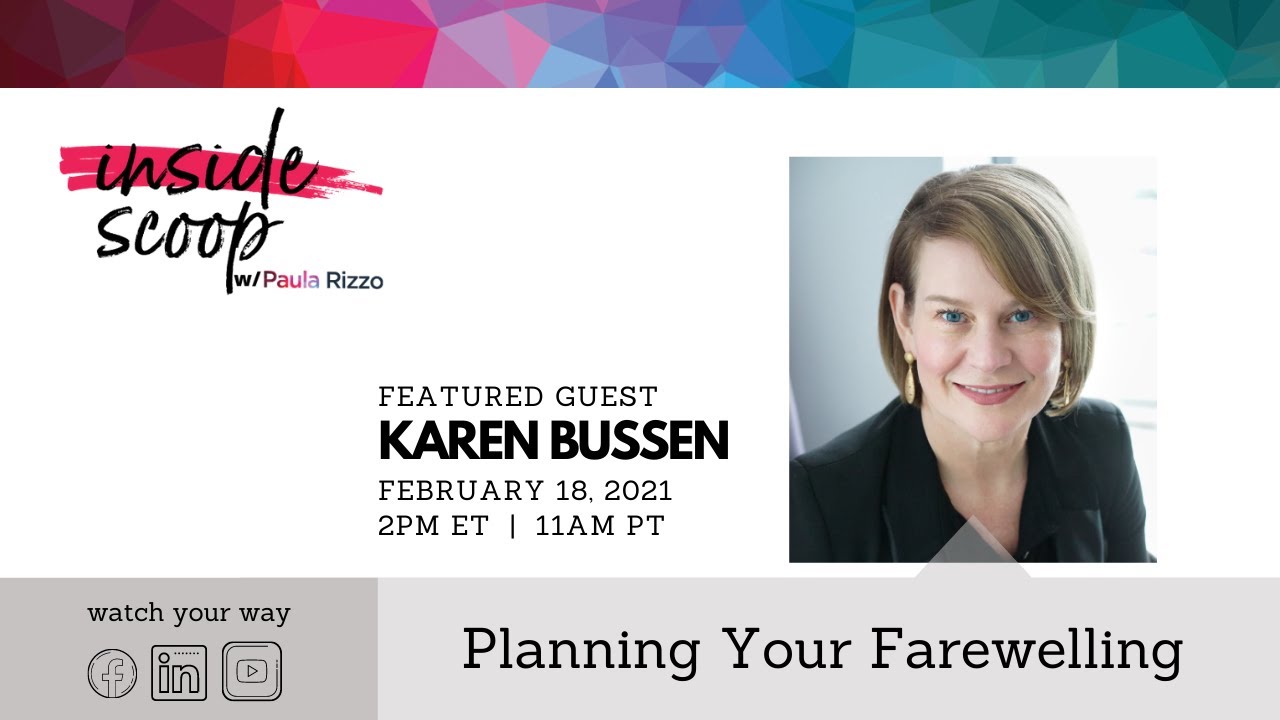
Paula Rizzo and Karen Bussen discuss end-of-life planning, which Bussen calls "farewelling." They cover the free Farewelling File tool, digital legacy, Swedish death cleaning, and how to personalize a funeral with music, food, and dress code.
Chapters
Hello, hello, hello. Welcome to Inside Scoop. I'm Paula Rizzo. Thank you for joining me. I am thrilled today because we have a very interesting topic. Today's topic is not one that you typically would have a to-do list for, but you know how much I love to-do lists or lists in general. I have lists for everything. Today we're going to talk about your farewelling to-do list, Farewelling, as in your death list. Yeah, it's actually not as morbid as you think. And, uh, the guest who I'm going to introduce you to in a moment is someone I've known for years, and she made her start as a wedding planner, you know. So she, she's, she's used to planning celebrations, and now she's found herself actually planning celebrations of life sort of after the fact. And I find this stuff really, really, really interesting. Part of it is because I'm half Italian, and for whatever reason, like, Italians love to talk about death. I guess I guess it's a cultural thing and we'll talk to my guest about it, but it's something that is not so taboo in my family. And so I think people are sort of catching up to the fact that this is something that you might want to talk about. You might want to know things about. And before I bring on a fabulous friend of mine to talk all about this, I want to tell you a little bit about a checklist that I have for you. So if you go to paularizzo.com/list, you'll find my list-making starter kit there, and it is a good way to start thinking about lists in a different way. I'm going to be talking about a different kind of list today. But, you know, this, this freebie that I have for you is much more about the to-do list and getting things, getting things done. I'm also a LinkedIn Learning instructor. And so I have lots of courses on LinkedIn, which I think that you'll find really helpful. One of them is on how to set boundaries and how to protect your time. This is super important now that we're all working from home, now that we're doing a million things. So I'd love for you to check out that course and any of the other ones I have. I have a bunch. If you go to paularizzo.com/linkedin. I actually, before I was an author and a media trainer and I did all these things, I was a TV producer for years. One of the guests who I interviewed years and years ago, one of my very first stories actually, I don't even know if she realizes this, but one of my first stories was about wedding stress because I was a health producer and I had to find health stories. I found Karen Bussen. Who is my guest today, and she is an expert in all things planning weddings, celebrations, all things like this. And her business model has changed quite a bit. So I'm going to bring on our fabulous Karen Bussen. Karen, thank you for joining me.
Hello, Paula. It's so good to see you. Thank you for having me.
I love that we're talking about planning your farewelling, and this is a topic that some people will be cringing and saying, oh gosh, I don't I don't really want to talk about this, but we're making it normal, right? We're making it an okay thing to talk about. Yeah.
And I think, you know, the thing is in our country, you know, until about 100 years ago, it was something that we talked about more and that families dealt with more in caring for, you know, a loved one who had died. And it's just in the more recent past that we've gotten away from that and it's become a bit more medicalized or turned into a service. And so, yeah, so there's a whole movement now to kind of bring us to a place where we can, it's never going to be the happiest topic, but where we can as a part of our human experience, as an essential part of it. Yeah.
Yeah. And you came to this in a very interesting way to be able to think, you had a business and then you were like, hey, I'm going to pivot this business to do this. What made you decide to do it?
Yeah, well, it was very interesting. So as you mentioned before, my background was in weddings, both producing like really, you know, high-end bespoke fabulous celebrations and even other big life events like birthday parties and big anniversaries. And I love that because I love joy and I love life moments and celebrating. And then I also created a really successful destination wedding program with my global hospitality partners. That was very exciting. And then about 4 years ago, my younger sister had a very close brush with mortality. And she had a rare late-stage cancer and my whole family was just thrown into a tailspin. And quite frankly, I just didn't really have a whole lot of experience in this space. But because of that, I ended up really starting to look into things and try to figure out what were we possibly gonna do if we had to do something. And so it wasn't coming from a place place of, you know, from a happy place, but a place of practicality. And that's where I just— that I just didn't see anything online or anywhere that I looked that spoke to me as, you know, a modern woman, as a designer, as someone who, um, who, who does believe that celebrating, you know, life moments is important. I, I couldn't find anything. And so that's when I first became interested, but I just— I put it away. Obviously I was dealing with my sister, she's fine now, thank God. So, yes, wonderful. But the notion of this space just kept coming back to me, and it just kept like, you know, nagging at me. And I finally gave myself permission to do some research and just to read about it, to talk to some of the innovators in the space. And because I was concerned, frankly, I mean, most people who know me know I'm a bubbly person. Yes. Like someone who's always like positive and doing stuff. And I thought to myself, gosh, Karen, is this something you really could get up and work on every day? Is this the—
Right.
—you want to be in? But I think it's a misconception, because when you start to get to know this space more, you realize how incredibly meaningful and what wonderful work it is. And it's been— I mean, I'll get choked up talking about it. It's been the most incredible thing that I've done. So after that research, after meeting my co-founder, Elizabeth Meyer Kransky, who is a funeral director— Wow. —also like most bubbly person you'll ever meet, I just decided I think I want to do this.
Yeah. And you did. I mean, you're diving in. This is your business now. And it's interesting because you launched this during the pandemic, which is the worst and best time for you to have done this, I think, because people have a very different relationship now with death given COVID-19 and the pandemic that we've all been through, and we've unfortunately seen the realness of death. And just today it was announced that the life expectancy has gone down an entire year because of the pandemic. That is shocking. That's a lot, you know. So how, how should we be thinking about this? You know, I mean, I know you, you help people, of course, plan the farewelling, which, you know, you can explain what exactly that is. But also for people who are thinking in terms of, hey, I'm a planner, I want to have my ducks in a row, I want to know what I'm doing. We should talk through that too. So first, take me through what is the Farewelling? What do you help people do? What should people be thinking of?
Well, you know, so as you just mentioned, there's sort of two sides of it. So there is the side that happens when someone dies and, you know, you have to be responsible for taking care of planning that tribute to them, but also taking care of all the ins and outs and the details that need to happen. And most people find themselves in a position where they've never really had to deal with that before, and they don't even know what the questions are to ask or where to start. And so that's where we're starting at Farewelling, is in trying to guide people through that process. We are right now working on building an incredible tool that's going to launch later this spring that will help people who are planning for someone who has died. And then when you talk about that idea of us all just trying to think, you know, more forward for ourselves. It's really, it's, it's twofold. I think the voice of the past has been like, you should get your affairs in order and don't be a burden to your family. Make sure, right? And my thing is that doesn't help anyone. Like, nobody likes to think about something in that way. So I say, instead of looking at it as a should, why don't you look at it as something that you could do for as a gift.
You know, it is nice. It's, it's an— it's a nicety that you do for other people, right? It's actually something that you want to make sure that people— I mean, they're already going to be upset by the fact that you died, hopefully, uh, and now they're gonna have this long list of to-dos to do that you're like, hey, I'm not— I didn't— I'm not, I'm not ready for all this. I'm already grieving.
Also, if you think about, like, I know you're a planner, like I'm a planner, and the fact is that, like, it's also about making sure that what your family or loved ones will do for you is in line with your own values, right? Ah. It's not just so traditional as it was before. I mean, some people are, you know, have a particular religious tradition, and so the sort of the funeral traditions are kind of prescribed and sort of an easier thing to, you know, to anticipate. But then there are a lot of people now who are, let's say, less religious, or maybe they have a more eco-friendly attitude where they want to make sure that even, you know, what happens after they die is something that's going to be reflective of those values. So, you know, I just say, like, you just give yourself a little bit of space to think about it, and you give yourself the opportunity to talk about it with the people who are most important to you so that when the time does come, they'll have a sense, and they will be so grateful to you. I mean, we've talked to so many people who just found themselves in terrible situations where they didn't know where anything was. They didn't know where contact information was. Right. Now we have our whole digital legacy that is part of what— Oh, for sure.
Passwords and yes. Oh my gosh. Your, your, your email and all of these things that, you know, that, that wasn't something you would think about. What will people do with all of those things?
For me, we created this, this thing that we call the Farewelling File and it's free. It's on the website. You can download it. And it's a, it's a document that really like walks you through the whole process and it asks you, it's not just like, check this off or do this. It asks you some questions too that help you kind of reflect on what is important to you. And that's not just with the, do I want to be buried or cremated or whatever? It's also like, how do I want to be remembered? If there was a celebration in my honor, what would some of the things that would be important to me or that I would like and why? Or things that you don't want. And if you're not sure, here's why I wouldn't want that. You know what I mean? So you just kind of eliminate people having to kind of go back and forth and say, I, she would never wanted that, or she would, right?
Exactly. People think they know you better than you know yourself. Maybe not, maybe not so much. Well, we have a question from Chris who says, how early should we start planning? Is it ever too early?
That's a really good question. And I personally do not think that it's, um, ever too early. In fact, we just saw a study coming out of the UK that said, um, 19% of millennials who have experienced some loss in their own life are already keeping instructions for their farewelling in the cloud somewhere.
Wow. Very interesting.
Vox just did a big article on young people who are open to the idea of thinking about what they want. So, and you know, a lot of people think, okay, well, when I'm getting things together and I'm like doing estate planning and a will, I don't have a lot of assets or I'm young. And so I don't, haven't accumulated a lot of property or whatever. Sure. The thing is that putting this together, it's not just a place to dole out assets or money. It's also a place to include instructions for what you want, what's important to you. I mean, we always get a lot of interesting comments and answers when we talk about even what would the music be like? Ah. Your farewell or something like that. So, or what readings would you like?
Right. But do people think about that? 'Cause like, I know I told you this before, but like my grandfather, Italian grandfather, of course, The Italians, for whatever reason, love to talk about death. But he wanted When the Saints Go Marching In played at his funeral. He knew that, and he told all of us that is what is to happen. And we were all like, okay. And so we played it, uh, you know, and it was actually really comforting and nice. It was almost like, oh, this is, you know, I mean, I feel, feel like we did something that he wanted, and it's almost like he's here with us in, in a way, you know. It, it really changes the, the mood. It makes it a little bit lighter in a way.
Yes, and I think that's the key, is that for every person, you know, a fair— a Farewelling is not one thing. It's— it is, you know, should be reflective of the beautiful life of the person that you are honoring. And so I love that. I love people who have opinions, or, you know, people— we talk to people who are like, I have everything planned out, I already— I told them the color flowers I want, I want that. And wow. Yeah. And so we're hoping to, with Farewelling, to also create inspirations for people so that they can think about you know, um, let's say just something that was a great interest or passion of the person that they're honoring, or, you know, just even recipes that they made, um, things like that. So these are ways that you can personalize. Yeah, I think people don't even think about it.
Like, I think if you said to somebody right now, like, for instance, we're going to say to the people who are watching right now, think about what song you would want played at your funeral. Like, could you even think of it? And you know what, there's something at stake here because we're doing a freebie, and so I think you can think of it. Uh, we're doing a gift giveaway of your co-founder's book. Uh, and so in the comments at any point, tell us what song you would want played at your funeral for a chance to win this book. And I think it's interesting to think about. I actually, you know, I, I've been thinking about it since, since you and I, you know, started talking about this, and I, I actually don't know. I'm not totally sure what my song would be. Are you— do you have one? What do you, what do you think?
I don't have a song. I have an entire playlist. It's called— oh, playlist, and it's on my— it's just on my, uh, my Apple Music, and it changes all the time. If I hear a song and I'm like, that song has a message that I like, and that would— like, you know, I have, um, Beyoncé's, um, Who Runs the World, Girls. I love it. I mean, but I have— I probably have like 25 or 30 songs because me, like, an event, just, you know, much like a wedding or a birthday party or something like that, you would have different songs for different parts. Like, there may be the walking in song that is maybe a little more low-key, you know. I like this band Real Estate that plays very like mellow rock music, so maybe that would be like as people were coming in, and then at the end there would be like, you know, a great dance song or something. I love it. So I mean, that's— it's a nice way to not—
not, you know, it's not fun, it's not that fun, but it's not unfun, you know. It's sort of a way to lighten the mood and change our conversation even with ourselves about it.
Exactly. And I mean, the thing too is I'm not saying that like a farewelling or a funeral or a celebration of life has to be fun. It is a sad occasion. We are grieving. We are feeling so much pain. But I just think that it's invoking the spirit of the person is what I'm talking about. It's not— and if that person was a very serious person and a very religious person, then that's the way to honor them. For sure. That's the way to give them the most beautiful farewelling, is to do things like that. And if they were a bit of a comedian or they just had that sassy sense of humor, then just doing something. It could be a little sign or a picture or something. We heard recently from one of our colleagues in the South that they did a red carpet themed— Ooh! —for a woman who had known that she was ill. She was close to death, and so she planned this whole thing out where instead of doing eulogies, speeches, they gave out awards to people in the community who had been helpful to her during the process of her illness. Like someone who had taken her to a doctor's appointment got an award. You know, they had a red carpet in the chapel and stuff like that. So it was what she wanted. And it, you know, it's— everyone could say that's so her.
Yes, right, exactly. You know right away that that's something that she would have wanted. That makes sense. We have some comments in here that I want to get to and address. Someone is saying, let's see, let me bring this in here. This is a great thing, although it hollers for procrastination, the curse of humans. It's so true. I should do that. That's a great idea. What do you say to that? Like, is there— are you gonna have a national farewell, you know, planning to-do party or something? We need to, we need to have that.
I hope so. We've already done a couple of farewelling fêtes which is when you just get a few friends together, like on a brunch on a Saturday or something like that, and you print out the Farewelling Files and you kind of just talk through it. And you can start— like, one thing I'm doing to try to help right now is we've broken down the planning into 5 different categories. So instead of having this long to-do list that has like 150 things on it, we have sections, and you could choose which section you feel like you could get started with. And I think that's the key, is just to get started, because having something is better than having nothing. Yes. So if you can't tackle this topic today, then you don't do that one. You just, you know, you start with something else and whatever speaks to you first. But it is true. I'm not going to lie. I think it is just one of those topics that I think the more we can allow just a little bit of light, you know, to be shined on it, the more that we hopefully will be able to be like, all right, yeah, it still is a painful thing to think about, but I want to put this in order. As a result of my sister's illness, I actually ended up creating my own will for the first time. Oh, wow. My own Farewelling File. And it made me feel really good. I made it kind of funny. Like, I wrote it in my own style. And I also— it had a lot of meaning because there were some objects that are not even valuable, but that I said that I wanted someone to have. And I came away from it just feeling like, I'm so glad I did that. So what we're trying to do is— and, you know, we're just— we're a young company. We just launched. We just turned a year old. Congrats. Thank you. Many things to come, but hoping to help people think about ways to personalize their own planning, even like the great courses that you're doing. Hopefully, we want to be able to do some courses that will help people through this aspect.
Yeah. And I think it is helpful to normalize it. As I've said, it's different with different cultures. Here, in America, I feel like people just shut their eyes to it, don't want to talk about it, don't want to deal with it. We have a comment here. As much as I can't fathom this, it makes me uncomfortable, but I can't stop listening. Like, she's here, so that's good. So you know what, if this at least kind of sparks the idea in your mind that this is not such a bad thing, you know, I, I, I learned this from my dad also, the Italian side of my family, you know. I mean, he's had his, his funeral planned for years, like since I was a kid, because he just wants— and my mother— because they just want it to be easy, you know. They know that it's going to be hard enough when it happens. But have I done it? No, you know, because I'm like Oh, but I'm so young, you know.
Well, and you are, but one of the things that I would suggest is, I mean, if people do want to come and visit us at myfarewelling.com, we have a lot of great content. And one of the things that we're trying to do to help this move forward into a more modern experience is to use a more modern voice in talking about this. In the past, people have been very formal about death. You know, they use these sort of euphemisms like they passed away, or they'll just calling people the deceased and bereaved, and it's this very old-fashioned kind of formal way of talking about it. So we are trying to just create an experience here that is like all the other beautiful modern experiences we have. So hoping that we can just bring it, because it's just been swept under the carpet and shoved off into the darkness. And totally, you know, we meet so many wonderful people in the industry who are here to try to make the experience better for families right now. And we want to be that one place where we can bring all those things together and connect people with resources.
Yeah. And, and one resource is of course this fabulous book that your co-founder has written. Uh, and, and look, leave a comment below. This could be your first piece of homework towards this. Just think about the song, the one song that you think could be played at your funeral for a chance to win the book, but also as a first step into thinking about what would you do? How would you start planning for this for yourself? What would you want? How would you want to be remembered? Is there one song that you really love that you know will bring your family together when they're feeling really sad because you're not there? Um, you know, what song is that for you? And think about that and leave us the comments in, in the, uh, you know, chat boxes below. We'll, we'll pick a winner. But we have somebody who, um, who does have a comment about the song. Let's see here. She says, uh, Christy says, I'm thinking, I'm thinking a playlist of artists who are deceased so everyone can think about me partying with me when I'm in heaven.
How about like Prince, you know, for example?
Yes, I love it! What a good idea. See, there's like a theme. See, now we're getting creative. People are getting it. I love it, Christy. That's a good one. Terrific. I, I love it.
As with everything, as with every great event, you start with like the mood that you want to create. So, you know, Maybe you do want people to cry for a minute. Right, right. I want people to be like, I don't want them to be miserable, but I want them to miss me, of course. Totally. You take them on a journey with your playlist of different moments. Yes, absolutely.
We also talking about cultures and different things, there's something in Sweden that they do that I find very interesting. Can you tell me about that? This is again a cultural shift on how people think about death. Yes.
Well, and like so many great things that the Swedish do, this one, I'm going to probably mispronounce this word, but in Swedish it's called döstadning. And if anyone out there who knows a better pronunciation, please let us know. But it's Swedish death cleaning. And what is that? Well, you know that right now if someone dies, basically their loved ones are going to go and have to clean everything out for them. And some people really don't give a lot of thought to that in advance. They just, they love their stuff. They're still continuing to accumulate stuff no matter how long. And so in Sweden, there's a trend where people who are getting older, or let's say that they know that there's an illness there, they actually actively start to downsize not just necessarily their living quarters, but their stuff. They go through it. They do a kind of a Marie Kondo. Ooh, I like it. And they actually take even objects that they love right now and they give them away. And they might have an event where they lay things out on a table and let their family come around and choose while they're still there. Oh, it's like a living estate sale in a way. And then they may find certain things that, you know, cause it's true that your family doesn't necessarily want all of your stuff. For real, yes. With things that you could then give away, that maybe it's just clothes that you don't use anymore. You could donate exercise equipment or something like that to a school or to another organization. And but the idea is actively doing this again as a gift because it is, it's one of the questions that I get asked most often is, you know, I can't deal with cleaning out you know, my mom's house or whatever it may be. It's just overwhelming. There's so much stuff and I— it's too emotional. I don't even know how to give away any of her things. It makes me feel like I don't love her.
Right, right. I don't know what she would want to do with this. I, you know, I feel bad. And then you start feeling bad about objects, right? It's like, I feel bad to give this thing away. I don't know. She loved it. I remember she talked about getting it in her trip and now I don't want it, but what do I do with it?
Yeah, so it's this idea of just, you know, participating in your own sort of organization. And, you know, I can say honestly that I think families appreciate this so much.
Mm-hmm. Yes, it's true. And actually, we have a comment from Julia who has said, my mom has planned out everything so well. It helps to take care of so many things that you can't think of during those hard moments. It's true. That's exactly what we're talking about. You don't want people— they're gonna be upset about you enough, right? You don't want them to then be burdened burdened with all of this planning. And if they're not good planners, it's stressful, right? I mean, this is not a job for everyone.
Well, that's— I'm sort of a control freak, so I don't— I'm like, I'll give you an example. Um, one of the things that really blew my mind was I— my favorite TV show ever is Mad Men. Ah, okay. And so, so Betty Draper, um, who's one of the main characters, um, she finds it— I might be doing spoilers here, but this show's been over for like years, so who finds out that she's going to die, and so she picks out the outfit that she wants to be buried in. She takes a picture of it and has it hanging in her garment bag and writes a letter to her daughter and says, this is what I want to be buried in, the blue chiffon. And it just blew my mind because I had never thought about the fact that you have to pick out what you're going to wear. Ah, right. All eternity. How many logistics, right? And so I'm like Oh my gosh, what if something happens to me? I don't want my sister just coming over and picking out a pair of like black leggings and a t-shirt. I need to like have a plan. Totally, right? And so, you know, it's just got us all talking about like final fashion and things. And I'm not minimizing, you know, this in any way, shape, or form, but it's a decision that someone is going to have to make for you. Right. And so that's important to you. You know, if you have opinions about things, you might—
most of us do, right? Most people are like, you know what, I I have— I want to stay in everything that I, that I do. And, and, you know, the idea too is legacy. You know, you have a wonderful podcast which I really love, um, and so anyone who's, who's interested, there are many, many, many more things to know than what we, you know, have time to talk about here. Check out the podcast, which is called Farewelling, of course, right? Uh, and one of the things that you do talk about is, is legacy and the idea of leaving behind this thing. Why should we be thinking about that? How is that important for us?
Well, I mean, isn't that what we— we all want to feel that we've led a meaningful life and that, you know, we've given gifts to this world or it's the people that we love. And it doesn't necessarily mean just, um, you know, a monetary legacy or, or something that has to do with objects, although certainly those are wonderful ways to, um, to to celebrate your legacy. If you have a special— could be a charitable— doesn't have to be something huge. It could even be leaving something for your local public radio station or for a school or something like that. But legacy is also about how you want to be remembered. Sure. More and more, there's some really cool, like, apps out there where you can actually answer questions about stories from your life and preserve those in the form of an audio recording or— Wow. Or a video. And so that those can be shared with your loved ones for years to come and even future generations. So I think it's really just what footprint do we want to leave? How do we want to be remembered? And so yeah, I think it's definitely worth thinking about. And that's something that you kind of do have to plan for if you do want, you know, if you want to have something that is like where you're giving something or starting something in honor of a cause, you have to kind of plan that out in advance.
Yeah, absolutely. And look, both of us are authors. You, you are many, many, many book time author. You have many books. Uh, and, and I mean, writing a book is part of your legacy, you know, leaving behind information that you know, that you know will help people is part of it, but not everyone is going to do that. That is not everybody's path. So what are the other things that you can think through, you know, and be able to do? And actually Julia says that, uh, final fashion is something that I support. I have to look fab. Even in death.
Okay, so I would ask, what about— so now you know what you want to wear, right? Like, you're thinking about your outfit, but do you want to have a dress code at your farewell?
Oh, now you're taking it to a new level!
Because I have a friend who said that black is her color. At her farewell, she will be wearing black. Ah, no one else may wear black. So it's like a white wedding. I love it. So I was wondering if anyone has any thoughts on that. Wow.
Yeah, let us know if you want to have a— if you want to have a dress code at your wedding, let us— at your wedding— at your funeral, let us know. Uh, and also, you know, tell us what song you're thinking about playing. Uh, put that in the comments below and we'll pick a winner, um, for a book— a book giveaway. But I also want to ask you a little bit about, um, you know, the idea of Talking to people who don't want to talk about it, because that is an issue. You know, there are people who will just push this away and push this away even though they know it's a good idea. Are there things that you can do to kind of smooth out that conversation?
I mean, there are all kinds of ways to approach it, and I think it has to be a very kind of personal thing. Because, for example, there are a lot of parents where, you know, if you bring it up to them, they may say like, um, I don't care what you do. Just throw me in a trash bag and dump me on the side of the road. And they're just going to, like, you know, make light of it or whatever. Right. I think it's a matter of finding a way at a time when it's not super high stakes, you know, to bring it up if you can. I mean, if there's an illness, then that's a reason to have that conversation. But if it's beforehand, you know, if you can just be sitting around the kitchen table at some point and don't turn it into a big thing, but just be like, hey, I read this really cool article. About people now who are sort of starting to think about this in a different way. Right. You know, wondering like what you think about that, not like wondering what you want for your farewelling. Yeah. Wondering what you think about it. So you sort of enter more gently, you know, into, or, hey, I just did this crazy thing. I made a farewelling file. And I mean, you're my parents, but I was wondering, like, would you look at this? Like, what do you think about this?
You know, ah, lead by example. Exactly.
So, um, or I filled out the first section, but I didn't do— I was wondering like 'Would you do this with me too?' Like, 'Would you feel weird about this?' Right. Like, you know, I sent my mom a blank Farewelling File, and it wasn't like, 'Mom, fill this out,' because, you know, the thing is, just because you talk about death, it doesn't mean you're going to die. Yeah. And it doesn't mean that you want the other person to die. It means that you want to respect them and that you truly want to know what's important to them. Yeah. Because we don't talk about it very much. I mean, even those as close to us as our parents we might not know. But I have another friend who told me her parents had already gone to a lawyer. They made a whole plan, and they were down to the detail of the dad wanted to be buried with his glasses on. Wow. The mom did not care about her glasses. And I was like, you know, think about it. You might actually care about—
you might care. Yeah, I mean, who knew? I mean, I'm glad we're opening the conversation. Share this with them. Share, share this conversation. Share your podcast, you know, the Farewelling podcast. —so that people can start to think about it and start to know. We have a couple more questions that I want to get through. But I want to ask you first about any very interesting ways that people have planned their farewelling or things they've asked for that was very over the top or you wouldn't have thought of. Because I'm looking at this also as an inspiration file. It's almost like a Pinterest file. Because you don't know what you don't know. You're not sure. This is sort of uncharted territory for people. So are there any things that have been more outrageous or more more fun or memorable that you can think of?
Well, number one, I think what you just said about like a Pinterest or gathering things is a really great idea. Whether you pull things out of magazines, it doesn't have to be things about funerals, it could be just things that you love. Like, you know, we have talked to people about doing like food trucks, um, that pull up outside after a memorial service and it serves like their favorite tacos or, you know, something like that. So that's one really cool thing. And then I mentioned about the red carpet funeral, which I thought was really an amazing way to community that had supported someone through an illness and took it to a very personal kind of level. We planned a reception that— I don't know why both of these things are about food, but where this woman had been very involved in like the food world and she had created some menus in her life for certain like big events, and so they recreated some of those dishes for the reception in her honor. So like that, or choosing a place like a venue that's extremely important, whether it's like a botanical garden or a surfer where they plan and they all do a paddle out and get into a circle and have a ceremony. Like, ah, how nice. So it's really an active memorial where people have gone on a run, you know, to honor someone who was a marathoner. Wow. And so it's just this way of choosing something that, you know, or it can also be something extremely simple where it's like a very simple eco-friendly gathering in a garden with a simple shroud and a very basic burial and some beautiful words. And as simple and elemental as that is, it was perfect for that person. So it's not necessarily that it has to be over the top at all. It can be at any budget. It's like a wedding. Some people want 2 people on top of a mountain, and some people want a wedding at the Pierre Hotel in New York City. Sure, sure.
But I love that, though, actually, because— and so does Deb Lee. She says, this is a great approach. And I agree because it doesn't have to be— I mean, weddings are stuffy. Do you know what I mean? For the most part, they're stuffy and they're sad and they're always done the same way. And it's just like, "Ugh." But the idea that you could personalize it and make it, if you're a runner, a run, and that is how people are going to remember you and that's what you wanted and that's great. That's actually really so personal and exactly what it is that that person would want, which I absolutely, I love. And Chris Russo says he would like a casual dress code. He would like playing happy upbeat music. He wants it to be a celebration of life. I love that. I think that is a great, great idea.
And I would just say, Chris, write it down. Ah. Put it somewhere and tell somebody about that so that they know that. Yeah. Because you know, what happens is if you have this, I mean, of course, You may say, well, I'm not going to be there anyway, but what happens sometimes is that people have a plan or they've written it down, but they haven't told anybody where it is. And then, you know, they end up being buried when they wanted to be cremated, or like, you know, they had a somber celebration when they wanted a celebration of life. So share that, the location of those details.
Smart. Very smart. Yes.
Even if you start, Kris, like as simple as that is, casual dress code, playing happy upbeat music, celebration of life, just even on a piece of paper, and you just keep that somewhere, like, that is a start. So yeah, turn it into like, I need to call a lawyer, right? Right. And it needs—
well, but there is a time and place for that too, you know. And that's— and, and you do give some, some resources on that as well, right, for, for people?
Absolutely. Well, like, for example, in the wills and estates and trusts, like, that's another very complex area of end-of-life planning. But now, um, on the internet, there are a number of great resources for like putting together a simple estate plan. And some of them are free. So you can read about those on the website, myfairwilling.com. We have a few different articles about it. And then, you know, there are, there are resources online now where you can actually connect with a lawyer if you need more detailed, you know, if you have a lot of assets or a complicated tax situation or trust situation. Yeah.
It's just, it's worth talking about, you know, it's worth just having it out there in a way. And Deb says, it's interesting how we gather together around food for both happy and sad occasions. It's true, food is really the headliner for most of these things.
Because food is a comfort to us, you know, it is something that brings us joy. It's such a sensory pleasure, but it also is a thing that we return to, you know, for comfort and for community as well, which I think has been one of the hardest things in this particular time is that we can't gather, you know, to do those things. So that's been another thing we've really learned a lot about and developed this year is the idea of the virtual celebrations being a part of what we're doing now and trying to find beautiful ways to make those still feel intimate and still feel the connection even though people are tuning in like remotely.
And so we have— Yeah, that's interesting, the idea of the— because, you know, I think initially when, when, you know, COVID-19 first started and then, you know, all of the awful stories of of funerals happening without loved ones, and people weren't able to travel, they weren't allowed to be there, all of those things. I mean, it's awful, but it's actually opened up the world in a way, because now there are ways to participate in those celebrations where you don't have to travel. If you weren't going to be able to be there anyway, you know, it's kind of changed the game. It's a whole other industry, really.
I think that that's going to remain over time. I mean, obviously once we can gather again together, funerals will return to you know, closer to what they were. But I do think that this possibility of adding in a virtual component, which is something we're working really hard right now to make available to our families at, you know, myfarewelling.com, is that that'll be a component so that no matter how many people are attending, there still may be some percentage of people who cannot travel for whatever reason, and they will be able to tune in and participate and feel a part of it.
Yeah, for sure. Well, it's great. And, you know, if you comment below, we are doing a giveaway. So comment below with the the song that you want played at your funeral for a chance to win a book by Karen's co-founder of Farewelling. And, you know, Karen, I think this is a good first start, you know, for people to start thinking about it, because, you know, there's— this is something that not everybody wants to talk about, not everybody wants to do. But if you can do one thing, you know, I like the idea of let's comment below on the song, think about the song. I think that's a good first step, right? Uh, and then beyond that, uh, you know, obviously we want people to go to myfarewelling.com and download the checklist to be able to thinking through, but what can people do to not be overwhelmed by all of this? Because this is a lot of information.
Yeah, totally. I think the key is to, you know, to start with a framework of just like an openness to the topic. That's the number one first thing. Just be like, okay, I'm going to read an article about this, or maybe I'm going to check out a book that just sort of talks about attitudes that are changing. And we, we do recommend a lot of those on our social media as well. And, um, you just kind of get you get you thinking about it a little bit. And then, and then starting with one thing, whether it is thinking about that celebration, or, you know, there are some people who just want to kind of get it done and like be practical. So thinking about how you plan best, right? So it's taking one line off of that checklist and being like, I'm just gonna do this one thing today, you know. And then once a week or once a month or something, you, you check in and you do one more little thing, and pretty soon you've got You know, even if it's not perfect. Yeah. Like, done is better than perfect, you know? For sure.
And also to have the conversation with people and involve people in your life in it. And, you know, maybe involve your friends. And it could be a fun thing and a light thing. It doesn't have to be so, you know, so morbid, really.
That's why we really love the Farewelling Fêtes, you know, where you just print out these checklists, you invite people over, you have some champagne or some wine, and you, you know, you talk about it, you, you just Because when you're in a group, everyone can joke about it and be like, you know, ah, yeah, it just for sure helps to crack that ice.
Yeah, absolutely. Well, Karen, thank you for being here. This has been, you know, really eye-opening and helpful because I think it's something that people do need to be thinking about. And so I'm thrilled to reconnect with you, and I'm so glad that we're able to see each other in this, in, you know, this way and continue our, you know, a conversation. I mean, our conversation started about weddings, you know, more than 10 years ago, so I'm glad that We're still talking about celebrations even though they've changed a little bit.
Yeah, and we're still talking about love. That's what it is. Honoring someone is just showing love for them. Yes, I love that.
And continue to leave comments below. We're going to continue even though, you know, if you're not watching the live session of this, we will be checking in the comments below. So if you have questions or you have ideas or you want to, you know, join in to win that free book, please make sure to tell us what your farewelling song will be. And Karen, thank you. I also want to just let people know that if they go to paularizzo.com/list, they'll be able to get my list-making starter kit. It does not involve a death to-do list, but maybe it should. Karen, maybe we'll have to collaborate in some way on that. But definitely check that out. And Karen, thank you again for being here and everybody for being here.
Thank you, Paula. All right.
See you all soon. We'll see you next time.










