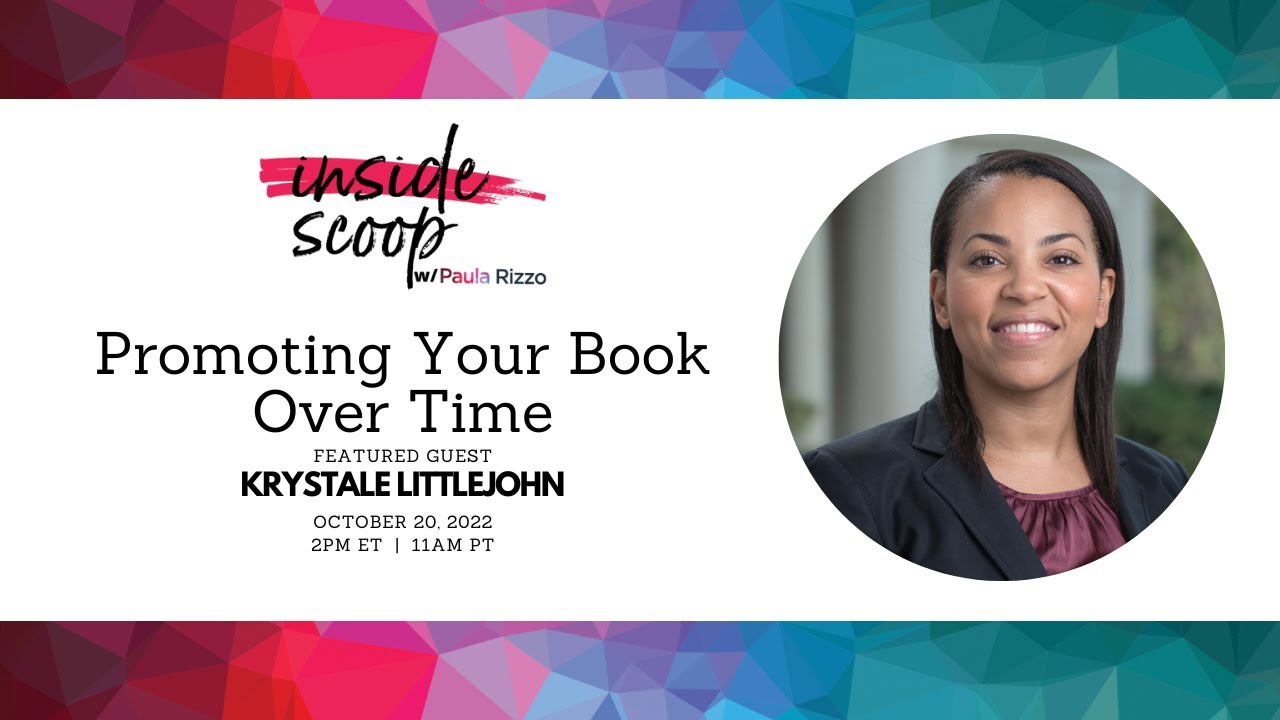
In this Inside Scoop interview, host Paula Rizzo talks with sociologist and author Krystal Littlejohn about how to promote a book beyond the launch day and turn it into a long‑term brand. They discuss the importance of planning the launch months in advance, creating a detailed timeline, and leveraging one’s existing academic network. Littlejohn explains how she had to translate her scholarly language into accessible, conversational terms for a mass audience and how that skill now improves her overall communication. Media appearances—especially NPR, podcasts, and YouTube shows—are highlighted as key drivers of sales, with an emphasis on repurposing those interviews on social platforms long after they air. Twitter is presented as the primary hub for sharing episodes, retweeting, and engaging journalists, while a personal newsletter (Intro to the Good Life) provides a more intimate, rapid feedback loop. The conversation also covers the mindset shift from teaching a familiar classroom to speaking to strangers, the value of seeing the book as a business that requires ongoing promotion, and practical resources such as Paula’s media‑expert checklist and a LinkedIn Learning course on setting boundaries. Overall, the episode offers a roadmap for authors to treat book promotion as a sustained, multi‑channel effort that continues well beyond the initial release.
Chapters
Hey there, welcome to Inside Scoop. I'm Paula Rizzo. Launch day for a book is like, it's amazing. I have to say it's a really exciting time and authors put a lot of time, energy, and thought into it. But that's not the only day you should be thinking about when you have a book. It's a long game. You're going to have that book and your name on it for a long, long time. So although launch day really does matter, it's how do you keep the book in the minds and in the mouths of people all over the world for a long time? It's no easy task, but we're going to talk about it today. I'm going to bring on an expert in just a moment who had a book come out over a year ago and is still getting lots of attention for it. So we're going to talk about that in a moment. And you know, I myself have written two books. About productivity, Listful Thinking, and Listful Living. And Listful Thinking, my first book, came out, oh my gosh, almost a decade ago at this point. But you know what? Like, I'm still talking about it. I'm still doing media for it. This is something that will be with you for a long time, which is actually really, really nice. And I do have a freebie for you if you're looking to get some attention for a book or anything else that you're working on as an expert. It's my checklist to become a go-to media expert.. So you can grab that if you go to paularizzo.com/checklist. There's a QR code there too, if you're into that kind of thing. But that will help you to think through how you can promote whatever it is that you're doing on video and also in the media, if that's something that you're into. I'm a LinkedIn Learning instructor as well. And so I have a bunch of courses there about productivity. And one that I think will really help this conversation is How to Set Boundaries and Protect Your Time. And the reason I say that is because to have a book launch, to carve out time for yourself, for your projects, it's very, very important to be able to set boundaries and protect your time. Because when you're putting that book out into the world, hopefully people will be excited about it and want to talk to you. And so you do need to sort of protect what you say yes to and what you say no to. And this course I think will help you to do that. So if there's a QR code, so you could check that course out. And also if you go to paularizzo.com/linkedin, you can check it out there as well. And I want you to share this video. If you have a friend or someone who is thinking of writing a book or has a book coming out, share it with them. Put their name below in the chat boxes and ask questions. Let us know what you're thinking about. Even if you're watching the replay, we'll be checking back to see what questions pop up. So please make sure that you leave them there for us. And without further ado, I want to bring on my fabulous guest who's actually one of my media training clients about a year ago. Hello, Krystal Littlejohn. Thank you for being here.
Hi, thanks so much for having me. It's great to be here.
Of course. Well, I wanted to get you on the show to chat about, of course, your book, which is called Just Get on the Pill. You are also the University of Washington's associate professor of sociology. So you were a success in many ways before being an author. And so we started chatting right before your book came out. And so tell me about your own thought process when the book first came out, your own timeline for what you wanted to do to help promote yourself.
So I have to be honest, I did not know anything about what I needed to do when my book was first going through production. And I remember us talking and talking with friends and talking with other colleagues who had published their books and learning that there was so much involved that I just didn't know about, from reaching out to friends to let them know my book was coming out so that they could help spread the word, to thinking more for kind of further along in the future, into how I was going to be promoting it on social media, what kind of opportunities I was going to be looking for. There was just so much of— there were just so many of these little details that I wasn't very clear on. And so kind of getting that together from the very beginning was really important and trying to get a sense of my timeline and then trying to think about what are the other things that I have to be thinking about, right? At the time, I was an assistant professor of sociology at the University of Oregon, and I was thinking about tenure and thinking about all of this other stuff. Teaching and my research and trying to make sure all of that was going while at the same time trying to make sure that I was promoting this book. And so I think the big thing for me was trying to get a really solid plan established from thinking about what I wanted the book launch to look like and then really trying to imagine how I could use the momentum from the book launch to get into other opportunities, whether that was media opportunities or like we— like I was saying at the beginning, just kind of leveraging my network so that my friends and my colleagues could help me promote the book.
Yeah, it's important to think through it because a lot of time authors do not. And that's why I was so impressed with you when we first met each other. I think you were on my list for listful thinking or you had been on one of my productivity lists and you sent me an email and you said, "Hey, I have a book coming out. I'd love to talk to you." And I was like, "Okay, let's see." And it's always nice to have authors who are thinking ahead because too often authors will think, "Oh, when the book comes out, then I'll promote it." And it's it's too late. You really need to start ahead of time to really give yourself that ground, do some groundwork beforehand, and then really make this be a long-term thing because it takes a long time. I mean, here we are, right? You're a year and a half out almost, still talking about the book, still excited about it. I'm much further down the road with my first book and it's still, still exciting to talk about. And Amber Graham, who's listening to us right now on LinkedIn, she says, "This is helpful as I finish writing my book." Good. I'm glad. This is important to think through for sure. I want to talk a little bit about your expectations for the launch. Like launch day, everybody gets really excited about launch day. What did you, when it came, I mean, we set you up, you had a launch, you had a virtual launch that you did and it was very exciting, but what was it actually like?
I think it was much more exciting than I expected it to be. I remember when we first started working together and I was kind of terrified and imagining that I was going to have to talk with people. And as a professor, I'm used to being in front of the classroom, but I wasn't used to having to talk with an audience of people that had read my book beyond academia. And I remember just being really scared, right? And I remember us talking and you really encouraging me to have fun with the book launch and to really remind myself that the goal here is to share my message with people and that I was really doing a service for the people that were going to be tuning in and picking up my book and reading it later. And I think that really helped me just feel really excited when the book launch happened. And so even though, of course, there are nerves, uh, just because you're kind of putting your baby out there into the world, I did feel really excited. I felt really prepared. And I think if there's anything that I can stress, it is probably that aspect of things, right? To not let just the excitement of getting your book out there, uh, cover up the fact that there are things that you need to do to prepare for your book launch. So from making sure that I had my list ready to go so I could let people know about my book launch, having material so that they could promote the book launch and share with other people. I ended up streaming it on different platforms, and so I ended up streaming it on Twitter and kind of letting my network know that I was going to be doing that, and then seeing them retweet it on Twitter a bunch of times, you know, all of those things. I think if you can kind of get that squared away at the beginning and kind of as you're going along, it can really make the book launch day itself so much more enjoyable because you're not worrying about all of these little details. All of that's been taken care of, and all you have to do is show up and be excited and really celebrate that there are all of these people there that are excited to share your work and excited to celebrate the fact that you have published a book, whether it's your first book or some other book. And I think that just made such a huge difference. And I have to say, the book launch ended up being much, much more enjoyable than I thought it was going to be. I thought it was just going to be this nerve-wracking thing that I wanted to get over with. And I remember you just really championing me and telling me, no, this This is exciting, you know, get excited. And then as you said, thinking about the future, I really thought that it was going to be a few months and then it was going to be over. And I remember us talking and you saying, no, this is a long game. This is just the beginning. And here we are a year and a half later, but it all started with that book launch. And, and I'm glad that I could get into the process from a really excited standpoint because that momentum has really carried me throughout.
Yes, good. I'm glad. I'm glad it was enjoyable and not painful because that's what we want. That's what we want it to be. And if you're watching at home and you have questions, leave us some questions in the chat box or even some comments, whatever, whatever, whatever you feel like saying. We'd love to hear from you. I want to talk a little bit about something that you said about speaking to academic crowds and to students. That is where your sweet spot is. This is what you were used to. And when we started talking, you were like, okay, now I have to talk to the masses. It's a different audience for sure. And I actually, I just did a media training for authors this week called Media Ready Author. And one of the people in the class, she said a similar thing. She said that she feels fine when she's teaching in front of her class, but when she starts talking as an author, she freezes up and she just can't do it. So have you— did you find that to be sort of a strange mindset switch to make yourself?
I think it was the notion that I was stepping outside of the classroom. I think to a certain extent when you're in the classroom, it feels a bit more comfortable because on an authority level, right, you're kind of the professor and you're in front of the classroom. And obviously that can make some people feel nervous, but also make some people feel really comfortable. But I think on the other hand, there's this familiarity, right? Like you're a professor in whatever college, right? I'm at the University of Oregon. So I go into the University of Oregon, you kind of feel like you're a community member. So even though you might be meeting a bunch of students for the first time, or you're talking to an audience at the university, if it's a broader talk, you have this sense of feeling like you know them a bit because you're part of the same community. Whereas when you're entering this realm of being an author and going beyond that space, I think it's a bit more nerve-wracking because you don't have that same sense of familiarity, right? So even if you are going into a space where you don't know anybody, before you could say, well, we're all a part of this community, community, right? It could make you feel a little bit better. Whereas when I started doing media stuff, right, it's like I didn't have, you know, a sense that I was part of a community. I remember my very first media thing was with NPR 1A, and here I was, you know, imagining talking to tens of thousands of people on the radio that were not part of what I imagined to be a community, right? It very much felt like I was talking to strangers. And so I think that is the part that can be a bit nerve-wracking, and that's what kind of separated my from being in the classroom, from having to do a different kind of public work. And I think the key thing for me was to just really remember that even if it feels like I'm not in community with the people that I'm speaking to because they're strangers, there is, right? There is something that connects us, right? The people that are tuning in are tuning in because they're interested in what I want and what I'm going to share, or there's something that piqued their interest when they saw something about it on social media. And so when I thought of it that way, it kind of helped me feel a bit better about the process. And then when people started calling into radio shows while I was on the radio and telling me about how much they appreciated what I was saying, or that they're gonna pick up the book, or I was getting emails from people that had picked up the book, then it just started to make me really get comfortable and say, I am really in community with people. Yeah, even though this is different than the kind of community I have as a professor, I am engaged in a different kind of community that's more expansive than the community that I have as a professor. And in fact, it actually has helped making my job— it has helped make my job as a professor more comfortable, right? Because when I have to go into a classroom of new students and, you know, we all get the kind of first-day jitters, I find that they're much better because I just have this kind of memory now of all of this, all of these kind of media activities that I've done. Where I'm talking with, or I'm talking on the radio with tens of thousands of people listening. And so it makes the first day of class feel better because you're like, I've done that. Yeah, I've done this before. I've done this for tens of thousands of people and I can do this in a classroom.
How funny. That's so nice. A nice added bonus there. But yeah, I love that, the idea of having it be a community and then just looking at it a little bit differently. That's really helpful to think of it that way. And Yvonne Sanders has a question from LinkedIn about about, you know, she says, did you, did you have to adjust speaking vocabulary for the mass audience versus your academic community? Yes. And we did it together, but I'll let you answer.
Absolutely. I love this question. I absolutely had to shift. And I remember Paula and I working together and I had already thought, right, that I, you know, really cared about speaking in really accessible terms and making sure that I was I was just acting like I was talking to my sisters kind of thing. But I think there's something, especially when you're moving from writing a book to kind of doing more of the public speaking stuff, where I think you just, I at least, just kind of was still in the habit of writing, right? Of writing or writing stuff that I was going to say as if I was actually writing it versus really thinking about how I would say it, right? And really trying to think about how people would hear it. And so Paula and I did a lot of work, right, trying to get me to get in there to change language that I thought was being accessible, that I thought was just the way that I might talk to anybody on the street, and realizing, no, you're still not there, right? And I think especially there were times when it was like, this is boring, right? And just really being able to be okay with that. Like, don't take it— it's not something to be offended by, right? Like, sometimes you just think that you're saying something and it's going to be interesting, and it's boring, right? And our job is really to punch it up and to make sure that if we have listeners that are taking the time to spend their day with us, right, that we're really giving them something of value that is interesting for them to listen to and doesn't feel like they're listening to a lecture that is not what they were kind of tuning in for. And so I think I absolutely had to work on that. And that was a big part of the process as well as, like I said, just remembering that editing and revising and learning how to translate things is a key part of the process. And it's been helpful long, long after I published my book, right? With— I think now I kind of approach everything, even, even my stuff in academia, right, for my students or for my colleagues, right? I'm always thinking about, is this interesting? Is this engaging? Is there a way that I could translate this to punch it up more? And I think it's made me more effective overall. So it's not just something I see as being important for the media and for talking with a public audience. I see this being just really important for for being more effective as a communicator overall.
Sure. These are skills you use all the time, which is great. I'm so happy to hear that it has bled into all of your work. Wonderful.
Absolutely. Absolutely.
Let's talk a little bit about media and your experience doing media, because as you said, you had a very, very— in the very beginning, NPR, that's a pretty big media hit, right? Right to start off with. Right. Which media did you find to be you know, the best for the book sales, if there was a way to sort of tell?
I absolutely think podcasts ended up being really important in a way that I just didn't anticipate beforehand. So going on NPR really helped, right? So NPR 1A and NPR Think were great for book sales. But I think I also have to stress the importance of smaller podcasts, right, that, that people people might not think have such a huge audience, right? But those smaller podcasts have engaged audiences often, right? So when people bring you on and say, I'm talking with this author, I love the book, right? That actually can make a big difference for, for people that will actually go out and buy the book versus you might have some of these shows or podcasts that have really large audiences and they might have lots of people that are going to go out and buy the book. Book, but they might not, right? That sometimes you are just listening and they're not as engaged as they can be with some of these smaller audiences. And so I think in my experience, there were— I did YouTube shows, I did podcast episodes, or there would be radio shows that they would then turn into podcast episodes. And I found that leveraging that on social media was really important, right? So kind of they had their audiences.
How did you do that?
I really took to Twitter. So I'm, I have, I'm on Twitter and I'm also on Instagram and Facebook, but I, my platform I would say is really Twitter. That's, that's where I spend the most time. And I would retweet stuff from the shows that I was on. I would really try and elaborate on some of the things that we talked about in the show so that after, long after the show had been published, right? If there was something that came up in the news that made me think about it, I would retweet the episode from a podcast that I was on saying, this really reminded me of this conversation that I had with X podcast where we really delved into this kind of thing, right? And so I think sometimes people can imagine that the experience of being on the show and then the kind of show's network of folks that are promoting the episode, that that is really where the heart of of the promotion is. But I think in my experience, authors can really do a lot for themselves if they just leverage those experiences when they happen, right? Making sure that you're sharing, uh, whether it's before or after the episode. There are times when I didn't— I couldn't share what was happening before the episode, but after the episode, right, I was on it. I would, I would share the episode weeks later, right? I would say, for example, as a professor It's time to start preparing new syllabi. And if you're looking for episodes, right, if you're looking for podcasts to incorporate into your syllabus, here are some things that I have done that I think would be helpful for you and kind of elaborating like one or two sentences about what the podcast episodes do to help people make it easier to incorporate into their syllabi. And so that could happen months later, right? That could be a podcast that was a year ago that I can now share and say— I just emailed somebody the other day, right, saying, hey, here's a podcast episode that I think would be helpful for your class that you talked about, or they email me and say, I know you've done a lot of media stuff. Is there anything that you would recommend that I incorporate into my classes? And so I think really leveraging the experiences on those shows and then taking it further, right? Long after, they might not promote the episode 3 months later, right? But you can do that for yourself. And that's, and that's something that I've done. I would also say just, yes, thanks. I would also just really, really briefly leveraging any opportunity that you have, right? So I've talked about the media stuff that I've done, but I've done— my book ended up in a library, right, and ended up being in many libraries, and I took to Twitter to share that, right, to say my— how exciting that my book is in the library and people are checking it out, right? That was not about a media opportunity, that was just somebody texted me, hey, I saw your book is in the library. And so I think really just thinking very broadly about promotion, and I think thinking about promotion not just as trying to sell your books, but as trying to let people know about the message that you're trying to share is really key. And if you think about it that way, it becomes a lot easier and more comfortable to do it over the long term. Because all what I keep thinking about is I want people to know about my work and the message that I, I'm sharing so we can change the world. And I don't feel uncomfortable doing that months later, right? What difference does it make if it's 3 months after the episode if the point is to make sure that people hear the message so we can do something to make our society a better place.
Yeah, and you know, never assume that people saw it the first time. You know, that is always, it's nice to have that long tail because you know, those things will be around for a long time. So retweet it, get it out there. You know, total pro tip to be using Twitter. I mean, I know you like Twitter, but for media, people in the media, journalists always use Twitter. So it's a really good place to be because they're gonna be promoting their things on Twitter. They're gonna see you more often on Twitter. So it's really smart to have those conversations and to keep them there. So I love that you do that. And to be able to come back to things and reuse it in that way is such a smart move and really something that people do miss out on. Because after a while, doing these media hits becomes like, "Oh, okay, well, I just did another one. Okay, great. I can say that I was on that show." But people are not really using the content as they could to be promoting the book or whatever it is that they're working on continuously. So this is really a brilliant thing. And I mean, I just did a media hit about a month ago. Or a couple of weeks ago for an article I wrote in 2014. We literally reshared it on LinkedIn and Anchor saw it because I'm connected to her. And she said, "You know what? This is a great idea. I'd love to do something on this. Let's have her on the show." And I just cracked up to myself and I said, "This has been around for a really long time, but sure, I'll come talk about it. Fine." So it's the gift that keeps on giving, really.
Absolutely. And I would say I even if you don't have anything to kind of share on social media about your work, just being on social media, right? So in my experience, I've had reporters reach out to interview me for stories because of things that I tweeted that were just my thoughts, right? Just my thoughts on something that was happening in the news. And it's happened multiple times now where they will actually include my tweets in emails to me that say, you said this on social media. I was wondering if you would be open to talking with me about it, right? So I think Like I said, if— and like we've been talking about, right? If you're thinking about the message that you're trying to share and you're thinking about really just trying to connect with people, it makes it where you can share your work and promote your work long after you've published the thing, as you were talking about with your article. And also even when it's not necessarily related to that, right? My tweets weren't related to— weren't about my book, right? They're related to some of the ideas, but they weren't about the book. But then in this article, right, where they interviewed me, then they linked to my book or they talk about my book, right? And Just kind of contributes to getting the word about the book out there too.
Yeah. What about your long-term game here? Because having a book is like having a business. I always say this, right? And it really does. It's its own thing. So now that you're a year and a half out, what are your plans for now and for the future with the book and beyond?
So one of the big things that I think surprised me was how the kind of life course of my work as an author has changed after the book launch, right? So I think at the beginning you're just kind of trying to get your work out there, and I was— there was a lot of media stuff about the book, but then as time has passed, it's been more media stuff that are related to the broader ideas in the book, not necessarily in the book itself. And so now, right, my task is to figure out what are the things that I want to be saying about these public issues that are related to my book ideas, um, that are really about my work as a public sociologist, right? And, and about my work as somebody who's trying to help shape our thinking about social issues. And so my kind of long-term goal now, my long-term approach now, is really getting clear on on the message that I have about stuff that's taking place in the world right now, and then using my different platforms to share that message and to think about the kinds of talks that I might want to give that are not just about the book, right? So at this point, there's more stuff coming up that is just about me as a person, right? My thoughts as a person versus just my book as a product. And that has been something I don't know if I anticipated, right? I think at least not this quickly, right? I definitely didn't anticipate that within a year right now I'm having to think about talks that are not just about my book and that are about the broader issues that our society is facing that my book has implications for and can help us think through, but that I hadn't planned on, on doing so quickly.
So that's important because— and that is the thing, like, I often will tell authors, like, it doesn't matter what the media wants you to talk about, just go do it. Because you will be identified as the author of that book and that is good enough. And a lot of times there's some friction there because they, "Well, but I want to talk about what's in the book." And I'm like, "It doesn't matter. It doesn't matter." Right? Like it, and now in hindsight, does it matter? It does not matter. Right? Like as long as they have you on and as long as they mention that you're the author of the book, it does not matter if we talked about page 254 or not.
Absolutely. I think the book is just a vehicle to share your ideas. And then once you realize that, then you realize that you just have ideas to share. And I just have ideas to share in general. And the book is just one set of ideas that I have, but I have lots of other ideas to share. And so that's where I'm at now, whereas I'm giving talks on my books, I'm on my book, I'm also giving talks on other ideas that I have that are just about broader social issues and then launching the next— think about the next book. Right. I definitely didn't imagine I'd be there at this point now, but I'm now working on my next book. And so it's— yeah, it's just— I think it's exciting. And it is really just— when you talk about kind of being a business owner, or being with— when you're a book author, right, it really is— it becomes its own, own thing, right? So I, I am a professor, and before I was a professor, but now you definitely feel the sense of I am a professor and an author, because being an author entails a whole different set of, of responsibilities, including thinking about your long, your long game and thinking about the kind of public sociologist that I want to be. And so that's kind of what's in store for the future is really just kind of shaping my ideas about what I want to share and how I want to contribute to making change. And then just thinking about the different projects that I can have in store to do that.
That's wonderful. I'm so happy to hear it. And I knew we would get to this day, Crystal. I'm so excited for you. And one of the things too is being your own producer, which you have been doing very much. You've been putting your content out into the world. You've been putting it on Twitter. You now have a newsletter. So tell us about that because it's important to have— as you have your ideas and your thoughts, put them somewhere, right? Because a book takes a really long time to come out. So you need another platform before the next book.
Absolutely. And I think that was the biggest thing, right? So my newsletter, Intro to the Good Life, right, became a space for me to really start to engage with, with people that were connected with me and realizing that once I started to do more media stuff and more book stuff, right, you start to just have a much bigger audience and it it can start to feel a bit less personal than it did at the beginning when I wasn't as connected to as many people. And so the newsletter became a vehicle for me to just kind of try and connect with, with people in my circle in a more personal way, in a more intimate way than I can do on social media, than I can do on Twitter. And so I think for me, the big thing has been just trying to find ways to package the stuff that I want to say in a way that is bite-sized for people, in a way that doesn't take a ton of time. Right. The book took years to write, of course, and forever to come out. And so one of the beautiful things about having a newsletter is that you are able to just be connected with people in a much faster manner. Yeah.
And living everything right now, it's nice to get feedback right away. I mean, I've been doing a blog for, oh my gosh, so many years, 11 years, 12 years, whatever. But it's nice to get that instant feedback from people because books do take a long time to come out. So I'm thrilled that you're doing that. I hope that people get the book. Just Get on the Pill is the name of the book, of course. And, uh, you can, uh, click on that QR code there and, and get that. And Crystal, thank you for being here. Thank you for sharing all of your insights, and I'm so thrilled that it's been a success for you and more to come, for sure.
Thank you so much for having me. It's been awesome to be here, and thanks for all your work.
Oh, thank you.
Thank you.
And for those of you who are watching, I have a little freebie for you as well. My checklist to become a go-to media expert. If you go to paularizzo.com/checklist, you can check it out. Uh, thank you for being here. Leave us questions, comments below. We'll continue to check those out, even if this is the replay for you. Thanks for watching and I'll see you next time.










