Build and Leverage your Thought Leadership Strategy
Peter Winick, founder of Thought Leadership Leverage, walks through a framework for building thought leadership: ideas become content, which fuel offerings, which need a platform. He covers LinkedIn, podcasts, and blogs, plus how to measure what works and test new formats.
Chapters
Hello, everyone. Welcome. Thank you for joining us for our presentation today, Build and Leverage Your Thought Leadership Strategy. My name is Mara. I'm the content manager at Ivy Exec, and I'll be moderating today's session. Before we begin, I have a few brief housekeeping items for our audience. First of all, all attendees are in listen-only mode. However, we highly encourage you to engage in this session today by asking questions using the question box in your GoToWebinar control panel at any time, and we'd love to have you asking questions throughout the session, and we'll answer them as they come up. Additionally, we're recording today's session, so you can look forward to receiving a copy of the recording via email in the coming days. And now I would like to introduce you to today's presenter. Peter Winick is the founder and CEO of Thought Leadership Leverage. For the past 2 decades, he has helped individuals and organizations build and grow revenue streams through designing and growing their thought leadership platforms, as well as acting as a guide and advisor for increasing business-to-business sales of thought leadership products. His clients come from a diverse set of backgrounds and specialties, They include New York Times bestselling business book authors, members of the Speaker's Hall of Fame, recipients of the Thinkers50 Award, CEOs of public and privately held companies, and academics at prestigious institutions such as Yale, Wharton, Dartmouth, and London School of Business. And with that, I will hand it over to Peter. All yours.
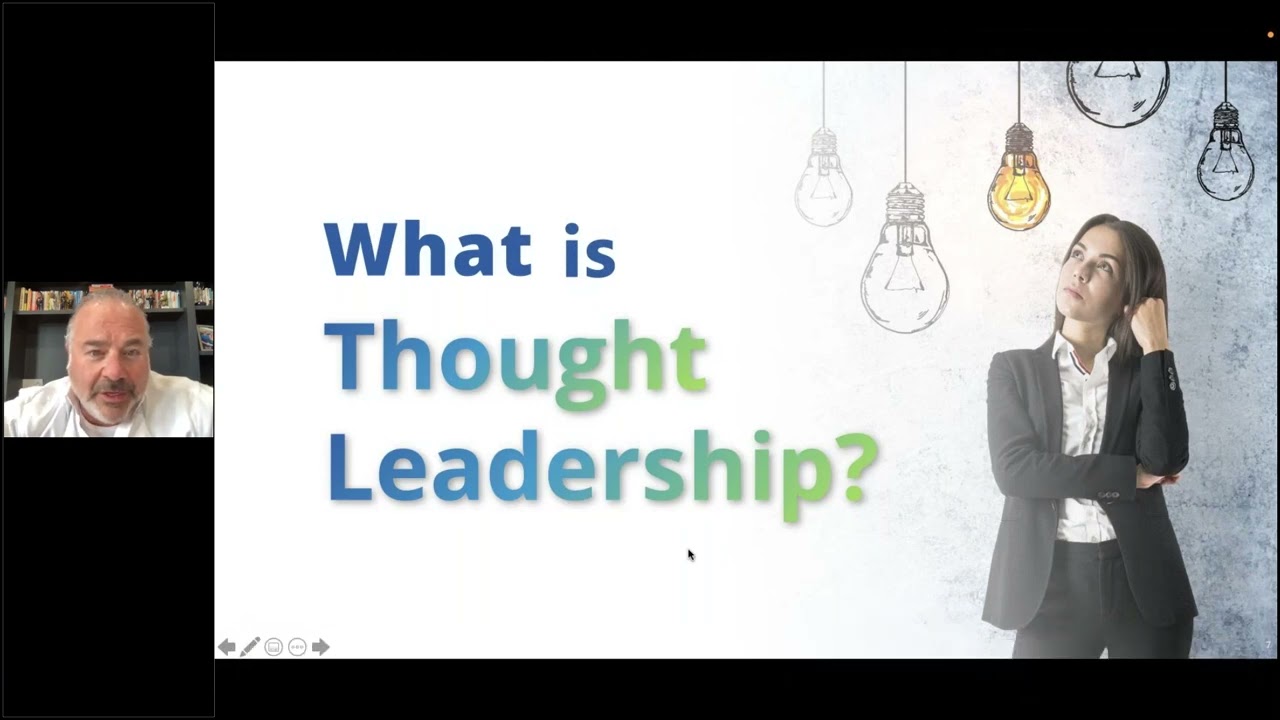
Well, thank you. So first, I, I would like to just encourage everyone to make this more interesting is to throw out questions throughout. Feel free to interrupt, throw out questions. You know, I've got a PowerPoint because I think it's the law that you have to have one, but I don't want to torture everyone with it. So if we can make this engaging and interactive, happy to answer any questions you have at any point along the way as we start to talk about building and leveraging your thought leadership strategy. So let me see if I get the technology to work properly. And okay, that should be showing my screen, I think. So let me just dive in here. So first off, most people come into the world of thought leadership with some assumptions, and some of those assumptions range from what it is, what it's not, how it works, best practices, you know, how is it different than content marketing? So there's a lot of assumptions that many of us have with respect to thought leadership. It takes a lot of work, it takes years to do, And I would just strongly counsel that for at least the duration of our time together here and potentially longer, that you start to question some of those assumptions, because some of them are valid and some of them might be holding you back from unleashing the power and the potential that you have in terms of developing, curating, deploying thought leadership to meet your objectives, both for your career, your brand, your business, etc. So first, a little bit about me. I built a company called Thought Leadership Leverage. We are a boutique consultancy and we help organizations and individuals create, develop, and deploy their thought leadership. So it's all about B2B thought leadership. We don't do anything in the consumer space. So that's that. And the other thing that I do, which is more for fun, but it's evolved into a little bit of a thing, is we've got a podcast that we host called Leveraging Thought Leadership. We're about 350 episodes in. We've had some amazing, amazing folks— Tom Peters, Dan Pink, Rita McGrath— over the years. You might want to take a listen to some of those episodes, or if you have specific questions, you can feel free to email me and I can point you to episodes that might answer some questions that you've had there. It's a little bit of shop talk for thought leaders, so that's kind of fun. And then I've been put up on a couple of different lists over the years, the Thinker 60, PeopleHum, etc., etc. So now let's get into the good stuff. So first off, and let me throw this out there, is, is if we were to have a meeting today on accounts receivable or cloud-based software or HR policy when it comes to onboarding, I think most of us would be pretty clear around what might happen in that meeting. However, when it comes to thought leadership, it's a term that gets thrown around, quite frequently, and it's a term that there's a lot of confusion with as to what it is and what it isn't. So let me just sort of throw it out there to start. Does anybody have any thoughts on sort of definitions or what thought leadership is or, or isn't? Maybe any questions or thoughts on that?
Someone says sharing what you know.
Yeah, part of it sharing what you know. Yep.
Yep.
Anybody else have any ideas as to what thought leadership is or isn't?
Someone else? Being a know-it-all, that it's not that.
Being a know-it-all, yeah, that, well, yes, but I would dial that down a little bit. I'll give you a working definition that I use because I think it's important, particularly when these conversations start coming coming about and you're involving others. So to me, there's sort of 2 sides to thought leadership. So the first piece of thought leadership is the thoughtful piece, right? So what is it that you're putting out there that is thoughtful? Now thoughtful could be an outcome of heavy-duty research, right? This could be a longitudinal study that's gone on and on for years. It could be your observations as a consultant, as a domain expert, et cetera. It could be your unique synthesis of 2 different ideas from potentially 2 different domains or 2 different areas of expertise that you're at, you know, that you're, you're, you're putting together on your own. You know, just sharing someone else's ideas or common, you know, 10 hacks to this, that's not particularly thoughtful. It doesn't mean it's not valuable, although oftentimes it's not. But I think putting the heavy lifting in and the effort and the work and the energy that it takes to be thoughtful is table stakes. The second piece of the way I think about and start to define thought leadership is the leadership piece. And what I mean by that is oftentimes people are putting information out into the universe that's fairly well known, right? And they're putting out there, whether it's best practices or standard protocol, or, you know, let me give you a recap of an article, you know, an HBR article I read or a book I read, etc. That's not leadership. So I think The leadership piece of this means having the courage to take the conversation to a different level, to elevate the conversation, to potentially go to places in the area, you know, specific domain that you're working in that might be a little bit against the norms. It might be a little bit contrarian, but we're not being contrarian for the sake of being contrarian. This isn't light my hair on fire and come look at me. F. It's having the courage to say, well, traditionally people have thought about management this way. And although I agree with A, B, and C, I'd like to add to the equation this way. And if you look at some of the things that are sort of highly topical in the universe today around the great resignation, around the hybrid workplace, about maintaining your corporate culture in a non-geocentric workplace, around diversity, equity, inclusion. There's a lot of leadership going on that's really thought leadership going on where people are questioning assumptions. They're putting thoughts out there that are new, that are different, that are unique. And there's a risk that when you do that, and the risk is not everyone's going to agree with you, and that's okay. And I would actually say that if you're too worried about getting everyone to agree with you, then it's probably not thought leadership. you know, you've probably taken out some of the spice, if you will, or some of the uniqueness in what you've got. So that's how I think about thought leadership. Anybody have any thoughts or questions or clarification on that?
Someone actually mentioned that thought leadership is sharing a futuristic view.
I thought that was— Yeah. So yeah, I think Well, let me— I'll split that in 2. There are thought leaders that are futurists, right? So that's, you know, where they're looking at demographic trends and things that are happening in technology and starting to be thoughtful about what— how that might impact our future, right? So that's one piece of it. I think the future-oriented piece is right in that, you know, could you have thought leadership going backwards? I guess you could, you know, putting together hypothesis and framing, but I think most thought leadership does have a bit of a forward-looking bend to it, that as a result of being exposed to these ideas, these thoughts, the stuff that I'm putting out in the world, people will think differently, behave differently, potentially believe differently, shed a belief that they had and embrace a new one. So yeah, I like the future-oriented component to that. Any other thoughts or comments or questions on that?
Yeah, someone mentioned that, you know, To them, thought leadership is innovative thinking on new ideas or existing assumptions. Yeah.
So, so again, so I think those are 2 different things. So there's brand new ideas, which by the way are really, really, really, really hard. You know, at some level you could argue that there's nothing new under the sun. There are new ideas. They're few and far between. Most thought leadership is actually, you know, what I believe is, is the proverbial standing on the shoulders of giants. You're adding to the conversation, you're adding to a discipline, you're adding a couple of new elements or thoughts or threads to some common-held assumptions or on top of a discipline that's been around for a long time. So yeah, that's a good piece. Thanks. Okay, so let me go to the next one here. So one of the other ways that we look at thought leadership is through a framework and a methodology that we created called the 4 Elements of Thought Leadership. So I'll walk you through this and feel free to stop and question anything along the way. If you look at this from the top, it goes from simple to expanded, and from the left to right, it goes from insightful thinking to market-facing. So first off, there are ideas, right? So there's just raw horsepower of ideas. So most people have an abundance of ideas. They tend to be, or at least they start somewhat unpolished. somewhat unvalidated, and not all ideas are good ideas, but you have to start with ideas, some hypothesis, and some assumptions. And then you move, moving sort of counterclockwise here to content. You take those raw ideas and you put them into some form of content. Content today, I mean, this is where we're living in a really, really amazing, wonderful time. There's so many variations and so many different forms of content that you can put out there. And it's really a function of what is best suited, what are the best vehicles for your work based on who you're trying to reach. So it could be a short-form video, it could be an infographic, it could be a research-based article, it could be a book, it could be, you know, a podcast. There's so many variations on what content could be, but ideas need to be ported into content. And then if we go over to the offerings, once it's in sort of some form of content, The offerings are— I think of those more as products, offerings, or solutions. How else can people consume that content? And offerings might have a price tag associated with them. You know, a book costs $28 or whatever the case is, or to license someone's content as a learning and development tool might be an enterprise licensing fee or per-head fee. So there are offerings, and offerings might range from validated assessment tools, video-based training systems, pull-down toolboxes, licensing, masterminds, institutes, think tanks. There's so many different ways that you can take that idea that's been put into content into an offering to get it out there. And that's more on the market-facing side. And then ultimately on the top right, the place that is, I would say, most difficult and mostly aspirational for many is shaping everything into a platform. So when you think about some of the folks out there in the universe whose content you enjoy, whose thought leadership you enjoy, whether it's a world-renowned author or an academic or consultant or advisor, whatever the case may be, the good ones really have a platform. And what I mean by platform is they are known as the X guy or gal. Right? So if you look at someone like a Marcus Buckingham, he is the strengths guy. You could look at some other folks that are known as, you know, Clayton Christensen was the disruption guy when it comes to innovation. And it's a place where all of your work can sort of hang, but it gives you the freedom to be expansive with just enough constraints to say, this makes sense. And what I mean by that is the blessing and the curse of many thought leaders is they're incredibly intelligent, they're incredibly smart, They've got lots and lots of things that they're interested in, that they're passionate about, that they study, that they want to know more and more about. But if it's a little bit all over the place, I always equate it to, you know, it would be like turning into my favorite radio station and one day it's playing, you know, punk rock and one day it's playing classic jazz and one day it's playing, you know, Broadway show tunes. It would sort of take me off. You want to know that what comes from that individual, that entity, that organization is sort of tied by a platform. So anybody have any thoughts or questions on ideas? Yeah.
On that note of the organization, somebody actually commented, Keith commented that a thought leader should create a framework for gathering ideas from the organization and market for the purpose of innovation. So talking about pulling ideas from the bottom up from the community.
Yeah, so let me touch on that for a minute. So there are sort of 2 different buckets of thought leadership, if you will. There are individuals that create thought leadership. So think of, you know, New York Times bestselling authors or world-renowned academics, sort of those folks. And that's sort of the traditional way, and that's great. But more and more today, what we're seeing is organizations, particularly in places like high-tech, financial services, professional services, and lately even nonprofits are putting out thought leadership to show the world who they are, to show the world what they're about, to show the world what they stand for. And I think it is the most cost-effective way to get your— to build up your brand, to acquire net new clients, and to show the world who you are. It's also to some degree an equalizer. So we could all sit around and say, well, you know, here's my competitors and they're 100 times bigger than me and they have a bigger brand and they have a bigger budget and they have a bigger footprint and all these other things. Well, you can clearly punch above your weight by putting out consistently high-quality thought leadership. And I think it is something that more and more organizations are experimenting with, are thinking about, etc., going, well, I can't outspend Coca-Cola or Deloitte or whoever, but I might be able to outthink them. I might be able to show the world in creative and unique ways That we have a perspective, that we have a point of view, that we have models and methodologies and frameworks. And it doesn't need to be one person in the organization that owns that, that has the exclusive responsibility for it. The best organizations are figuring out how to empower many, many people in the organization to, to be putting out high-quality thought leadership that's aligned with the goals and the objectives of the business. Any other questions on that one?
I think, you know, you're making an interesting point about balancing giving credit and growing your own brand and growing an organization. And it's an important question about making sure that those on the rank and file get their credit, you know, that there's room for everybody.
Yeah, so let me stay on the career piece of it. Let me— I can stop sharing the screen for a moment, I think. So let me, let me stay on the career piece of that and why I think it's really important and powerful at the individual level to start investing in thought leadership for your own personal career benefit. So I was lucky enough to have a conversation with Tom Peters about a year ago. And for those of you that recall, Tom Peters sort of, amongst other things, created this personal branding movement. So I think it was 1997, 1998. In Fast Company magazine. So back in the stone ages, we had these things called magazines. There was a cover story called The Brand Called You that was an article written by Tom Peters. And he basically gave birth to the personal branding movement, the personal branding sort of language and the business piece. And back in the '90s when that started, we weren't using terms like thought leadership. And part of the gist of what Tom Peters was saying is you have to stand out from the crowd. Now, in those days, one way to stand out from the crowd was to say, well, Peter could be the goofy guy that wears purple bow ties to every meeting or brings jelly donuts to every meeting. And in the absence of anybody doing anything else to differentiate, that would be sufficient. And I had a debate slash— I wouldn't say argument, but a heated conversation with Tom Peters. And I said, I think thought leadership is actually personal branding 3.0 or whatever number. And the reasons I think that is that all things considered, if a future employer is looking to hire you and there's 3 other comparables there, and you come with a history of producing, curating, deploying thought leadership, it is absolutely a tiebreaker. And in some cases could be a huge advantage to the career to say, wait a minute, all these other people are really good technically. But do they have a point of view? Do they have a perspective? How do I know how they think? Wow, they've really been committed to this and putting out high-quality work that would be beneficial to the firm. As an individual, the other benefit to that is statistically, odds are today that wherever you're employed today probably won't be where you're going to be employed in 5 years and almost certainly will not be where you're going to be employed in 10 years. But you do get to sort of take that thought leadership with you. It is transportable. It is not you know, work product that's owned by the company. Now there's an asterisk there, you know, I'm not an attorney and there are some instances where maybe, but for the most part, the more that you can invest in thought leadership, as long as it is aligned to the goals and objectives, you know, of what you're doing professionally, it only enhances. It's a win for the organization and it's a win for you long term. So let me pause there because people tend to have lots of thoughts and questions around how do I start developing my thought leadership at the individual level, and how does it benefit the organization, and all that sort of stuff. So any thoughts on that?
Yeah, I think people are typing. Ah, you know, someone's worried about maybe speaking on behalf of a company when you're not authorized to, while still developing their personal brand.
Yeah, so, yeah, so that you clearly have to be careful. So I think that when you're developing your personal brand, it could either be totally outside of the scope of your responsibilities, etc., of your, of your, quote, day job. And there's one set of rules that go there, right? There's a point where the organization might look at that and go, are they really committed to us? Are they focused on us? Are they Spending too much time on this. I think what I'm saying is there are ways to do this which are more in aligned with what you are doing. And I would argue that the way to do it is to test it out there internally. Ask permission a little bit, you know, talk to your manager, talk to your supervisor, talk to your boss and say, you know what, I'm really curious about X, I'm really passionate about X. And I, you know, I'd like to do some research on— I'd like to do some work on it. outside of my current responsibilities. And I would be speaking about that in terms of, here's the benefit to us, the individual, you know, the team, the organization, your functional business unit. Maybe it's marketing doing some things that would be beneficial to sales. Maybe it's technology doing something that would be beneficial to HR, whatever. But speak to it in terms of what is— what's in it for the organization to not just allow you to do it, but to encourage and ultimately support you to do it. There are many folks that are out there speaking on behalf of their organizations, writing on behalf of their organizations, you know, even though it isn't really part of their, you know, roles and responsibility. But I do think you need to be— where you do need to be careful is permission saying, you know, there's an implied— you know, it's implied that if you're an SVP at Company X, that when you're speaking in a public way, that you are speaking on behalf unless you specifically say, you know, opinions are mine, this has nothing to do with my professional role. So any other thoughts and questions?
Yeah, someone's asking about what channels you'd recommend for publishing besides LinkedIn and a personal website.
Yeah, so I'll give you what might seem to be a somewhat long-winded answer to that, but I think it's a critical question. So The channels, meaning, you know, do I go on Twitter, do I go on Instagram, do I go on LinkedIn, whatever, are really just tactics, right? And I think what happens is far too often people wind up drowning in tactics, and those tactics are in search of a strategy. So what I would say is before I started thinking about the tactics, you know, the platforms, etc., I would work backwards and get really, really tight and really, really clear on the who. I, we talk about them at my organization in terms of the avatars. Who are the avatars that I'm trying to reach? Right, and I would get really, really, really specific. An avatar is some combination of demographics and psychographic. It's not just, you know, women 43 to 55 with an Ivy League education. That's a demographic, so what? You know, an avatar really speaks to the pain points that that person is in. Particularly in the, you know, professionally. So it might be, you know, newly minted first-line managers in high-growth technology companies backed by private equity firms. That's interesting, right? So I would start with the avatars, then I would research the avatars and say, where do they get information from online and offline, right? So what are the events they're going to? What are the, what are the, you know, folks that they're following on LinkedIn? LinkedIn as a platform is incredibly powerful and incredibly strong. It wouldn't be the only thing I do, but I would let the clarity of the avatars drive where I put my stuff out. So blogging is great. The problem with blogging is you're also burdened with building the audience, which is hard. So oftentimes what we find is it's easier to say, hey, there's an association of X, that X represents my avatar. Let me volunteer to write for them and their members because they get to bring the right audience to me. Being a guest on podcasts, I find, is a wonderful way to get thought leadership out there, as long as you've got the discipline to only choose the podcasts that are bringing an audience to you that look pretty much like the avatars that you're trying to reach. So once you have the avatars, sort of the platforms and the where starts to come into focus, you know, on its own a bit. Any other questions on that?
Not at the moment. I'm sure more will be coming.
Okay, cool. Let me go back to— if I can— there we go. Cool. Can you see my screen again?
Yes.
Okay, cool. Great. So, you know, why should you care about this? I've touched about this a little bit earlier, but thought leadership is the absolutely, my humble opinion, most cost-effective way to bring— increase your brand awareness and attract net new customers. It just is, and I'll show you a little data underneath that. Edelman and LinkedIn came up with the most not sexy named survey. It was called the US 2020 Edelman LinkedIn Thought Leadership Study, so they might need a little bit of help on the creativity there, but here's some highlights as to what that report showed. 41% of decision makers are willing to pay a premium to work with an organization that produces thought leadership than those that do not. So think about that, you know, if 4 out of 10 of your clients or prospects would pay a premium because they've been following you online, they saw you speak at a conference, they've been reading the pieces that you're putting out there, the ROI on that speaks to itself, speaks for itself. 59% of decision makers agree that an organization's thought leadership is a more trustworthy basis for assessing its capabilities and competencies than its marketing materials and product sheets. So, I mean, what that really means is we don't believe the marketing hype. You know, so it's one thing if Company X tells you how great they are, or, you know, how high quality their product is, or how amazing their offerings are. It's another thing if you become a fan of or a follower of person X who happens to be a leader at that organization, that's the way to build the trust. That's the way where the products and the offerings and the solutions sort of speak for themselves, and you don't have to put a spotlight on how great you are. The thought leadership does that job. On the trust side, because again Edelman is in— they also produce the Edelman Trust Index, 88% of decision makers say that thought leadership can be effective in enhancing the perceptions of an organization. Marketing, for the most part, doesn't reach that 88% number in terms of perceptions, right? Sometimes it is echoing what's already known about an organization, but enhancing the perceptions, that's an incredibly powerful thing to do. And then 73% of producers credited deep thinking and intellectual rigor among the most important drivers of their last exceptional thought leadership success. So that's the what's in it for the individual creator. It is a forcing mechanism to think deeply and have this intellectual rigor that will add and enhance your product offering, your suite, the way you do business, the way you operate, the way you interact with clients, the way you interact with prospects. You know, we all need to get folks on the sales side of the world to get through the sales cycle quicker, and one of the things that we found in my organization is when someone comes in cold, they haven't seen our work before, it takes us longer to explain who we are, what we do, why we're qualified to do what we do. If they've been a follower of our thought leadership for some period of time, it, it condenses, if often eliminates, that first wave of the sales cycle where you have to educate the client and educate the prospect around this is who you are and this is what you do. So it's incredibly effective that way to take some of the burden off of the sales and marketing folks. Any questions, reactions, thoughts?
Is there a way to— someone's asking, is there a way to tell if somebody is familiar with your thought leadership?
Yeah, so, well, there's— so there's a couple ways to tell. So one is in general, at a high level, you know, I think LinkedIn is a really amazing laboratory. You put stuff out there. And you can see levels of engagement and you can see things like comments and you can see things like sharing and all that. There are some plugin tools. We use one called Shield, but there's, there's a bunch out there that really give you some, you know, counterintuitive insights as to who's following, who's watching, what's going on, you know, is this resonating with the right audience? Sometimes you'll have a high level of resonance with a subset of the market that is totally irrelevant to you, you know, so it might be flattering to the ego, but it has no impact on the business. So I think you need to constantly be monitoring who's interacting with your work, what they're saying, how they're sharing, how they're sharing, what about what you're saying, what you're putting out there is resonating, and how do you learn and put out more that way. That's a great question. Thank you for that. Anybody else? Okay, go back here. Do we have something else there?
No? Okay. Ah, no.
Okay, so, you know, right now we're living at a bizarre point in time, and I don't think it is going to change anytime soon. We're just— everything is being commoditized. If we were having a conversation 10 or 15 years ago about what is being commoditized, it would have been more on the product side of the house. Generic cereal products offerings, etc. Now, services are being commoditized, consulting is being commoditized, medicine is being commoditized, the law is being commoditized. Things that were always thought to be off limits or protected from commoditization is absolutely being commoditized now. And as a result of that, we're all facing to some degree a downward pressure in pricing, an increased level of competition as we're being commoditized from not just the markets that we thought of as our competition, but we have competition outside of our market, right? So think of, you know, Airbnb coming out there and taking a shot, a very big shot at the traditional hospitality industry, right? That's, that's a commoditization. We rethink what a hotel room is, right? Airbnb's in that mix, Uber, etc. So if we're all being commoditized, you know, the cost-effective way to fight that commoditization is clearly through thought leadership. And, you know, ultimately some of the benefits there are the protection of pricing. If you're seen as, and as I mentioned in the earlier slide on Edelman, a way to protect pricing, a way to protect margin, a way to protect the brand and the quality of the brand and the integrity. I mean, think about some of the best consultancies, for example, out there. Part of what they're known for is the highest quality of work that they put out in the universe. It is very common today for well-funded technology startups, for example, to have their CEO or CMO or CTO put out an amazing book on the journey, on the story, on what got them there, etc., to stand out from the competition and crowd. So let's go over here for a minute. It allows you to clearly punch above your weight class. So your competitors may certainly have bigger budgets than you, more resources, etc., but they're probably not all smarter than you, right? And I think this is the piece where what might have been a frustration at a previous point in our history actually becomes a benefit. Where you can sort of throw the gauntlet down and be a little bit of a challenger brand going after some of the biggest competitors in your marketplace, as long as you actually have something to say that's done in a thoughtful way. And it's interesting to sort of poke the bear, if you will, to see if they'll, if they'll take the bait, to see if they'll be engaged, to see if some of their former clients might be in agreement to what you're saying and how you're saying it. So another reason or benefit of developing thought leadership here. So what we're focused on here, and let me just sort of frame this because this is a little bit of a pivot from where we were a little bit earlier, is, you know, many thought leaders fancy themselves consultants. And I'm a consultant, and there's nothing wrong with consultants. However, there's a limiting— words matter, and sometimes it is a self-inflicted limiting constraint to say, well, I'm a consultant, so I come in there and I consult. And so what that leads us to think about is, you know, sort of what is consulting? So consulting, my version of it, my definition, which might not— may or may not be right, but it's a fairly decent operating definition, at least for the time being, is, you know, you're getting paid the big bucks to solve a specific problem at a specific point in time for a specific client based on actual data trends in the marketplace, what's working, what's not working, etc. And for the most part, most clients don't really care all that much. They may be curious, they may be intrigued, but they're not overly concerned about the tools, the models, the frameworks, etc., that you use to solve the problem. They just know that you and your organization have the reputation, you've solved problems like this before, so we're going to bring you on. There is often opportunity for consultants to take the models and the methods and the framework, in essence the raw DNA of their thought leadership, and turn that into training solutions to reach broader audiences. So this is another way to deploy and scale and leverage thought leadership is to think about what is the expertise that I have and were to think about yourself as a consultant for a moment, whether you are or aren't, we all provide consulting services whether we're labeled that way or not at times. But what are the things that I have? What is the intellectual property I have? A model, a method, a framework, a way of seeing the world that I can break down into bite-sized pieces that I can make teachable. And I'm not advocating that you can, you know, create some sort of a training program and in 20 minutes make someone You know, transfer knowledge that you've got based on being in the market for 20, 30 years, but you could put things out there like language definition, working definitions, some base-level stuff that's valuable to folks that opens up a whole new market. And those training solutions might have a price tag associated with them. They may not, depending on your goal and objective. You may give those things away to show people, you know, that you— that, you know, to support other work that you do. You may have price tags associated with them. It's really a business strategy issue. So any thoughts or questions on that?
I think we had a thought come in on what you were saying a moment ago, and they were saying that, you know, they have ideas. What do you do if you have ideas but you're not a good writer?
Yeah, so that's a great question. So I am somewhere between mediocre and terrible writer. I don't— and I don't enjoy it, which I think is the bigger issue. So if I enjoyed it and I was mediocre and terrible, that means I probably shouldn't be a writer. So back when I started the company about 13 years ago, blogging was much sort of hotter than it was today. This is pre-LinkedIn, etc., etc. So I forced myself to blog, and I did hundreds of blogs. Some of them, like on my best days, they were mediocre and they did the trick as best that they could, but I really just did not enjoy the process. I don't think I got much better at it. It was grueling, whatever. So I started to experiment with other modalities. I like to talk, right? So I wound up being a guest on a zillion different podcasts and then said, geez, you know what, I'll just open my own podcast. I'll do that. That'll be fun. That's a great way to have conversations. So I think it's about experimentation. Everybody has what I think is a preferred content creation format, and you might never have thought of this before, but writers write, you know, artists draw, uh, speakers speak, people that like video produce videos. So I would say if you're not a great writer, one is you might want to try some things you can do to be better. It doesn't mean you should never write, but I would say, well, what is it that you really enjoy And how could— what is a format or a modality that aligns with that, that could be the primary vehicle for your thought leadership? And then you could also obviously hire ghostwriters, editorial assistants. You could get videos that you do transcribed and turned into other things.
Yeah, and we have a couple of people asking sort of similar questions on this topic of, you know, what if you put ideas or you put a training product out there, but you don't have enough followers, or you don't get engagement? What if you get crickets?
Where do you go from there? Yeah, so I think there's a tendency to, you know, we live in a dopamine-fueled universe, right? So I think there's a tendency to obsess a little bit about, ooh, you know, how many retweets, or how many this, or how many that. And I think that's a bit of a mass marketing way of thinking, right? So assuming that I don't have any Kardashians on the line here, and if I do, you know, thanks for your high-quality work. I appreciate it. We're not— it's not a popularity contest. I would say it's about engaging with the right people in the right way, right? So it's not a numbers game in terms of volume. It's high-quality engagement with the work. Now, that being said, sometimes you put stuff out there, and if it's crickets, I think the market's telling you maybe that's not all that interesting, right? Maybe you need to do something else to it. So I would, you know, if you're determined or you think there's something there, try putting the same idea out in a couple different modalities. So if you only put it out in video format, try a blog, you know, try an infographic, try a different format, try a different twist on it, try a different format or style instead of writing in a fact-based or data-driven way, maybe, you know, integrate, you know, the hero's journey or tell it in a more anecdotal way. So I think a lot of it is just experimentation. And by the way, I would always think of anything that you put out as an experiment. And by definition, a majority of experiments fail, and that's okay. It gives you the opportunity to go on to the next piece and experiment there. Other questions, thoughts?
Not just yet.
Nope. Okay, cool. Let's go over here. So this was a phenomenal movie, Field of Dreams. This is Kevin Costner about 130 years ago. But the gist of this movie, if any of you recall it, was if you build it, they will come. So he built this amazing baseball diamond in a cornfield, and lo and behold, all these, you know, historical baseball figures appeared. Wonderful movie, really stupid strategy. And what I mean by that is lots of people stubbornly consider to build things and build things and build things and write and go out there, and they're not listening to the market and they're not listening to the response. So I think you need to have a better strategy, right, in place. And the other thing I see often is people mistaking a tactic for a strategy. So I am going to blog daily. Okay, that's a tactic. What's the underlying strategy? And the underlying strategy might be, I'm going to blog for the purpose of reaching these type of people to get them engaged so that there's a call to action, or, you know, I want them to become aware that we have a new methodology out there that may be beneficial to them. So, you know, it is easy to drown in the tactical because there's always a new tool. You know, there's— remember how hot Clubhouse was just I don't know, over the summer, 6, 8 months ago, Clubhouse was on fire, and it's sort of done the wave right now where I don't think it's gone to zero. But, you know, the dust has kind of settled there. And, you know, I don't know that you needed to be the first kid on your block to be on Clubhouse. So people were diving into that from a tactical perspective without an underlying KPI, you know, OKR business strategy underneath it to say, why am I going on to Clubhouse? Is Is my audience there? Do I want them to become aware of me? Do I want them to interact? Do I want them to reach out? Do I want them to, you know, follow up to ask additional questions or sell my services or whatever the case may be? Thoughts on your ideal buyers. This goes back to a little bit of the avatar conversation, is starting to think about what sort of an organization Are you trying to connect with? Is it a startup? Is it a small business? Is it a family-owned business? Is it a Fortune 1000? Is it a socially conscious business? Is it a high-growth company? Getting really tight on the types of organizations that you work with. You know, thought leadership is not one size fits all. It just isn't, you know. Then we need to really get an understanding of the pain points. What keeps them up at night? What are they struggling with? If you were to talk to 10 folks that look like your client avatars and get them to document the top 3 things that they're stressing out about. So if I was a head of HR at a Fortune 1000 today, I would be stressing out about the Great Resignation. I would be stressing out around what are our new policies relative to work from home, work in the office, hybrid, what are we gonna mandate? I would be stressing out over do we have the highest, the highest—
Talent.
quality DE&I initiatives out there, both inside the organization and outside. And then, you know, looking at it from the perspective of what do they want to achieve? What does it look like to get them through on the other side of that pain through what you do in your work? What is, you know, what is sort of the proverbial promised land look like for them? What would it look like on the other side there? Any thoughts or questions on pain points or identifying organizations?
I think that was very clear.
Cool. So this is something that, you know, we do a lot of thinking on and we have conversations on. Okay, great. So I get it. But now how do I actually use it? What am I going to do with this stuff? Right. So, you know, there's an argument to be made. You're going to spend time, you're going to spend energy, you're going to spend some effort, you're going to spend some resources. what are the use cases? You know, I think it's a great question. So the thought leadership marketing, we look at one way to deploy thought leadership. So you've created it, now you've got to get it out there, and we call that thought leadership marketing. And the way to think about thought leadership marketing is I've got this clearly defined avatar, right? So we got to a high level of specificity, and, you know, some litmus tests there are if you're answering the question, of your work, who your thought leadership benefits with. Oh, this could benefit everyone. You haven't done the work right, because unless you have the marketing budget of a Coca-Cola or UPS or something, you can't afford to effectively market to everyone. So the higher the level of specificity, the better, almost to the point of it's really— it should be somewhat of a challenge to find the avatars. It shouldn't be as easy as, you know, a demographic survey. Search on LinkedIn. Then you got to figure out the blogs, the publications. I just got a note there. The blogs, the publications, the conferences that they're attending. Then you have to align the format of your content. We talked about the modalities before, but if you're working with an audience that is, you know, maybe agency work, creative, etc., they're going to want to see highly creative examples of thought leadership. They're going to want to see video, they're going to want to see infographics, they're going to want to see animations. If you're putting out, you know, 17,000-word academic articles with 17 pages of, you know, footnotes, it's not going to resonate with that crowd. Then you got to allocate some resources. How much time, energy, and effort am I willing to invest in this? And I think The key piece of thought leadership marketing is we all live in a world where we like immediate gratification, where we like to see that instant dopamine hit, where we like to, you know, send something out in the morning and get accolades in the afternoon. You have to have a long game. It takes time and energy and effort to build out an audience, to build your voice, to fine-tune the machine. And then ultimately there is a flywheel effect because most thought leadership that is produced and put out there is designed to be somewhat evergreen. You know, it's not, it's not the recap of, you know, yesterday's football game where, you know, in a day or two nobody's going to care. Think about when you're putting thought leadership out into the universe, how do I make sure that this might resonate with the right person today, a week from now, a month from now, even a year or two from now, right? Then you have to have some metrics. And again, I would argue that some of the social media metrics that the PR folks have sort of thrown on us aren't really particularly valuable. So likes, you know, retweets, unless we know that they're a predictive indicator to an outcome that we're looking for, I'm a bit skeptical there. So logical metrics that I like are, as a result of investing in thought leadership for 6 months, 9 months, whatever that time period is going to be, it would be great if we were to acquire, you know, 3 net new clients. And our average, you know, customer acquisition cost would be Y, and our average lifetime value of a client is X, and those numbers make sense, right? We'd like to know that our sales and marketing people are telling us that when they're engaging with prospects, there's a level of awareness amongst the buyers that didn't exist before. So it doesn't have to be as direct as You know, they read the article, they bought the whatever, but how is your other arms of your business realizing and benefiting from the investment in thought leadership? And then you have to implement and monitor and be consistent here. Thoughts, questions?
Okay.
And you know, the shorthand for this is you got to get the right message delivered in the right modality, at the right cadence. So let me just talk about cadence for a minute. Different platforms, and again, we're thinking about the platforms not from a tactical perspective, but once we've confirmed that this is where our audience or our desired audience or the group that we're trying to influence lives, have different cadences, right? So Twitter has a high-frequency, short-content cadence. It is not uncommon for people to put stuff out multiple times a day, several times a week, etc., on Twitter. That's the Twitter cadence. If you were to put out stuff 6 times a day on LinkedIn, for example, people are going to find that grating and going to find that annoying and eventually disconnect and tune out. You know, Facebook really depends on the type of business that you're in. For some, that works. Some businesses that are more visual, some that are more consumer-focused. On the B2B side, probably not so much. You know, YouTube, it depends on your work, Instagram, Pinterest, etc. So I would just, before you dive into a new platform from a tactical perspective, spend some time to educate yourself and understand sort of the cultural norms and cadences that work there. You don't want to be the, you know, the obnoxious folk that walks into the networking room and starts throwing out your business cards or shouting or whatever the case may be. Start by observing and engaging and consuming content on the platforms before you start producing and posting, and you'll get a sense of what works here, what doesn't work. Is this one, you know, a platform that's a little bit more quirky? Is this one where I need to be more polished or less polished, etc.? So, you know, sort of align yourself to the standards and norms of the platform as long as it's aligned with your brand and your values. And that's All I've got here, so again, I'll open it up. Questions, thoughts, specifics, stump the expert, whatever you'd like. Anything I can— questions I can ask or anything I can do to be helpful in terms of where to start in your thought leadership journey, struggles that you're already having, how to convince others in your organization that it's a viable pursuit.
Yeah, someone actually just asked, What do you do if you post something and someone writes a very angry, disagreeing response?
Yeah, I think that's okay. You know, listen, what you don't do is take the bait, right? So, you know, I think response— you know, there's a 2% or 1% of the population that are just absolute jerks and gross on the internet. Like, that just is what it is. It's a price we pay. It's a tax that we pay. I would stay professional. You know, I would either ignore it if there's something that you can— some way to counter what they're saying in a logical, you know, way that's fact-based, that's not emotional-based. Some people try to do it to rally up. And you know what? Healthy disagreement is healthy, right? It's when we get disrespectful. It's when we personalize it. Someone could violently disagree with lots of ideas I have, and I don't take it personally, right? That's okay. That's healthy. But I think we've lived in a world where those lines have been blurred, and people misperceive disagreeing with my idea of, you know, invalidating my identity or my thought or whatever. So I think, you know, take the high road. You know, engage if it's thoughtful.
If it's just, you know, slanderous or silly or stupid, Someone's asking, what do you see as the difference between thought leadership and evangelism?
That's great. I think, well, I define evangelism maybe a little bit differently, not in the, you know, religious perspective, but I think many good thought leaders are actually evangelists for the idea, for the platform, for the thought leadership, right? Part of their reason for being on the planet is to unleash the power of their ideas so that it has impact. And part of their purpose is to get that idea out there because they know that it makes people's lives better or alleviates a pain, or it's a different way to look at the world. You know, I've met several evangelists that are agile software developers that they're so passionate about that methodology, which is a software development methodology, that they are evangelical in the way they act. So I don't think there's anything wrong with it. I think it actually shows a level of commitment and passion, as long as it's done, you know, again, with respect and not at the expense of others. I think it's great.
Thank you. We have someone asking, where have you seen others fail? Obviously not, you know, through faking it, he says. What are some less obvious So that's interesting.
So there's less obvious fails. I'll push that into on the thought leadership side, people that are just lazy, that put stuff out there that's absolute thoughtless crap. Like, the world is smarter than that. We are living in a world right now, which is the opposite of the world we lived 25 years ago. So we're living, you know, it used to be a world of information scarcity and information behind paywalls and whatever. Now we're living in information abundance. I get drowning in a firehose of information every day. So if you're just going to regurgitate or tell me things I already know or put something out there that is silly or not thoughtful, there's no tolerance for that. I think that's failure. I think making claims that are ridiculous— thought leadership is not Latin for infomercial. This isn't the ShamWow of it. I think you need to be real. You need to be pragmatic, authentic, honest, transparent, you know, don't, you know, enhance your credentials or the power of your thoughts or whatever. But that's an interesting— I like that question. Any others?
Yeah, someone wants a view under the hood. She's asking, can you share insight into your own thought leadership strategy?
Yeah, no, totally. So my thought leadership strategy, there's a couple of pieces to it. I have not written a book. That's part of my strategy, right? 90-some-odd percent of my clients are world-renowned authors. For me, and I've had offers to do so, and it would be fairly simple to put it together, it doesn't— strategically doesn't make sense for me, right? So I have a very, very, very small market. I know who my market is. And a book is a mass-produced product. And I don't think the return on investment of my time and the firm's investment in a book is the right way to do it. So, you know, part of our thought leadership strategy is a podcast. So I get pitched 20 times a day to talk to interesting people to be on the podcast. And lo and behold, many of those people align to our avatars and become clients as a result of those interactions. We do some joint ventures and sponsorships. We have a partnership now with the Stevie Awards, and we have created a category for the Stevie Awards, which is an award group that's been around for 20 years in business. where we own the thought leadership category. So there are now Stevie Awards for thought leadership in a bunch of different categories that we're part of. We are in conversation with an organization to do a television show that'll be captive audiences inside of airports. And that's part of our thought leadership. I'm, you know, there's some groups that I speak to that are pretty, pretty, pretty niche, where I know my, my, my peeps, if you will, my tribe is.
Thanks for that. We have time for a couple more questions, sort of on that same vulnerability train. Someone's asking, does it ever get easier emotionally to put yourself out there?
Yeah, I mean, listen, putting yourself out there is relative, right? So you have the Brené Brown spectrum where it's all about vulnerability and whatever. And then there's putting yourself out there in a more— I don't want to say she's unprofessional, but there's different degrees of putting yourself out there. For some people, just being the face of the product, the brand, and the offering is a little bit overwhelming from a put yourself out there perspective. For others, it's how much of the kimono that you're opening. Are you talking about your failures? Are you talking about your struggles? Are you talking about those things? I think you have to do what you're comfortable with, you know, and those boundaries are different. for everybody. And I would say push the boundaries a little, but if you're, you know, if you're coming up to a place where, yeah, I just don't feel comfortable talking about that, then don't. You know, be as transparent or vulnerable as you can.
So someone asked you who your favorite thought leaders are, and I'm gonna— oh, sorry.
Yeah, that's like a— I'm sorry?
Now I'm going to add to that. How do you find thought leaders to follow and emulate?
Yeah, so my favorites, it's like asking who your favorite kid is, right? So I've got, I mean, like, you know, literally hundreds and hundreds of folks that I follow. You know, I love Malcolm Gladwell. I love Jim Collins. I love Tom Peters. I love— there's just so many. David Burkett. I mean, there's There's dozens. I mean, I'm a dork that reads 2 books a week, and then I'm, I mean, all day, every day I interact with thought leaders. So I've got the greatest gig in the world and can never get enough of it. In terms of, you know, where do you find thought leaders? I think that's a really interesting question. And I would push on that question to say, well, there's thought leaders of every, you know, every flavor, every domain expertise. Is it that you want to find a thought leader in an area of expertise similar to what you do?
Right.
So if you're in the innovation space, who are great people in innovation, you could look for TED Talks. Is it something that, you know, you're a technical person and want to take on some thought leadership that's totally outside your comfort zone, maybe like, you know, emotional intelligence or something like that? You can find them on TED. You could look, you know, you could find books. There's groups like the Thinkers50 that ranks thought leaders every year, sort of, sort of kind of the Oscars for thought leaders. You could ask other people who you admire and respect, hey, who are you reading? Who are you into? Who do you follow? I love to ask people, hey, who's out there that you admire? Who's out there that you follow? Who's out there that as soon as you hear they're putting out a new book or something, you're doing the, you know, the pre-buy on Amazon or something?
Yeah, that's a great answer, especially about choosing your favorite kid. So I think we have a good question to end on. Here, which someone's asking, if you're ready to start building your thought leadership strategy, what's the first thing you should do?
Yeah, well, the first thing that you should do is commit to building the strategy, because I think it is so tempting to dive into the tactical. But take the time, the effort, and the energy. It's not going to take you months, might take you, you know, a month or two, but really, really put together a viable strategy. Who am I trying to reach? How am I trying to reach them? What's the investments I'm willing to make? Time, energy, effort, money. What's the outcomes I expect? You know, what's the feedback I'm gonna get to constantly modify and tweak it along the way? And, you know, sticking to some sort of a plan with a high level of commitment, realizing that in 6 months, that plan, once it's, you know, the rubber's met the road, is going to change and morph, and that's okay too.
All about planning and patience, huh?
Yes, exactly. Well, and persistence, I think. I think there's a grittiness and a persistence and all that.
Yeah, not every post can be a world hit.
Yeah, exactly, exactly.
Well, that's all the time that we have today. Thank you so much, Peter, for all your insights and your advice, and thank you everyone for attending. Thank you all for attending and your questions. And we hope you all have a great day, and we'll be sending out the recording shortly.
Thanks for having me. Thank you all. Thanks.
Bye.










