Four Keys to Mindful Thought Leadership - Mindful Marketing Live Stream Event
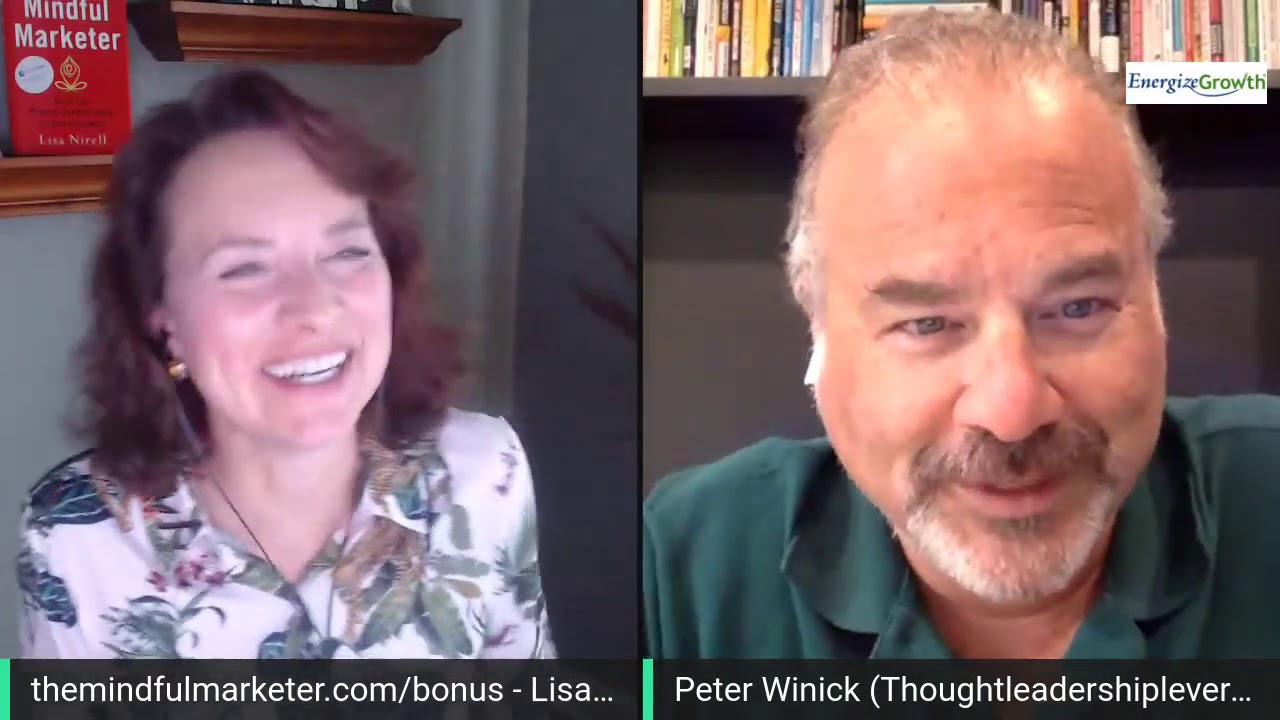
Peter Winick breaks down thought leadership during COVID-19, covering what it actually is and isn't. He walks through ten traits of successful thought leaders, from reframing and humility to storytelling and monetization, then explains how to build a repeatable platform around your ideas.
Chapters
Good afternoon, everyone. It's Lisa Norell here on a Friday, July 24th. It's wonderful to see so many of you already on the Facebook Live and LinkedIn Live livestream. This is the Mindful Marketing livestream. It's our 3rd time this month, and I'm just thrilled about bringing it— being able to bring you some pragmatic insights on mindful marketing during COVID So sit back, take a couple breaths, and please stay with us for the next 30 minutes or so. I'm also going to remind people that we love interaction, so be sure to leave any comments or questions in the comment box, and we'll get to as many of them today as possible. I'm gonna start off by telling you that we have a terrific guest today. An old friend of mine, Peter Winick, is joining us from New York. of thought leadership leverage. And as we talk about mindful thought leadership in the time of COVID I couldn't have thought of a better person to be part of this conversation today. So Peter, welcome to the livestream today.
Wow, thanks. Thank you for having me.
Yes, Peter, this morning I wanted to tell you what I did and tell you why I thought it was just so relevant to what we're talking about today. I do walkabout meetings with my clients who live in the Washington, D.C. area. So we joined up on the W&OD Trail, which is a 71-mile-long trail here in Virginia. Didn't walk 71 miles, but— Well, we typically do 4 or 5 miles and, you know, solve all the world's problems. And today was just this bonanza of wildlife. So we did— on the first part of the trail, we saw 2 almost glow-in-the-dark turtles cross our path. And then we saw 2 jackrabbits cross our path. And, you know, it was really interesting because the minute I got close to the turtles, they retracted their heads into their shells. But when I went up to the jackrabbits, they paused for a moment, let me take their picture, and then they dashed off. So I challenge— my challenge for our group today is, as a professional, which one are you? Are you the jackrabbit or are you the turtle? Because I think there's so many opportunities to be a thought leader and to bring your gifts and your talents to the world, but Why is it, Peter, that so many people retract during COVID and think, you know, I'll wait till things get better? So I think that's what we're going to cover today, and I hope we can dive into that together.
Yeah, that'd be great.
And by the way, I'm wearing my wildlife shirt for that reason as well. So I see we have John joining us also from, I believe, from Minnesota. So John, welcome to the session. So, Peter, you're the founder and CEO of Thought Leadership Leverage and also a serial entrepreneur like myself. You have a great podcast I've been listening to for the past year and a half called Leveraging Thought Leadership. And you've helped organizations and individuals build and grow revenue streams by designing their content strategy, their thought leadership platforms. And your client list does lead— it does list like a who's who. Our mutual friend Chip Conley, you've worked with him. You've worked with Juliet Funt, Dan Pink, Keith Ferrazzi, and New York Times bestselling author Carol Roth. How did you ever get on this path to thought leadership as your mission or your passion?
Well, I think like many of my clients, totally accidentally, serendipitously, and coincidentally. So it wasn't— a deliberate linear, like, let me do my time here, here, and here to get there. I think it was a combination of 2 things. Number one, I've always been entrepreneurial, you know, from, you know, multiple paper routes and all those sort of things as a kid. And, you know, starting businesses, building businesses, growing businesses, all that. Always loved that. Always loved the challenge of business. And then I was also always sort of a contender, just, you know, reading, reading, reading, taking it in, taking it in, but thought there were 2 very distinct sides of me. And then sort of the 2 came together in '03, '04, something like that. I was at that point a COO of a boutique consulting firm, and I got recruited in from a friend of mine who ran a turnaround company to help them with a company that did communications. So they were basically a presentation skills company that was in trouble. When they bring in the turnaround firm, that's like about 5 minutes before they bring in the undertaker. It's either like we can revitalize the patient or, you know, pull the scraps of gold from their teeth and sell it off. And we were able to turn it around. But what I learned from that experience is like, wow, there's a whole business side to this content world. I've just been a guy buying a bunch of books and reading a bunch of things and never really followed the money. And then when those 2 things came together, I'm like, ah, this is my— This is my spot. This is where I need to be. This is where I wanna stay.
Yeah, and here you are, what, 2 decades later?
Yeah, yeah, exactly, exactly.
We have a lot of followers on LinkedIn, and I'm curious, I mean, I joined LinkedIn probably 13 or 14 years ago, but when did you see the genesis of the terminology thought leadership? When did that even start?
Yeah, well, I'm— it's gotten a little abused, quite frankly. I think it's been out there for quite some time, but when I started the company almost 15 years ago, it wasn't as trendy or fashionable, or it wasn't like, you know, your dentist is now a thought leader or something. It was what we did. You know, we helped people leverage their thought leadership. And now it seems, which I think is a good thing, that more and more people want to understand what thought leadership is. how to become a great thought leader, how to integrate that into their businesses. So yeah, I think probably the last 5, 6 years, it's sort of, the S-curve has popped a little bit.
Yes, so now it's a little bit more mainstream. And can you tell us what thought leadership is not? 'Cause sometimes I learn better when I understand the opposite, when I apply Genusian thinking. Because I do hear the term a lot.
So I'll break it down to what it's not. So first there's thought. So if it's not thoughtful, it's not thought leadership. And what I mean by that is there are plenty of people out there that are not adding to the conversation. They're regurgitating or parroting or pick a word there. It's, I've heard that before. I've heard that before. They're retweeting something that they've heard or quoting something or whatever without adding any context, any flavor, taking it to the next level. So that's, if it ain't thoughtful, it's not thought leadership. And then the leadership piece, piece is where are you taking that discipline directionally? Where are you hoping to— and A, recognizing that you're standing on the shoulders of giants. You didn't invent your domain, whether that's leadership, management, agility, creativity. Like, there were people there before you, and you should be fluent in everything else that's out there in your space, whether you agree with it or not. It's fine to disagree with it, but at least understand sort of what's out there, and then lead that conversation, lead that discipline into a better place, into a new direction, or challenge it To accept a new way of thinking. And I think those are— if you're not doing those things, you're not a thought leader.
Right. Well, you know what I did? I put on my David Letterman hat this week and I came up with a top 10 list.
Oh no. Do I have to do a stupid pet trick? Because we opened with turtles.
No, there are no stupid pet tricks involved. But, you know, I've been— running my own firm for 18 and a half years. And as I tell my dear friends, I'm now fully officially unemployable.
Right.
And I always aspired to be a thought leader, not for the ego trip, but because I wake up every morning saying, how can I help as many people as I possibly can in a way that's true for me, you know, based on my 14 or 15 years of corporate experience in marketing, sales, and leadership? And so I came up with a top 10 list of what I've learned being surrounded by thought leaders, including yourself. So do you mind if we play around and just look at those for a minute?
And then let's—
and then I want to hear more and tell people about your wonderful white paper that you published around thought leadership.
Sure.
That they can receive for further amplification on this.
Is Paul Shaffer going to play the keyboard? Get us jammed up here or no?
All right. I wish.
If you're under 30, Google that.
That's right. That's right. Who's Paul Shaffer? So, and by the way, I also want to welcome Tom. Tommy's here from Sweden, and we have Joyce from Texas joining us. We have Robbie from Northern California. Welcome, Robbie. So we have some great people joining in who can post questions anytime. So number one, here's No, we start with number 10, right? So number 10, thought leaders can reframe. Thought leaders reframe old beliefs or old constructs in a way that gets people to think differently or to jolt their imagination. That's my first thought.
Okay, I'm good with that. I like that one.
So like, I was approached by a journalist last week who said, Lisa, give us your top tips for motivating employees. And I said, there's no such thing as motivating employees. You come to a per— if you hire a good person, they're already motivated, right?
Exactly.
Your job is to inspire them and make sure your values are aligned. So that's just an example of how do you reframe a conversation to get people to think differently. Number 2, or number 9, number 9, thought leaders have thick skin. Because I learned that from Guy Kawasaki. You've got to polarize your market. If you're a corporate executive right now and you're watching this and you're going, oh, I'm a thought leader, but I don't wanna upset anybody. I wanna make sure my message appeals to 100% of the audience.
Chances are, no. And we actually counsel a lot of clients and say, wow, okay, that's so bland. If you're not sort of ticking off 10, 15, 20% of the world, you've boiled it down to something useless. Like, there should be people that agree. And your job isn't to get the whole world to go, oh my God, I agree with you. But you want to get, you know, another point of view. You want to stir it up a little bit. And if nobody's disagreeing with you, you're not saying anything that anybody really is connected to, cares about it enough to say, no, I disagree with that. I have a different way of thinking.
Absolutely. Absolutely. And the third one, number—
I've got to get used to— number 8.
Number 8.
I'll do the counter. There we go. 8.
Here we go.
Thought leaders are willing to experiment. Yeah, 1,000%.
So I am currently experimenting with live streams. This was, you know, every year I experiment with something new and live streaming is my end 2020 experiment. Thank you, COVID. You know, so—
Well, I think all of thought leadership is a series of experiments because what happens is I think in the old days, you know, 15, 20 years ago, a thought leader would go out there, lock themselves up in the cabin à la Walden Pond and come out with the tome and put the book out and then get really depressed if it sold 12 copies. Like, it shouldn't be a surprise to you. I mean, if you're starting to put content out there in small bits and small nibbles in blogs and video, you get a better sense of what the market wants. And by the way, I'd rather fail by writing an awful blog that nobody cares about than spending 18 months of my life writing an awful book that sells 4 copies.
Yes, and I was just watching a livestream by a a consultant, and I— can I tell you an example of what not to do? Sure.
So this—
and again, I'm trying to be mindful about this, and I don't mean to disparage other people. It's the, it's the process that I'm criticizing. And the process was a thought leader coming in on a livestream the other day who said, oh, I'm so excited, I'm working on my next provocative idea, and I've spent the last 5 years working on my book proposal. And I just went, oh my gosh, oh my gosh, you know, this is that paralysis. Um, if you're an experimenter, you're going to say, what can I get out the door in the next 90 days?
Or Seth Godin says ship it. You got to ship it, you know.
You got to ship it.
Yeah.
So, uh, it's about, as, as Alan Weiss says, it's about success, not perfection. Right.
Number 7, in case you—
That's right, number 7. We never call ourselves thought leaders.
1,000%, 1,000%. If you call yourself a thought leader, you're a jerk. And that goes for guru as well. It is a title that others respectfully bestow on you, colleagues or others in the community, but don't ever, ever, ever, please don't ever do that.
Exactly, exactly. So please, I am not a thought leader, you know. Number 6, They believe wholeheartedly in attribution. Attribution is big for me, Peter. I sat next to—
Yeah.
I'll tell you what attribution is not. I met a CEO of a company who claims that they grew their company to $100 million and sold it. So, and they call themselves a thought leader. And they met me at a conference and they saw my book and they went back to their office. I gave them a book, they went back to their office and they sent me an email. And you know what they said? I love your book, Lisa. I loved it so much. Remember, she runs a $100 million company that she sold. I loved your book so much, I made copies of chapter 7 for all my employees.
Yeah, let's Google copyright infringement. Yeah.
Yeah, so I thought that was interesting. I wanna pause now. We made it to number 6. I wanna take a comment. I have a question from Robbie in Northern California. Hi, Robbie Baxter. How do you find the true thought leaders and separate them out from the regurgitators who have a big platform? It seems like, it seems like there are all kinds of tips and tricks for building followings that have nothing to do with authentic followers. I'm often surprised by poor quality thinkers with huge followings, and on the flip side, best kept secrets who have great content and small followings.
Yeah, so I think that, you know, there's a subjective piece to it, right? So there's clearly a subjective piece. So I might You know, have a glass of Pinot Noir that I love, and I share it with Lisa, and she goes, "Ugh, this is vile," and we could both be right. However, I don't think the metric is following. You know, to me, I wrote a blog years ago that got a little bit of buzz, and I talked about steak versus sizzle. So there's a group out there that have a ton of sizzle, right? It's just it's magic and charisma energy, whatever. But there's no steak under there. I tend to gravitate towards the steak and say, "You know, we just need to help you add a little sizzle to." Because if somebody doesn't have the underlying stake and it's all puffery, they might be sort of a social media rock star, but you know, you can fool some of the people some of the time. I think true thought leaders don't focus on size of following metrics of that. It's the impact they want to have in the world, how they're helping the businesses that they're serving, how they're connecting in the communities they want to be connected with, etc. I mean, the number of Twitter followers or something is, is, uh, you know, that's like, I think that's for Gary Vee to worry about.
Right. Yes, yes. Uh, the funny follow-up from Robbie: someone told me years ago I was all steak and no sizzle.
That's a compliment in my world.
Yeah, all steak and no sizzle.
Exactly. Spice it up a little, that's all.
Did you notice all the metaphors we're using today, Peter? This is fun.
You started with like the turtle. Well, you started with the turtle and the hare, so I didn't know where we were going.
Absolutely. I, uh, I just was in this land of metaphors today, and I wonder, have you ever gotten calls from people, authors or wannabe authors, who have said to you, Peter, I have a book coming out, can I hire you to build up my followers to 1 million people in 30 days. I mean, have you ever been asked to do some unreasonable thing?
Yeah.
How, what?
I mean, so first of all, we're not, yeah, so I mean, we get asked a lot of ridiculous things. And first of all, we're not in that business. We're not in the social media grow your follower business. We're in the business of helping people develop their strategies, to leverage and scale their thought leadership. I think the underlying question to that question is there are really wise people, really smart people that put a lot of energy and effort, let's say, into launching a book, but are delusional when it comes to what are logical expectations and such to have. They think the publisher is going to do everything, or the hard part is writing the book, and then I launch it, and then blink, blink, rainbows and unicorns. I mean, I don't need to tell you, Lisa, but it takes a lot of work to write a book, it takes equal amount or more energy and effort to get the book out there. And by out there, I don't mean that everybody should be held to the same standard of, I want to be a New York Times bestseller. That's a great aspiration, but I always start on the other side of that with our clients and say, listen, if, if we got this book into the hands of 200 people, let's name who they are, how would that change your world? And then build from there, because people tend to think of books only as sort of air cover, and there is a almost guerrilla ground-to-ground, ground-level combat that you can have with a book to get it out there. But yeah, building a million followers, I don't know, go buy a list somewhere.
Right.
Soviet bots or something, I guess you can do.
That's right. So that's what I want to remind people is it is not about how many followers that I have. I call those in my book, The Mindful Marketer, I call those vanity metrics.
Yep, totally.
They're not too helpful. Let's go back to number 5. Okay, we're still getting to the top 10 list. Thought leaders are self-effacing. In other words, there's a modicum of humility and self-effacing and a willingness to say, you know what, I did this over here, I messed up. I'm not perfect. I'm gonna make mistakes. However, I've been successful over here. What's your perspective on that?
So I think there's a continuum where there are many, many that are evolved and self-effacing. And there are many, many that have, they have to walk in the doorway sideways 'cause the ego is so big, right? That it's all about them and charisma. Don't be that guy or gal. So I think the more you can be vulnerable, the more you can be self-effacing. I mean, any thought leader that says, I've learned everything I need to learn, should hang up their hat. I mean, it's, you have to be aware open to it. But I think there are many— listen, this is a weird space where, where up until, you know, COVID hit, think about how many of these people earn their living. They flew first class to go somewhere to spend an hour. That was their day's work. They get paid a ton of money, and the day ended in a standing ovation. I mean, I see my mailman every day working hard. I don't think he's ever gotten a standing ovation, and I know he's never gotten paid $30 grand for an hour to deliver the mail. So there's a little bit of it You know, the fumes get to your head a little bit, and I think you have to stay grounded and stay self-effacing.
Yes, absolutely. And being able to make fun of ourselves and how, you know, how did we make a mistake and then how did we recover from that mistake so others won't make the same mistake.
Exactly.
It's very important. Number 4, they're great storytellers.
Yeah.
They're great storytellers.
Yeah, if you, you know, I think there's 2 elements to great storytelling for thought leaders. Some deal with issues that are really, really high-level, complex, etc., and to make the complex simple is an art. And then the other side of that is those that come from research-based, data-based, etc., being able to bring those stories to life in ways that people care, because you almost have to untrain academics who have been schooled in writing for academic journals that, by the way, 5 people read. How do you take that concept out in a way that is approachable and could be received by a broader audience and still not— it's not about dumbing it, but making it. It's really hard to do. Not an easy thing to do.
And we live in such an exciting time. I'm going to transition to number 4, which is being able to— excuse me, number 3. I cannot count today. I cannot count today.
So number one is thought leaders do not have to be good at math.
We can— Thank you.
And with the beginning, start with the end in mind.
Thank you. Are you channeling your inner Stephen Covey?
Exactly.
Talk about a monumental thought leader. You know, he was the first thought leader I ever met in my career. Oh, wow.
Wow.
When I was a business columnist on the side for the San Diego Transcript, and it was one of the best sites hustles I ever had. And I was, uh, I, I— the LA Times lost their opportunity to interview Dr. Covey when I was at a conference. They just, they just blew it off. They didn't show up. So the head of PR came running and found me and she said, Lisa, Lisa, could you— I know we essentially— I know we blew you off multiple times and said—
Yeah.
We cannot interview Dr. Covey. But guess what? We have an opening. And I was totally unprepared.
So cool.
But I pulled myself together in 20 minutes and got to interview him not once but twice. It was awesome. It was life-altering for me. That's when I realized, wow, this thought leadership can really change the world.
It can.
And so speaking of which, and he did that very well, Number 3, thought leaders can monetize their expertise.
Yeah, 1,000%. 1,000%. Give me—
give us an example of where you saw that happen with one of your clients, where they just had this big sexy idea, to steal Mark Levy's favorite saying, big sexy. They took a big sexy idea and they were able to really help a lot of people and monetize it in an effective way.
I mean, I think it's pretty much all of our clients aspire to and get to that point. So number one, I mean, I think there's different chunks of that. Number one is the first step is, can you make a living from your content, right? So it starts off for some as, I've got this burning desire, I've got this thing, I'm writing this book, and then it sort of becomes a train that leaves the station on its own. And if you're able to step— to me, I always look at it in tranches. Step one, Can you make a living from your content? Congratulations, that's better than 99% because most people are sort of dabbling and doing something else like a day job. So if you can make a living coaching, advising, speaking, consulting, etc., the real capital M money from a monetization perspective comes from transforming from a practice to a business. So what I mean by that is when you're making a living monetizing your content directly, Ultimately, it's a practice like a lawyer, like a dentist, like whatever. So you're selling time for money, whether that's in the form of a project or whatever. And that's okay. You know, there are worse ways to make a living. But ultimately, how do you take the IP, the assets, the intellectual property that you've built and have them living in other modalities— video-based training, validated assessment tool, consulting tools, licensing? That's where the creativity and to me the excitement comes in, figuring out the right match depending on your client. Target audience. And, you know, that's, that's the ultimate objective to do. And I think one of the things that we do a lot of is moving people from a practice to a business. So it doesn't mean they give up speaking, or it doesn't mean they give up coaching, but you layer on top of that something that's got a multiple to what they're able to generate on your own, because you can only grow mathematically, right? Charge more for what you're doing, you know, or book— you have a full book of business. Ultimately, there's a cap to Right, and then if you're able to scale, you can now grow geometrically instead of arithmetically.
Yes, quickly, I do also want to welcome Shawna from Virginia who has joined us, and also Allison from Washington, D.C. in the U.S. So I'm very glad that they're staying on and giving us a lot of accolades here on Facebook. Not that I like vanity metrics, but it's good to know that some people are engaged in learning some things today. I jump to number 2. A thought leader is open to new ways of sharing their expertise, particularly in the digital world. Tell us a couple of digital platforms that you think show great promise in this tiny industry that's only $190 billion called—
Yeah, only $190 billion.
So called the e-learning world, because it's more— it's an e-learning world that we live in now.
Well, it's, it's— so here's, here's the thing. One of the benefits, and I think, or positives, if you will, of COVID is all it did on some levels is accelerate a couple of things like distance learning. So we've been talking about e-learning for 20 years. It started with dial-up, you know, squeak, squeak, squeak, wait 3 hours to download what was basically a bloated PowerPoint, hit next. It was awful. It's evolved and evolved and evolved, but it still hasn't gotten the the uptick until we had no choice, right? Until we literally had no choice. And now everybody is sort of diving into distance learning. And like anything else, some are doing it well, some are doing it not so well. So I wasn't smart enough to pick the right choice when the only choice was VHS or beta back in the day with VCRs. So I don't even attempt to guess the right platform. What I do watch are the trends. So number one is, and I think this is the biggest challenge for thought leaders, Do you have what it takes, the models in place and such, to decompose your content, to break it down into small molecular pieces so that it is teachable and scalable and sustainable? If it only lives in your head, that's it. It's, you know, it's not gonna work. Do you also have an understanding and a respect for instructional design? There's an art and science to how adults learn. It is a translation piece. And I think all too often what happens is a smart thought leader, you know, someone says to them, hey, you know, I like that speech you gave. Could you do a workshop? And they go, yeah, I guess a workshop's kind of like a small, a long speech, it's like 3 hours, and I'll make up an activity, and they mean well. But the real question is, is learning happening? Will people be able to do something, say something, believe something, think, develop a capability that they wouldn't have without it? And it's not about being entertaining. So I think it's about laying that foundation and getting the help, and then the platforms come and go. LinkedIn is hot, LinkedIn Learning is hot, Kajabi is hot. I mean, there's a million of them. The trick is, do you want to control your destiny? Do you want to have distribution partners? Those are really business model issues as opposed to technology issues.
Absolutely, and I'm not suggesting everyone become a digital goddess or a digital diva or a digital dude, because there are some preexisting platforms. I am currently on the LinkedIn Learning platform. I'm on Skillsoft. Those digital platforms are great, and I'm going to suggest people look at the recent Wall Street Journal article called Pop Stars Follow the Money. This was yesterday or the day before, a long article about pop stars.
Yep.
And they talked about Kanye West and Rihanna and several other musicians who get between 20 to 50% of their income now from non-musical sources now that live concerts have dried up temporarily. So look outside at different places where people have monetized their brand or their expertise for fresh ideas. By the way, I'm—
Did you just mention Kanye West on a conversation around thought leadership? 'Cause I thought I've seen everything, but that's a new one. Here we go.
I know. Well, I'm not suggesting that I see him as one of my avatars and my heart goes out to him. because I know he's going through some rough times. So I send him heartfelt thoughts. I just love, as a person who aspires to help many people, I find inspiration from the weirdest places, whether it's on the hiking trail or it's on, you know, by R&B stars and rappers.
But I think your point on the, you know, on the what are they doing in other domains is interesting. There's a platform called Cameo. Which is primarily B and C actors, actresses, celebrities, whatever, and they'll make a little customized video for you for a friend's birthday or something for anywhere from like $50 to a few hundred dollars. So if there's a sports player from 20 years ago that your friend is really into, they can say, hey Lisa, happy birthday from Mookie Wilson from the Mets or something like that. Those are cool things. So then you go, well, what can thought leaders do about that? Is there a platform for thought leaders to kick off a meeting for a sales leader in a way that's easy. I mean, I think there are ways to, you know, taking your point and say what's working in other domains that thought leaders can sort of borrow from.
Most definitely. I'd also encourage people not only to look at Cameo, but also look at community.ai, which is a mobile platform that Alicia Keys used to reach out to me and a million of her followers during the early month or 2 of COVID And it was a beautiful, non-intrusive way for her to reach so many people in a 30-second to 1-minute time. Yeah, it was really clever and not intrusive. So there are fresh ideas out there to be had. I'm down to number 1, Peter.
Okay, drum roll. Here we go.
Number 1, thought leaders respect marketing.
Only if they want to make a living at it. Yeah, and actually, I've actually conflated the term and have developed a methodology that we call thought leadership marketing, because I think there are many thought leaders that don't like the M word, don't like the marketing word. And I think the reality is, if the basis of your marketing is your thought leadership, they're more comfortable with it, getting out samples and such of their content, because I think sometimes they perceive marketing to be this something that's outside of their comfort zone and it makes them a little queasy and whatever. But if you connect it to the content, to the thought leadership, I think it's closer to where they are.
Right. I wanted to show this very briefly because believe it or not, we're coming up to the end of our session today, but I love what you did in your recent white paper, which I think people can find at thoughtleadershipleverage.com and reach out to you. This is so helpful for those of us that don't think about how do I create a platform, a process that's repeatable and scalable. Do you want to give us a 1-minute kind of a dance through this and share with us what it's all about?
Yeah, so, so the team sort of codified this into a model. And so the circle on the bottom there is strategy. Everything has to— the strategy is number one. So everything that we do as an organization always starts with strategy, because people want to get to the fun stuff, the sexy stuff, but you've got to have an underlying strategy that dictates everything. That's number one. Good, we moved it there. So it, you know, on the left-hand side here, it's insightful thinking. Insightful thinking starts off as an idea, and then it gets refined and polished into content, an article, blog, speech, something along those lines. And then you expand from the simple, you expand that out and you say, hmm, what is my platform? And I think the platform today, not technology, is the most important thing that a thought leader needs to sort of think through strategically on the front end. And when I say platform, I mean Lisa is the X woman. When I talk to Lisa, Lisa is the mindful marketer. That is her platform. Based on that, there are things that I would expect to hear from her, and there are things that while she may have an opinion on, I really might not— probably wouldn't take it for much. When it comes to this unique way of marketing in a mindful way, bang, that's what I want to hear from her. I think all of her content, everything that she does, flows from that. That's really important because if she were to introduce herself as, oh, I'm a senior-level marketing exec, now I'm hearing the voice from the teacher from the Peanuts because there's 18,000 people that I've met that could say that, but there's only one person that can say I'm the Mindful Marketer, and that's pretty cool, right? So that's your platform. And then ultimately, if you get to the bottom right quadrant there, it's the offerings. And this is what we were just talking about a moment ago. How do I take this and turn it into assessment tools, video consulting tools, licensing, and those are the more marketing-facing things. And you'll notice there's a continuum of this heavy-duty insightful thinking sort of the back of the house, the laboratory, the research, all the things that you do there in service of getting it to be market-facing and getting it out there to more people, not just for monetization, that's obviously lovely, but impact. You know, having more impact and getting it out there so people— your thinking becomes part of the standard language in the subset of business by which you're known.
Yes, it's so critical. It's, again, it's all about a combination of insightful thinking and then the market-facing activities that have to happen, which is your superpowers, Peter. Those are your superpowers.
Thank you.
So, and we all need those, someone we can lean on to give us those insights, because as a friend of mine once taught me, it's very hard to read the label from inside the bottle.
Well, I think it's so hard to be a true thought leader today that if you layer on top of what does it take to be a commercially successful thought leader, you have to have strategy, you have to have product knowledge, you have to have social media experience, distribution, sales, marketing, product— nobody has all those skills. I don't care what anybody says. I mean, most people, a lot of clients that we deal with are, you know, they're an A+ over here and like a struggling C, C+ because they have to be over here. And that's a hard place to be where there's all these other things that you need to do but might not be great at or don't even enjoy.
Most definitely. And I got to tell you, I am not a technical support whiz. It took me 4 and a half weeks just to sit here with you and be completely relaxed and comfortable with this new platform known as StreamYard and LinkedIn Live. I mean, it takes some time.
You did it. There you go.
And I want to spend my time with creating new ideas, and serving my clients, not learning whether I have the right bandwidth on my Wi-Fi system. Or, you know, I want to focus on my clients and on helping them with new ideas. So one final comment, and then we want to wrap this up, Peter. One person mentions thought leader— being a thought leader educates, inspires, and activates. So one of my clients, Nancy from Bethesda, Maryland, explains this in a very simple and cogent way. So go Nancy!
I second that.
So Peter, where can people find your podcast, Thought Leadership Leverage?
Yeah, so it's on our website, which is leveragingthoughtleadership.com. It's on Spotify, iTunes, Stitcher, all the usual suspects.
Good. And your email, people can find you on your website because that white paper is so helpful for anyone who's listening right now and going, am I a thought leader? Do I have the potential to be a thought leader, whether I'm inside a corporation or I'm on my own? Or maybe I was recently laid off and it's time for me to step into a bigger game as an entrepreneur. This is the time.
So, Peter, definitely the time.
Peter, it was really great talking to you. There's no way you're a turtle. There's just no way. You are, you are a jackrabbit. You are a man who's very thoughtful but then goes into action, and we honor that.
It's—
this is the time to go get out there and change the world and make it a better place. So thanks for being here.
Thanks for having me. I'm glad you ended the jack with rabbit because I've been called other jack Today I'm a jackrabbit. I'm down with that.
That's right. That's right. And I want to wish everyone a great Friday. Peter, we'll have you back again soon. And this is Lisa reminding everyone that you can download a lot of these free resources at themindfulmarketer.com/bonus. Tell your friends, come on back the first 3 Fridays of every month. To LinkedIn Live and Facebook Live. Have a good weekend, Peter.
Thanks.










