How to develop your thought leadership with Peter Winick
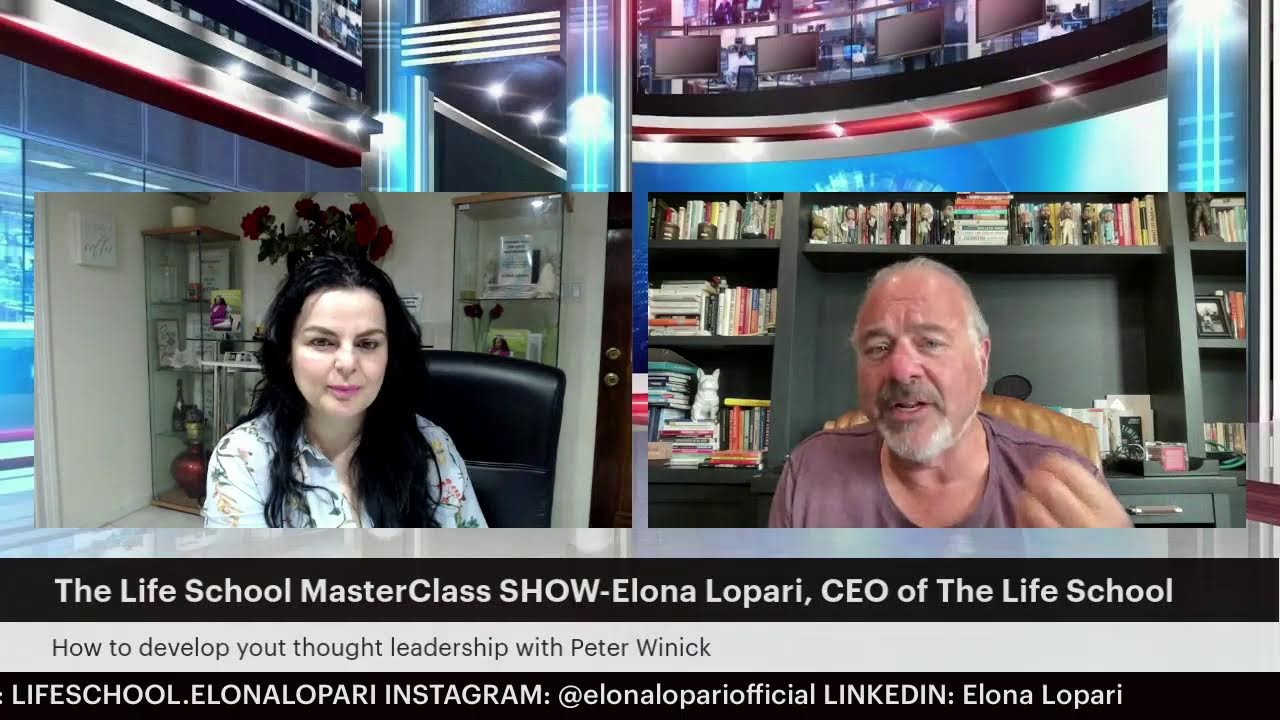
Peter Winick explains why entrepreneurs should build thought leadership as a long-term differentiator when products become commoditized. He stresses defining a precise target audience, creating concrete frameworks and methods, and distributing across podcasts, LinkedIn, and YouTube. Authenticity means serving the tiny audience you can truly impact, not everyone.
Chapters
on purpose through mindset, branding, marketing, sales systems, and team so they can make amazing impact and income and positively affect their communities worldwide. Ensure that you are sharing this show, you're subscribing, and you also are leaving us a review so we can create more amazing content around those areas to help you level up to the next level and also bring amazing guest experts that can share their knowledge and expertise with you so that you can create amazing legacy. All right, Visionary CEOs, welcome back to another show, Let's Create Legacy. I'm back with you with another amazing guest and, uh, conversation. And today we're going to be speaking about developing our thought leadership, uh, being a thought leader, um, instilling our authority out there in the marketplace, ensuring that We're building a brand and we have— we are unique, we're authentic, right? And we're building our frameworks around our life experience, our learnings, and all of that is really an important part in building an authentic brand, especially in today's day and age when, you know, with AI we have so many other things that could maybe leverage us away from our authenticity. So today I have amazing Peter Winick, a really great connection from our LinkedIn community., and he will, uh, be speaking a little bit more regarding this topic and all the amazing work that he does on a daily basis. Peter, thanks so much for coming on our show. I so appreciate your time and everything that you share with us today.
Yeah, thanks for having me. I appreciate it.
It is such a pleasure. So Peter, let's start with an introduction. How did you get to the work that you're doing today? Some of the most meaningful moments, if you could share that with us.
Yeah, I mean, I think the short version of a somewhat longer story is much earlier in my career, I was, well, I still am an entrepreneur, right? And that is a fancy word for under-resourced, underfunded, trying to get everything done, stubborn, et cetera, et cetera. So I think part of an extension of being a young and hungry entrepreneur was, at least for me, I was constantly devouring anything I can get my hands on to learn, whether that was articles, magazine, any way you can take information. And now there's a fancy word for that, which is called thought leadership. Then it was called being a nerd.
Right.
But like most people, I never, ever, ever up until maybe 20 years ago put any effort or energy into thinking about, wow, someone wrote a book or an article, or they have this expertise in growth or leadership or resilience or whatever. How do they make their living? What's their business model? Right. And now that's kind of all I do, right, is help people like that develop the right business models to scale, leverage, and monetize their thought leadership through various ways.
Yeah, your curiosity led you to the work that you do. You're a lifelong student is what I always say here at the Life School. We're all students as entrepreneurs because, yeah, we don't know what we don't know. So we're always surrounding ourselves with information and hopefully Now we've learned how to apply that as well, which is important in life. So I love that. So accessing your expertise and understanding how to leverage that to build a business that through your expertise, you can create impact and income with that as well. So where do we start with that, Peter? What do you, what do you feel through the work you do with businesses and entrepreneurs? You know, what are some of the main fundamentals that you see that you'd like to share? Yeah.
So, you know, let's start at a macro level. I don't care what business you're in, if it's product, if it's services, if it's solutions, etc. We are all at risk of being commoditized today. That's just the reality, right? So if you sell whatever it is that you sell, whether it's coaching, whether it's consulting, product, retail, CPG, whatever, we're all being commoditized. You know, by definition, commodity means that we're not extracting the value based on what we do, but it's sort of low, you know, the pricing is going down, price pressure is going down. I believe that thought leadership is one of the most cost-effective ways to fight the commoditization. Because what, again, whether you're a lawyer or you own a candy store, somebody else does what you do, probably just about as good, probably for just about the same price, right? That's kind of not a great place to be. So I think an effective use of thought leadership is, you know, one is it elevates your brand. It can be used to attract, uh, the right type of customers, to differentiate your offerings and services from competitors, etc. And unlike other forms of marketing, you don't have to outspend, you have to outthink, right? So if your competitors are 10 times bigger than you, or they've been in the business 20 years longer, they have more, uh, offices or farther reach or bigger brand or whatever, you can't outspend them, right? You can't outbillboard them or outbuy ads on the Super Bowl, but you can outthink them. And I think that thought leadership allows you to democratize really cost-effectively that you're as smart or smarter than a competitor that might be exponentially larger than you, as an example.
I love that. You can't outspend, so you can outthink. That's the leverage we have wherever we start in this journey. All right, beautiful. So what is the things that we do to leverage our thought leadership? What do we need to do? What do we need to put out there so that we are seen as thought leaders?
Yeah, so this might be a little bit counterintuitive because as entrepreneurs, we're always looking to attract the next client, sell the next thing, grow the business, etc., etc. And thought leadership does that, but— and it's an important but— you have to be careful that you're not pretending that you're being using thought leadership or developing or curating or deploying it when it's really just content marketing. So content marketing is great, right? So if I was in the business of selling, you know, whatever, organic ice cream, I'd want to be able to tell people how, you know, organic ice cream is better than non-organic ice cream. But it's a self-serving piece, right? Because ultimately what I want is them to buy my organic ice cream. So I think that you need to differentiate how, you know, when and where do you use content marketing and when and where do you use thought leadership? The use of thought leadership is really around showing the marketplace that you've done the homework, you've done your thinking, whether it's research-based or qualitative-based or whatever. Where are you getting these thoughts from and how are you packaging and putting them out in a way that resonates with your target market? And why would they sort of take the time to listen to you, read you, whatever the case may be? So that when they need someone like you that does what you do, obviously you're gonna be top of the list. So you have to think again, use case for thought leadership, and it is not something that one does specifically in a campaign, right? It's not, this is not pay-per-click. This is not, you know, we're all ADD riddled, you know, having no patient entrepreneurs. Thought leadership is a mid to long-term game, but it pays dividends. It pays substantial dividends. You just have to be a little bit patient. Saying patient to entrepreneurs is sort of contrarian, right? It's not like you write that first beautiful piece of thought leadership, you hit send, and all of a sudden, like, where are the clicks? Where are the clicks? It's not how it works.
Yeah, it doesn't go viral right away. Oh my gosh.
It might, but we know that when we send out— think of a typical marketing thing that most of us do as entrepreneurs. We send out a newsletter. Okay, so then we can go to Constant Contact, whatever tool we use, and say, wow, how did my open rates do today? How did my click-throughs go today? Or you buy some SEO or whatever. We get that immediate gratification and the dopamine hit. You've got to be a little bit more patient. Think about the marshmallow test. Let it do its job. And then there's a compounding and a flywheel effect. And once it starts kicking in, it kicks in really strong and heavy.
Yeah, it's like you almost— you invisibly don't see the results right away, but they do. They do multiply down the road. So, you know, I've had that experience and I have it with people that I work on. It's almost as if you feel like whatever you're doing, and especially the beginning, uh, years of your entrepreneurship, just putting yourself out there and building relationships and showcasing what you know and giving value and serving and all the good stuff, right? It almost feels like it's just going into deaf ears, but it's not because people are always watching, right? And you doing also the proactive approach of building relationship, it's really the icing on the cake because just a piece The content does not do it today, right?
Yeah.
There's more, we need to leverage relationships beyond that. But it's just that initial trust building factor that people do read it and they resonate with what you are saying. So it just makes the context of the conversation much warmer, so to speak.
Yeah. And that thought leadership does build trust over time. The other thing that I find is it shortens the sales cycle. So that's, so I just said two things that don't add up, right? Hey, it takes a long time and it shortens the sales cycle. How can both of those be true? Well, both of those are true because at any given time, most of us have the supply to do what we're doing, sell what we're selling, et cetera. We are uncertain as to whether that demand is coming from a certain buyer based on things that are beyond our control. Right? So one of the things that I have found for myself and then for many, many clients over the years is that people are consuming your thought leadership at a time when they don't need you at that moment. But you're staying top of mind, when they decide to reach out, they're coming to you sort of at third base. They're coming to you saying, hey, I've been following you for a long, long time, and I know that you wrote about this and wrote about that. Now is the time for us to have a conversation.
Right? Yeah.
I mean, they're ready. They're ready. We all know that when a buyer comes to you and says, I think it's time, and the thought leadership has done the job of keeping them sort of in tune to who you are and what you do and why they need you, that's a far better sales call than reaching out, reaching out, reaching out and trying to convince someone that you meet a need that they have or solve a pain that they have or whatever the case may be.
Well, there's a return on the investment for the patients. It happens all day, every day where people that are in my audience for years, 5 years, all of a sudden are my clients, right? Right.
That's exactly right.
They'd be consuming it. For such a long time, and when they're ready, just like you said, people will make that decision, will take action.
And it enables you to really cost-effectively scale that relationship maintenance piece because when they come to you at that point, they feel as they should, as if they know you. Hey, I've been reading your stuff or following you on YouTube or listening to your podcast, whatever it is, for a long, long time. So they understand your voice. There's a self-selection piece that's already done. If they don't agree with your principles or the way you work, they wouldn't continue to listen to your stuff, right? So they're coming in going, yeah, you know, you're my person. I think you're the one that can help me solve this problem. Can we have that conversation today? Because it's an urgent need that I have right now.
Absolutely. And that is the only way to market in 2023. The whole— these things that are happening, people are— want to be aligned with your values nowadays. You know, we have a very educated market, uh, whatever market you're into, because of the social— the age of social media. So understanding these is crucial. Peter, what are other vehicles that we can leverage beyond content marketing? We just spoke about one of them, but what, what are the other vehicles that we can leverage that you probably help your clients on a daily basis?
Yeah, so I think there are a lot, but the way I would be thinking about answering that question from, from the audience's perspective is making sure, number one, who, who are my avatars? Who am I trying to reach? Because a lot of people assume that they could be helpful to everyone. And that's really a silly thing as an entrepreneur. You've got to get really, really tight and say the type of people that I serve best are and be able to answer that 3 different ways, not just demographically, but psychographically and situationally. And then once you have that clarity and say my clients are people in blah, blah, blah, whatever, heads of finance at rapidly growing technology companies that are in a state of digital transformation. That's really specific, right? And people say, well, specific means less, but the narrower you can get it, the better. Once you know who your most desirable prospects, clients, etc. is, then you work backwards and say, where are they getting influenced by? Where are they getting their information from? Where are they consuming content? So, for example, maybe there's podcasts that they're listening to. Maybe there's trade magazines that they're reading, whatever the case may be. For example, if you know that your community is listening or following certain podcasters, then it would be great to go be a guest on their podcast, right? Because somebody's done the hard work. Like, quite frankly, I have a podcast, you have a podcast. This is the easy part, right? Having a fun conversation with somebody smart like you, this is really, really easy. The hard part is the audience that you've built. So I am inadvertently hijacking your audience for a moment in time. Value to them. And maybe some of them think I could be helpful, right? You'll come on my podcast, the same thing, right? And it's not like, um, you know, the hard part is having a great conversation about what you love to do. I could do this all day, right? But who else has put together an audience of people that are important and relevant to me? And how can I provide high-quality value to them to show who we are and what we do? So that's one way to do it. And then the other thing I would say to think about that question is experiment. So I believe that everybody has different modalities or mediums that they're more comfortable with. Writers like to write. People that are maybe better on their feet like to speak. But if your audience— understand and be empathetic to the audience and say, ah, my audience are— they're younger. They like TikTok. I don't like TikTok, but they do. OK. Well, then get over yourself. If that's where your people are, then figure out how to get there because going to a different place doesn't make any sense. So it's not about, you know, kind of, you gotta get over yourself.
Yes, I agree. I love it. I love it. That's why I'm like the golden, golden stuff. 'Cause sometimes like, I don't wanna do it, but it's not about you. You wanna serve them, right? I mean, that's what you decided to serve. You need to know where your people are and leveraging other audiences is key. And being specific means quality. And there's a lot in quality. There's a lot of money in quality. There's a lot of high influential impact and quality. So for all the people that used to think like me, I want to serve the world. Now you're just spreading your energy too thin. What about framework?
I want to just touch on something you just said there where, yeah, we all want to serve the world theoretically. It took me a long time to realize and be really comfortable and happy that to 99.9-something percent of the universe, it didn't matter that I got out of bed today or that my company exists. I am totally irrelevant. And that's okay because what that allows me to do is spend all my time, not all, but a lot of my time and energy thinking about how can I be the best that I can be and provide the most value to that 0.0001% that are my peeps that I want to serve, that I can do great things with. And everybody else, who cares? They couldn't care if that I exist, that we do great work for our clients or any of that.
I love your honesty and truth because truth does set us free. And sometimes we do need to hear these things, uh, just, you know, from a different angle. I love it. Peter Winick, frameworks, and we'll end with this. And I would love for you to share your specific framework on how you help your clients, but how important are frameworks, developing your own methodology or framework? People call it different things. Yeah. Your body of work. How important is that? And where can we start with that? And also what is your specific framework in helping your clients?
Yeah. So as a thought leader, you can't even— first of all, you should never call yourself a thought leader because that's just an annoying and obnoxious thing to do. But as someone that aspires to be a thought leader, you can't even ponder doing that unless you have models, methods, frameworks, and systems, right? Like, what would make you a thought leader? Like, that is the— you know, if you're a craftsperson, you have your tools, right? Those are your tools. Those are your things that you need to do the job. If you hired a plumber and he pulled up in front of your house without any tools or anything and said, well, I have a lot of theories on plumbing. Okay, great. But the toilet stuff, like, what are you going to do to fix it? Those are your tools, right? And you choose what tools to use. Some of them could be proprietary that you've developed. Some of them are tools that you've experimented that you didn't develop but work well. So I think that you've got to— I mean, it's not even an option to have the right models, methods, frameworks, and methodologies. How you get there is different for everybody. It's typically iterative, right? There is no one great way. I think that if you look at it on a continuum, you have people that have a more academic bent or more risk-averse. They tend to go ready, aim, aim, aim, aim, aim, and they don't fire. Most entrepreneurs that I know, myself included, are ready, fire, aim, ready, fire, aim. And that's okay with thought leadership. You throw stuff out there and then maybe Wow, it lands with a thud. Great. Try something else. Try something else. But stay in your lane and constantly iterate and develop. And the beauty of a framework is once you effectively explain and articulate it to that right 0.001% of the universe, they will light up and go, wow, now you put this lens in front of me that helps me see the world or this problem that I have in a very, very different way. And I can't unsee that. That's the power of a model and a method and a framework.
Yeah, and talk about results. I mean, that's the destination to getting people results. Otherwise, you know, you're like, I don't know, let me see. Just like you said, showing up as a plumber, my toilet clogged. I'm like, I gotta do something. Well, let me test it there. Yeah, that's not right, right? Because they're paying for that. So they're paying for the results and they're investing with you. I love it. Peter Winick, what's your framework? How do you help your clients?
Yeah. So our framework, or I actually say our process, is the way we start. So clients come to us with all sorts of different needs and issues, et cetera, but they're all authors, speakers, academics, thought leaders, consultants, entrepreneurs, large businesses, et cetera. So some of them come with what they think are various sort of things that need to be done, and the client's not always right. So what we know to be true is, yes, you might have something tactical that is keeping you up at night. What do I do on YouTube? Or what do I do with the podcast? Or I want to write a book. And that's important. Our process is we always start with the development of a viable and solid strategy that enables thought leaders to do what they need to do. So it gives them the clarity that they need to effectively prioritize what could they do, would they do, should they do. Because as you know better than anyone, type A people that are passionate about what they do and are entrepreneurial, always are, you know, they're spinning 75 plates at once. And what I do is come in and say, timeout, let's take a deep breath and decide if are we spinning the right plates in the right sequence. And what about that other stack of plates over there that you're thinking about spinning, you know, right? How do we get the real clarity strategically so that we're not confusing activity with productivity? Because they're very different things. And entrepreneurs tend to be really, really active, but they're not necessarily productive.
Yeah, I love that. Well, Peter, thank you so much for everything you share, all your wisdom and thought leadership with us today. I so appreciate it. And definitely go check out the website that you have. Tell me a little bit about where people can continue the conversation with you besides the website, which is on the screen.
Yeah, you can go to the website or you can email me directly at peter@thoughtleadershipleverage.com. LinkedIn, YouTube, all the usual places you'll find us. And happy to always have conversations with folks that are interested in thinking about what's next for them relative to thought leadership.
All right, beautiful. Thanks again. And I will absolutely go check out Peter Winick's website and stay connected with an amazing entrepreneur that's doing really great things out there. And it's not even about the expertise. It's not about the thought leadership. It's about the impact, reaching people with your message. And, you know, once you have a methodology and a framework you believe in and it's proven, right, why not help many more people based on your desires and what you want to do with your channel or vehicle of entrepreneurship? Your show. Peter, thank you so much for being on our show today, and I will see you next time with another show. You know what to do to support our show: subscribe, share, and also review, uh, leave us a review so that we can bring more amazing speakers just like Peter. Thanks again. Have a beautiful rest of your day. Bye, everybody. I want to share with you the 4 books that would change your life personally and professionally. So the first book is Connecting the Dots Backwards, one of the books I've written that will help you connect the dots between your past, your present, and your future life vision. You will find topics in there around marketing, sales, spirituality, relationships, all the areas that you need to be fulfilled as a human being. The second book that I've written, which is a journal, uh, accompanies the Connecting with the Dots book, and this journal will help you apply the information that you learn in the book into a journal. It has self-guided questions that you can go, uh, through and into to get the clarity that you need to discover your values, your vision, and your mission. This is a journal attaching, um, the book as well. And then Purpose-Driven Entrepreneurship is my latest book where I have included my legacy framework in building legacy businesses everything from mindset, branding, marketing, sales, systems, and team. And I have connected all the dots between all those areas so that you have the fundamentals that you need to build a truly legacy empire. And then my latest creation is the Focus on Purpose Planner for increased productivity and efficiency where I have included a framework around your productivity, where you can plan ahead, uh, work on purpose and leave amazing impact on the planet with your work. You can find any of my books on the website below, elonaloparicoaching.com/books, and definitely grab your copy. Let me know, leave me a review on Amazon and let me know how this book has impacted you and changed your life.










