Leveraging Thought Leadership Live featuring Benjamin Granger
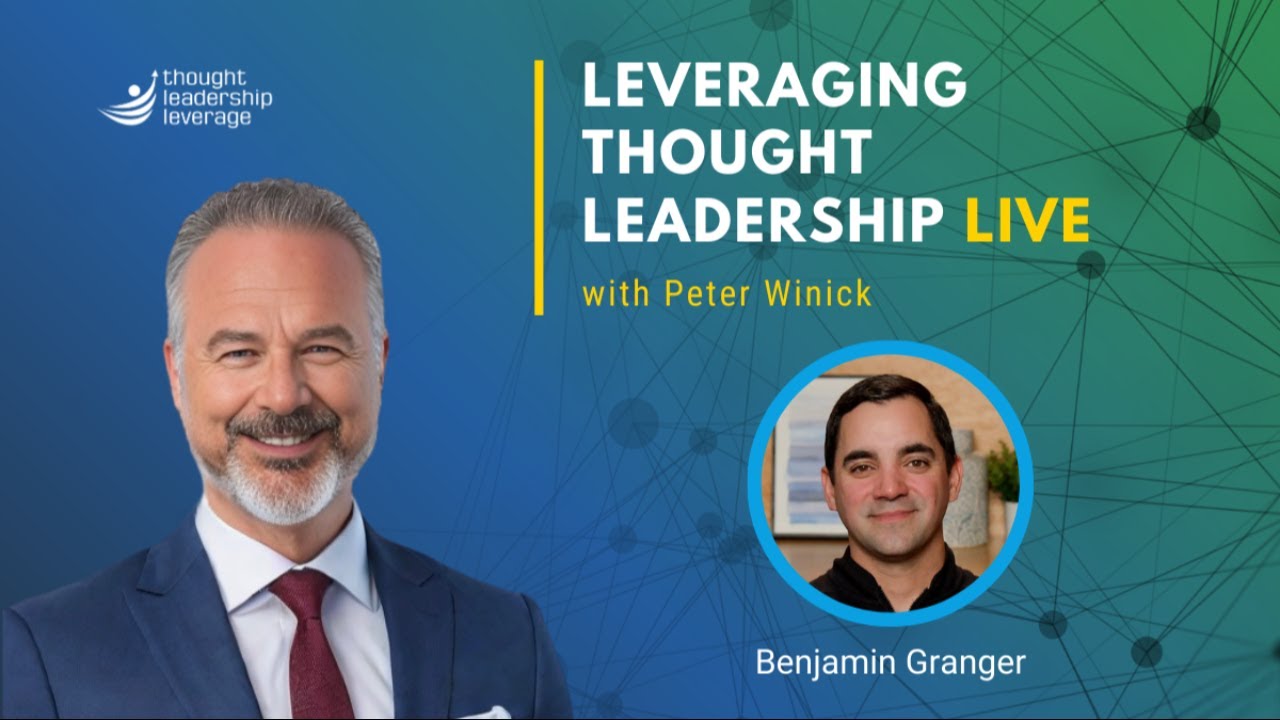
Ben Grainger, Chief Workplace Psychologist at Qualtrics, explains how ancestral cognitive biases called "evolutionary hangovers" shape modern workplace behavior. He traces how a church encounter led to his USA Today bestselling book A Leader Worth Following, and argues leaders need daily reflection practices to overcome misinterpretation and flawed metrics that block real change.
Chapters
And welcome, welcome, welcome. This is Peter Winick. I'm the founder and CEO at Thought Leadership Leverage, and you're joining us on this LinkedIn Live version of our podcast, which is Leveraging Thought Leadership. Today, my guest is Dr. Ben Grainger. He's a chief workplace psychologist at Qualtrics. Many of you know Qualtrics. You've probably use them whether you know it or not. Um, he has over 15 years experience building, running, and optimizing experience management programs across hundreds of global organizations. His research has been published in academic and business media including CNBC, Forbes, Wall Street Journal, and he's earned a doctorate in industrial psychology from University of South Florida. And he is now an author of A Leader Worth Following, which is now A USA Today bestseller as of, I guess, midnight this morning or whatever. Welcome for coming on.
Thanks, Peter. Yes, pleasure to be here.
So I want to talk about your sort of journey, if you will, right? So you've got a really cool job at a really cool company. So I'm familiar with Qualtrics for a long time, but what— tell us what your job— like, if you were writing the job description of your job, because not everybody knows what an organizational psychologist does at a tech surveying tech company. But what is, what is the day job?
Really what I do is I, I take a lot of the data that we collect. As you can imagine, those are familiar with Qualtrics, we collect literally billions of data points every year from how consumers feel about brands, for how employees feel about their employers, What's going well, what's not going well. And so my job is really to look at a lot of that data and to distill actionable insights from it and share that with business leaders, with business professionals, customer-facing employees, just anybody in an organization on what are some of the things they can do to improve the experience of—
You're spotting patterns and you're seeing things that happen in the aggregate, right? Because everybody's using Qualtrics to measure their stuff, but you get to see the big kahuna without violating any privacies there.
Exactly.
Patterns by industry or geography or trends and all that. And in reading your book, I see lots of— there are lots of things that stuck out to me. I want you to define, because it's the first time I heard the term defined the way you did, as the evolutionary hangover. Well, I read that, I'm like, what the heck? And then I was like, That makes sense. So tell us what that is. That was one thing that stuck out for me reading the book. Yeah.
So evolutionary hangover is just my word for cognitive bias. And so I got really fascinated. Obviously, I'm an organizational psychologist, Peter, as you know. I'm fascinated by the field of evolutionary psychology. And so one of the things that I normally do just in my own day-to-day work is I try to think more deeply about some of the normal mundane stuff that we do. For example, what's a company? What is an organization? The way I define it is, an organization today is a group of people working together using shared resources to accomplish a shared mission. Humans have always done that. We just do that today in what we call companies and organizations. But I think we glean a lot if we go way back in time to look at How did the human brain evolve? Why did it evolve the way it does? And a lot of it has to do with us being a social species. So evolutionary hangovers have to do with, well, why do we engage in all this automatic judgment of people? You know, if we run into a mean person in the street and we— and they, and they, they say something rude to us, or we're dealing with a customer and they lash out at us. And we say, man, what an abrasive person, or what a rude person. Well, that's a cognitive bias and what I call an evolutionary hangover. Essentially, it's something that developed over evolutionary time for a very good reason. But in modern business settings and modern social settings, it can sometimes cause problems, just like— Right. So today, not so much.
Right. So we're tribal. If I had a jerk detector on and really quickly I can go, oh man, that person's abrasive or a jerk, I'm probably doing that biologically to go, I don't want that person to be in my tribe because they're not going to be fun. They could put my life at risk or they're not going to be good hunters, whatever. And that kind of made sense at that time. But I think the evolution of technology and the way we do things, whatever, the brains are always going to be a couple hundred years behind.
Exactly. Exactly. The author Hillary Scarlett puts it really nicely. You know, our brains weren't designed for 21st century living. They still think they're on the savanna.
Yeah, exactly. Exactly. So you've got this job. It's a really cool job at a really cool company.
Right.
And then you sit around and you go, you know what? I don't have enough to do. I think I'll take on another project. I'll write a book. Right. That's how this happened. I have so much time to fill. Is that how this happened?
Not exactly.
Yeah.
But But what basically happened was I was—
I'd been working—
I've been working for Qualtrics for over 10 years. And I've had a bunch of different jobs. And I was doing some work with our PR, with our PR team, with the media. And our PR team said, hey, you know, you're doing a good job with the media, we need to elevate your title so we can open some more doors.
Okay.
So they gave me this great job title, Chief Workplace Psychologist. And I said, yeah, sign me up for that. But the problem, Peter, was I'm surrounded by amazing behavioral scientists and psychologists. So I'm sitting over here thinking, do I deserve this? Like, do I belong in this job title? So I just said, I got to earn this. And so I just started tearing through books and academic papers in my area, leadership, all these other areas, cognitive psychology, evolutionary psychology, physics, as you've seen.
Yeah.
Different subfields of physics. And then I started writing notes. And so I had this— I had like hundreds and hundreds and hundreds of notes on my iPhone because when I read, I write.
Yeah.
One day I'm sitting in church. I'm a religious person sitting in church one day and I get this little nudge. Hey, maybe I should put this all together into a book. Not 2 or 3 days later, I got hit up by a major publisher who said, hey, we just read something that you wrote, you know, your work. Would you like to work together on a book? And I was like, well, just so happens I just decided to write one. So here we are.
Stay there a minute. So I want to go back in time to— all right, I think this is a good idea to write a book, right? So this is, I'm guessing, a year or 2 ago, something like that?
About 2 years ago.
2 years ago. So you said, all right, I'm going to write the book. And now here we are on the other side of that. What were your expectations as, I don't want to say young Ben, but pre-author Ben versus the reality? And I'm having you eat a little bit of your own dog food that's in the book.
Yes, thank you.
Dr.—
naive Dr. Ben. Let's talk about naive Dr. Ben. I love reading. I love writing. I was having a blast. I was like, oh, this is great. I can't wait to start my next one. And I have a couple in the works, by the way. Right. And at the time, we were kind of joking about this beforehand. A lot of the publishers that I was talking to around the time were saying, hey, you know, the real work starts once you're done with your manuscript. And I'm like, yeah, I mean, I do keynote talks all the time. I do workshops. This will be great.
Right.
Yeah, sounds awesome. Let's do it. That's not work for me. I like that part. Oh my God, did I underestimate the amount of work involved in marketing and promoting. And I should also add, you know, self-promotion is not natural for me.
I don't like that.
It feels—
Stay there a minute, right? So in your job at Qualtrics, which is just an amazing company, you're not client-facing, right? You're not out there on the business development side. You're not out there attracting clients. In your role, there's always plenty for you to do. You're not— you don't have to create demand of Uh-oh, there's not enough data today for me to sift through, right?
In my current job, that's true. But I have been on demand generation. I've been on revenue-generating teams. So I've done a lot of that work. But in my current job, that's true.
Right. But even when in those roles, you're not promoting Ben, you're promoting the suite of offerings and services and solutions that fall under the brand. So, you know, a lot of folks tell me that it's It doesn't feel natural, it doesn't come natural, it's not what I do. But how are you coming to terms with that, right? Because part of what you need to do, right, is if you've gotta believe in this more than anyone else, and I know that you do, and then you gotta take on the role of, geez, I gotta be banging the drum on this thing.
Right. The way I justify it to myself is the message is what needs to get out there.
Right.
And I do, and I have heard competing arguments here, and I'm actually very curious what you think about this, Peter, because, you know, you, you know this area better than me. Of, I don't see it so much as it's me that I'm selling. What I'm selling is the message, which I really believe in. And I get that feedback a lot.
Stay there for a minute because I think that's really important. I think that people are smart. And there are people that promote themselves and everything that they do, whatever that is. There's always a price tag at the end of the thing. One week it's a program or a book or whatever. And that's fine and dandy if that's who you are and what you want to be and all that sort of stuff. I think you're right that you are really the messenger, the evangelist, call it what you will, for the ideas. And these ideas could live longer than you, right? Like, I can imagine a time in whatever, 50, 100 years from now when you're not here anymore, when people are still looking at this book going, those are pretty cool ideas, right? And I think that's a great mindset to say, part of the reason I'm on the planet is to unleash the power of the ideas, not for ego satisfaction, because anybody that reads this book will be smarter, a smarter leader, a better leader, a happier leader, a more grounded leader.
Yeah, that's such a good way to put it. Totally agree. And I like the way, you know, one idea about ideas that has really stuck with me comes from the great John Henry Cardinal Newman.
Mm-hmm.
And what he used to say is ideas are infinite and the ideas unfold over time in the play of lively minds. I just see myself in that unfolding. I'm helping to unfold these ideas. Not only will these ideas live past me, they've lived before me.
Right.
And they'll continue to live on. And I feel like my job is to help catalyze the unfolding of that and to get people talking about it, to engage in this conversation.
Yep. So what other surprises, what other things surprised you along the journey? And I know you're early in the book marketing journey, although you're in the depths of it now. What are the things that, quote, young Ben of 2 years ago Naive bet, not know.
Well, this is a— this is kind of a meta point and a key point that I address in the book itself. It's about communication. So the whole book is an effort in communication, right? I'm having a conversation with people through the book.
Yeah.
But one of the most fascinating things I found in— probably the biggest surprise, actually, was when I was going down into the development of human language. And so, like I mentioned, I allowed my reading to take me wherever it needed to go. So if I was reading a book or a piece and I was like, oh, that's interesting, I just, I just allowed myself to go because I wasn't planning on writing the book, right? So I just was studying. And when I eventually got to how long ago did humans learn to talk, right?
Right.
Because what a lot of anthropologists agree— this is disputed— but what most anthropologists agree is that that the development of human speech developed about 100,000 to 200,000 years ago.
Okay.
Now, I think to the average person, that sounds like a long time. But in the evolutionary history, right, if we really zoom out and we look at how long has mankind been around, it's almost like we learned to talk yesterday and we learned to write an hour ago.
Right.
Because we've been communicating nonverbally for millions and millions of years. So this got me thinking, okay, now we're living in this world where everybody texts each other. We're all on anonymous social media posting nonsense to each other. We're sending emails to thousands and thousands of people. And we assume that the meaning behind the words that we string together are interpreted exactly the way that we intended.
Well, but we all know that's not true, right? We've all gotten that email from a friend or a colleague or a loved one. And you read it 3 times, and it could be depending on your mood. You're feeling sensitive that day or cranky that day, you don't have enough coffee, and go, oh my God, why are they attacking me? Or why are they sarcastic? Or why, you know, like there's, there's a bold font, right?
Right.
Not a sarcastic font, right? Like, so, and, and sometimes that leads to negative stuff where you got to pick up the phone and say, did you— I took that to mean this. Is that what you intended? Like, oh no, no, no, no, I left off a letter, or I You know, I was, you know, because we don't think about the other. We're thinking about, they were rushing off to get that text to you or that email while they were at a Starbucks or something. And they didn't sit there and contemplate it for 20 minutes like you just did on the receiving end.
Exactly. And, but, but, but so here's, here's my big challenge. I think we all do know this. But how often do we operate as if that's true?
Right.
That's a different question. And I think we often don't operate as if that's true. Especially when we're the one delivering the message.
So let me ask you this. So you've got a pretty demanding job at a pretty high-growth organization, and they sort of blessed the project, right? You could have just done this all on your own, but they said, you know what, Ben, this would be a good thing. It's good for you, it's good for us, it's good for our customers, it's good for our employees. What do you think— why do you think they justified that this is a great use of some percentage of your time over the last couple years and in moving forward now? In promotion and speaking and all that? What's the benefit to Qualtrics?
I think the first thing I would say is the book, the studying in the book I did on my own time. So that was, that was, I made that very clear and we were very clear on that together. But then I went through a lot. I did a lot of work to pitch it to the company to say, hey, Qualtrics, look, I've been working on this for a while. Looks like I got a book deal here. Do y'all want to partner on it? And one of the things I did, and I did— this wasn't a mechanism to sell it to Qualtrics. I just did it because, you know, we sit on a ton of data and insights.
Yeah.
I weaved a lot of what we've learned into all the academic studies I did. So it's intertwined. And so I said, look, I think what this is going to do is it's going to show off how deep our research is and put it on the same plane as all this other academic research that a lot of people are very familiar with, that's mutually beneficial. And so that resonated. And so, and also the mission and vision I had for the book, which is to improve the human experience, is identical to the mission and vision of our company. So there was, there was—
Right. Stay there a minute, because I think a lot of authors and thought leaders struggle with this issue. And the reality is there's alignment. Now alignment might last for a month or 10 years or forever. But as long as there's alignment around benefit and around why and around— and I love how you brought it back to sort of mission, vision, values. It's probably not a coincidence that your personal mission, vision, values line up to Qualtrics and you've been there a long time, right? So there's a self-selection piece there, right? And the more successful this book is and the more successful you are, there's a halo effect to Qualtrics.
Exactly.
And that'll, you know, so there's a flywheel effect there. Good for Ben, good for Qualtrics, good for our employees, good for our customers, whatever. And I think it's, you know, it's really a cool thing for a brand, if you will, to go, we have X number of published authors because we expect that. of academia, right? Like, you're not going to stay— like, you could have been an academic if you wanted to, right? Academia is the, the, the KPI, if you will, is publish.
Publish or perish.
Right. And, and the fact is, uh, sorry, my academic friends, nobody reads most academic journals. There's 5 people that read the article you spent years on. What I love about what you did is it hits an academic standard in terms of the quality of research, whatever, but it reads like a real book, right? So therefore, you're unleashing the power of the ideas, not by dumbing them down to the silly level, but making them approachable and relatable and whatever. And there are a couple pieces in there I'm like, wow, there had to be a ton of data under that to get to that point. Like, this isn't— I don't believe this just because, well, Ben said, right? Like, that's a piece of it. So interesting, interesting.
It's right on. And I would also add to my academic friends there is the work that they do is essential.
is critical. Yeah.
We need both. We need the evangelists who can take those insights, distill them, tell a story about it to the general population, and we need the people who go really deep and get very technical because that's where those insights come from. They're testing it, they're beating it up, and they're saying, okay, this— and then I'm a practitioner, I'm a scientist practitioner. I take a lot of that, I bring it into the field, I test it in the field, And then I say, okay, that passes the eye test. Let's put it— let's go out there and get it.
And that overlap of the theoretical to the applied, the academics typically don't get the advantage. Like, they could model out and prove their ideas from a research perspective, but you work in the real world, right?
Yeah.
And oftentimes the real world, you know, what is it, the Mike Tyson quote, everyone has a plan until they get punched in the face.
Right.
Everyone's got a PhD until they get punched in the face, right? It's, it's, it's— you're dealing with that on a day-to-day in the reality of the customers and, and such using Qualtrics. So—
Here's a, here's a really good example of exactly what you're saying, Peter. I'm working right now with a good friend of mine and colleague, Dr. Shawna Waters, and she herself is a, is a phenomenal thought leader and publisher and, and author. And one of the topics we're working on is this, the problem of goal setting in organizations. Now, goal setting as a science has over 1,000 articles that have been written on it in academia. Locke and Latham back in the '90s. I mean, it's one of the most well-established practices of motivation. And yet you take that, you take that practice that's so well published on and established, and you drop it into a messy, complex, large organization. And surprise, surprise, it doesn't work exactly the way the research suggests. So, We're talking about why is that the case? And it's not a problem of the science. It's a problem of assumptions that we make when we apply the research in the real world.
Well, we talk about an example in the book, and it's funny, when I was reading that, I've had the exact same experience where you go to buy a car, the car's amazing, the experience is great, the sales guy's great, the price— like, you're like, wow, this was awesome. And then I've had this several times with real car companies. And then at the end, the sales guy or gal sits down with you and says, and you're going to get this survey and blah, blah, blah, blah, blah. And they're going to tell you how to answer it. I'm like, wait, time on, timeout here, timeout. Like, I know the head person at BMW didn't say this was a good idea. I know the people at Net Promoter Score, whatever tech they're using for that, didn't train that person in how to do it. So why did that person do that? Well, why he did that is because X percent of his comp per vehicle comes from getting these scores. So if you're going to say to me, this is going to hit me in the pocketbook, you don't have to train me. I'm going to sit down and look eye to eye and say, hey Ben, you know, I hope you love everything, but you know, it's really not good for me or my career or whatever unless you circle the number 5. Let's practice circling the number 5 again. And you just bastardized the entire data and you just wasted zillions of dollars, right? Like, but we've all seen this every day. And I love that you call that out because if you make the metric the wrong thing, right, they weren't— the intent of the measurement was to where can we get better, not how do we penalize the sales guy?
Exactly, exactly. It's one of my favorite, it's one of my favorite and least favorite examples. In fact, I had a friend of mine who I gave the book, I gave an early copy of the book to. He was reading that chapter. I think it was Chapter 4, if I'm not mistaken, on the plane. His plane landed. He just finished that little section in the book, and then what happened when they landed? The flight attendant said, "Oh, you're gonna get a survey," and he said he just busted out laughing.
And the flight attendant's not holding you hostage until you get off the plane.
Right. Until you unless you give us fives, you know.
Yeah. At least they didn't do that in the air and say, "If you don't give us five, I don't know. The pilot might not be in a good mood today. It might be a rocky landing." Yeah.
Maybe we're not going to LAX. Kind of depends on the rating here.
Right.
You rate us a two. You're landing clear.
Cleveland, right?
Like, sorry Cleveland.
Um, what— so what's next now? So the book's done, the book's out, you're trying to promote it, etc. What are the things that you, you hope— if we were to say let's schedule a time a year from now and talk, what are you hoping is different in the maybe the business lexicon in your world and the Qualtrics world? What would be the— what would be different?
Yeah, I hope that I hope that we get more comfortable with having hard conversations with ourselves. I know that sounds a little fluffy and light, but I don't think it is. I really want to see— I want to see a bit of an internal revolution. And say more about that.
What does that mean, conversations with yourself? Because, you know, I'm in New York. I walk down the streets and see a lot of people having conversations out loud. Is that what you mean?
Deep, intentional introspection. So introspection is that term I think we're all somewhat familiar with. It's a— I say it's almost synonymous with psychology as a field. But really what that means is trying to access your thoughts and trying to access why do I do what I do? Why do I say what I said? Why do I think the way I do about people especially? Why do I create the stories that I do about somebody based on a small interaction in an isolated experience. And really just starting to get comfortable being uncomfortable with these conversations with ourselves. I don't think enough people do this. Because I interviewed tons of leaders as part of this, this process.
How often? What's the frequency?
What's the—
I mean, imagine it's not something you're gonna say, hey, boss, I'm taking off 3 days to talk to myself, right? Is it you carve out a cup of coffee on a Monday morning, or what? Is there a frequency? Is there a way? What— how would you prescribe this?
What one of the great suggestions I heard many years ago was from Marshall Goldsmith, and he said, you know, one thing you can do after each day is just ask yourself a couple of quick questions at the end of the day. What could I have done to be a better coworker? What could I have done to be better at delivering customer service? And that's a great place to start, a quick 2-minute daily reflection. But then I also think we should probably start to do things like more intentionally. Hey, I'm going to spend an hour and I'm just going to sit down with a notepad and I'm going to write about— just get— and by the way, Arianna Huffington at a conference one day mentioned this, that women are much more likely to sit in silence And do really in self-reflection than men. Um, I thought that was interesting. I kind of looked it up to see if that was true. I found that it was. And so this is something I think it— obviously some women need to hear this too. Obviously some men need to hear this too. Maybe some men do this already, but I think we all need to be able to spend some dedicated time really thinking deeply. And so cadence, that could be once a month. That you sit and you have a 30-minute conversation with yourself, and that might be your future self, you know? Right. And the book, I call that Travel Back to the Future, a nod to one of my favorite movies of all time.
Well, this has been great. I appreciate your time. So much insight here. And I wish you the continued success with the book and all the other things you're working on.
So thank you so much, Peter. I really appreciate you having me. Love the questions.










